Record Interiors 2026
SO–IL Envisions a Cleveland Public Library as an Open Civic Platform
April 1, 2026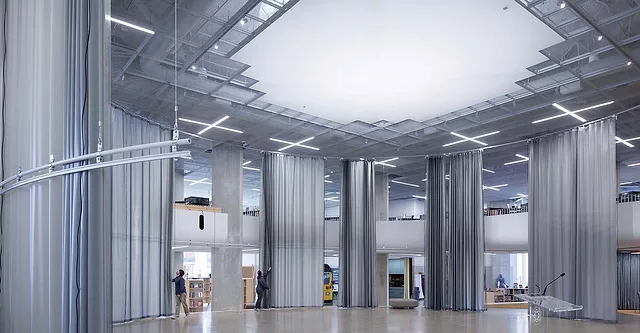
Record Interiors 2026
SO–IL Envisions a Cleveland Public Library as an Open Civic Platform
April 1, 2026
In the spring of 1967, civil rights leader Martin Luther King Jr. visited Glenville High School in Cleveland’s East Side. He urged the students gathered there to commit themselves to education and to nonviolent organizing. The previous summer, the city had suffered through the Hough Riots, when long-simmering frustration with racial injustices boiled over, resulting in hundreds of fires being set, dozens of serious injuries, and four deaths. “Let us move on toward the goal of brotherhood,” King said, “toward the goal of personal fulfillment,” echoing sentiments he expressed in his famous 1963 “I Have a Dream” speech, in which he spoke of coming together at the “table of brotherhood.” Brooklyn architecture studio SO–IL adopted this image of a grand table—a place for both study and camaraderie—as the central concept for the new home of the Cleveland Public Library’s Martin Luther King, Jr. Branch.
The library, which opened in January and replaces the original facilities across the street, occupies the first two floors of a new residential tower in the East Side neighborhood of University Circle. Its relocation is both part of a broader decades-long initiative to reinvent the area as a second downtown—named Uptown—and a more localized $417 million housing-development project called Circle Square. The University Circle neighborhood—what Cleveland officials claim is “Ohio’s most spectacular square mile”—does have a lot going for it: an art museum and an art school, the city’s orchestra, botanical garden, and natural history museum, and the university medical center are all nestled there, along a brand-new light-rail line. The old library, a two-story building with a yellow-brick arched colonnade, sits kitty-corner to the new site, but there are plans to eventually build a residential tower there as part of the same development.
In 2018, SO–IL won an international design competition funded by the Cleveland Foundation, the organization spearheading these revitalization efforts. In a somewhat unusual arrangement, the one building comprises two distinct projects. SO–IL’s scope of work included only the first two of 11 floors, with local firm J. Kurtz Architects serving as architect of record. Cleveland-based Bialosky Architects designed the nine stories of studios and one-bedroom apartments that sit atop the library, dubbed the Library Lofts. The two teams, however, had to work hand in glove on the design of the superstructure and on aspects that would necessarily affect the library at its base, such as column placement and the fire egress for the apartments.
Beyond the city’s goal of densifying the area, “there was an opportunity to completely rethink what a library is,” says Jing Liu, founder along with Florian Idenburg of SO–IL. As archives have become more digital, libraries today no longer require large bookstacks. Some branches have even reported that their digital-media lending has recently surpassed physical loans. In response, “the library is becoming more of a civic and cultural center rather than just somewhere you go for books,” adds Liu. Thus the idea of the table—a place for work and community—and not the bookshelf became the programmatic core of the library.
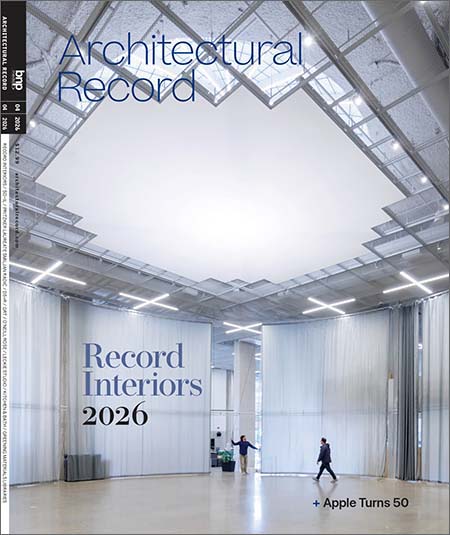
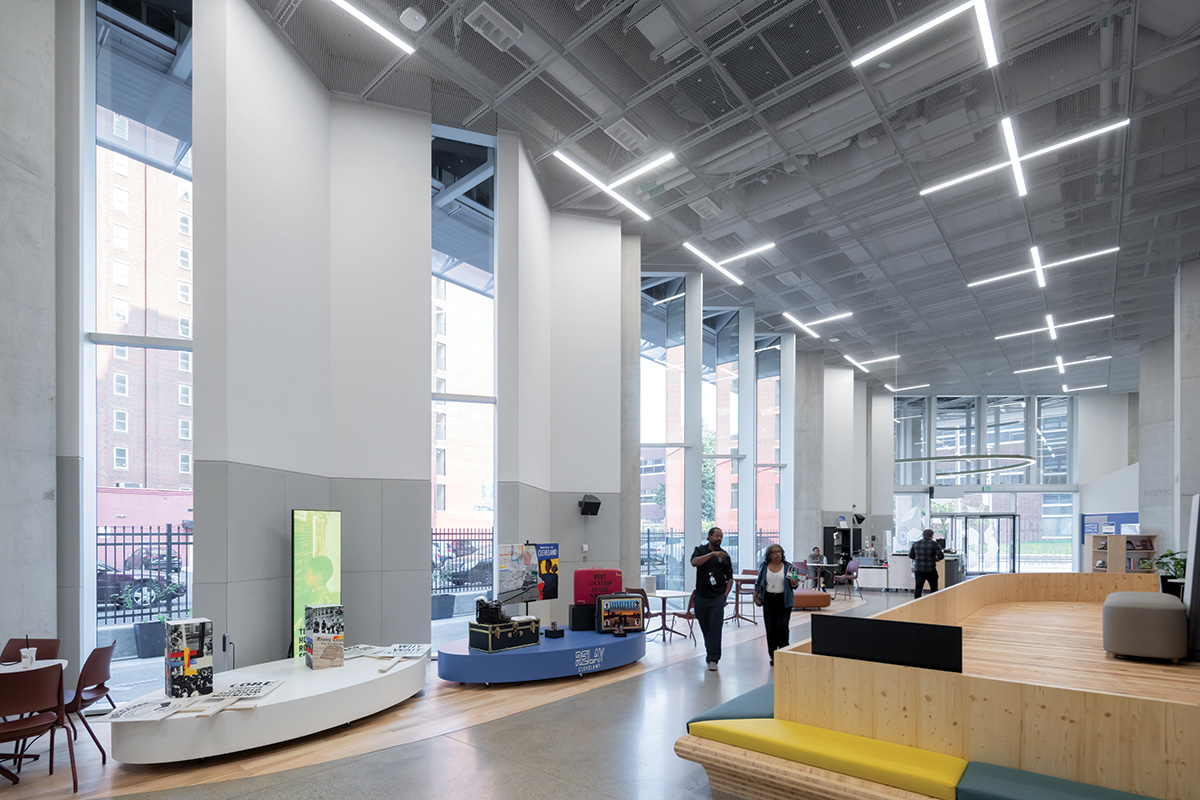
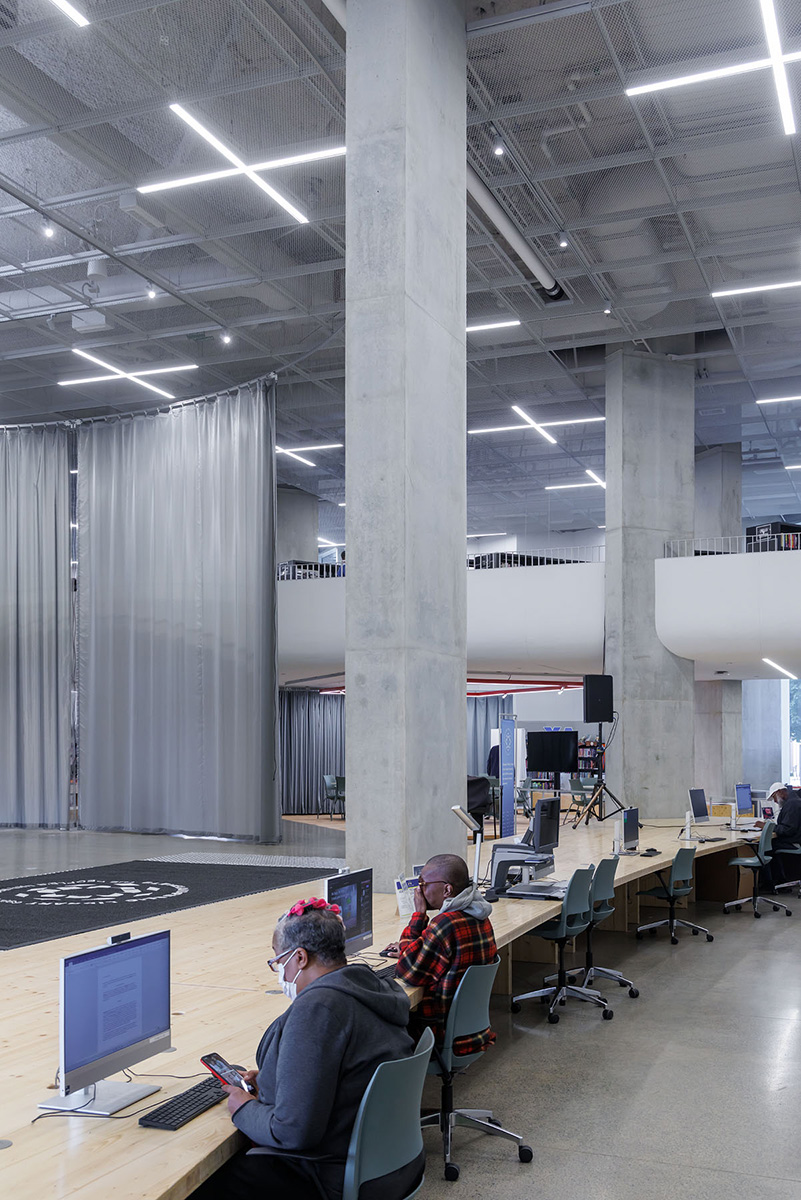
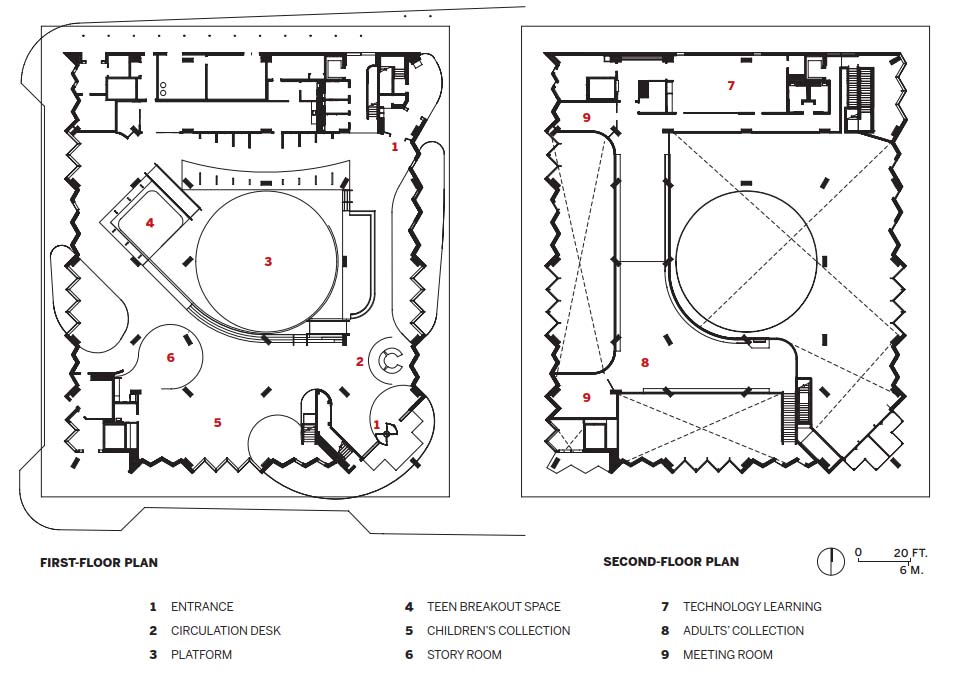
A 65-foot-diameter concrete platform occupies the center of the library. Desks, benches, steps, and a teen breakout zone, all milled from cross-laminated timber (CLT), ring the platform. Together, the multifunctional stage/assembly area and the wood built-ins around it compose the conceptual “table.” The platform, which conceals ventilation ducts, can host lectures, movie screenings, and even wrestling matches and dance parties. Acoustic curtains—some of which are composed of multiple layers of cotton and PVC film—on a track above the “table” allow for flexibility while mitigating sound that would otherwise reverberate in the open 23,000-square-foot, double-height space. Overhead is a 25-foot-diameter skylight, diffused by a diaphanous stretched-polymer screen. (The apartments are in a U-shape configuration that allows for the skylight.)
1
Milled-CLT built-ins wrap the central platform (1 & 2). Photos © Iwan Baan
2
While the architects are known for their cultural buildings, this is their first library. “We know how to design public institutions,” says Liu, “but with this experience, we realized that the constituency of a library is very different and much broader than a museum’s.” Cleveland Public Library, whose moniker is “The People’s University,” aims to be a space for everyone in the community, from young children to retirees, those who don’t have access to technology at home or do not have homes. “Everyone” also means a lot of rambunctious high schoolers. “We have teenagers who come every afternoon, and they drink Gatorade and eat pizza. They might throw the pizza. I don’t know why, but they will,” Liu jokes. The design had to stand up to whatever is thrown at it—literally.
The walls on the ground floor are lined with an aluminum mesh finish that, in addition to being durable and easy to clean, helps absorb sound. The undersides of the mezzanine and catwalk on the second level are finished in a sound-absorbent, fire-resistant foam sealed in a coating that can be scrubbed if a slice of pizza makes it up that high. The railing around the mezzanine includes a deep CLT ledge, which can be used as a workstation or as a place to display books. The ledge is raked so that no stray Gatorade bottles can roll or spill over the edge. The second story also includes rentable meeting rooms and a technology learning center. It is designed to allow for secure access for community events after the library has closed and the librarians have left.
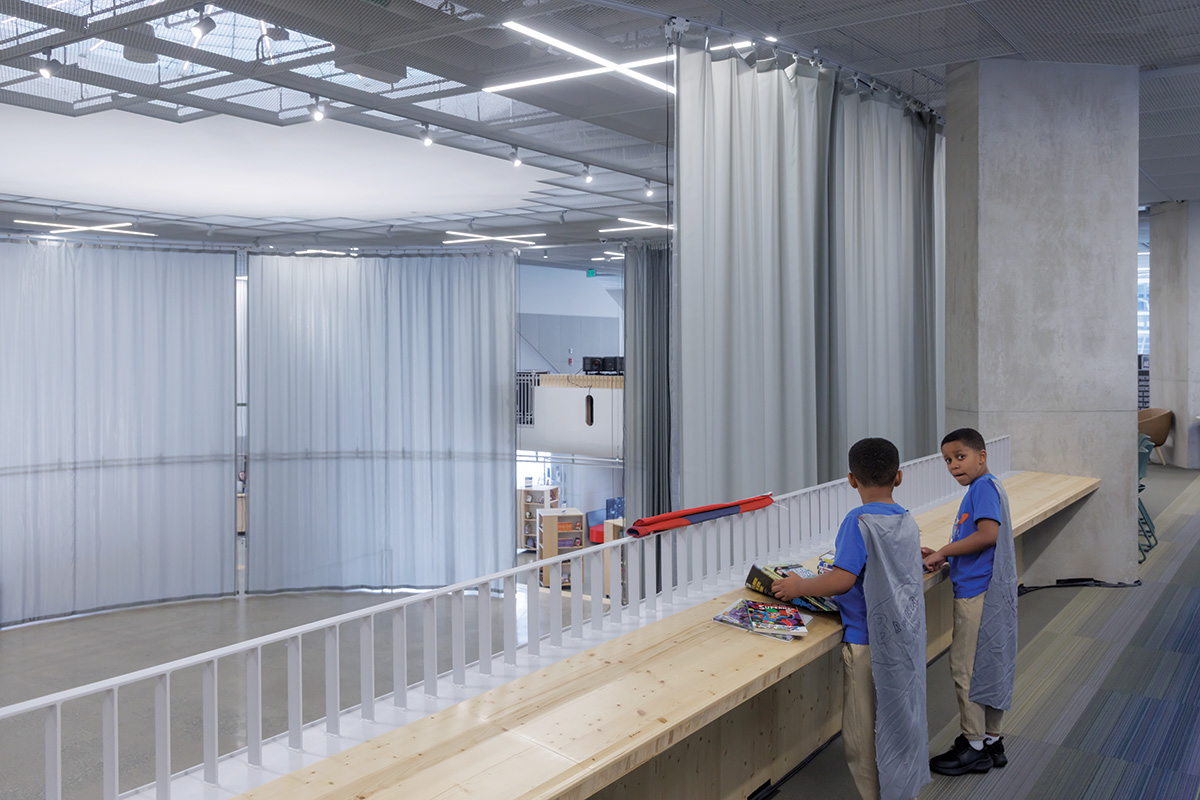
Acoustic curtains ring the platform, and a milled-CLT ledge lining the mezzanine provides a work or display surface. Photo © Iwan Baan
The new branch is a departure from the traditional idea of the library. Dark, narrow rows of bookshelves for quiet, intimate perusal and personal discovery are replaced with a light-filled, open, and flexible space that aims to bring people together, provide services, and foster self-expression. Or, as Liu concisely puts it, “This is the opposite of shush.” SO–IL’s design invokes King’s philosophy, both through the concept of the “table of brotherhood” and in the details. “Dream” and “peace,” among other invocations of King’s ideas, are etched into the library’s concrete columns, literally building his words into the civic pillars of the community.
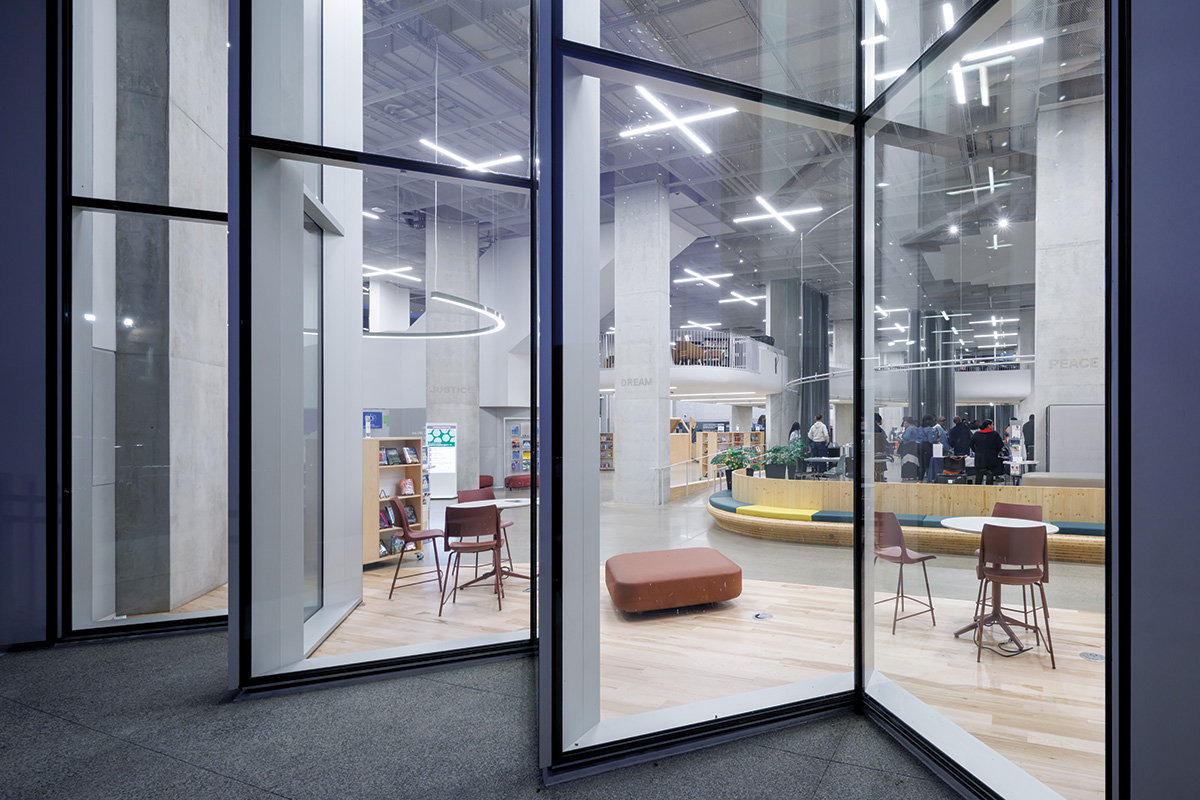
Words are etched into the library’s concrete columns. Photo © Iwan Baan
Credits
Architect:
SO–IL — Jing Liu, Florian Idenburg, principals
Associate Design and Architect of Record:
J. Kurtz Architects – Jonathan Kurtz, principal
Engineers:
Simpson Gumphertz & Heger (structural); Wright Engineering (MEP); Zinkon Creative Studio (lighting, AV, technology)
Consultants:
Threshold Acoustic (acoustical); Nesnadny + Schwartz (wayfinding & branding)
General Contractor:
Panzica Construction Company
Client:
Cleveland Public Library
Size:
27,000 square feet
Cost
$21.9 million (total); $16.8 million (construction)
Completion:
January 2025
Sources
Metal Panels:
Metalwërks
Glazing:
Viracon
Doors:
Assa Abloy, Dormakaba, Ceco Door, Oshkosh Door Company, EZ Concept
Acoustical Ceiling:
USG
Cross-Laminated Timber:
Binderholz
Millwork:
Reserve Millwork
Drapery:
Gerriets
Stretched Fabric Ceiling:
Barrisol
Plaster:
Baswa
Metal Ceiling:
Linder USA
Wood Flooring:
Baird Brothers
Carpet:
Kinetex
Lightning:
Insight, Lumenwerx
Looking for a reprint of this article?
From high-res PDFs to custom plaques, order your copy today!
Looking for quick answers on architecture and design topics?
Try Ask RECORD, our new smart AI search tool.
Ask RECORD →

_JEFF-SVITAK-INC_KAYA_09.webp?height=300&t=1784169659&width=300 "Kaya San Diego lobby")
Jason-ORear.webp?height=200&t=1778792343&width=200 "Scripps Theater, Hudson Valley Shakespeare")