An Open-air Pavilion by Studio Gang Serves as the New Home of Hudson Valley Shakespeare
Garrison, New York
Jason-ORear.webp?t=1778792343)
Architects & Firms
Mere hours before his fictional brutal murder, King Duncan of Scotland arrives with his retinue at Inverness, where he declares himself much impressed by Macbeth’s crenellated crib. “This castle hath a pleasant seat,” says the ill-fated monarch, “the air/ Nimbly and sweetly recommends itself/ Unto our gentle senses.” If only the hospitality lived up to the natural ventilation.
While they can count on a more welcoming reception, first-time visitors to the new home of Hudson Valley Shakespeare might break out into their own breathless iambs. Framing astonishing views over the river, with West Point Military Academy and Storm King Mountain in the distance, the Samuel H. Scripps Theater Center, from the New York outpost of Chicago-based Studio Gang, is a castle of a very different kind—a prefabricated laminated-timber structure of A-shaped struts supporting a turtle shell–like canopy. “The company does Shakespeare in such creative ways,” says Jeanne Gang, the firm’s founding principal. “We wanted to create a space that reflected their values.”
Jason-ORear.jpg "Scripps Theater, Hudson Valley Shakespeare")
The Hudson River serves as a backdrop while back-of-house needs are accommodated in an array of cabins. Photos © Jason O' Rear
Jason-ORear.jpg "Scripps Theater, Hudson Valley Shakespeare")
Since 1987, Hudson Valley Shakespeare has been entertaining seasonal audiences throughout the region, primarily from a makeshift tent at the historic Boscobel Gardens estate, south of scenic Cold Spring, New York. “We’re a classical theater for the 21st century,” says Kendra Ekelund, the company’s managing director; outgrowing their old digs, Ekelund says the ensemble needed a space that could “emphasize and exponentially amplify all the great pieces of our work.” The troupe’s move to its current quarters a few minutes away in Garrison was made possible by some rather outrageous (good) fortune—chiefly, the donation by a wealthy patron of a 98-acre hillside property, once the home to a high-end facility for recovering alcoholics and most recently a golf course. “Balls have been turning up constantly,” Ekelund says, pointing to several scattered around the grassy, path-lined grounds. The work of Nelson Byrd Woltz (NBW), the landscape also preserves several curious stone follies, built as therapeutic undertakings by the former rehab inmates.
The building’s architects had originally intended to model their project on the less formal structure that their clients had previously occupied. “We thought it could be a sort of tent,” says Gang. “We tried it over and over, but it didn’t work.” Besides its aesthetic limitations, the designers found a tensile solution would have entailed a relatively high carbon footprint, owing to the steel members necessary to hold the fabric; instead,they began to explore iterations of a wood frame and roof. The final configuration of the latter, covered in dark wood shingles over beams shaped into “a series of circles arrayed around a circle,” according to Teo Quintana, the senior project leader—afforded both optimal airflow for patrons beneath it and a soft, rolling profile that mimics the contours of the Catskill Mountains across the river.
Jason-ORear.jpg "Scripps Theater, Hudson Valley Shakespeare")
The mass-timber roof is held aloft by A-frame columns. Photo © Jason O' Rear
Jason-ORear.jpg "Scripps Theater, Hudson Valley Shakespeare")
Photo © Jason O' Rear
Oriented to the north, with NBW’s sloping lawn a de facto extension of the stage, the theater effectively turns the entirety of the Hudson into a kind of permanent set. Entering from the (somewhat oversized, owing to community concerns) parking lot, theatergoers pass between a series of freestanding auxiliary structures through narrow, funnel-like vomitories that double, during performances, as wings for entering and exiting actors. The three-quarter layout of the seating ensures unimpeded sightlines to both the stage and scenery, which is another major improvement over tensile buildings like those at Boscobel, where “we had to have discounted tickets for spots with partial obstruction,” says Ekelund.
Jason-ORear.jpg "Scripps Theater, Hudson Valley Shakespeare")
The site overlooks Storm King Mountain and West Point across the Hudson River. Photo © Jason O' Rear
Back-of-house considerations did pose a problem. “You can’t hide,” notes Gang: without a conventional offstage area, performers and technicians have to be somewhat strategic about their angles of approach. Production facilities, including dressing rooms and storage, are housed in the separate volumes around the south-facing entrance, while a westerly pathway provides a discreet route toward the stage and lawn. Clad in yakisugi, the support buildings are the only portion of the complex with artificial air handling, and they also provide areas for a greenroom and hangout space with adjoining patio, perfect for cast parties.
Input from ecological consultant Buro Happold early in the process—along with low-flow fixtures in the bathrooms below the raked seating, as well as an ultra-efficient power system for all the theater’s complex lighting needs—combined to make the project the first purpose-built, open-air theater in the country likely to garner LEED Platinum status.
Its green bona fides seem confirmed by its popularity with local wildlife, including a number of hairy woodpeckers that have been spotted hovering around the structure. (Gang, an avid birder, notes that the wood has been treated to make it less appetizing: “There are no insects in it for them to eat.”) All that Scripps seems to need now is “the roar of the greasepaint, the smell of the crowd,” and perhaps a good strong storm as a moody backdrop. For its opening season, Hudson Valley Shakespeare will be staging King Lear; with any luck, clouds and thunder would appear right on cue with the title character’s famous line: “Blow, winds, and crack your cheeks! rage!”
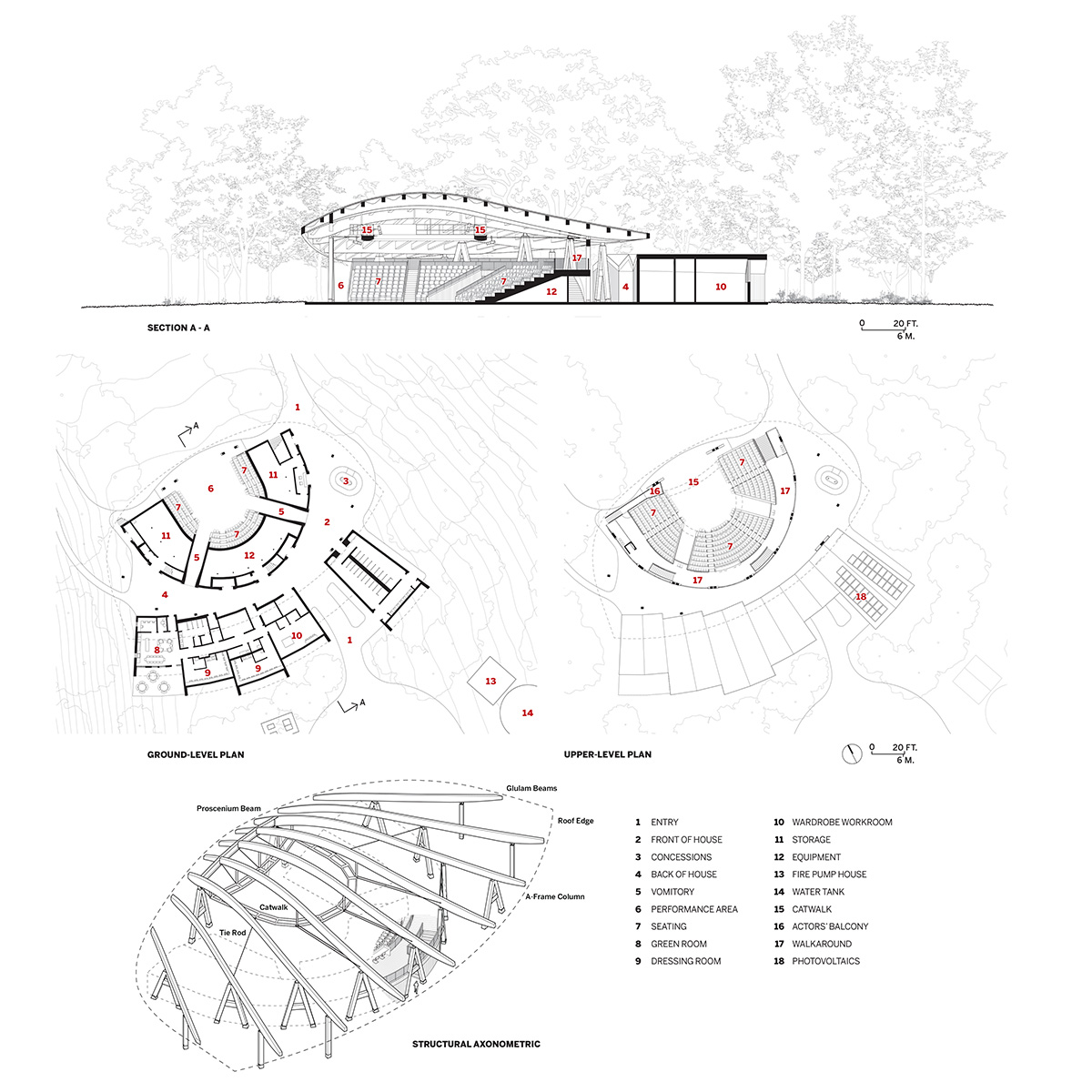
Images courtesy Studio Gang; click to enlarge
Credits
Architect:
Studio Gang
Landscape Architect:
Nelson Byrd Woltz
Engineers:
Thornton Tomasetti (structural); Art Massif (mass timber); Badey & Watson (civil)
Consultants:
Fisher Dachs Associates (theatrical); Threshold Acoustics (acoustical, audiovisual); Buro Happold (MEP, FP, IT, security, sustainability); Tillotson Design Associates (lighting); Flyleaf Creative (wayfinding); Simpson Gumpertz & Heger (code)
Construction Manager:
Consigli
Client:
Hudson Valley Shakespeare
Owner’s Representative:
About The Work
Size:
26,000 square feet
Cost:
$41 million (total); $33 million (construction)
Completion
May 2026
Sources
Wood:
Montana Timber Products Charwood
Roofing:
VaproShield, Brava Cedar Shake Tile
Floor and wall tile:
Daltile Remedy
Resilient Flooring:
Tarkett LinoFloor xf²
Lighting:
HE Williams, WAC Lighting
Hardware:
Schlage Everest, Allegion LCN, Allegion Von Duprin, Krieger Cam Lift Hinges, Zero, Allegion
Looking for quick answers on architecture and design topics?
Try Ask RECORD, our new smart AI search tool.
Ask RECORD →
Looking for a reprint of this article?
From high-res PDFs to custom plaques, order your copy today!