A Public Plaza in Montreal Honors Women While Uniting Two Neighborhoods Bisected by a Sunken Highway

Montreal has a surprising few public spaces—parks, roads, and municipal buildings—named after women. In response to this scarcity, in 2016 the city government created Toponym‘Elles, a name bank aiming to increase the representation of women in Montreal place names. At the time, women made up only six percent of the city’s roughly 6,000 place names, while men represented more than 50 percent.
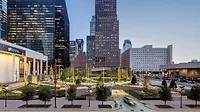
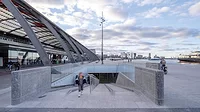
Perhaps most significant recognition of Montreal women in the public realm was realized last May with the opening of Place des Montréalaises. Capping a sunken section of the east-west Ville-Marie Expressway, this roughly four-acre public square reunites Old Montreal and the city’s administrative quarter with the downtown area around the Champ-de-Mars metro station. More than just an urban fabric–repairing highway lid park and universally accessible pedestrian corridor, Place des Montréalaises is a constantly evolving landscape-tribute that acknowledges 21 Montreal women, each of them selected by a municipal advisory body, the Conseil Montréalaises.
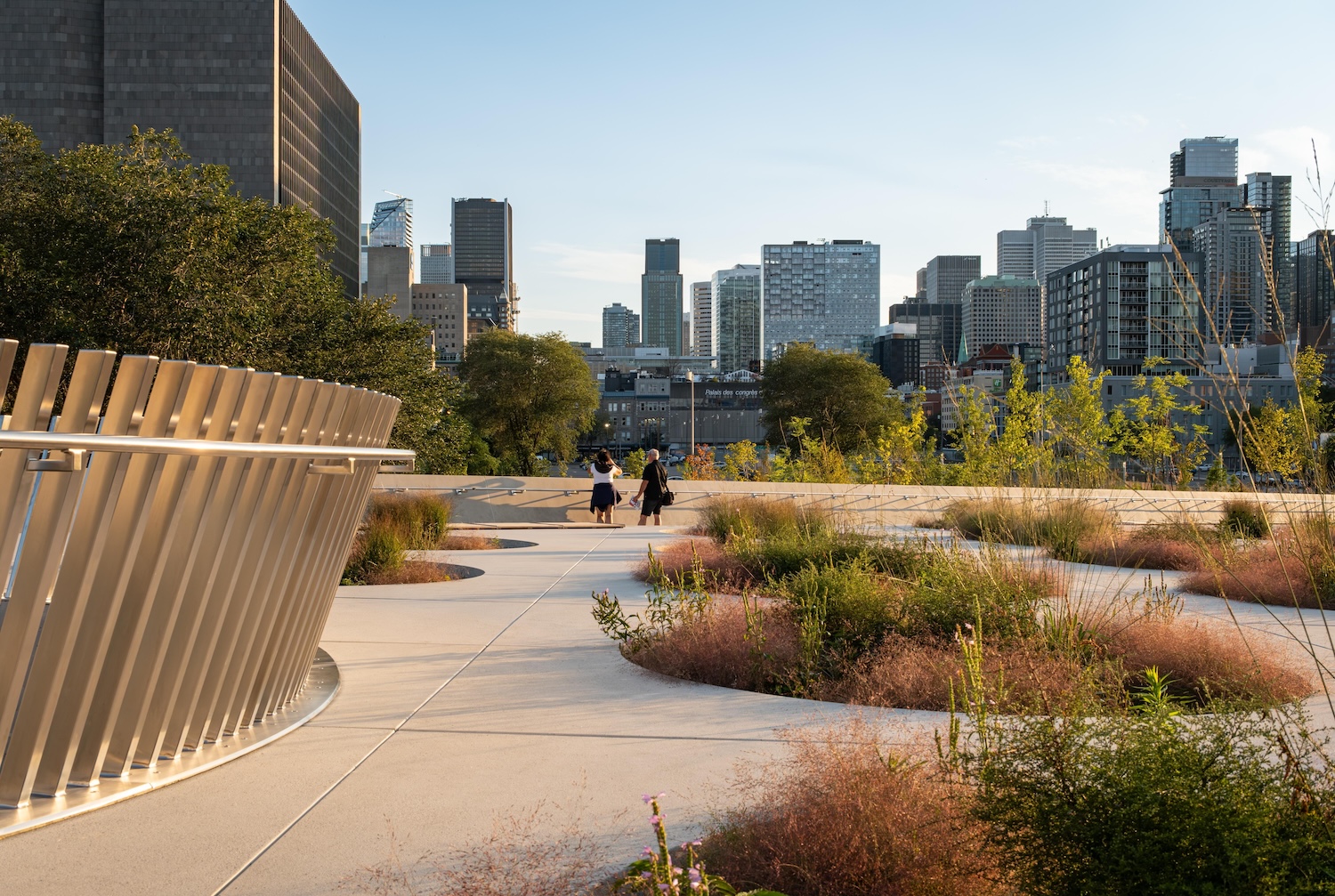
The meadow's nearly 90 planting modules contain a variety of indigenous species. Photo © Vincent Brillant
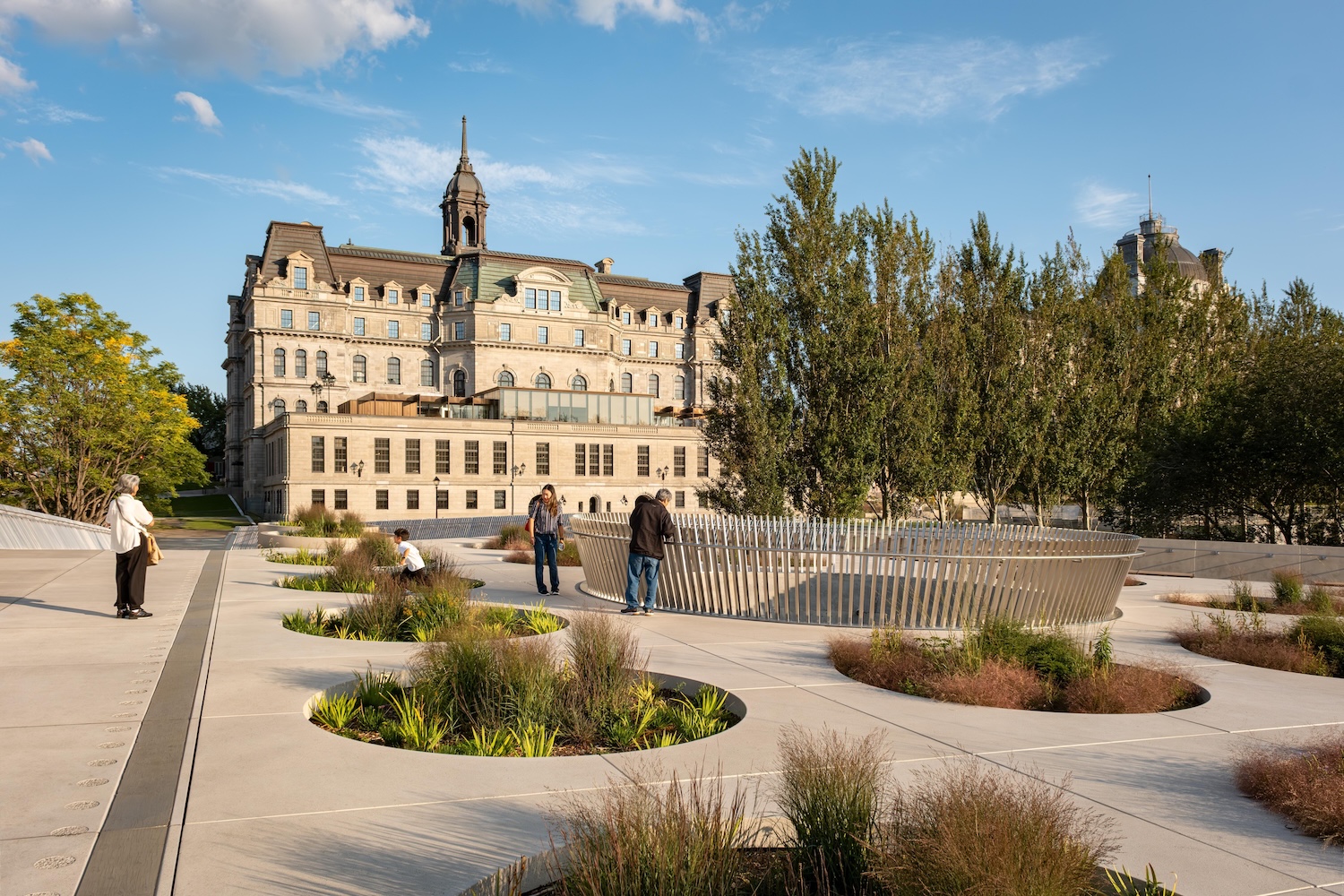
View of the plantings and oculus with Montreal City Hall in the background. Photo © Vincent Brillant
The unique legacies of the women are memorialized by the 21 different perennials used throughout the plaza’s sprawling meadow of 86 circular planting-bed modules. These vegetated clusters are arranged atop a floating, inclined plane that conceals the highway beneath it at the heart of the site. “The meadow is a big bouquet of flowers of sorts that blooms sequentially throughout the season,” explains landscape architect Patricia Lussier, a design principal at multidisciplinary design firm Lemay. “The plant species are spread out, so that it varies and creates a sequencing of the space while addressing the specificities of each of the women, because they all have such different backgrounds.”
Puncturing a corner of the sloping, triangular platform is a large oculus that allows an elm tree planted along the roadway below to grow through the slab—a move that helped to lighten the structural load of the cantilevered bridge-deck as it spans Rue Saint Antoine and a highway off-ramp to connect with Old Montreal. “It helps to bring more light down and reduce the weight of the concrete,” adds Jeffrey Ma, senior design director with Lemay, of the “elegant and delicate solution” to one of the project’s more complex design challenges.
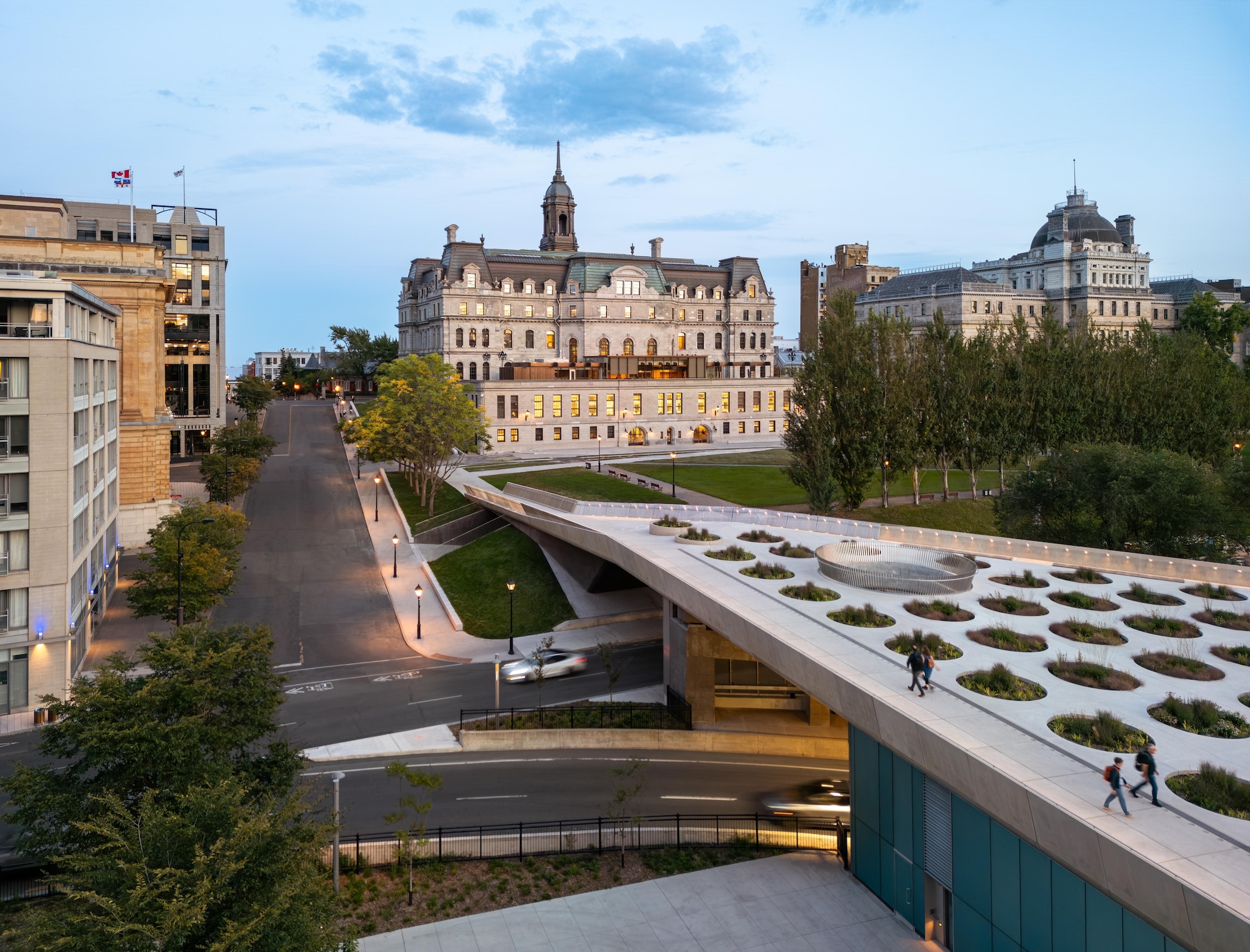
A pedestrian flyover links Place des Montréalaises with Champ-de-Mars. Photo © Vincent Brillant
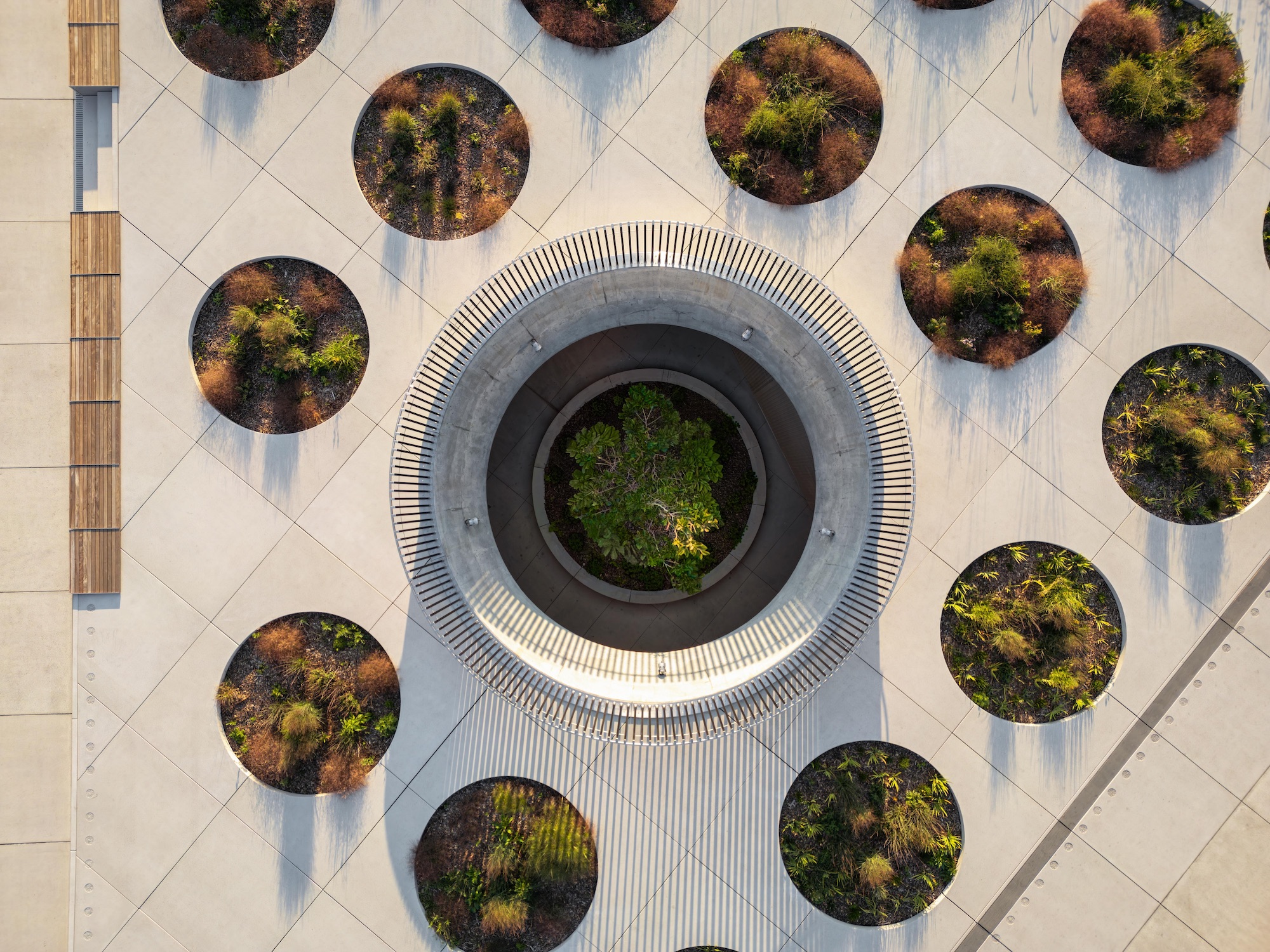
Aerial view of the oculus, surrounded by the circular planting beds. Photo © Vincent Brillant
Elsewhere at the site, Miroir des Montréalaises, a cylindrical mirrored installation by Montreal-based conceptual artist Angela Silver, who led the project's art and commemoration strategies, has inscribed the names of each woman. On one side of the work, which wraps a small service structure, are the names of seven significant Montréalaises pulled from different eras and backgrounds, including early-20th-centry hockey champion Agnès Vautier and pioneering nuclear scientist Harriet Brooks. On the opposite side of the Miroir are the names of the 14 women fatally shot in the École Polytechnique massacre of 1989. Each of the 21 names appears in full once before the letters become fragmented as the mirrored surfaces curve, carrying over to the nearby steps of the suspended meadow. Passersby are “invited to rearrange these letters to compose infinite variations of women’s names, ensuring they are never forgotten,” explain the designers.
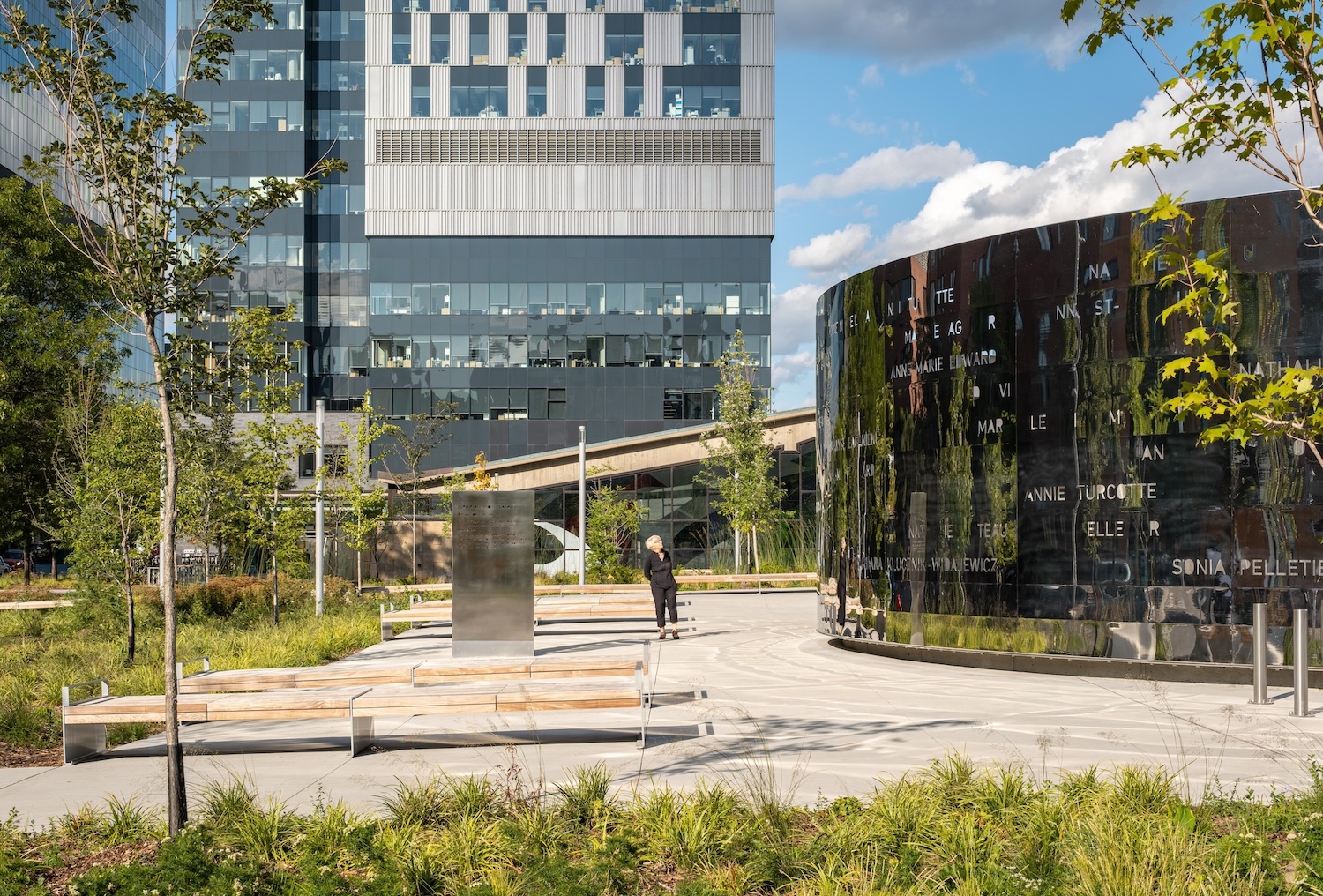
A visitor interacts with Angela Silver's Miroir des Montréalaises. Photo © Vincent Brillant
Describing the project as an “architectural response to a historical imbalance,” Montreal-based Lemay, joined by Silver as project design partner and structural engineer AtkinsRéalis, won the commission out of an international design competition in 2018. Built atop a slab constructed by Quebec’s transport ministry to conceal one of the few remaining open-air sections of the highway near Montreal City Hall, the project replaces a dark, dank pedestrian tunnel that linked the metro station with Old Montreal.
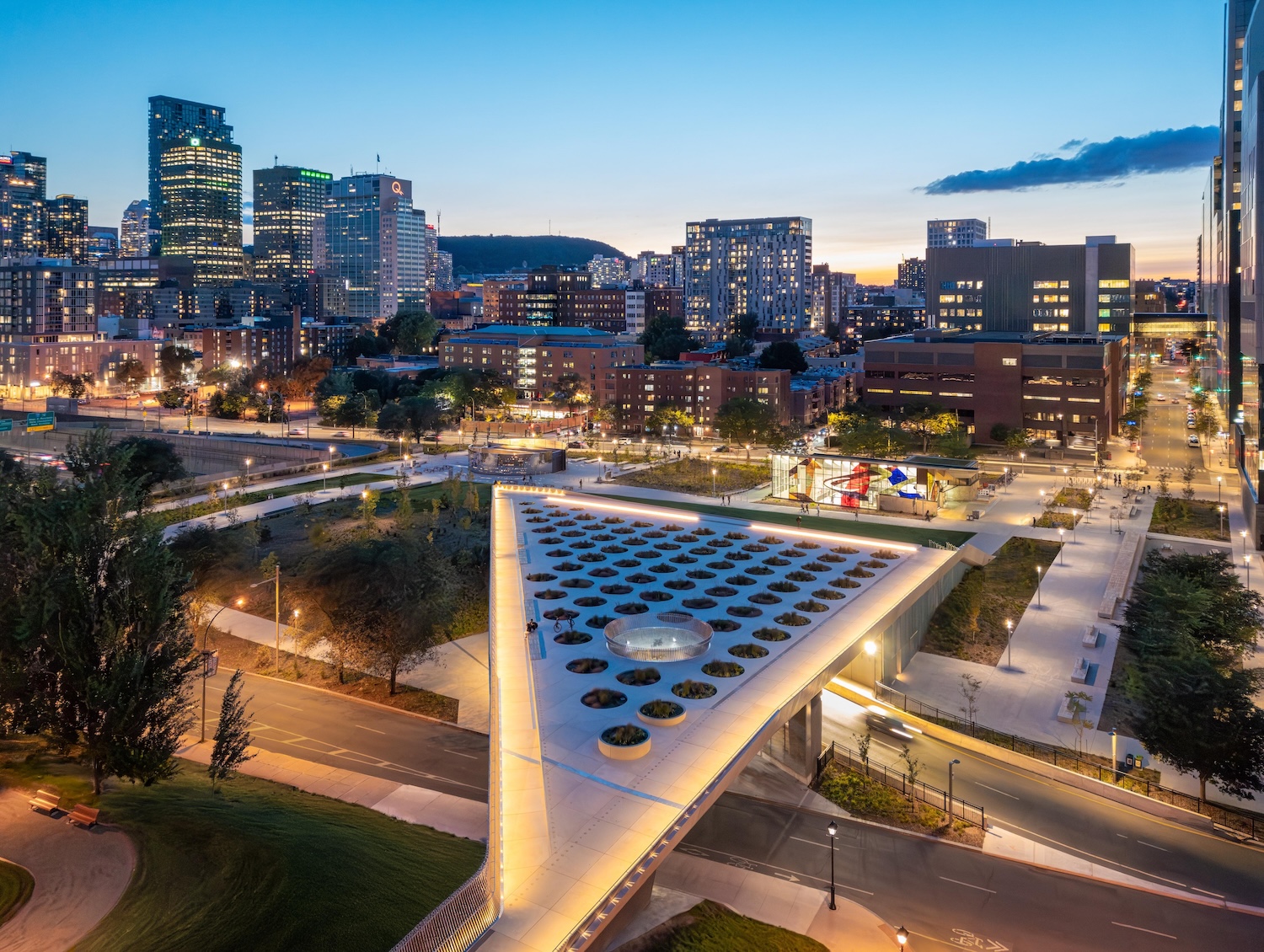
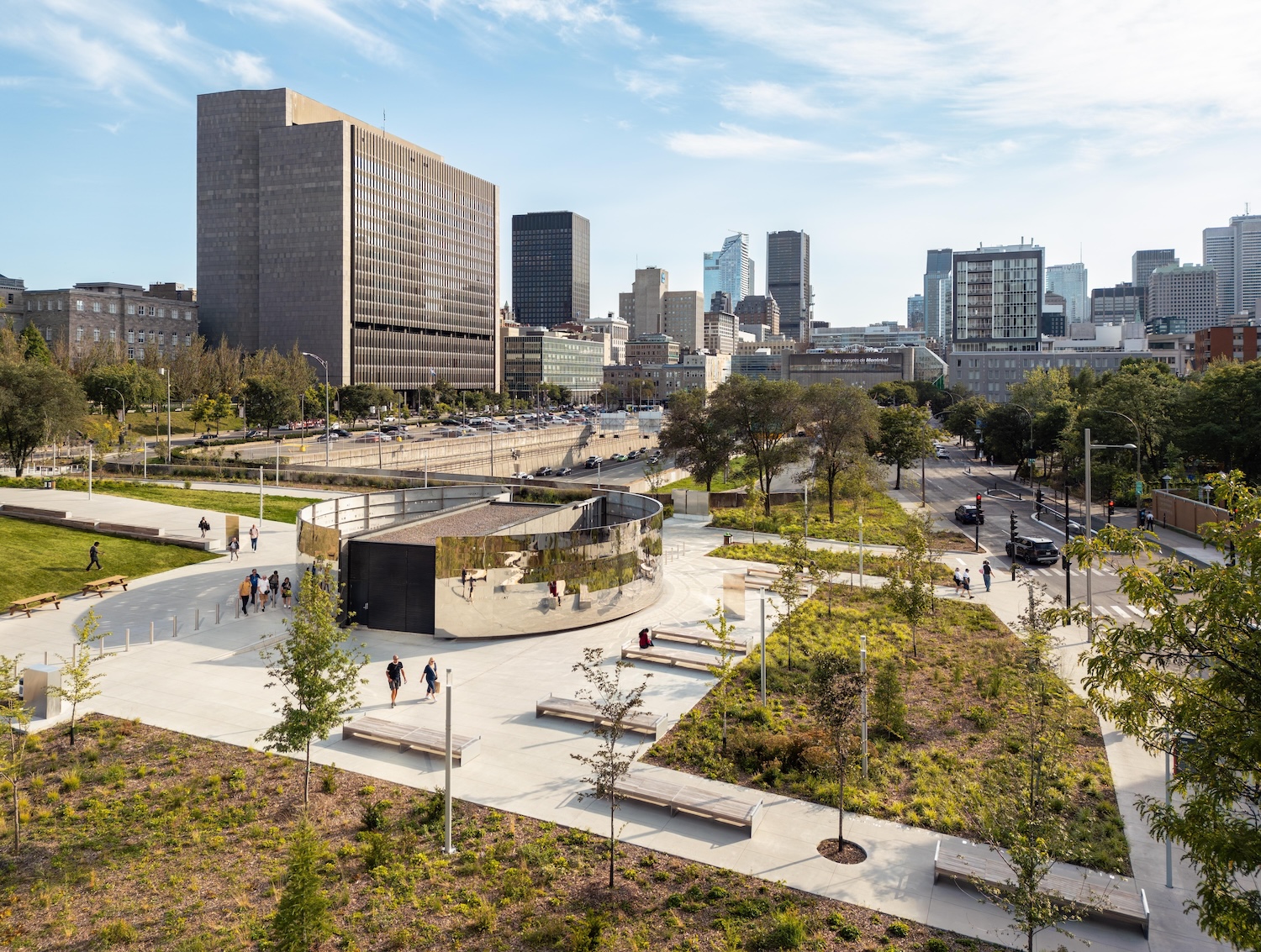
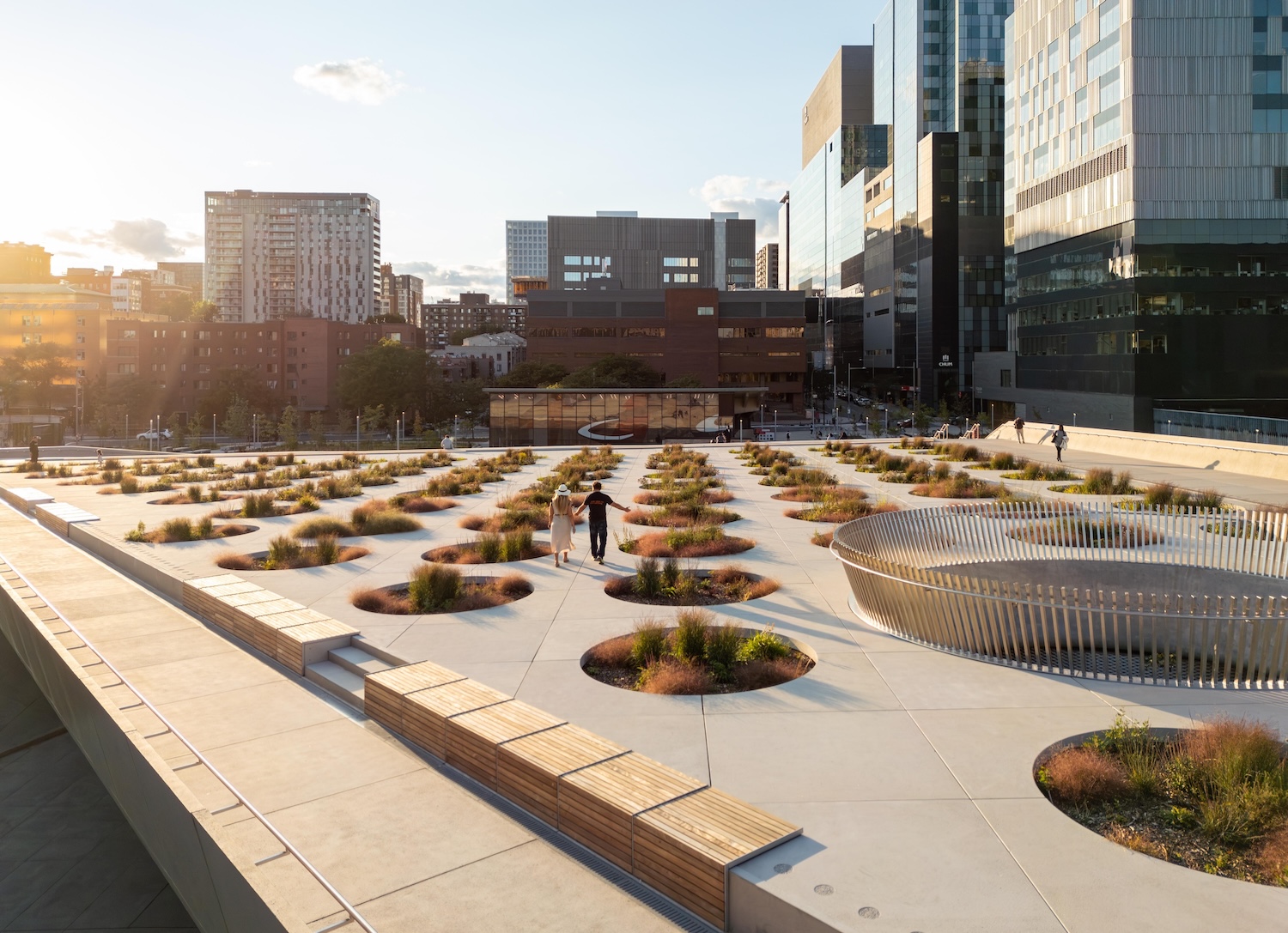
Built atop a sunken highway and mass-transit infrastructure, the site bolsters pedestrian connectivity while providing a new public venue for residents and visitors to congregate. Photos © Vincent Brillant
Two other women also have a presence at and around the site. One is the late stained-glass artist Marcelle Ferron, whose colorful abstract work adorns three facades of the adjacent Champ-de-Mars metro station headhouse. The stained-glass of the south facade can be newly appreciated from the amphitheater seating that extends down from the elevated meadow. The other is Marie-Josèphe Angélique, an enslaved Black woman in colonial Quebec accused of committing widespread arson in 1734. Her existing namesake public square, at the western corner of the site opposite City Hall, was redesigned as part of the project.
Looking for quick answers on architecture and design topics?
Try Ask RECORD, our new smart AI search tool.
Ask RECORD →
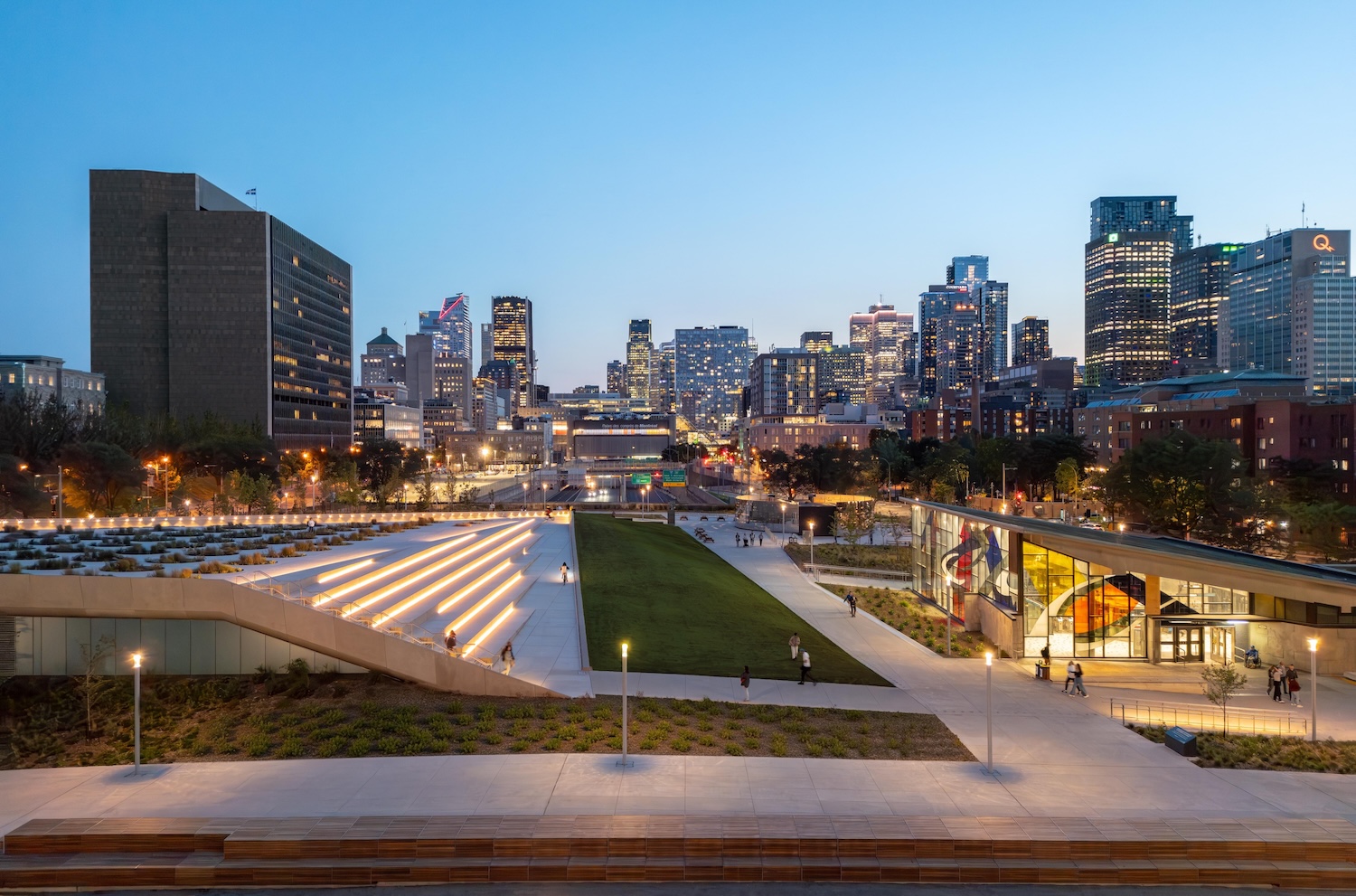
The plaza provides views of downtown and the stained-glass facade of the Champ-de-Mars metro station from an expansive public lawn and amphitheater-style seating area. Photo © Vincent Brillant
In addition to the structural complexities of fusing together the plaza with Old Montreal via a pedestrian overpass, another formidable constraint emerged on the northern edge of the site near the metro station where the creation of a transitional “urban forest” was complicated by the fact that it sits atop a tangle of crucial infrastructure, including a shallow subway tunnel. Lussier says that a root specialist was brought in to advise the design team; ultimately, the plant species used were selected based on their ability to adapt to shallow soil depths while offering maximal ecosystem benefits. “The public transit authority didn’t want us to plant trees on top of the tunnel, so we had to make the case in order to do so and get really creative,” she explains, likening the intricate process to a game of Tetris.
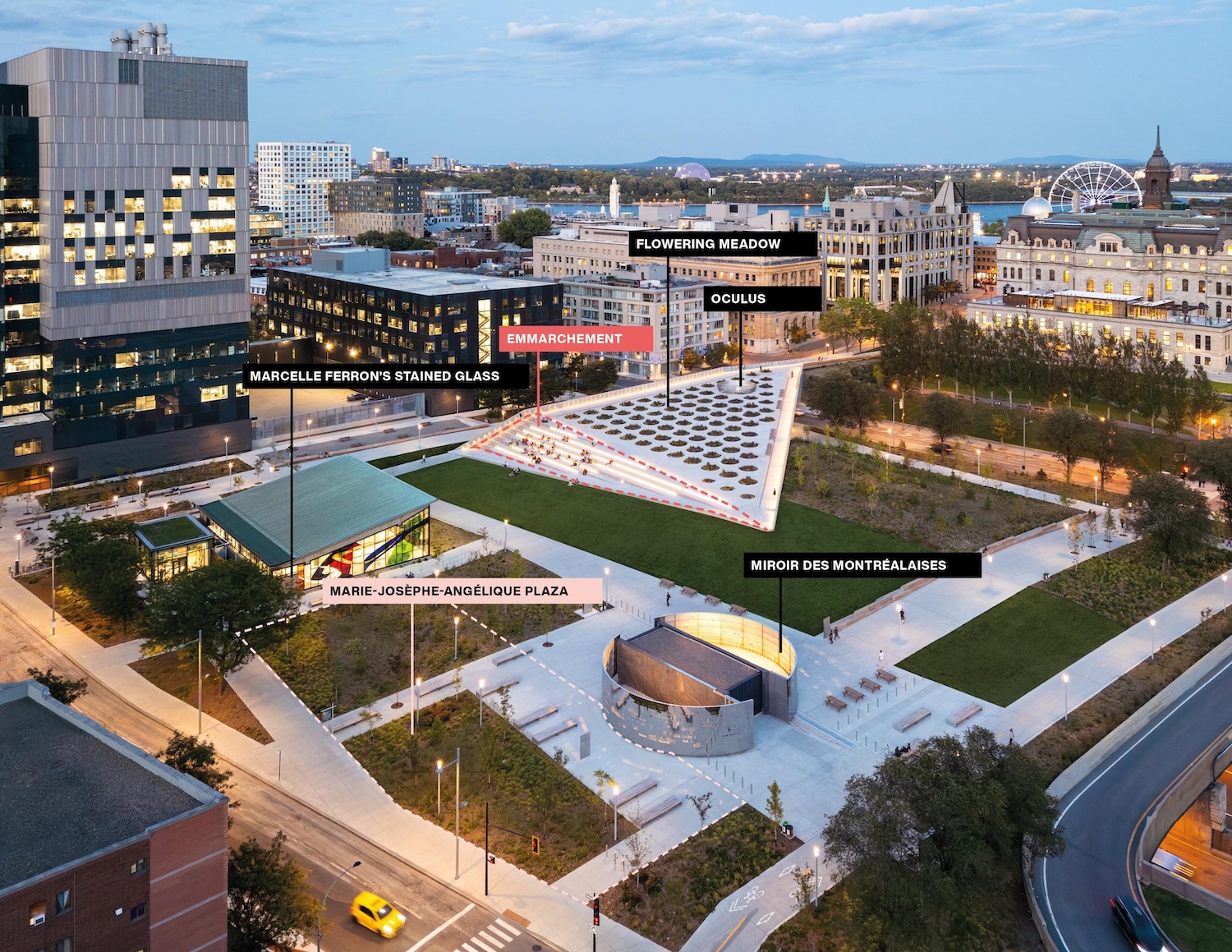
Photo © Vincent Brillant
While Place des Montréalaises succeeds as a feminist memorial site, its greatest triumph is as flexible open public green space for both gathering and passing though that stitches together a swath of the city scarred by highway construction. As Ma says, the project creates a new perspective that simply didn’t exist before. “It provides a point of view of the city that was essentially lost because of the highway—now, when you're standing on top of it, it’s like it was never there.”
Looking for a reprint of this article?
From high-res PDFs to custom plaques, order your copy today!