The Met Showcases Rare Medieval Architectural Drawings in ‘Gothic by Design’

-Roriczer_ca.-1490-93.jpg "Gothic by Design work")
Hans Holbein the Elder (German, ca. 1465–1524); Portrait of the Architect Mathes (Matthäus) Roriczer ca. 1490–93; silverpoint on gray-white prepared paper, later partially covered with gray body color and dark gray-brown ink; Kupferstichkabinett, Staatliche Museen zu Berlin (KdZ 5008)
-Vienna_ca.-1515.jpg "Gothic by Design work")
After Anton Pilgram (Czech, Moravia, ca. 1460–1515); Elevation, Section, and Floor Plan for the Stairs to the Pulpit, Stephansdom (Saint Stephen’s Cathedral), Vienna ca. 1515; pen and brown ink, over blind ruling with stylus, guided by compass and straightedge, on paper
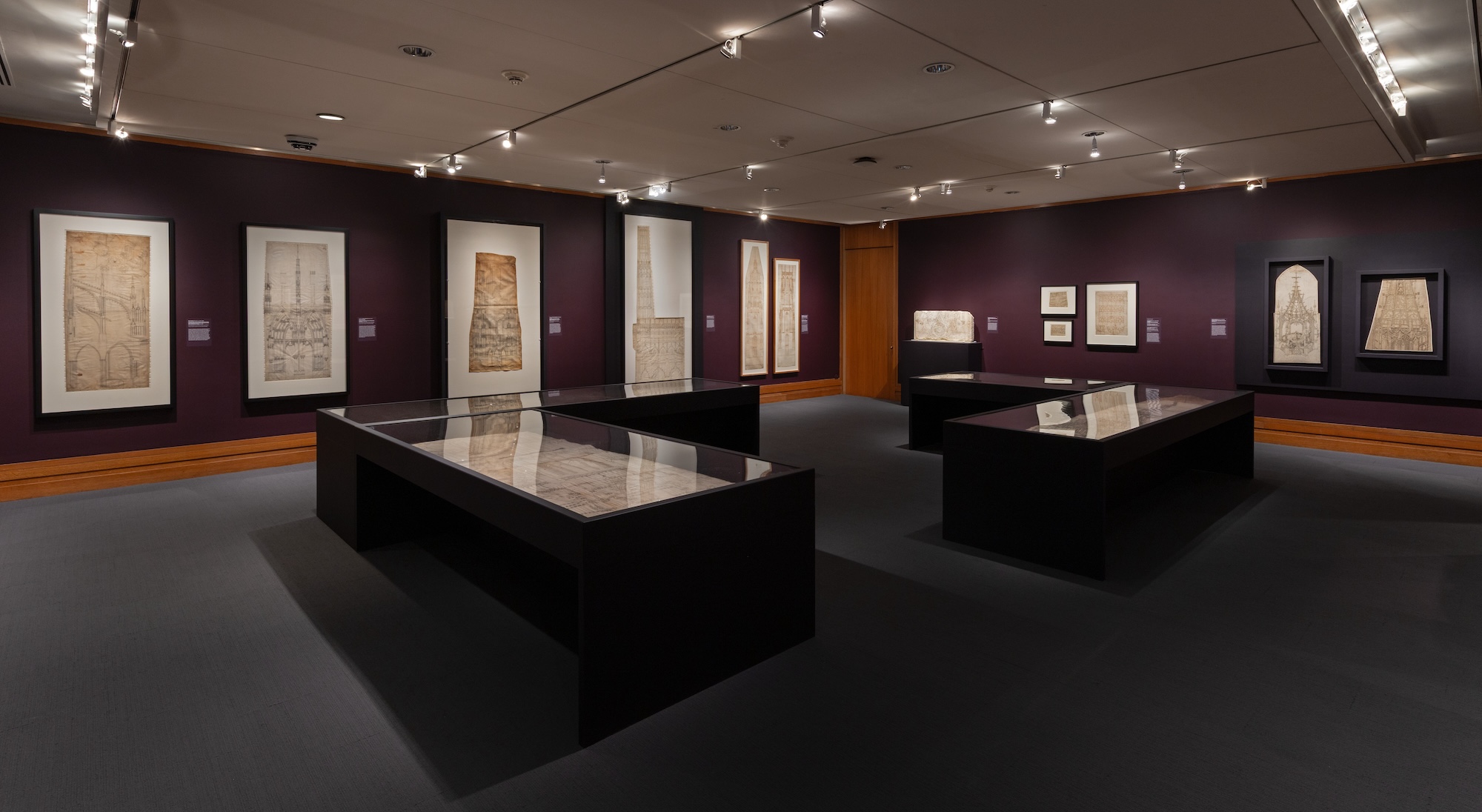
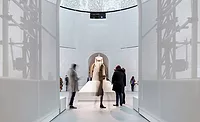
Installation view of Gothic by Design. Photo courtesy the Metropolitan Museum of Art
The room to the right of the central gallery opens with a video showing a re-creation of this medieval drawing process, which began with the ink and parchment. Both materials were incredibly expensive in the Middle Ages, but especially parchment, which consists of animal skins that have been soaked in a lime solution, scraped, stretched, and smoothed. It can be inferred, then, that these large-scale drawings were not construction sets, which would have been drawn with cheaper materials, worn out through use on-site, and therefore mostly lost to time. These drawings were for presentations to clients and stakeholders.
For the tower of the Imperial Dome of Saint Bartholomew in Frankfurt am Main, the exhibition includes two versions of its elevation, presented side by side. The first, from circa 1434, is by Michael Kurtze, an apprentice of the city architect Madern Gerthener. It features an ornate dome, with layers of pinnacles and buttresses, capped with a spire. In the 1490s, after part of this design for the cathedral was completed, the project started running out of money. The officials called in the “internationally renowned” architect Nikolaus Quecke to see if he could salvage the church within the remaining budget. His drawing shows what had been built already, but the dome is scrapped and replaced with an elegant Gothic cornice. After deliberation, the city council decided not to proceed with the new, cheaper design, and Kurtze’s original is what stands in Frankfurt today. Both presentation drawings were archived by the city for centuries. If making the most of value engineering, redesigning from preexisting conditions, and trying to convince functionaries to approve your scheme isn’t the work of an “architect,” nothing is.
-Prague_ca.-1360.jpg)
1
2
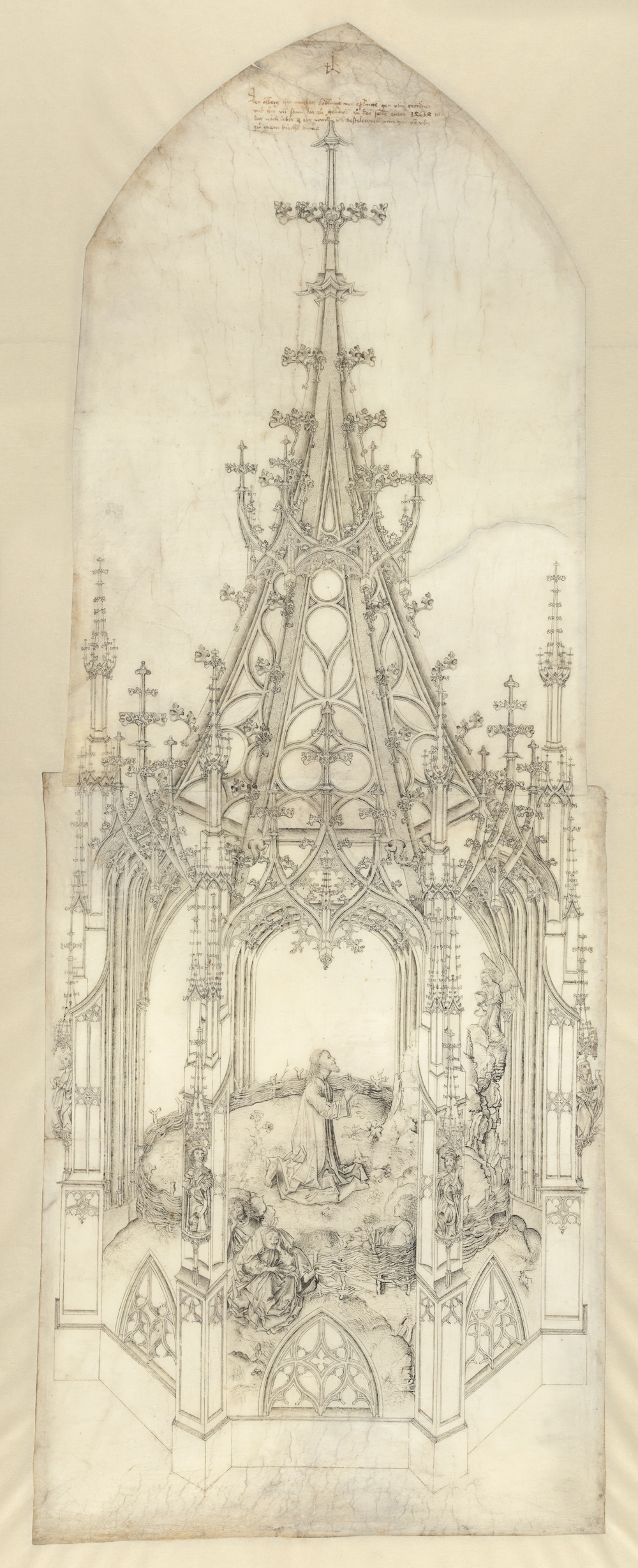
Peter Parler (German, ca. 1330–1399); Cross Section of the Northern Half of the Choir and Flying Buttresses of the Cathedral of Saint Vitus (Veitsdom), Prague ca. 1360; pen and black ink, over blind ruling with stylus, guided by compass and straightedge, on parchment; Graphic Collection, Academy of Fine Arts Vienna (HZ-16821r) (1); Matthäus Böblinger (German, ca. 1450–1505); Design for a Mount of Olives Monument for the City of Ulm 1474; pen and black ink, over blind ruling with stylus, guided by compass, on parchment; Evangelische Gesamtkirchengemeinde Ulm (Stadtarchiv Ulm, E Münsterbauamt 1) (2)
There are, however, two rare construction drawings included in the exhibition. One is a full-scale profile for the stonecutters building Saint Stephen’s Cathedral in Vienna in the 1460s. “They would create paper templates to figure out the moldings of a pillar or a wall,” explains Speelberg, “and they would just put them on top of the stone and trace it.” The other is a roughly 21-by-41-inch sheet of paper on which intersecting circular bands drawn in brown ink are segmented into arcs. Each is labeled with a mix of numbers and letters. The charcoal underdrawings mapping out its geometry are still visible. It is the vaulting plan for the Chapel of Saint Catherine in the Strasbourg Cathedral from circa 1542, with notation indicating where each stone is to be placed.
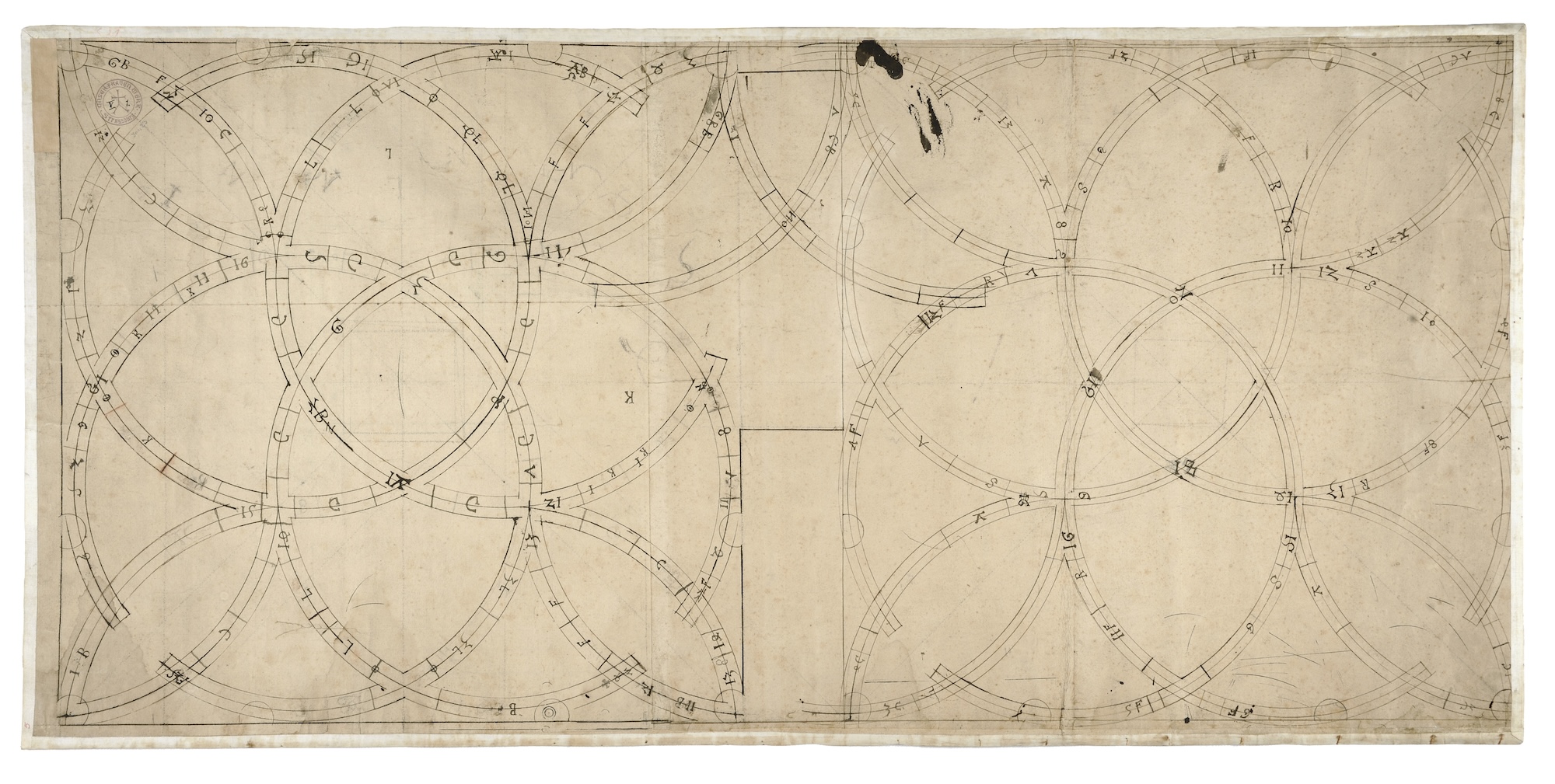
Bernard Nonnenmacher (German, active 1520–51) Vaulting Plan for the Chapel of Saint Catherine, Strasbourg Cathedral, with Instructions for the Assemblage of the Vaulting, ca. 1542–46; pen and brown ink over red chalk and charcoal underdrawing; Fondation de l’Oeuvre Notre-Dame, in custody of Musée de l’Oeuvre Notre-Dame, Strasbourg (D.22.995.0.9 [OND 23])
Beyond the beauty of the drawings on display, with their mesmerizing detail and complexity, and beyond their ramifications for the predominant narrative about the profession, Gothic by Design succeeds in bringing to life a part of history that can feel so distant from today. Looking back at the small portrait of Mathes Roriczer at the entrance to the exhibition, one can almost imagine the life of an architect working some 500 years ago: the hours spent inking presentation drawings, explaining the design to patrons or city officials, and the site visits to coordinate with builders, charcoal pencil in hand.
Gothic by Design: The Dawn of Architectural Draftsmanship runs through July 19, 2026, at the Metropolitan Museum of Art.
Looking for quick answers on architecture and design topics?
Try Ask RECORD, our new smart AI search tool.
Ask RECORD →
Looking for a reprint of this article?
From high-res PDFs to custom plaques, order your copy today!