Tall Buildings 2026
With a Set of Faceted Skyscrapers and an Elevated Park, WilkinsonEyre extends Toronto’s Business District
Toronto
Architects & Firms
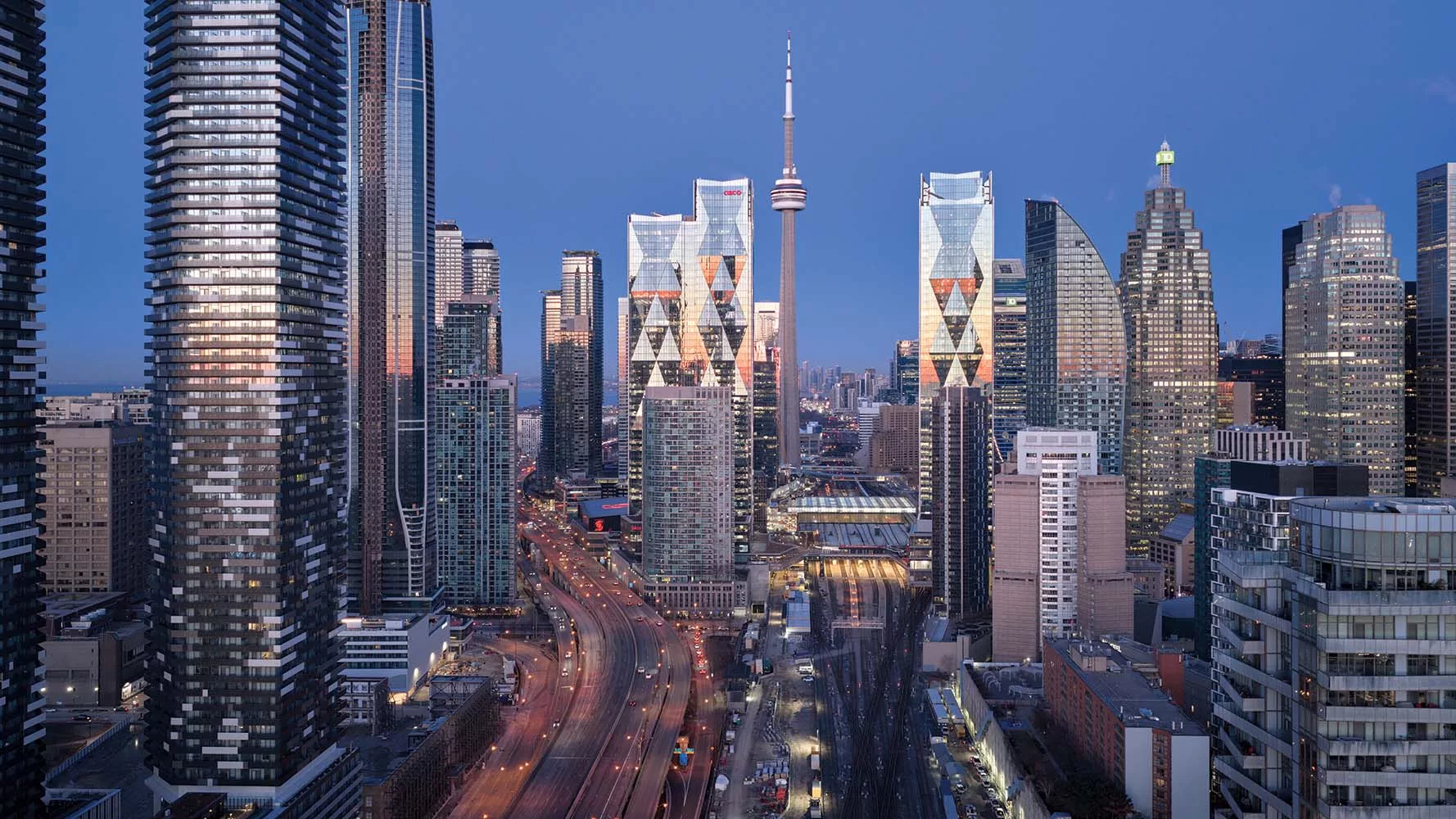
A central node of Toronto’s financial district is migrating south and up 80 feet into the air. In response to a design competition by developers Ivanhoé Cambridge and Hines to link two sites split by a rail corridor across the street from Canada’s busiest station, London-based architect WilkinsonEyre has designed two towers connected by a 1-acre park. By so doing, it has created a campus four stories above the pavement for one of the nation’s Big Five banks. The Canadian Imperial Bank of Commerce (CIBC) was announced as the anchor tenant in 2017 and now leases over half of the towers’ 3 million square feet. Dominic Bettison, a WilkinsonEyre board director who led the winning competition submission in 2014, speaks with a note of relief when describing floor plates as “sensible” and “predictable” in a project that is otherwise over the top. It is now a short distance for bankers to travel from trading floors onto a landscaped swath inspired by regional landforms and programmed with a skating rink, to gaze serenely beyond the congestion below.
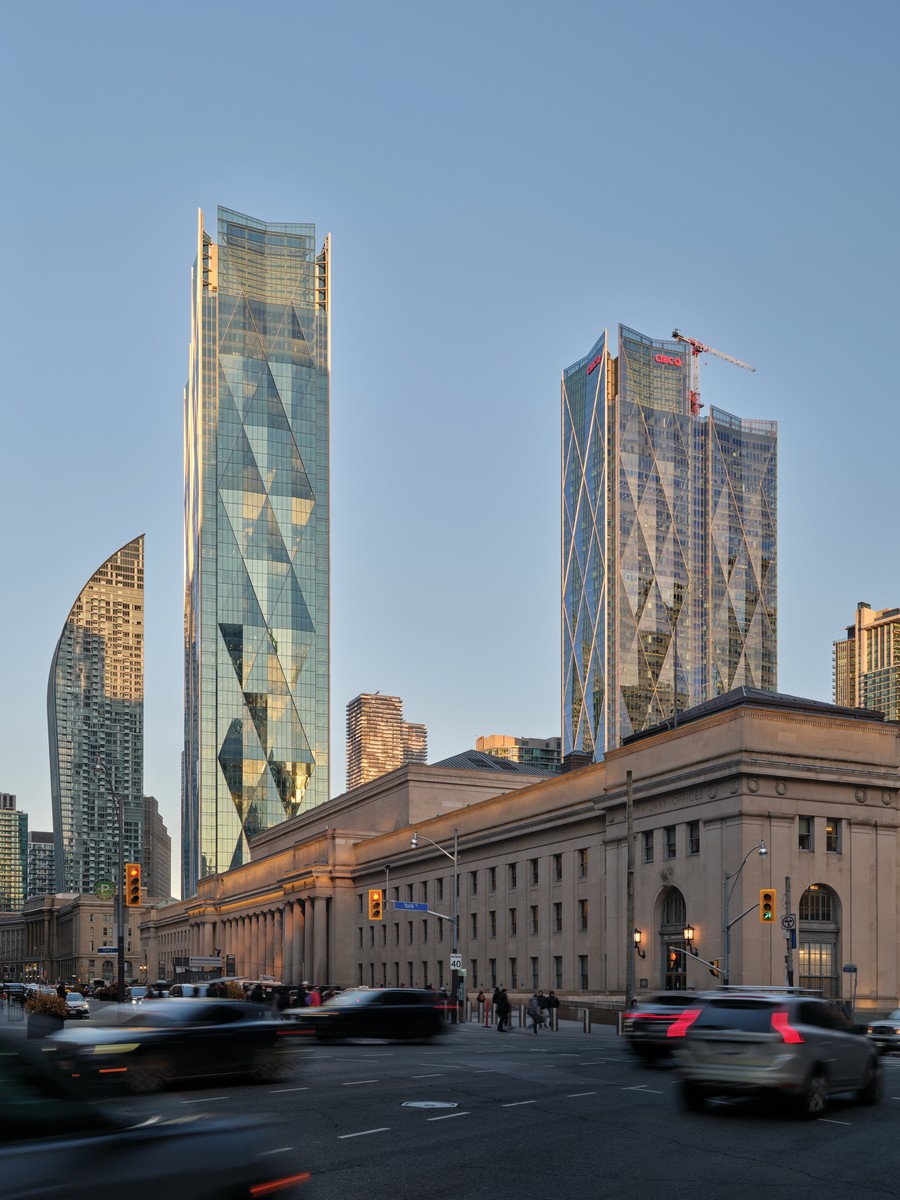
The towers’ faceted facades reflect changing colors throughout the day. Photo © Doublespace Photography, click to enlarge.
WilkinsonEyre’s strategy for ensuring CIBC Square would “resonate with the bankers” began by replicating a local legend. “The floors are almost identical to the Toronto-Dominion Centre,” Bettison says, referring to the 1960s tower ensemble designed by Ludwig Mies van der Rohe a couple of blocks north. Each of CIBC Square’s rectangular volumes is split in half by a vertical notch, making the two 820-foot-tall towers look a bit like four. Several details—like chamfered corners and glazing that continues beyond the top story into the sky—make the curtain wall seem almost to float at a distance from the floor plates. As a result, the towers feel lighter and more open than most others in the district. Facades patterned with colossal diamonds also diverge from the dogged rhythm of horizontal spandrels that saturates the financial district. By projecting a mere 30 inches, the diamonds’ facets reflect a surprising variety of colors throughout the day. This effect is accentuated at dusk by lighting at nodal points, directed along fins at the diamonds’ edges—what Bettison calls his “lightsaber” detail. Nearer the ground, steel-and-glass canopies mitigate downdraft and complement lightweight stairs that signal access to the park. (Escalators directly inside are a more popular option for ascent.)
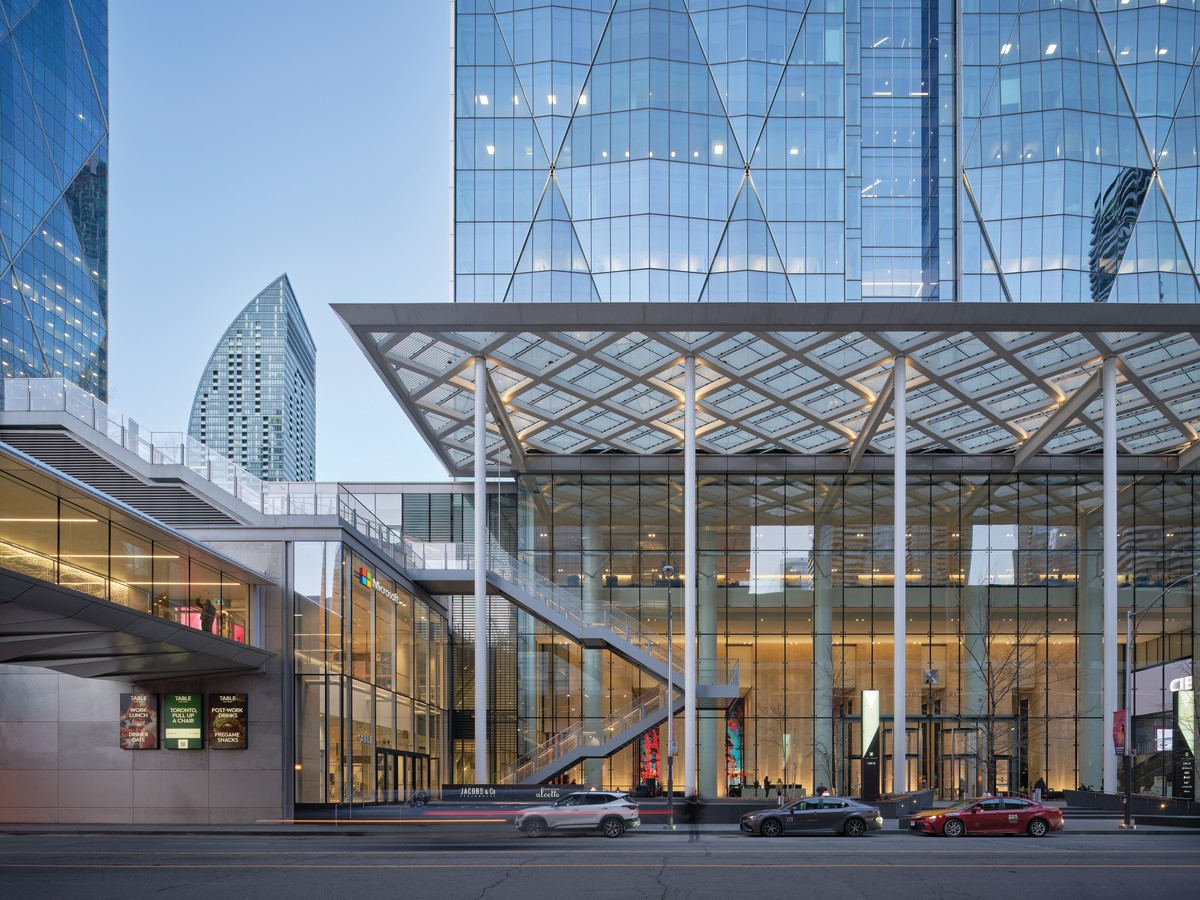
A steel-and-glass canopy complements lightweight stairs to the park. Photo © Doublespace Photography
The towers’ nearly identical appearance masks a major structural difference: one side of the north tower sits over the rail tracks. There are no columns below the sixth floor. As when standing on one leg, it is lateral loading—sway from the wind—that is most difficult to deal with in this situation. Though outriggers near the building’s top limit this movement, a cable system with incorporated springs helps maintain the right amount of tension in the glazing at the base as the tower sways. This leaves the north tower’s lobbies extra open. Travertine facing on the elevator banks seems to glow in the daylight, and floor-to-ceiling backlit artworks by the painter Steve Driscoll literally do. In the south tower, his depiction of a pine forest rendered in red resonates with the CIBC logo.
The larger urban agenda of CIBC Square is to help reconnect downtown Toronto to its waterfront. The towers’ sites seemed cursed with infrastructural blight; they were occupied by a parking lot and an aging bus terminal. The train tracks, an elevated expressway, a sudden grade change, and the congested tangle of Union Station itself all stood between office workers and a harbor-front stroll. (Half of the south tower’s podium houses the relocated bus terminal, which Bettison says is “designed along the lines of a small regional airport.”) A leap of imagination will be needed for Torontonians to see that they can, in fact, walk straight down to Lake Ontario. WilkinsonEyre’s canopies and stairs combine with a spindly Santiago Calatrava–designed galleria, completed in the early 1990s, jutting over the sidewalk to constitute a series of lightweight features punctuating the view down Bay Street, over the tracks, and toward the lake. We will have to wait until summer to see if people pick up on the signals and throng this way to the boardwalk.
CIBC Square is Toronto’s first test of the strategy of suturing its infrastructural wounds with rail-deck parks, and it signals the difficulty of pulling off the procedure. Due to the height required to surmount the train tracks, the park may function more as a destination than as a connection. It is simply too many steps up and down, when going under or around are also options. Bettison notes that other pedestrian bridges WilkinsonEyre has designed have been about 50 feet from the ground, but this one is 30 feet higher: “It would have been a lot easier without such a big level change.” Bettison observes that the investment required to plant a park on a bridge was only worthwhile because the client owned land on both sides of the tracks; the payoff will continue for generations. CIBC Square’s park—a privately owned public space—faces open skies to both the east and the west, and it is unlikely that a building will go up to block the light. If plans to green the roof of the adjacent train shed come to fruition, one side of the park will overlook a small sea of green. Even now, other banks’ headquarters surround the site at a comfortable distance. Once they start hopping the tracks, Bay Street’s southern migration will be accomplished.
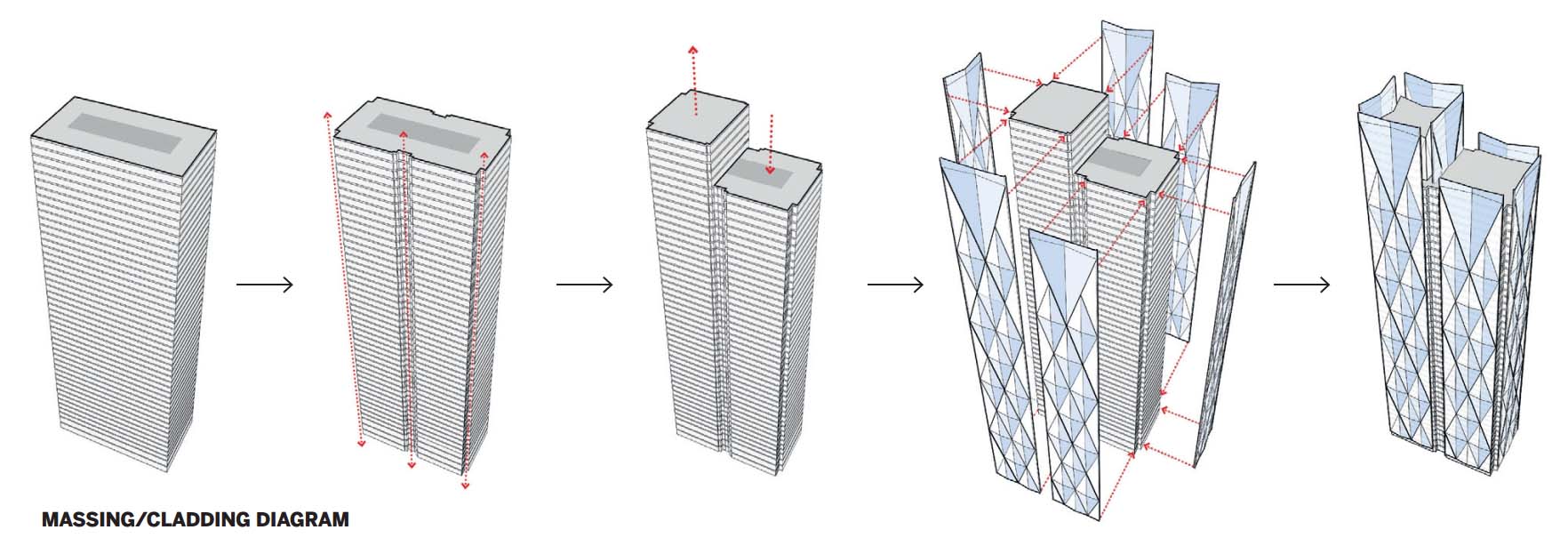
Image courtesy WilkinsonEyre
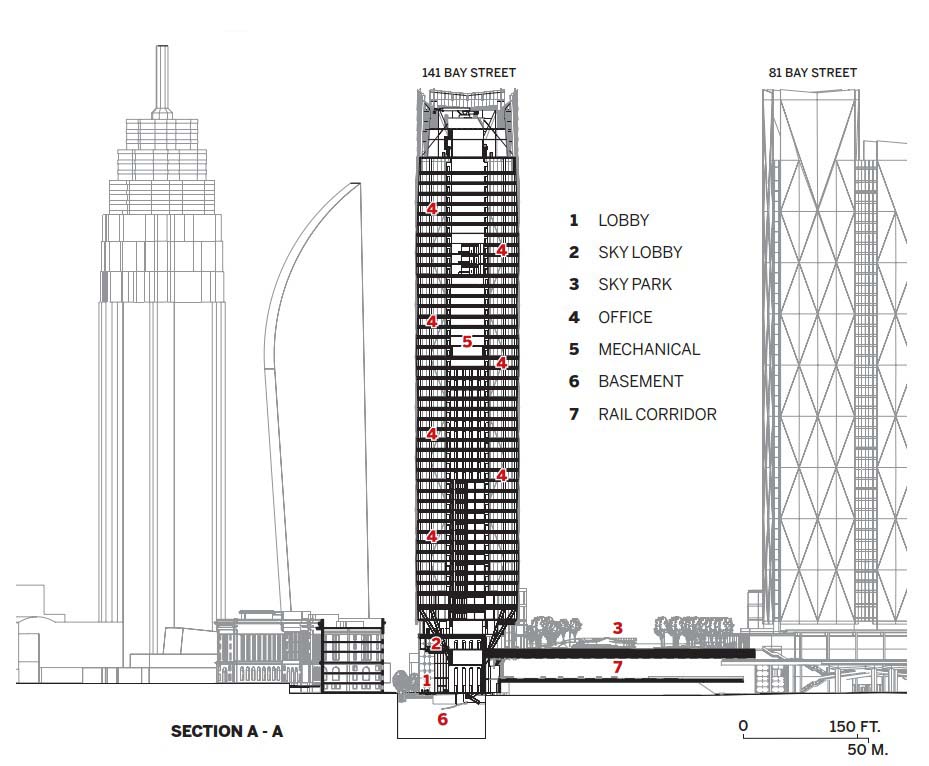
Image courtesy WilkinsonEyre
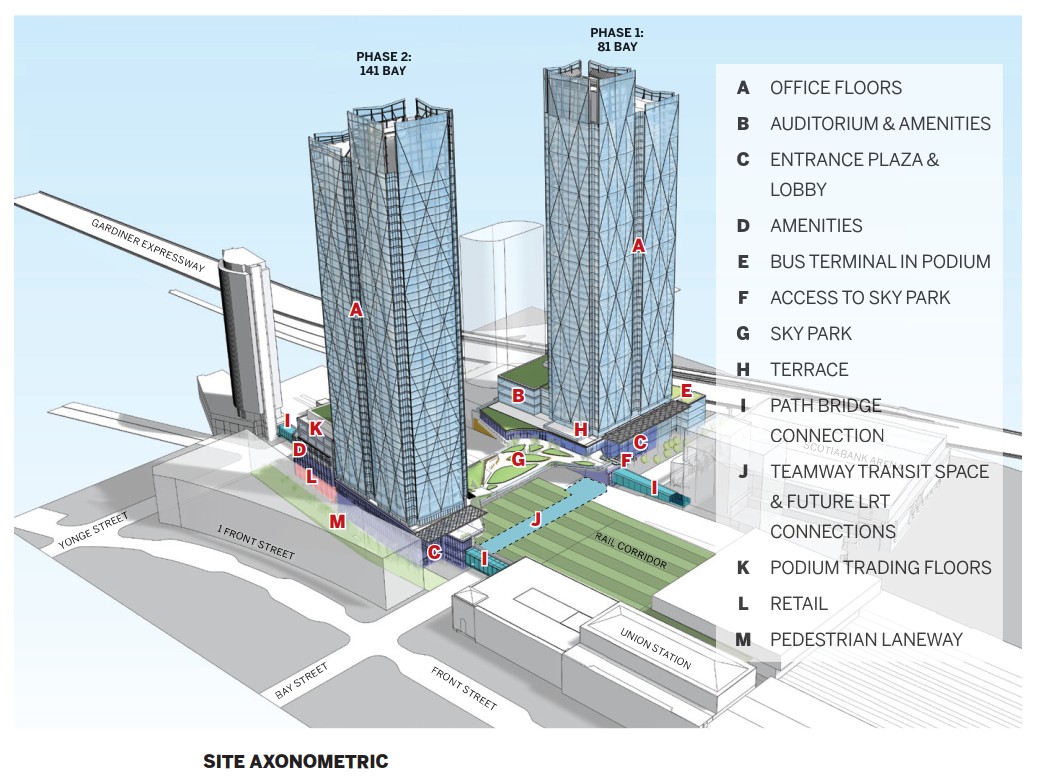
Image courtesy WilkinsonEyre
Credits
Architect:
WilkinsonEyre
Executive Architect:
Adamson Associates Architects
Consultants:
BPA (services); Read Jones Christoffersen (structural); Mulvey Banani Consulting Engineers (electrical, ICT, AV, lighting); HMA Consulting (building controls); Entuitive (building envelope); DTAH, Public Work (landscape)
General Contractor:
Ellis Don
Owner:
La Caisse, Hines
Size:
3 million square feet
Cost:
Withheld
Completion:
September 2021 (Phase I); July 2026 (Phase II, projected)
Sources
Structural Steel Nodes:
Cast Connex
Curtain Wall:
Harmon, CGI Contract Glaziers, Novum Structures
Metal Panels:
Flynn, Kingspan
Glazing:
Viracon, Finnglass
Roofing:
Tremco, Sika, Henry/Bakor
Hardware:
Schlage, LCN, Von Duprin, CRL
Acoustical Ceilings:
Armstrong World Industries, Saint-Gobain
High-Prassure Laminate:
Wilsonart, Nevamar
Solid Surfacing:
Corian
Looking for quick answers on architecture and design topics?
Try Ask RECORD, our new smart AI search tool.
Ask RECORD →
Looking for a reprint of this article?
From high-res PDFs to custom plaques, order your copy today!