John Ronan Architects Designs Cultural and Education Hub for the Ayn Rand Institute in Austin
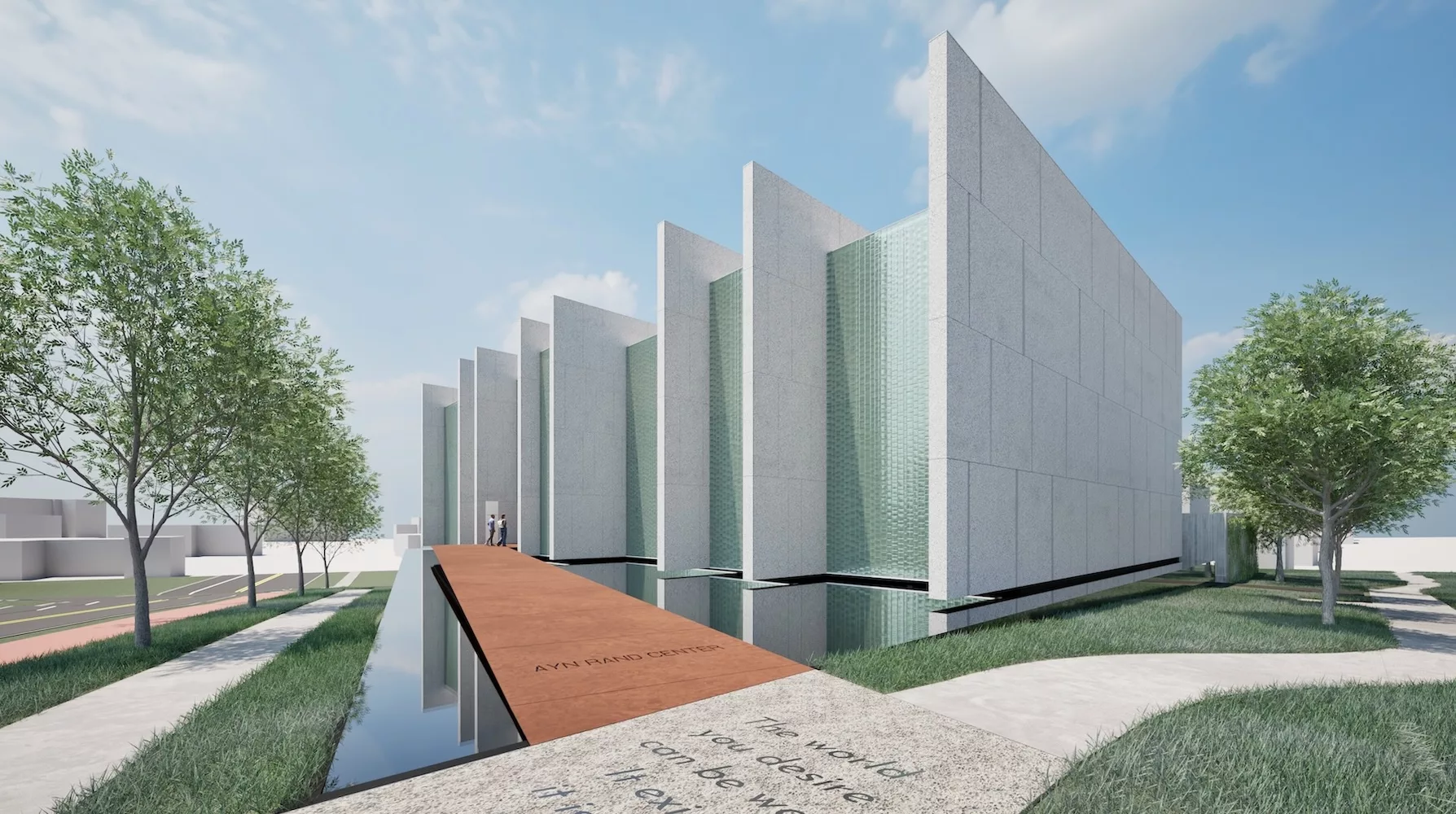
Rendering depicting entrance to the Ayn Rand Center in Austin.
Architects & Firms
An Orange County, California–based nonprofit dedicated to the promotion of the Objectivist movement has revealed the design for the forthcoming Ayn Rand Center, a roughly 27,100-square-foot cultural and educational hub that begins construction in mid-July in Austin’s West Campus neighborhood near the University of Texas. Funded by private donations, the Ayn Rand Institute (ARI)’s estimated $30 million new facility, which combines archives, educational and event spaces, and immersive exhibition areas, is designed by Chicago-based John Ronan Architects (JRA).
JRA founding principal John Ronan, who has taught at UT Austin but not designed in the city before, told RECORD that his involvement with the center came about in part because JRA’s 2011 headquarters for the Poetry Foundation in Chicago was a favorite building of a member of the architect selection committee. “They’re both literature-oriented, and very similar in size and program,” said Ronan. (The firm was also a finalist to design Chicago’s Obama Presidential Center; ultimately designed by Tod Williams Billie Tsien Architects, the 19-acre South Side campus is now open to the general public.)
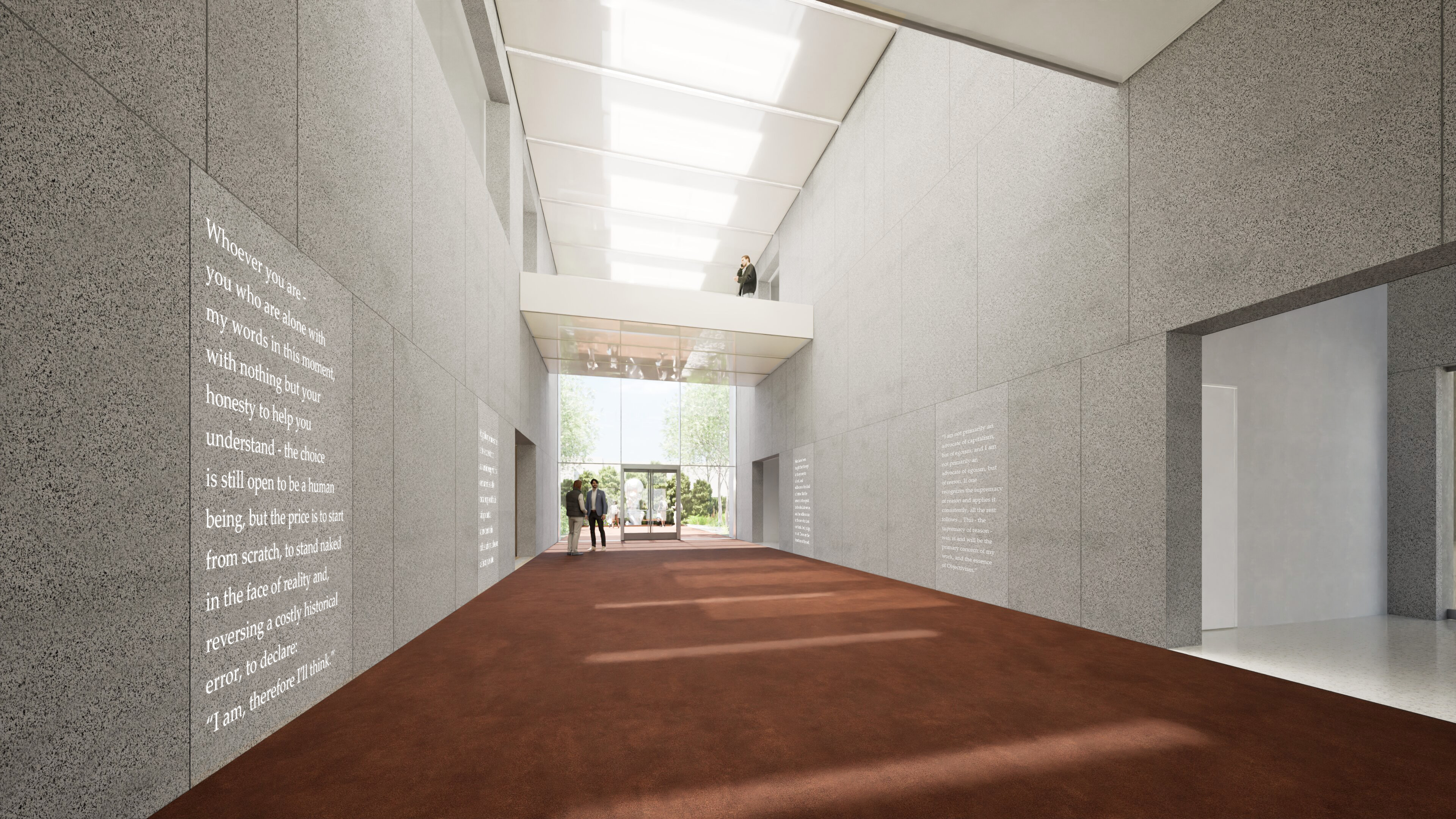
Main lobby view. Image courtesy JRA
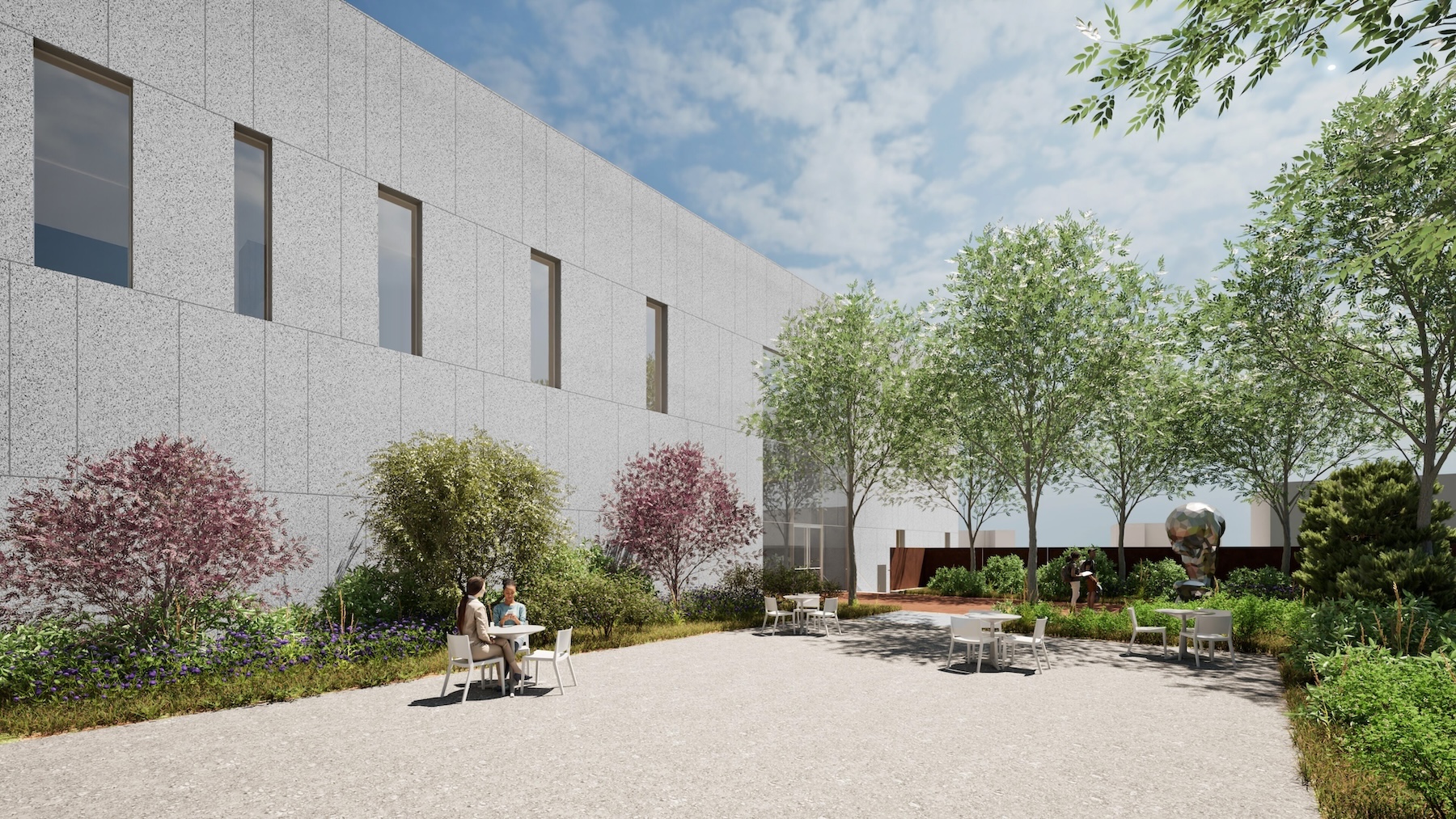
Garden view. Image courtesy JRA
The Ayn Rand Center will rise two stories (with underground parking) from a sloping, vacant lot—once the site of a dilapidated multifamily residential building—along a mostly commercial stretch of West Martin Luther King Jr. Boulevard that skirts the southern border of the UT Austin campus. The newly revitalized Blanton Museum of Art is just down the road. The surrounding neighborhood is dense and architecturally diverse—and largely populated by students and academics.
The UT Austin-adjacent location is a highly intentional one. “Austin is becoming an intellectual hub, with a lot of people moving there after Covid for different reasons” explains ARI president and CEO Tal Tsfany. “A lot of Objectivist thinkers are already in the city and we had a major donor help identify the land, so it made sense—one requirement was that the center be near UT, Austin’s intellectual center.”
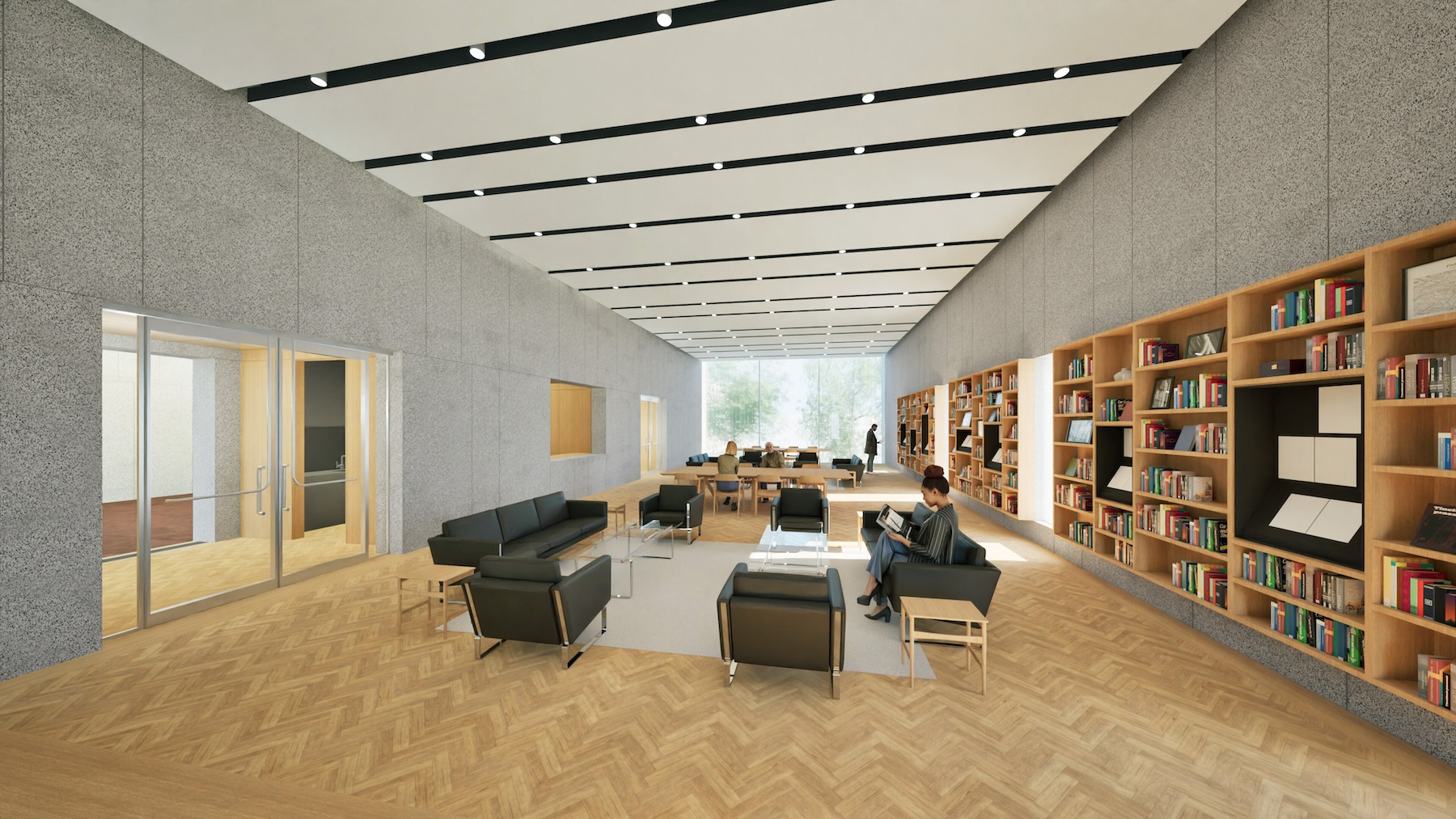
Salon-library view. Image courtesy JRA
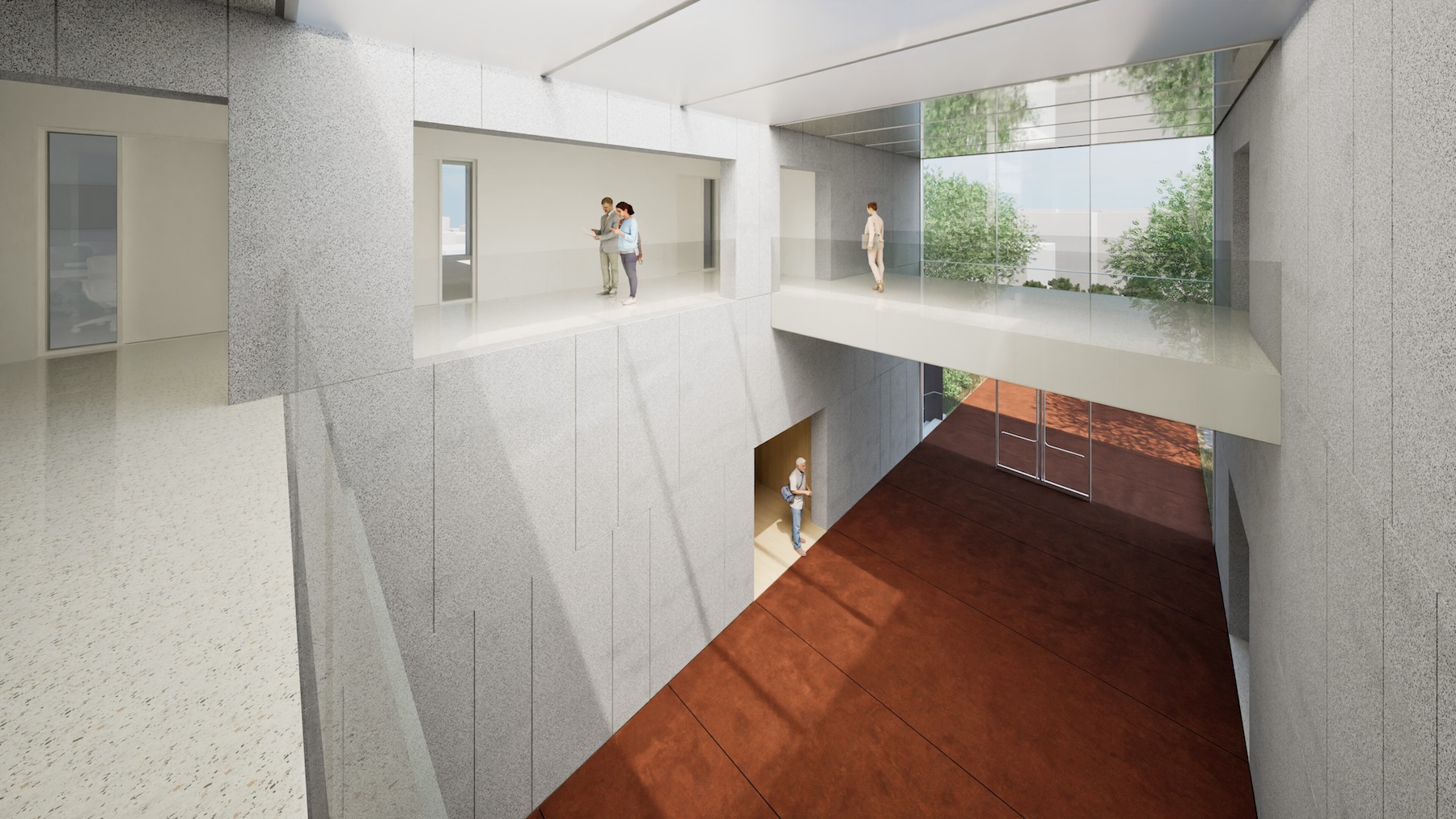
View of second-level bridge. Image courtesy JRA
When completed, the building will serve as the new headquarters for the ARI, which will fully relocate from Southern California. As Tsfany explains, some of the institute’s scholars, such as board member Tara Smith, already teach at UT Austin.
Flanked by a public garden at its rear, the two-story center is organized by heavy parallel walls that cantilever over a large reflecting pool at the front of the building; the reflecting pool doubles the perceived height of the relatively squat structure. “The center had to have a monumentality to it because Rand’s philosophies are very aspirational,” explained Ronan of the central design challenge to make a modest building appear heroically proportioned. “We were limited to a 30-foot-tall building because of zoning—but the reflecting pool makes it appear 72 feet tall.”
Ronan likens the soaring walls to “chapters of a book” that visitors move through to learn about the life and work of Saint Petersburg–born Rand. In the decades following her 1926 emigration to the United States from Russia, she achieved literary fame with best-selling novels such as The Fountainhead (1943), a paean to egoism and independence concerning a young architect named Howard Roark, and the dystopian Atlas Shrugged (1957), which addresses many of the tenets underpinning Objectivism, the philosophic system developed and promoted by Rand during her later years. Although polarizing due to their uncompromising rejection of collectivism and embrace of laissez-faire capitalism, both books and the ideas explored in them have had a lasting influence, particularly within the libertarian, entrepreneurial, and conservative movements. Rand, who herself did not join or endorse any specific political party and renounced the libertarian mindset, died in New York in 1982. The ARI was founded three years later to continue the promotion of her philosophy.
Looking for quick answers on architecture and design topics?
Try Ask RECORD, our new smart AI search tool.
Ask RECORD →
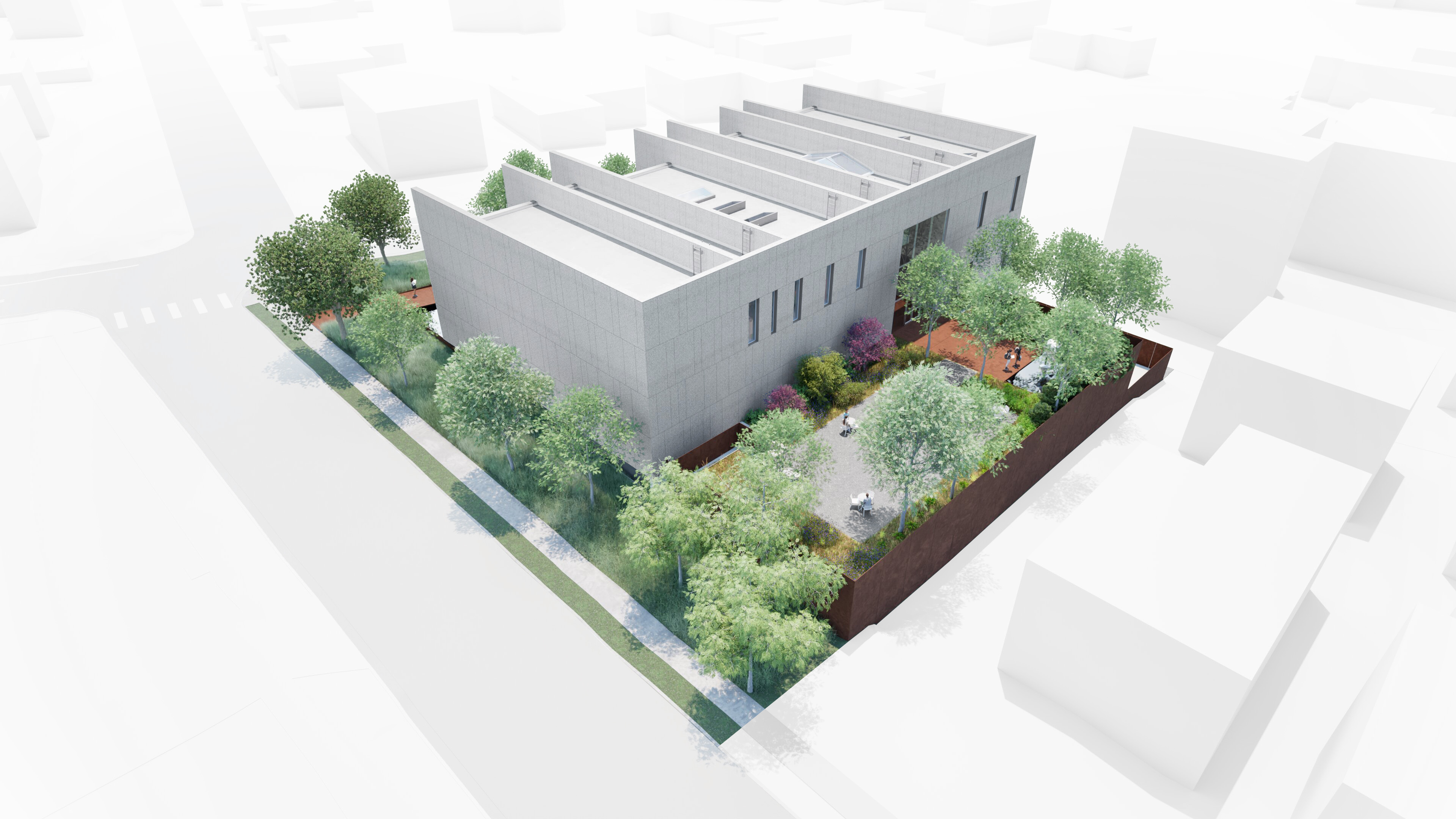
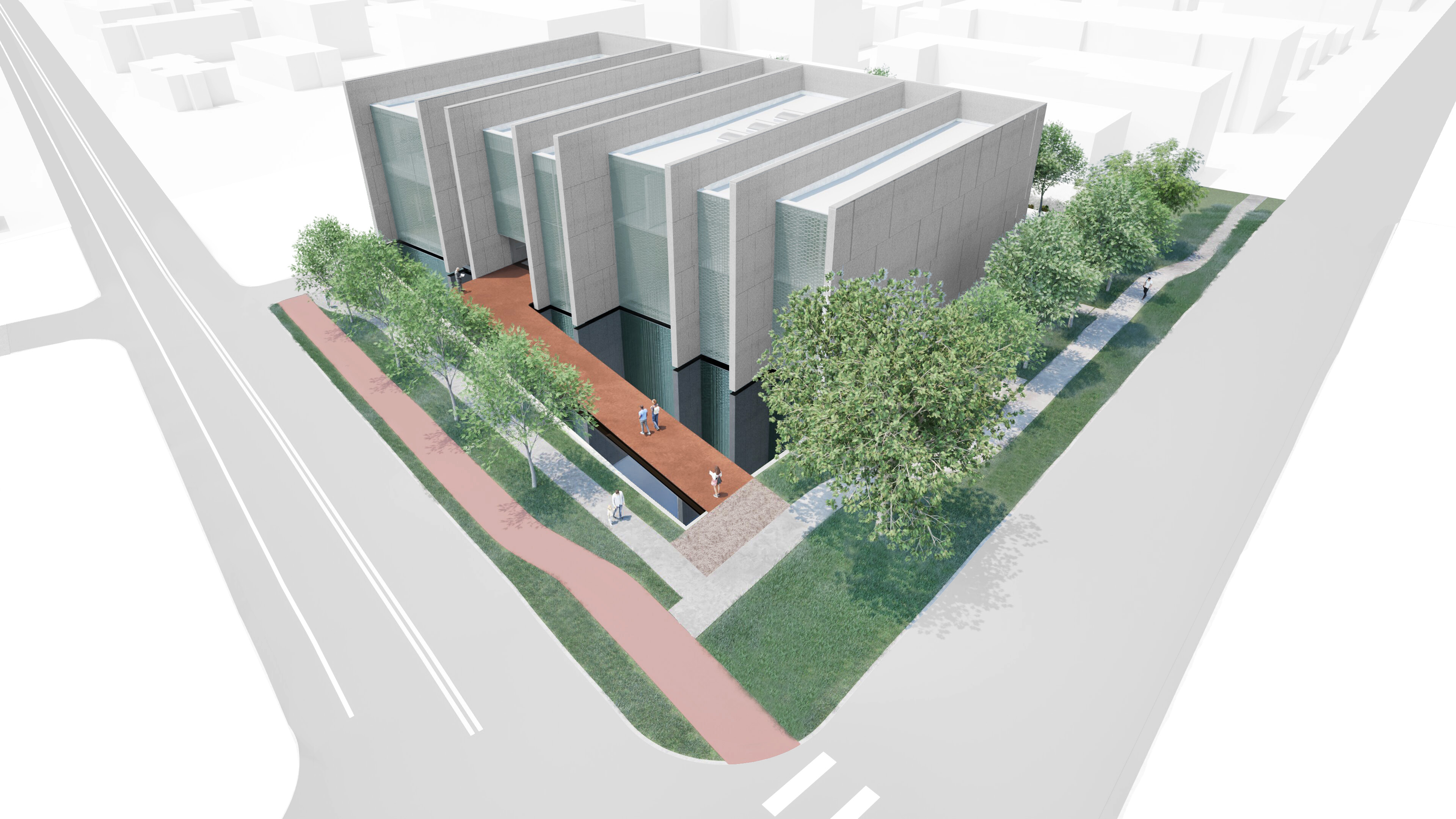
Aerial views; click to enlarge Images courtesy JRA
The materials of the Ayn Rand Center offer subtle nods to Rand’s novels. The stone cladding references the granite quarry that played a central role in The Fountainhead while the presence of rusted steel is meant to evoke the railroad industry that serves as the backdrop of Atlas Shrugged. The glass blocks that comprise the south facade are arranged in vertical bands, an allusion to the deckled page edges of a book.
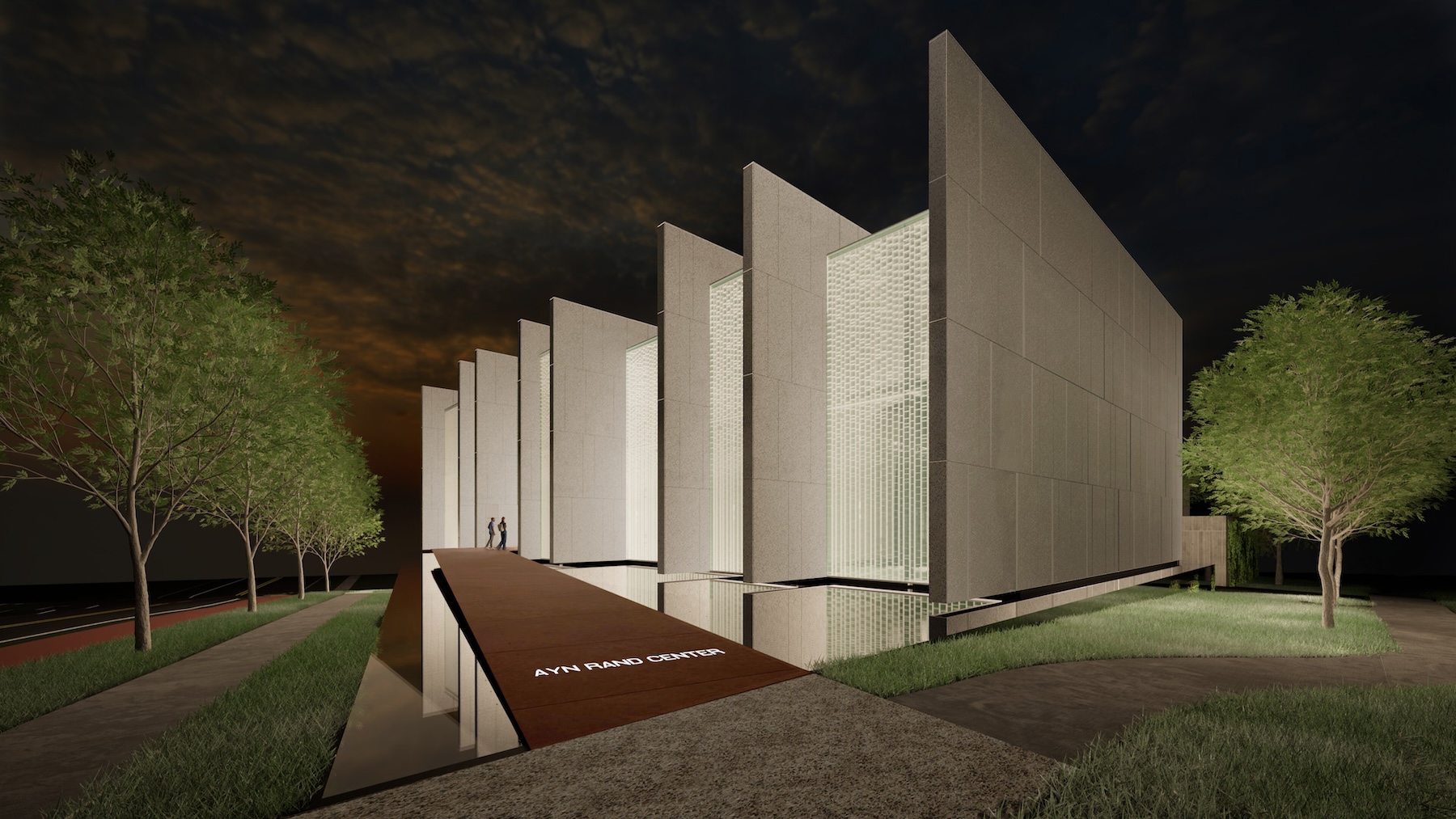
Nighttime view from entry plaza. Image courtesy JRA
The building’s public program is oriented around a daylit, double-height lobby that divides a 4,100-square-foot museum to the west and, to the east, a library and salon that will host lectures, debates, screenings, and other public events. There is also a ground-floor café. Visitors enter the lobby via an entrance bridge that slices across the reflecting pool; this linear circulation route continues through the lobby to the center’s garden, which Ronan says will be frequently used as an outdoor event venue.
On the upper level, are a trio of large classrooms along with conference and meeting spaces. Connected by a bridge directly opposite the lobby atrium are administrative offices, a podcast studio, staff support spaces, and nearly 800 square feet of archival storage. The educational spaces will serve as home campus to ARU, the institute’s learning initiative which offers programs “devoted to the study of Objectivism, the history of philosophy, and the intellectual skills required for independent thinking and effective communication,” according to a press release.
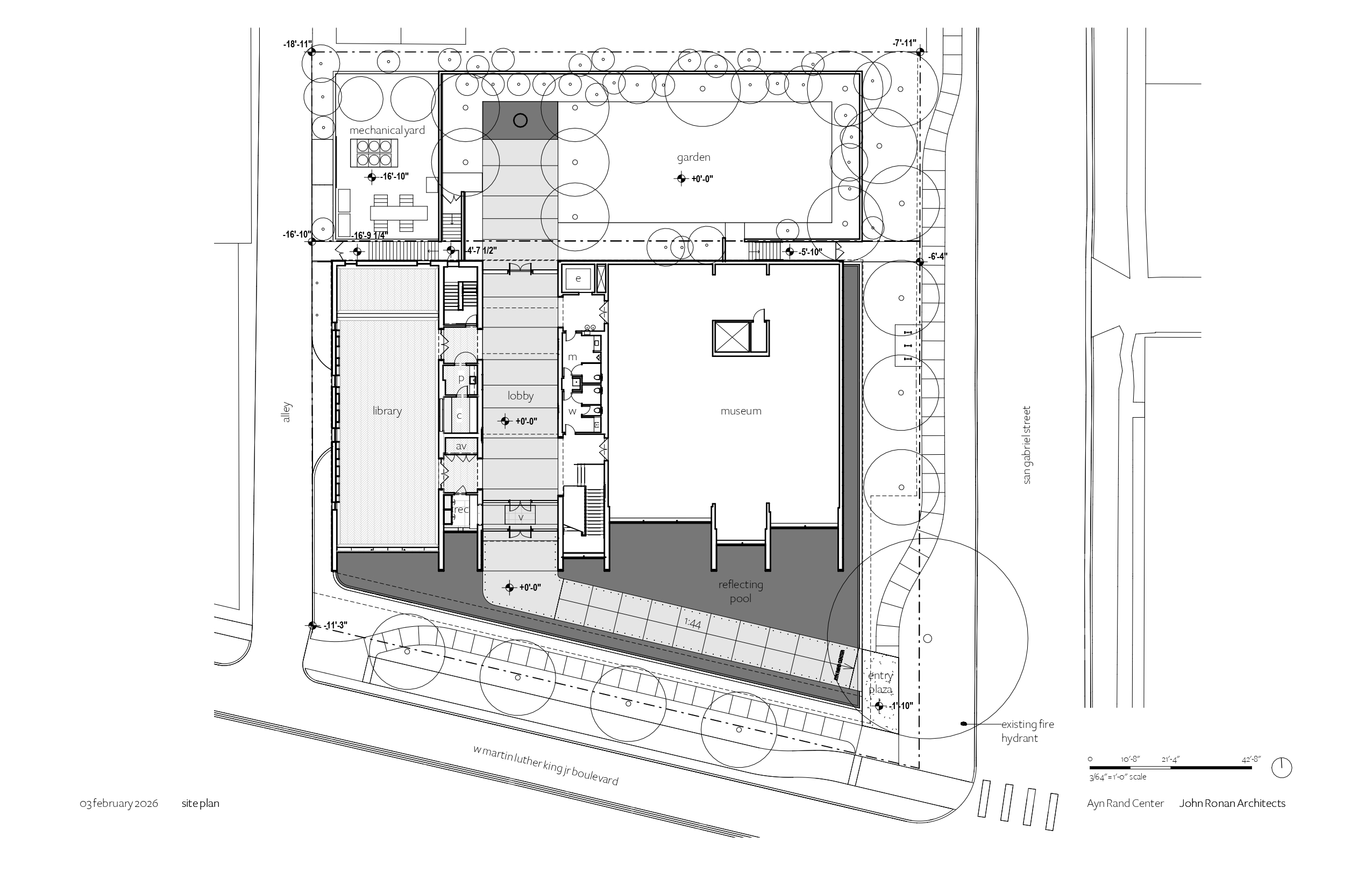
Site plan drawing. Image courtesy JRA
Although he said that he, like “every architect,” had read The Fountainhead, Ronan doesn’t consider himself a Rand adherent and had to study up on her philosophies when taking on the project. “I didn’t know much about Objectivism coming in,” he said.
The Ayn Rand Center is anticipated to open in 2028.
Looking for a reprint of this article?
From high-res PDFs to custom plaques, order your copy today!


