Architectural Record
search
cart
facebook twitter linkedin youtube
  • Sign In
  • Subscribe
  • Sign Out
  • My Account
Architectural Record
  • NEWS
    • Latest News
    • Awards
    • Interviews
    • Obituaries
    • Podcasts
      • Design:Ed Podcast
      • Sponsored Podcasts
  • OPINION
    • Book Reviews / Excerpts
    • Exhibition Reviews
    • Forum
  • EXCLUSIVES
    • Videos
    • Design Vanguard
    • Top 300 Firms
    • Sponsored Content
    • Sponsored eBooks
    • From the Archives
  • CONTINUING ED
    • Editorial Continuing Ed
    • CE Center
    • CE Academies
  • PROJECTS
    • Buildings By Type
    • Reuse & Renovation
    • Museums & Arts Centers
    • Colleges & Universities
    • Multifamily Housing
    • Interiors
    • Lighting
    • Kitchen & Bath
  • HOUSES
    • Record Houses
    • House of the Month
    • Featured Houses
  • PRODUCTS
    • Products by Category
    • Record Products of the Year
    • Latest Products
  • EVENTS
    • Dates & Events
    • Record on the Road
    • Innovation Conference
    • Sustainability in Practice
    • Women In Architecture
    • Webinars
    • Ad Excellence Awards
    • Submit an Event
  • CONNECT
    • Ask RECORD AI
    • Newsletters
    • Contact
    • Advertise
    • Editorial Calendar
    • Store
    • Customer Service
  • SUBMIT
    • Submission Guidelines
    • RECORD Competitions
  • MAGAZINE
    • Subscribe
    • My Account
    • Digital Edition
    • Current Issue
    • Firm Pass
    • Historic Archive
Architecture News

Bjarke Ingels Explains 'Court-Scrapers,' Robo-cars, and Mirrored Ceilings

At Architectural Record's annual Innovation Conference, the Bjarke Ingels Group founder presented his idea of 'Hedonistic Sustainability.'

By C. J. Hughes
November 4, 2011

Architects & Firms

Bjarke Ingels Group
Architects do a lousy job of selling their ideas to the general public, said Bjarke Ingels, on Thursday morning during his keynote address at Architectural Record’s annual Innovation conference in New York.
 
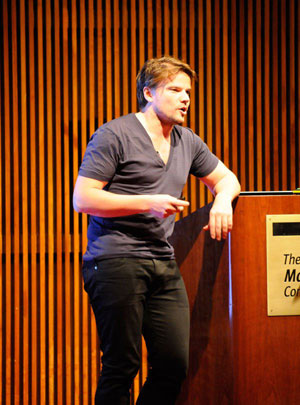
Bjarke Ingels
Photo © Laurie Meisel


They need to “find ways to present their ideas or concerns in words that are so clear that non-architects will actually take an interest in them,” said Ingels, founding partner of the Bjarke Ingels Group (BIG), a Copenhagen-based architecture firm.

He spoke to a packed house in the auditorium at the McGraw-Hill Building in Midtown, Manhattan, where the ninth annual conference had drawn 400 attendees. Titled “Crossing Borders and Disciplines,” the day-long event also featured four panel discussions.

“Doing Architecture Abroad” included representatives of global firms of various sizes including Eugene Kohn of Kohn Pedersen Fox, Audrey Matlock, and Thom Mayne of Morphosis. “Crossing Into Product Design” brought together Nicholas Holt of SOM, Alexander P. Lamis of Robert Stern’s office, and Hilary Sample of MOS Architects. A discussion about “Team Collaboration” paired Mahadev Raman of ARUP with design firm partners Charles Renfro of Diller Scofidio+Renfro and Sylvia J. Smith of FXFOWLE Architects. And “Crossing Disciplines” featured Michael Bierut of Pentagram, James Carpenter, Michel Rojkind, and SHoP Architects’ Corie Sharples. TED Conference founder Richard Saul Wurman closed the day with a special guest lecture.

Wurman had presented the first Wall Street Journal Innovator of the Year award in architecture to Ingels the weekend before, and when the Danish architect took the stage to deliver his opening keynote, the World Architecture Festival had just proclaimed his 8 House in Copenhagen World Housing Building of the Year. Officially titled “Hedonistic Sustainability, Social Infrastructure and Public Participation Extreme,” the Innovation conference address, which Ingels, 37, delivered energetically in a black V-neck T-shirt, was at times like a motivational speech about how to make sustainable buildings fun.

“The Protestant idea that it has to hurt to be good,” is wrong, Ingels said and showed a photo of world leaders with pained looks on their faces at a recent United Nations conference on climate change. “As you can see, it wasn’t a party,” he remarked and got a big laugh.

Heeding his own advice, Ingels embarked on a highly visual and entertaining tour of his often whimsical body of work, using images of houses atop parking garages; mirrored ceilings; and giant silver balloons.

Presenting his work with Audi, the auto manufacturer, Ingels mused about what role cars might play in the city of the future, vis a vis how they move down streets. For decades, he says, most technological advances among car-makers were focused on improving navigation. But as cities turn their backs on autos, those manufacturers might now want to consider different ways of propelling the cars in cleaner, more pedestrian-friendly ways, including, perhaps, robotically. After all, he said, robots essentially already pilot subway trains and airplanes.

This could be accomplished using photovoltaic cells embedded in pavement, which could also be used to shut down certain streets if crowds were suddenly to gather there; animation showing how this redirected traffic might look used the theme from the 1980s TV show Knight Rider, which famously featured a driverless car. He announced that a prototype of the photovoltaic pavers would be on view in an Audi-sponsored pavilion at this year’s Design Miami.

In the “public participation” part of his talk, Ingels spoke about the city hall his firm designed for Tallinn, Estonia. Its main chamber has a mirrored and angled ceiling that functions as a “democratic periscope” to reflect the meetings of civic leaders to the public in a central plaza outside.

Those reflected images offer a “perfect overview of the city council, to see people absent, or sleeping, or doing dirty deals,” Ingels said. That brought more laughter.

As a coda, Ingels also previewed the 600-unit apartment building he’s designed for developer Durst Fetner on West 57th Street in Manhattan. Groundbreaking for the building, Ingels’s first in New York, will take place in March, he said.

And true to form, it’s offbeat, with a pyramid shape. And instead of placing a courtyard in its center, it’s been relocated to a cavity in an exterior wall, on its sunny 

southern facade. A “court-scraper,” he called it.
 
KEYWORDS: innovation conference

Share This Story

Looking for a reprint of this article?
From high-res PDFs to custom plaques, order your copy today!

Post a comment to this article

Report Abusive Comment

Subscription Center
  • Create an Account
  • Start a Subscription
  • Manage My Account
  • Sign Up for Newsletters
  • Visit Customer Service
  • Update Preferences

More Videos

Sponsored Content

Sponsored Content is a special paid section where industry companies provide high quality, objective, non-commercial content around topics of interest to the Architectural Record audience. All Sponsored Content is supplied by the advertising company and any opinions expressed in this article are those of the author and not necessarily reflect the views of Architectural Record or its parent company, BNP Media. Interested in participating in our Sponsored Content section? Contact your local rep!

close
  • TAMLYN XtremeTrim Exterior Trim
    Sponsored byTamlyn

    Designing Cleaner Panel Facades: Why Exterior Trim Details Matter

  • Building with Vapor Barriers
    Sponsored byReef Industries, Inc.

    Vapor Barriers Help Control Moisture in Tighter Building Designs

  • Duct Interior with Prodeq System
    Sponsored byHenry, a Carlisle Company

    Designing Resilient Water Containment Systems

DESIGN:ED Podcast
Listen to Architectural Record’s DESIGN:ED Podcast

Events

June 10, 2026

Rethinking Stormwater – The Power of Porous Paving

Credits: 1 AIA LU/HSW; 1 AIBD P-CE; 0.1 ICC CEU

Learn how porous paving systems support stormwater management, reduce heat island effects, and enhance sustainable site design performance.

June 11, 2026

Very Early Warning Fire Detection for Mission-Critical Facilities

Credits: 1 AIA LU/HSW; 1 AIBD P-CE; 0.1 ICC CEU

Examine advanced fire detection strategies that support uptime and enhance safety in data centers and other mission-critical facilities.

View All Submit An Event

Products

2026 Architect's Square Foot Costbook

2026 Architect's Square Foot Costbook

See More Products

Popular Stories

Practice Matters illustration

What’s in a (Firm’s) Name? Thinking About Succession and Legacy

Coronado Bridge

The Architect’s Guide to San Diego

Practice Matters illustration

By the Numbers: Counting America's Architects

Riverdale House by Studio Lau

Riverdale House by Studio Lau

KRESA by DLR

In Kalamazoo, DLR Group Completes a Mass-Timber Hub for Career and Technical Education Programs

Broader Sustainability of CMU - Free Webinar - May 21, 2026

Related Articles

  • Newsmaker: Bjarke Ingels on the Smithsonian

    See More
  • Exhibition Review: Bjarke Ingels' Hot to Cold at the National Building Museum

    See More
  • BIG | Bjarke Ingels Group

    See More
×

The latest news and information

#1 Source for Architectural Design, News and Products

SUBSCRIBE
  • RESOURCES
    • Advertise
    • Contact Us
    • Submit
    • Store
  • ACCOUNT CENTER
    • Create an Account
    • Start a Subscription
    • Manage My Account
    • Sign Up for Newsletters
    • Visit Customer Service
    • Update Preferences
  • PRIVACY
    • PRIVACY POLICY
    • TERMS & CONDITIONS
    • DO NOT SELL MY PERSONAL INFORMATION
    • PRIVACY REQUEST
    • ACCESSIBILITY
  • SERVICES
    • Marketing Services
    • Reprints
    • Market Research
    • List Rental
    • Survey/Respondent Access
  • STAY CONNECTED
    • Linkedin
    • Facebook
    • Instagram
    • YouTube
    • X (Twitter)

Copyright ©2026. All Rights Reserved BNP Media, Inc. and BNP Media II, LLC.

Design, CMS, Hosting & Web Development :: ePublishing