Newsmaker: Bjarke Ingels on the Smithsonian
Architects & Firms

 |
|
Photo © Laurie Meisel
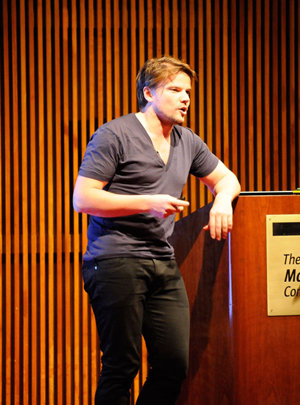
Bjarke Ingels presents at Architectural Record’s 2011 Innovation Conference.
|
The architects will have to wrestle with remarkably disparate typologies, from High Victorian to Brutalist, on this much-celebrated site. But Ingels says he has no plans to interfere with the treasured national symbols; his assignment is to make what’s already there more intuitive and accessible.
Beating out a slew of architects, BIG’s commission is a major coup. The firm has no permanent built work in the U.S. and first opened an office in New York City about two years ago. BIG currently has no financial restrictions, though the Smithsonian says it will start a fundraising campaign once the designs are fleshed out next year.
Architectural Record: What’s the scope of the project? What are the Smithsonian’s major concerns?
Bjarke Ingels: We went to the table with a lot of research, which gave us some direction for the project. We found that the more successful institutions have entrances right on the Mall, and the less visited buildings don’t. We have to reorient the institutions so they’re all accessible from the Mall.
Another issue that has been on the Smithsonian’s radar for a long time is the lack of visibility of the underground museums, the Sackler Gallery and the National Museum of African Art. Shortly after the underground museums, classrooms, and offices were completed in the late-1980s, the Smithsonian started looking at ways to make the entrances more welcoming and more blatant. When we visited, we went down one of the big staircases, and there was a man sleeping on a couch at the bottom. We took a photo and used it in our presentation to the jury to demonstrate the potential of the space.
What’s your plan for the underground spaces?
One of the main objectives is to give these amazing collections and activities a much stronger presence on the Mall. At the same time, it is going to be an exercise in stealth. We don’t want to get in an architectural pissing match with the existing buildings. Whatever we do must be much more visible and intuitively attractive for people arriving from the Mall, but at the same time, it has to blend in with the very different architectural styles of the buildings around it.
What do you have in mind for the Smithsonian Castle?
The majority of people go to the Castle to use the bathrooms. It’s basically a completely overblown toilet. It could have more exciting functions; it could become a gateway to the whole institution. The Castle is the only building that pokes into the axis of the Mall, so in that sense, there is a great potential for attracting people to the building. There’s a great desire from everybody to have it be more than a beautiful bathroom.
The Castle garden is essentially the roof of the museums underneath it. We’re looking into lifting up and removing some pieces of the garden to reveal the exhibitions and activities underneath. With the majority of the program underground, there is a great potential to pop out and create appearances in various locations. In the end, we’re not going to try to wedge in another building. It’s a question of making the existing spaces more manifest and exciting.
Can you tell me more about the plan for the underground circulation?
If there’s one thing they have lots of, it’s subterranean square footage. But we don’t want to end up with a giant molehill. It’s a matter of more intuitive connectivity and making the spaces more inviting.
Are they going to let you tinker with the main lawn?
We haven’t been granted any license to mess with heritage or other planning elements, but the idea right now is to think big, and then see what is possible in reality.
What’s your plan for the Hirshhorn?
I’m a great fan of Gordon Bunshaft. The Hirshhorn is a great piece of architecture. The idea of the elevated donut—creating a public square at its base—is very nice. But the building is completely walled in, which has incarcerated it from any interaction with the rest of the Smithsonian. Some careful aperture adjustments—by removing some of the walls—could make the idea behind the Hirshhorn even stronger.
Is the Smithsonian open to tearing down some of the walls around the Hirshhorn?
It is going to be precision surgery because I’m the last person who would want to mess with Bunshaft’s ghost. The same goes for all the other buildings. We’re going to be walking through a political minefield of concerns for preservation. I don’t want to assume anything, but so far in our meetings, the Smithsonian seems interested in creating the most welcoming, inviting, hospitable, and successful institution that they can. They’re an incredibly considerate and ambitious client.
Which of your past projects did the committee look to?
For whatever reason, all our work in Denmark right now is underground. The Danish Maritime Museum, our first museum, is opening this summer. It’s located next to the Kronborg castle, a UNESCO world heritage site. The museum is submerged to preserve the site. At first, the Maritime Museum seemed like an exercise in stuffing some program into a preexisting pit. But it turned out to be a rather wonderful underground public space that is completely open to the sky. The gallery spaces are completely bathed in daylight.
We also recently completed a sports hall and gathering space at my old high school in Copenhagen—it’s three or four underground buildings that look like wooden molehills in the schoolyard. So, we have experience tunneling around sites.
Many of the same conditions are present in the Smithsonian. The Smithsonian wants, on the one hand, to be respectful towards the entire existing campus, and on the other hand, to become much more blatantly attractive to people coming from the Mall. These are both exercises in trying to integrate with a historically charged context and trying to improve the overall performance of a larger complex with very specific interventions. We’re very much aware that this is a greatly sensitive historical site, part of the national heritage of the United States, so we have to tread with care.
Looking for a reprint of this article?
From high-res PDFs to custom plaques, order your copy today!