Architectural Record
search
cart
facebook twitter linkedin youtube
  • Sign In
  • Subscribe
  • Sign Out
  • My Account
Architectural Record
  • NEWS
    • Latest News
    • Awards
    • Interviews
    • Obituaries
    • Podcasts
      • Design:Ed Podcast
      • Sponsored Podcasts
  • OPINION
    • Book Reviews / Excerpts
    • Exhibition Reviews
    • Forum
  • EXCLUSIVES
    • Videos
    • Design Vanguard
    • Top 300 Firms
    • Sponsored Content
    • Sponsored eBooks
    • From the Archives
  • CONTINUING ED
    • Editorial Continuing Ed
    • CE Center
    • CE Academies
  • PROJECTS
    • Buildings By Type
    • Reuse & Renovation
    • Museums & Arts Centers
    • Colleges & Universities
    • Multifamily Housing
    • Interiors
    • Lighting
    • Kitchen & Bath
  • HOUSES
    • Record Houses
    • House of the Month
    • Featured Houses
  • PRODUCTS
    • Products by Category
    • Record Products of the Year
    • Latest Products
  • EVENTS
    • Dates & Events
    • Record on the Road
    • Innovation Conference
    • Sustainability in Practice
    • Women In Architecture
    • Webinars
    • Ad Excellence Awards
    • Submit an Event
  • CONNECT
    • Ask RECORD AI
    • Newsletters
    • Contact
    • Advertise
    • Editorial Calendar
    • Store
    • Customer Service
  • SUBMIT
    • Submission Guidelines
    • RECORD Competitions
  • MAGAZINE
    • Subscribe
    • My Account
    • Digital Edition
    • Current Issue
    • Firm Pass
    • Historic Archive
Architecture News

The Colony at MoMA PS1
By William Hanley
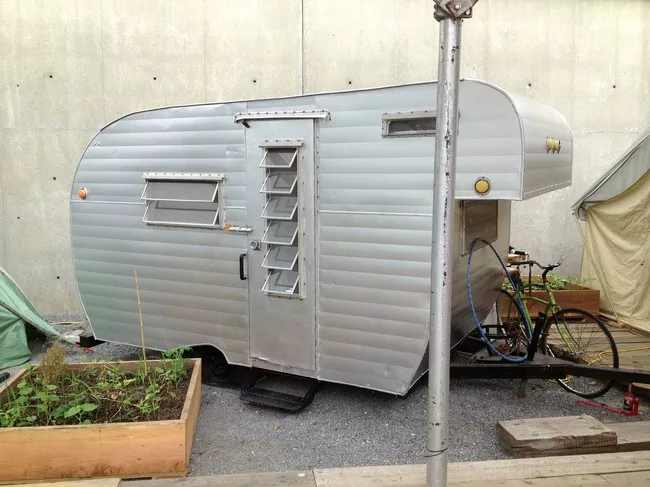
One of the vintage-looking trailers in the Colony, a temporary communal dwelling at MoMA PS1 designed by a77.
The Colonists
One of the vintage-looking trailers in the Colony, a temporary communal dwelling at MoMA PS1 designed by a77.
Photo © Architectural Record
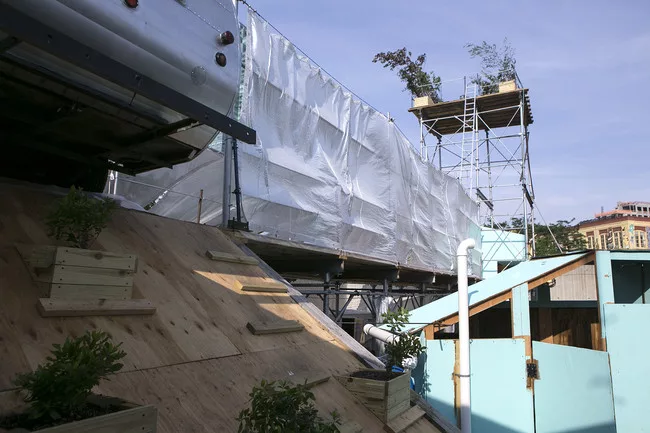
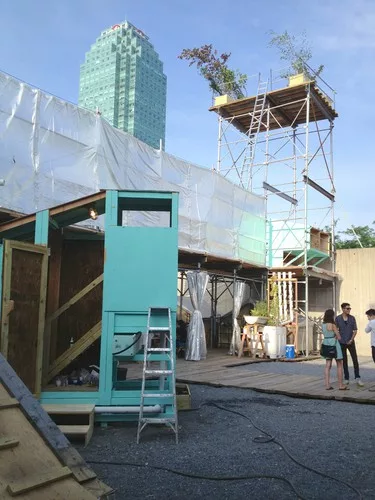
The Colony, designed by Argentinian firm a77, at MoMA PS1.
The Colonists
The Colony, designed by Argentinian firm a77, at MoMA PS1.
Photo © Architectural Record
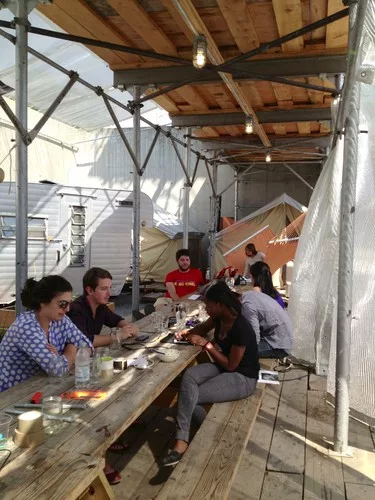
Students working at the Colony.
The Colonists
Students working at the Colony.
Photo © Architectural Record
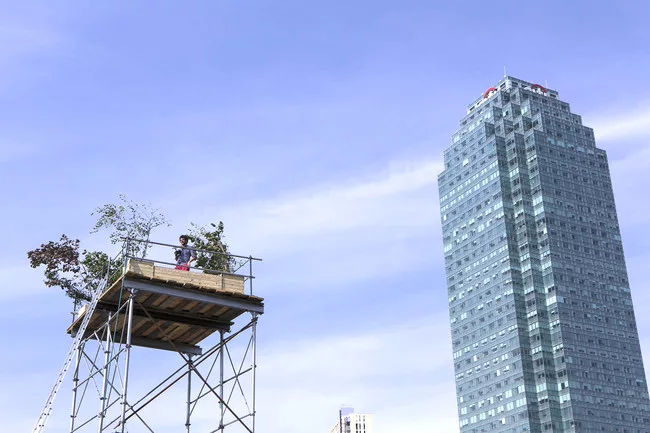
A trailer perched on the second floor of the the Colony's scaffolding structure.
The Colonists
A trailer perched on the second floor of the the Colony's scaffolding structure.
Photo © Charles Roussel
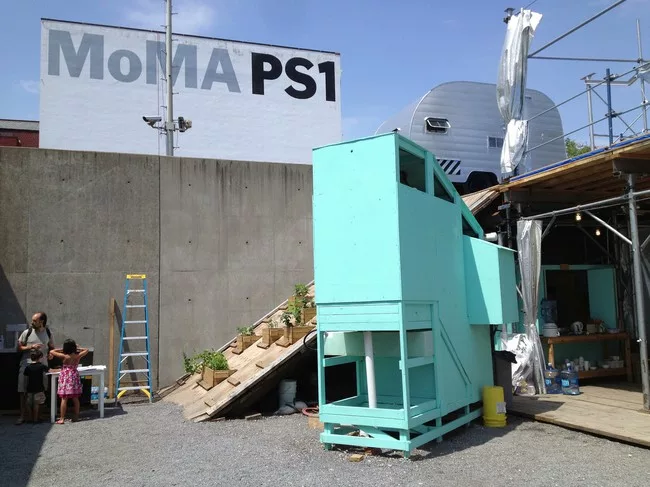
The Colony occupies an annex inside MoMA PS1's courtyard.
The Colonists
The Colony occupies an annex inside MoMA PS1's courtyard.
Photo © Architectural Record
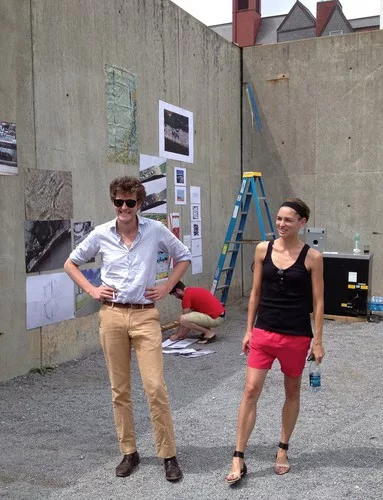
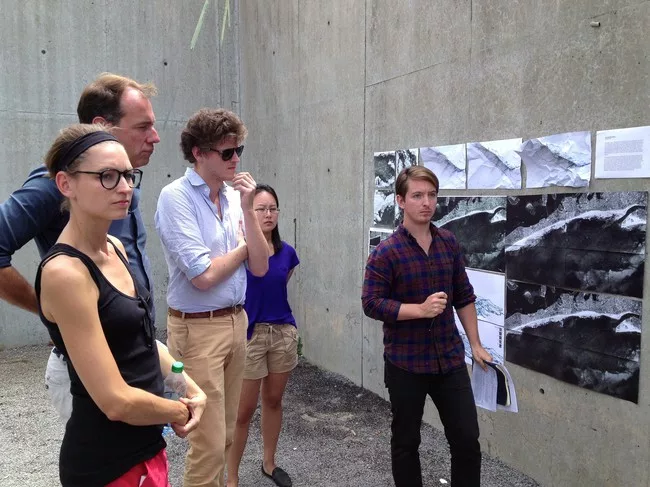
Visiting critics Sam Chermayeff and Johanna Meyer-Grohbrügge of the Berlin firm June14 Meyer-Grohbrügge&Chermayeff.
The Colonists
Visiting critics Sam Chermayeff and Johanna Meyer-Grohbrügge of the Berlin firm June14 Meyer-Grohbrügge&Chermayeff.
Photo © Architectural Record
From left to right: Visiting critics Johanna Meyer-Grohbrügge, Niklas Maak, and Sam Chermayeff stand with students Yoonjee Koh and Stefan di Leo, who are living at the Colony at MoMA PS1.
The Colonists
From left to right: Visiting critics Johanna Meyer-Grohbrügge, Niklas Maak, and Sam Chermayeff stand with students Yoonjee Koh and Stefan di Leo, who are living at the Colony at MoMA PS1.
Photo © Architectural Record
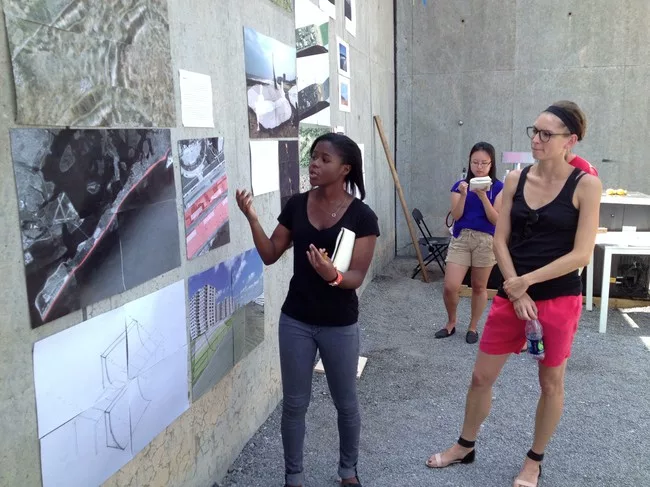
Catherine Joseph presents her plan to redesign the Rockaway peninsula.<br />
The Colonists
Catherine Joseph presents her plan to redesign the Rockaway peninsula.
Photo © Architectural Record
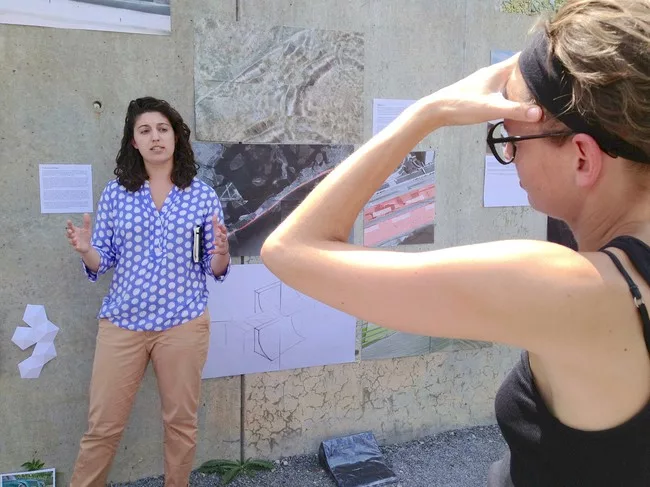
Kristen Williams presents her project.
The Colonists
Kristen Williams presents her project.
Photo © Architectural Record
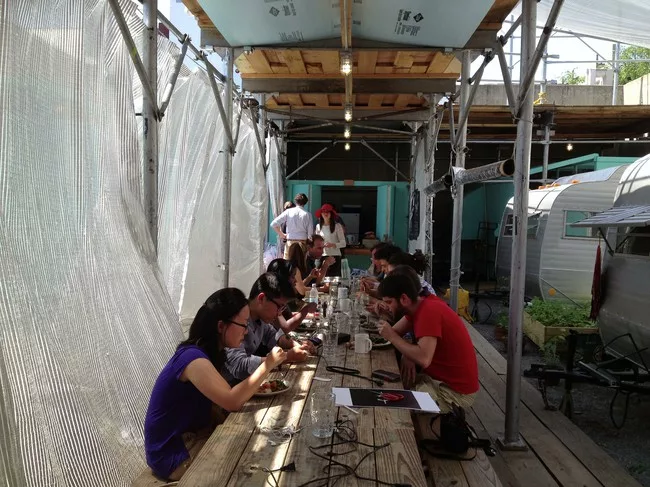
Students and guests have lunch following the mid-residency critique.
The Colonists
Students and guests have lunch following the mid-residency critique.
Photo © Architectural Record
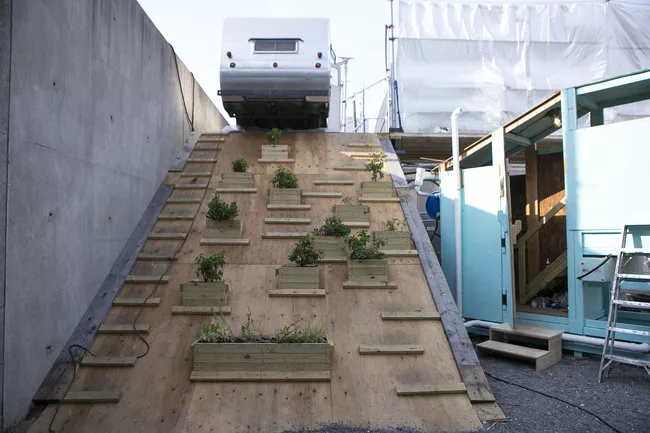
The Colony's aquaponic garden.
The Colonists
The Colony's aquaponic garden.
Photo © Architectural Record
The Colony by a77 at MoMA PS1.
The Colonists
The Colony by a77 at MoMA PS1.
Photo © Charles Roussel
The Colony by a77 at MoMA PS1.
The Colonists
The Colony by a77 at MoMA PS1.
Photo © Charles Roussel
One of the vintage-looking trailers in the Colony, a temporary communal dwelling at MoMA PS1 designed by a77.
The Colony, designed by Argentinian firm a77, at MoMA PS1.
Students working at the Colony.
A trailer perched on the second floor of the the Colony's scaffolding structure.
The Colony occupies an annex inside MoMA PS1's courtyard.
Visiting critics Sam Chermayeff and Johanna Meyer-Grohbr&#252;gge of the Berlin firm June14 Meyer-Grohbr&#252;gge&amp;Chermayeff.
From left to right: Visiting critics Johanna Meyer-Grohbr&#252;gge, Niklas Maak, and Sam Chermayeff stand with students Yoonjee Koh and Stefan di Leo, who are living at the Colony at MoMA PS1.
Catherine Joseph presents her plan to redesign the Rockaway peninsula.<br />
Kristen Williams presents her project.
Students and guests have lunch following the mid-residency critique.
The Colony's aquaponic garden.
The Colony by a77 at MoMA PS1.
August 15, 2013

Shortly after MoMA PS1 opened for the day on Sunday, a few of the first visitors to enter the courtyard at the New York City contemporary art space looked surprised when they turned a corner and stumbled on a small encampment. Four metal-sided trailers were parked underneath a spartan scaffolding structure hung with silvery curtains that reflected the bright early-afternoon sun. Another mobile unit was perched on the structure’s second level opposite a crow's nest-like tower. Below, a group of students hunched over laptops at a long wooden table while others finished pinning up a series of drawings on the courtyard’s high concrete walls.

“Their first question is always, ‘Wait, you guys live here?’” said Catherine Joseph, a second-year M.Arch candidate at Cornell University, explaining a typical interaction with perplexed visitors. And for the moment, the answer is yes.

Along with four other students from Cornell and three from Harvard’s Graduate School of Design, Joseph is participating in a two-week residency at the Colony, a temporary communal habitation designed by Argentinian firm a77 and built in the courtyard at MoMA PS1, just around the corner from CODA’s Party Wall installation. Throughout the summer, the cluster of trailers has played host to a series of short residencies, housing filmmakers, Icelandic artists, and now, architecture students.

During their stay, Joseph and her fellow residents have each been asked to develop a plan to protect the Rockaway peninsula, a stretch of coastal New York City neighborhoods and urban beaches that were badly damaged by Hurricane Sandy. “If you look at the response to the flooding so far, it looks almost like a military action, with concrete walls and guard rails,” says journalist and architecture critic Niklas Maak, who with Frank Barkow of the Berlin firm Barkow Leibinger, is leading the exercise. Rather than fighting the water, Maak has encouraged the students to devise softer strategies for protecting neighborhoods and to speculate about new ways of living along the coastline. “We asked them to create a zone of interference between the sea and buildings,” he says, “one that would protect the buildings from being washed away but also create a new kind of communal space.”

The project will culminate with an exhibition that opens at MoMA PS1 on August 16. But on Sunday, the students were gearing up for a mid-residency review. As they finished hanging their work, a group of visiting critics arrived at the camp. Maak and the students were joined by Berlin-based architect Arno Brandlhuber as well as Johanna Meyer-Grohbrügge and Sam Chermayeff, the young principals of the Berlin firm June14 Meyer-Grohbrügge&Chermayeff. After brief introductions, the troupe of visitors moved from presentation to presentation along the concrete wall as the students explained their ideas in succession.

The proposals ranged from canals cut through the peninsula that use a concrete mix activated by floodwater to self-reinforce, to sponge-like formations on the beach designed to soften storm surges, to a series of artificial rock formations modeled on the secret lairs of James Bond villains. Meyer-Grohbrügge and Chermayeff, chain smoking but attentive in their sunglasses, coaxed students to better define their projects, several of which were still largely unformed halfway through the residency. Brandlhuber goaded, encouraging bold moves. “Society, after a disaster, always wants to go back to what was there before,” he said. “This should be an evolution.”

His demand for big ideas fit the concept behind the Colony. The encampment was orchestrated by Museum of Modern Art curator Pedro Gadanho as one part of a larger initiative titled Expo 1: New York, a series of exhibitions and events tackling ecological concerns, politics, and social organization in the wake of Hurricane Sandy. “The Colony is a one-to-one scale model that can be used to try out certain things that in a normal architectural exhibition you would only state as a hope,” says Maak. “The idea was to create a new kind of communal dwelling and ask, which spaces can be shared, how much private space do you need?” By working and cohabitating on public view, he adds, the students are embodying the questions about collective space that they have been asked to address in their designs.

After the crit, the group sat down to a lunch of pasta with sage pesto and a local kale salad. Every day, a live-in chef prepares simple, mostly vegetarian meals in a rustic cantina kitchen for the residents. Along with the cluster of trailers, the camp also includes an aquaponic garden growing in a stand of white pipes, as well as bathrooms and showers enclosed by turquoise-painted plywood. “The showers are not the most private situation,” says Stefan di Leo, a second-year student at the GSD. “You can have a pretty good conversation with someone while you’re in there.” During lunch, the silver curtains were closed and a museum guard kept visitors from interrupting the diners.

“Being on exhibit is definitely an interesting experience,” says Kristen Williams, who is in her second year in Cornell’s B.Arch program. “People come in, they usually look around a little puzzled, and then they take a photo of us,” adds di Leo. For her part, Joseph has enjoyed the experience and welcomes the interruptions during art space’s public hours. “I like the idea of a two-week design charette, challenging myself to work quickly, and not getting bogged down with the details,” she says. “And it’s fun to have visitors come in and talk with you about your work.”

Share This Story

Looking for a reprint of this article?
From high-res PDFs to custom plaques, order your copy today!


Post a comment to this article

Report Abusive Comment

Subscription Center
  • Create an Account
  • Start a Subscription
  • Manage My Account
  • Sign Up for Newsletters
  • Visit Customer Service
  • Update Preferences

More Videos

Sponsored Content

Sponsored Content is a special paid section where industry companies provide high quality, objective, non-commercial content around topics of interest to the Architectural Record audience. All Sponsored Content is supplied by the advertising company and any opinions expressed in this article are those of the author and not necessarily reflect the views of Architectural Record or its parent company, BNP Media. Interested in participating in our Sponsored Content section? Contact your local rep!

close
  • TAMLYN XtremeTrim Exterior Trim
    Sponsored byTamlyn

    Designing Cleaner Panel Facades: Why Exterior Trim Details Matter

  • Building with Vapor Barriers
    Sponsored byReef Industries, Inc.

    Vapor Barriers Help Control Moisture in Tighter Building Designs

  • Duct Interior with Prodeq System
    Sponsored byHenry, a Carlisle Company

    Designing Resilient Water Containment Systems

DESIGN:ED Podcast
Listen to Architectural Record’s DESIGN:ED Podcast

Events

June 16, 2026

Focus on the Façade: Exploring Steel, Timber & Fire-Rated Curtain Walls and Channel Glass Systems

Credits: 1 AIA LU/HSW; 1 AIBD P-CE; 0.1 ICC CEU

Explore modern façade and glazing systems that enhance daylighting, fire safety, and thermal performance while expanding architectural design possibilities.

June 18, 2026

Rebooting the Aging Office Building

Credits: 1 AIA LU/HSW; 1 AIBD P-CE; 0.1 ICC CEU; 1 PDH

Explore façade retrofit strategies and award-winning design concepts that can transform aging office buildings into healthier, higher-performing workplaces for today’s hybrid workforce.

View All Submit An Event

Products

2026 Architect's Square Foot Costbook

2026 Architect's Square Foot Costbook

See More Products

Popular Stories

Coronado Bridge

The Architect’s Guide to San Diego

SanDiegoAirport

Top 300 Architecture Firms of 2026

Practice Matters illustration

By the Numbers: Counting America's Architects

Crane Cove, ONO

Design Vanguard 2026 Winners

House on a Hill

Design Vanguard 2026: Forma

Focus on the Facade - Free Webinar - June 16, 2026

Related Articles

  • Testing the Waters: COSMO Pavilion Opens at MoMA PS1

    See More
  • All Decks on Hand: CODA's "Party Wall" at MoMA PS1

    See More
  • Pedro & Juana Summer Pavilion

    Pedro & Juana’s Summer Pavilion ‘Hórama Rama’ Opens at MoMA PS1 in New York

    See More

Related Products

See More Products
  • bim design firms.jpg

    BIM for Design Firms: Data Rich Architecture at Small and Medium Scales

See More Products
×

The latest news and information

#1 Source for Architectural Design, News and Products

SUBSCRIBE
  • RESOURCES
    • Advertise
    • Contact Us
    • Submit
    • Store
  • ACCOUNT CENTER
    • Create an Account
    • Start a Subscription
    • Manage My Account
    • Sign Up for Newsletters
    • Visit Customer Service
    • Update Preferences
  • PRIVACY
    • PRIVACY POLICY
    • TERMS & CONDITIONS
    • DO NOT SELL MY PERSONAL INFORMATION
    • PRIVACY REQUEST
    • ACCESSIBILITY
  • SERVICES
    • Marketing Services
    • Reprints
    • Market Research
    • List Rental
    • Survey/Respondent Access
  • STAY CONNECTED
    • Linkedin
    • Facebook
    • Instagram
    • YouTube
    • X (Twitter)

Copyright ©2026. All Rights Reserved BNP Media, Inc. and BNP Media II, LLC.

Design, CMS, Hosting & Web Development :: ePublishing