Architectural Record
search
cart
facebook twitter linkedin youtube
  • Sign In
  • Subscribe
  • Sign Out
  • My Account
Architectural Record
  • NEWS
    • Latest News
    • Awards
    • Interviews
    • Obituaries
    • Podcasts
      • Design:Ed Podcast
      • Sponsored Podcasts
  • OPINION
    • Book Reviews / Excerpts
    • Exhibition Reviews
    • Forum
  • EXCLUSIVES
    • Videos
    • Design Vanguard
    • Top 300 Firms
    • Sponsored Content
    • Sponsored eBooks
    • From the Archives
  • CONTINUING ED
    • Editorial Continuing Ed
    • CE Center
    • CE Academies
  • PROJECTS
    • Buildings By Type
    • Reuse & Renovation
    • Museums & Arts Centers
    • Colleges & Universities
    • Multifamily Housing
    • Interiors
    • Lighting
    • Kitchen & Bath
  • HOUSES
    • Record Houses
    • House of the Month
    • Featured Houses
  • PRODUCTS
    • Products by Category
    • Record Products of the Year
    • Latest Products
  • EVENTS
    • Dates & Events
    • Record on the Road
    • Innovation Conference
    • Sustainability in Practice
    • Women In Architecture
    • Webinars
    • Ad Excellence Awards
    • Submit an Event
  • CONNECT
    • Ask RECORD AI
    • Newsletters
    • Contact
    • Advertise
    • Editorial Calendar
    • Store
    • Customer Service
  • SUBMIT
    • Submission Guidelines
    • RECORD Competitions
  • MAGAZINE
    • Subscribe
    • My Account
    • Digital Edition
    • Current Issue
    • Firm Pass
    • Historic Archive
Architecture News

Commentary: Zaha Hadid's Serpentine Gallery Expansion Opens in London
By Hugh Pearman
Zaha Hadid Architects
Serpentine Sackler Gallery
 
Photo © Luke Hayes
Zaha Hadid Architects
Serpentine Sackler Gallery
 
Photo © Luke Hayes
Zaha Hadid Architects
Serpentine Sackler Gallery
 
Photo © Luke Hayes
Zaha Hadid Architects
Serpentine Sackler Gallery
 
Photo © Luke Hayes
Zaha Hadid Architects
Serpentine Sackler Gallery
 
Photo © Luke Hayes
Zaha Hadid Architects
Serpentine Sackler Gallery
 
Photo © Luke Hayes
Zaha Hadid Architects
Serpentine Sackler Gallery
 
Photo © Luke Hayes
Zaha Hadid Architects
Serpentine Sackler Gallery
 
Photo © Luke Hayes
Zaha Hadid Architects
Serpentine Sackler Gallery
 
Photo © Luke Hayes
Zaha Hadid Architects
Serpentine Sackler Gallery
 
Photo © Luke Hayes
Zaha Hadid Architects
Serpentine Sackler Gallery
 
Photo © Luke Hayes
Zaha Hadid Architects
Serpentine Sackler Gallery
 
Photo © Luke Hayes
Zaha Hadid Architects
Serpentine Sackler Gallery
 
Photo © Luke Hayes
Zaha Hadid Architects
Serpentine Sackler Gallery
 
Photo © Luke Hayes
Zaha Hadid Architects
Serpentine Sackler Gallery
 
Photo © Luke Hayes
Zaha Hadid Architects
Serpentine Sackler Gallery
 
Photo © Luke Hayes
Zaha Hadid Architects
Serpentine Sackler Gallery
 
Photo © Luke Hayes
Zaha Hadid Architects
Serpentine Sackler Gallery
 
Photo © Luke Hayes
Zaha Hadid Architects
Serpentine Sackler Gallery
 
Photo © Luke Hayes
Zaha Hadid Architects
Serpentine Sackler Gallery
 
Photo © Luke Hayes
Zaha Hadid Architects
Serpentine Sackler Gallery
 
Photo © Luke Hayes
Zaha Hadid Architects
Serpentine Sackler Gallery
 
Photo © Luke Hayes
Zaha Hadid Architects
Serpentine Sackler Gallery
 
Photo © Luke Hayes
Zaha Hadid Architects
Serpentine Sackler Gallery
 
Photo © Luke Hayes
Zaha Hadid Architects
September 28, 2013

Architects & Firms

Zaha Hadid Architects

Zaha Hadid Architects

London

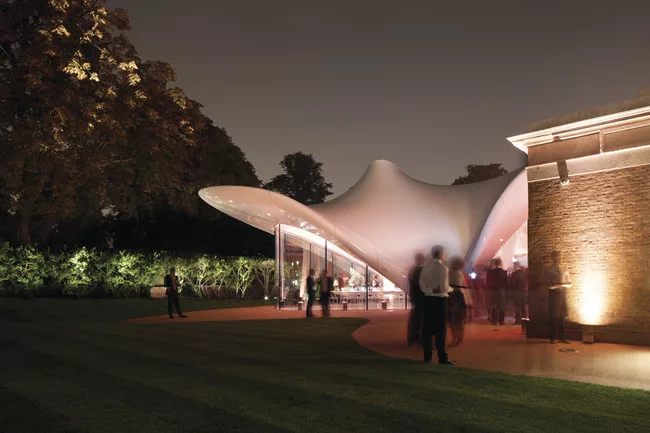
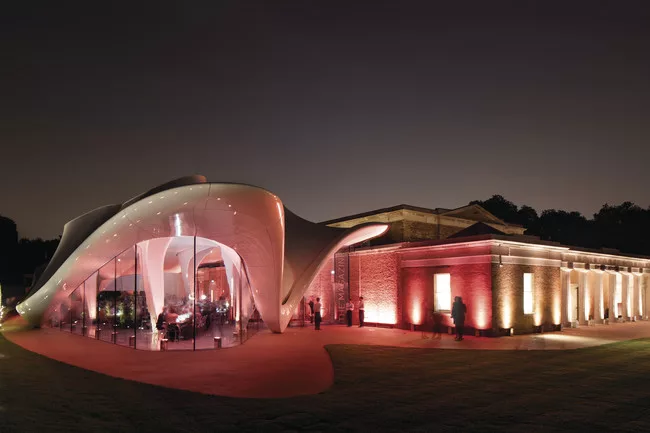
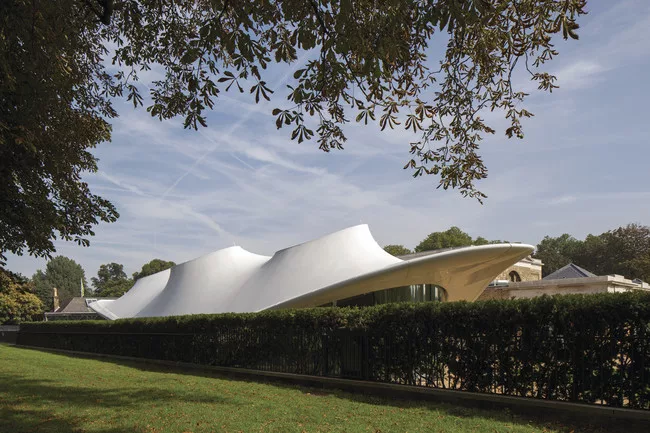
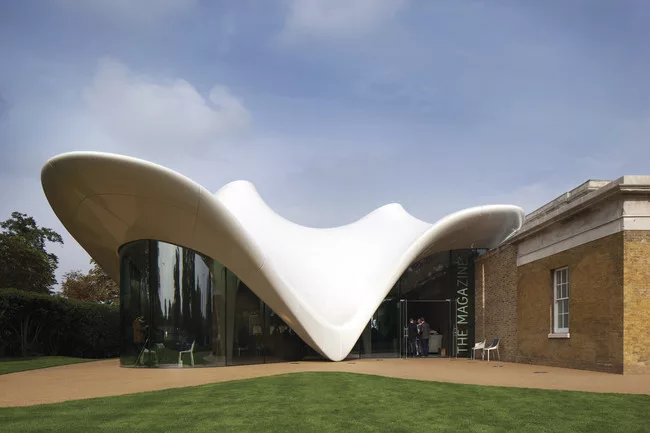
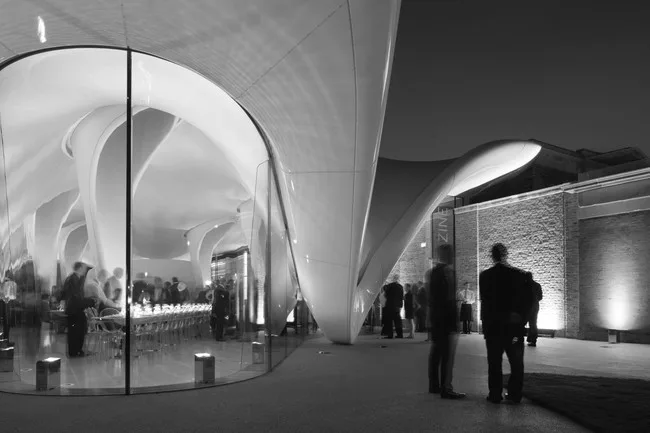
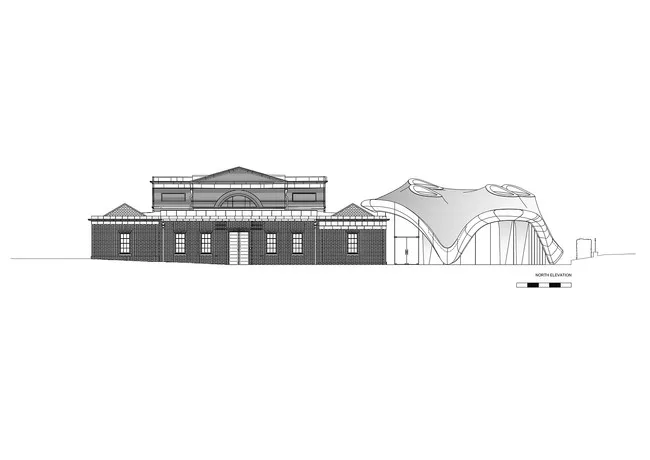
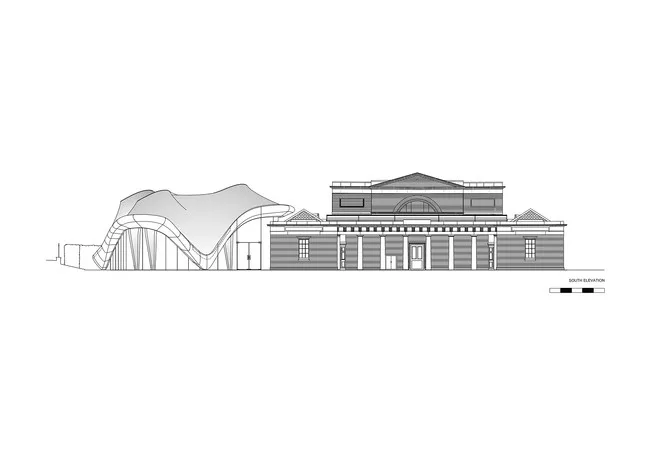
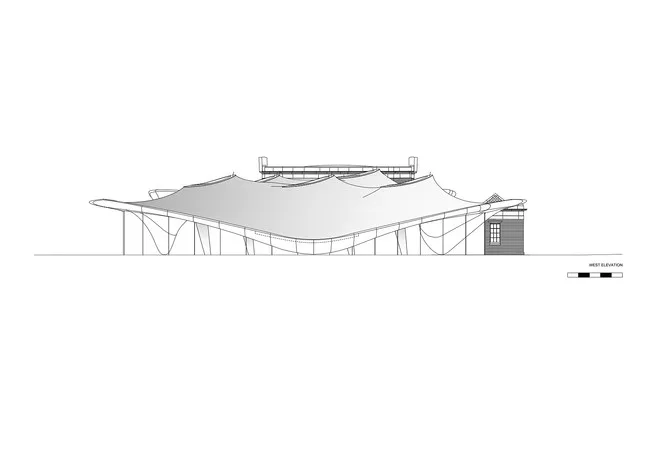
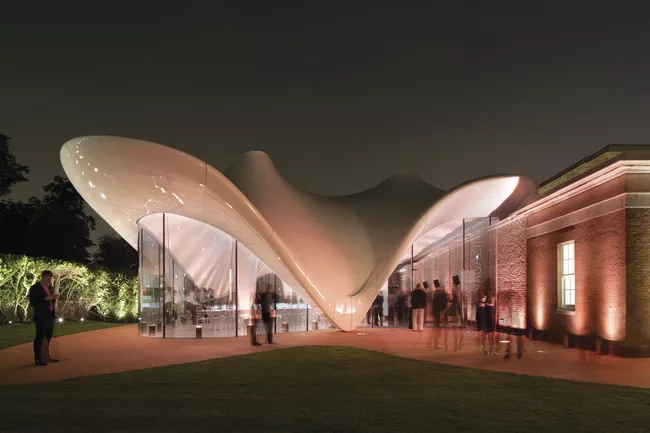
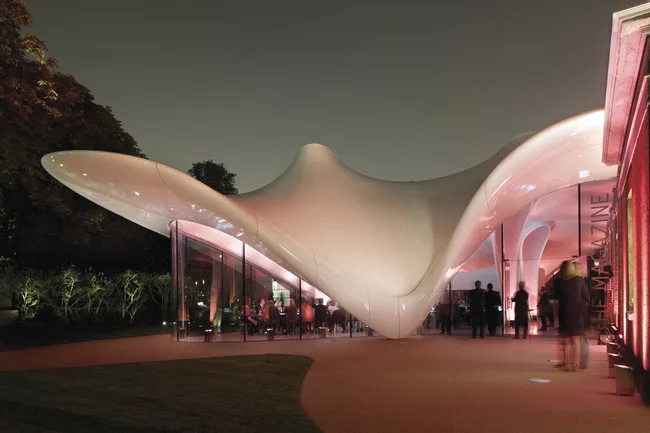
Zaha Hadid Architects’ first permanent structure in London—a restaurant building made from tensile fabric, steel, and glass—has something of the appearance of a carnival tent. I’ve watched this building grow in Hyde Park over the past year, appearing like a white efflorescence on the side of one of London’s odder little buildings, an austerely neoclassical 1805 military gunpowder magazine. Now it has taken on a new use as the second home of the Serpentine Gallery, a short walk away.

It may not be the biggest or most dramatic of Hadid's recent work—for that one must look to Baku in Azerbaijan and her glistening white Heydar Aliyev Centre—but in architecture, client prestige and location are everything. The tiny Serpentine Gallery has a cultural reach way beyond its size, something amply demonstrated by its ambitious program of annual temporary pavilions by international architects—Sou Fujimoto this year. Hadid is a trustee of the gallery, and the chairman of its board is none other than Pritzker Prize chair Lord Palumbo. It also occupies a site within the green heart of London, the great former royal hunting grounds of the adjacent Hyde Park and Kensington Gardens. The $23.5 million spent on Hadid’s building here has an impact worth ten times that spent elsewhere.

But the Royal Parks organization is famously conservative about what—if anything—it allows to be built on its zealously-preserved land. The legendary Crystal Palace of 1851 may have stood near here, but that was temporary. A no less fierce guardian is the state conservation agency English Heritage, tasked with vetting any alteration to a building on the historic register. And so we find Hadid designing a tent-like building. The structure looks as if it could be taken down at any time, a visual fiction agreeable to the authorities.

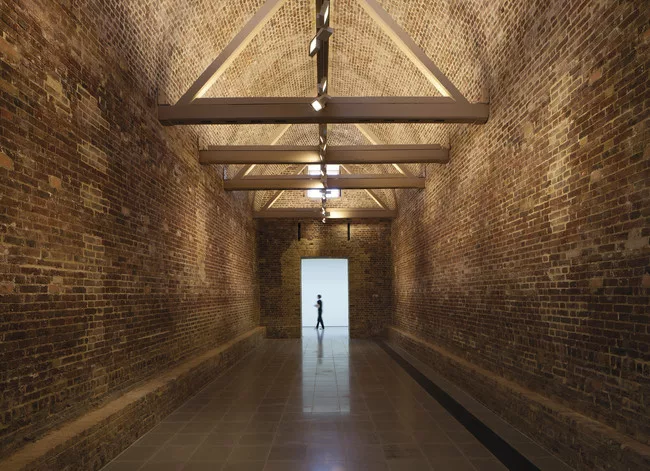
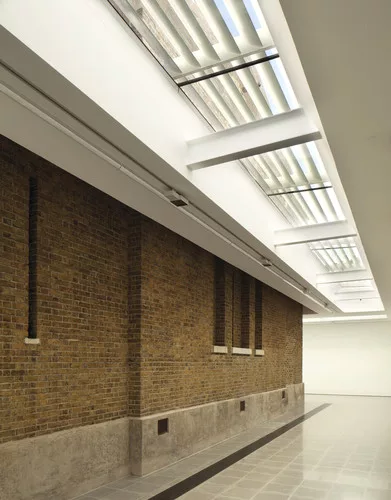
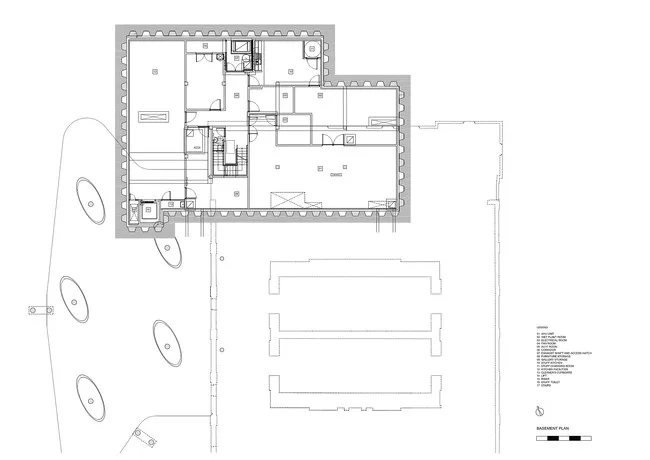
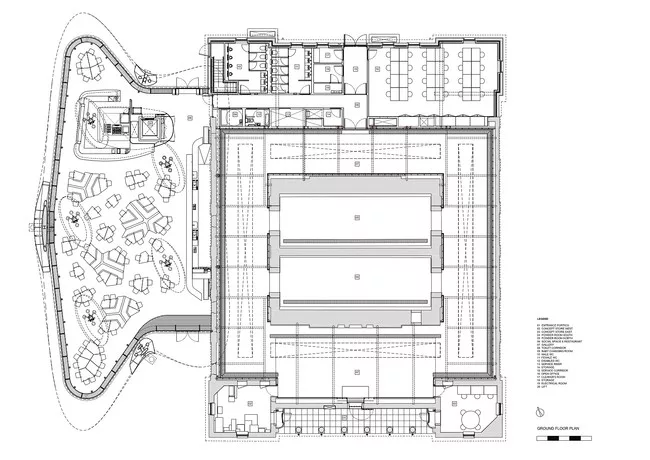
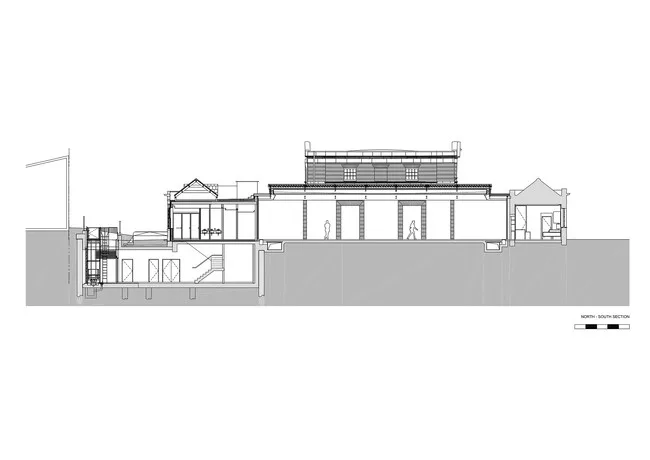
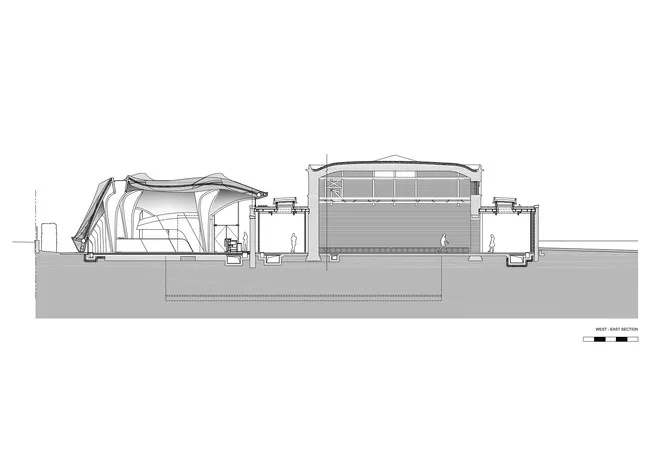
Hadid and her firm, however, have done much more than just add this organic extension, which shares some formal preoccupations with its bigger sister in Baku. Working with traditionalist architect Liam O’Connor and noted conservation architect Julian Harrap, they have transformed the old gunpowder facility as well. This entailed roofing over the open courtyard that used to separate the original magazine from its slightly later perimeter building with its broad portico and extending the original building in replica—recycled matching bricks, stone copings, and all. This provided space for toilets, storage, and administrative offices for the gallery. From outside, few will notice the difference between old and new. Inside, the main result is a gallery circuit with perimeter top-lighting that runs around the twin massive brick-vaulted structures of the original magazine storgage facilities, now themselves acting as galleries.

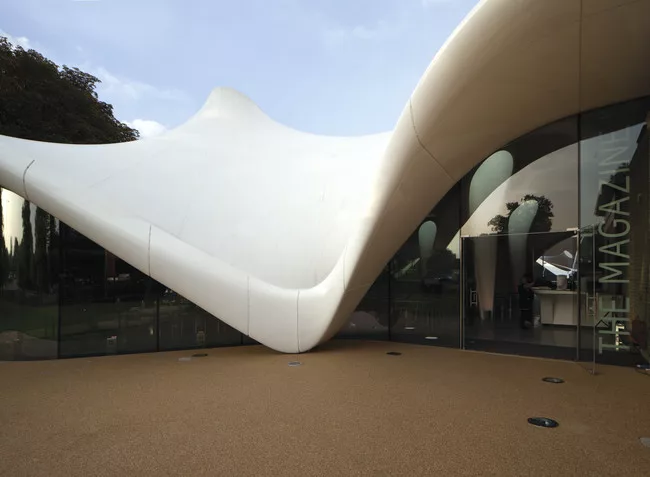
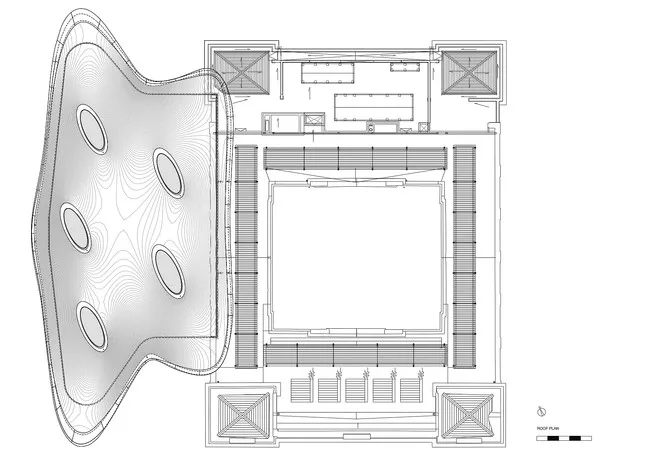
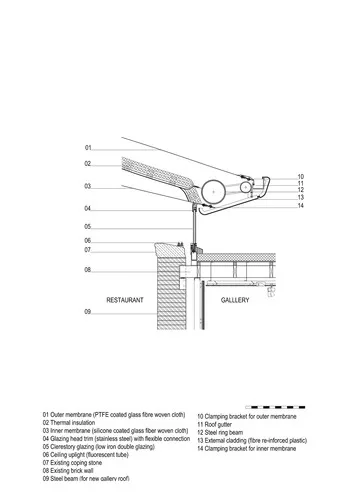
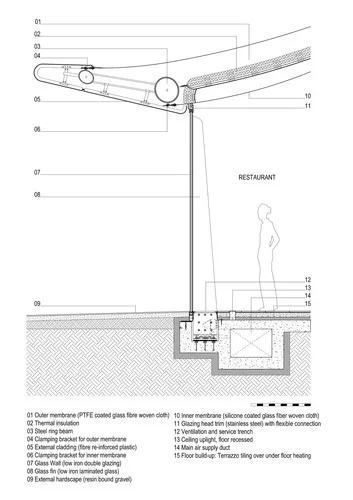
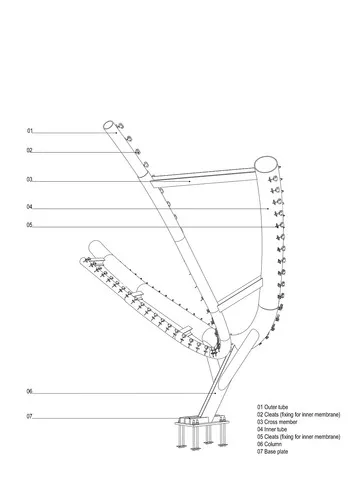
The eye-catching restaurant is symmetrical in plan but more free-form in elevation. It involves some typically Hadidian structural gymnastics, delivered by Arup. The undulating steel ring-beam of the structure, given a shiny GRP (glass reinforced plastic) edging, touches the ground at only three points. There are a couple of discreet attachment points to the old building, otherwise it is separated from it by a band of glass. The main curving glass walls are freestanding, and the roof is designed to flex above it.

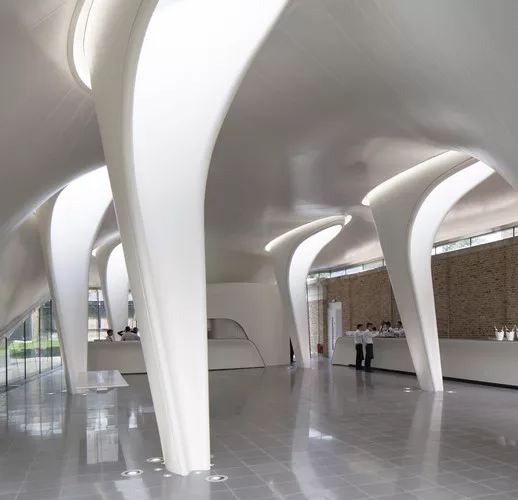
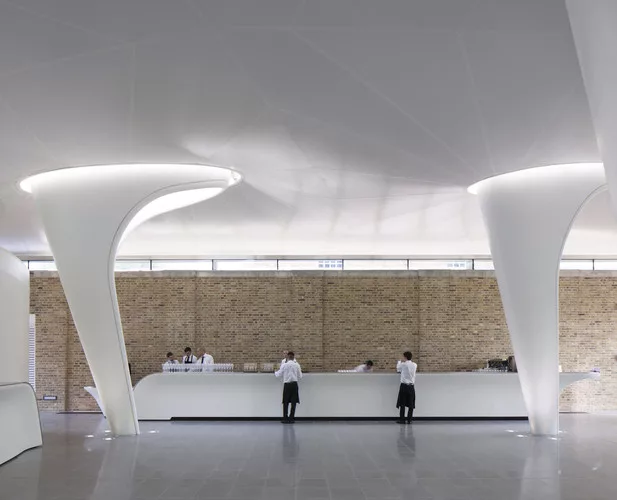
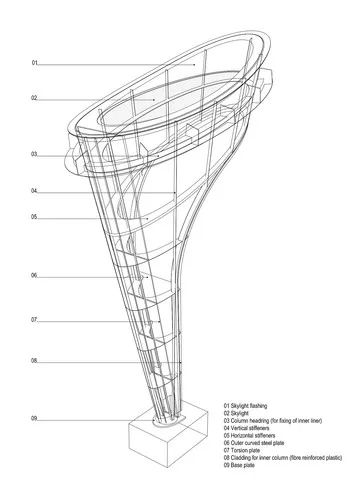
This extension is visually problematic externally: clumsy, uneasy, a troubling clash of materials and textures, the soft and the hard. Inside, it’s another story: suddenly elegance returns, especially in the form of the five columns tensing the roof fabric. These are hollowed on one side, broadening at the top like lilies to allow for oval skylights. Daylight washes down the stems, supplemented by artificial light fittings set around the perimeter at the top. This is very neatly done. In all, it is an airy, almost ethereal space, equipped with a bar and a rather intrusive kitchen, nonetheless perfect for parties.

Zaha’s first permanent building in London, then, is a somewhat tame affair for this Pritzker and double Stirling Prize winner. The creation of a second Serpentine Gallery, however—named for benefactors Dr. Mortimer and Dame Theresa Sackler—is a highly significant cultural event for the British capital. It means that Zaha, once an outsider here, is now officially part of the establishment.

Hugh Pearman is architecture critic at the Sunday Times, London, and editor of the Journal of the Royal Institute of British Architects.

KEYWORDS: Serpentine Pavilion

Share This Story

Looking for a reprint of this article?
From high-res PDFs to custom plaques, order your copy today!

London-based Hugh Pearman is the editor of the RIBA Journal.

Post a comment to this article

Report Abusive Comment

Subscription Center
  • Create an Account
  • Start a Subscription
  • Manage My Account
  • Sign Up for Newsletters
  • Visit Customer Service
  • Update Preferences

More Videos

Sponsored Content

Sponsored Content is a special paid section where industry companies provide high quality, objective, non-commercial content around topics of interest to the Architectural Record audience. All Sponsored Content is supplied by the advertising company and any opinions expressed in this article are those of the author and not necessarily reflect the views of Architectural Record or its parent company, BNP Media. Interested in participating in our Sponsored Content section? Contact your local rep!

close
  • TAMLYN XtremeTrim Exterior Trim
    Sponsored byTamlyn

    Designing Cleaner Panel Facades: Why Exterior Trim Details Matter

  • Building with Vapor Barriers
    Sponsored byReef Industries, Inc.

    Vapor Barriers Help Control Moisture in Tighter Building Designs

  • Duct Interior with Prodeq System
    Sponsored byHenry, a Carlisle Company

    Designing Resilient Water Containment Systems

DESIGN:ED Podcast
Listen to Architectural Record’s DESIGN:ED Podcast

Events

June 10, 2026

Rethinking Stormwater – The Power of Porous Paving

Credits: 1 AIA LU/HSW; 1 AIBD P-CE; 0.1 ICC CEU

Learn how porous paving systems support stormwater management, reduce heat island effects, and enhance sustainable site design performance.

June 11, 2026

Very Early Warning Fire Detection for Mission-Critical Facilities

Credits: 1 AIA LU/HSW; 1 AIBD P-CE; 0.1 ICC CEU

Examine advanced fire detection strategies that support uptime and enhance safety in data centers and other mission-critical facilities.

View All Submit An Event

Products

2026 Architect's Square Foot Costbook

2026 Architect's Square Foot Costbook

See More Products

Popular Stories

Practice Matters illustration

What’s in a (Firm’s) Name? Thinking About Succession and Legacy

Practice Matters illustration

By the Numbers: Counting America's Architects

House on a Hill

Design Vanguard 2026: Forma

Crane Cove, ONO

Design Vanguard 2026 Winners

KRESA by DLR

In Kalamazoo, DLR Group Completes a Mass-Timber Hub for Career and Technical Education Programs

Broader Sustainability of CMU - Free Webinar - May 21, 2026

Related Articles

  • 2026 Serpentine Pavilion

    Lanza Atelier’s Curving Brick 2026 Serpentine Pavilion Opens in London
    See More
  • Sou Fujimoto's 2013 Serpentine Pavilion Opens in London
    See More
  • Temporary Pavilion By Zumthor Opens in London
    See More

Related Products

See More Products
  • Architectural Record - October 2025

    Architectural Record October 2025 Issue

  • book3.jpg

    If Architecture is a Language, Then a Building is a Story

See More Products
×

The latest news and information

#1 Source for Architectural Design, News and Products

SUBSCRIBE
  • RESOURCES
    • Advertise
    • Contact Us
    • Submit
    • Store
  • ACCOUNT CENTER
    • Create an Account
    • Start a Subscription
    • Manage My Account
    • Sign Up for Newsletters
    • Visit Customer Service
    • Update Preferences
  • PRIVACY
    • PRIVACY POLICY
    • TERMS & CONDITIONS
    • DO NOT SELL MY PERSONAL INFORMATION
    • PRIVACY REQUEST
    • ACCESSIBILITY
  • SERVICES
    • Marketing Services
    • Reprints
    • Market Research
    • List Rental
    • Survey/Respondent Access
  • STAY CONNECTED
    • Linkedin
    • Facebook
    • Instagram
    • YouTube
    • X (Twitter)

Copyright ©2026. All Rights Reserved BNP Media, Inc. and BNP Media II, LLC.

Design, CMS, Hosting & Web Development :: ePublishing