Architectural Record
search
cart
facebook twitter linkedin youtube
  • Sign In
  • Subscribe
  • Sign Out
  • My Account
Architectural Record
  • NEWS
    • Latest News
    • Awards
    • Interviews
    • Obituaries
    • Podcasts
      • Design:Ed Podcast
      • Sponsored Podcasts
  • OPINION
    • Book Reviews / Excerpts
    • Exhibition Reviews
    • Forum
  • EXCLUSIVES
    • Videos
    • Design Vanguard
    • Top 300 Firms
    • Sponsored Content
    • Sponsored eBooks
    • From the Archives
  • CONTINUING ED
    • Editorial Continuing Ed
    • CE Center
    • CE Academies
  • PROJECTS
    • Buildings By Type
    • Reuse & Renovation
    • Museums & Arts Centers
    • Colleges & Universities
    • Multifamily Housing
    • Interiors
    • Lighting
    • Kitchen & Bath
  • HOUSES
    • Record Houses
    • House of the Month
    • Featured Houses
  • PRODUCTS
    • Products by Category
    • Record Products of the Year
    • Latest Products
  • EVENTS
    • Dates & Events
    • Record on the Road
    • Innovation Conference
    • Sustainability in Practice
    • Women In Architecture
    • Webinars
    • Ad Excellence Awards
    • AIA 2026 Videos
    • Submit an Event
  • CONNECT
    • Ask RECORD AI
    • Newsletters
    • Contact
    • Advertise
    • Editorial Calendar
    • Store
    • Customer Service
  • SUBMIT
    • Submission Guidelines
    • RECORD Competitions
  • MAGAZINE
    • Subscribe
    • My Account
    • Digital Edition
    • Current Issue
    • Firm Pass
    • Historic Archive
Architecture News

Learning From Legacy Cities
By John Gallagher
November 13, 2013

bruner loeb forum
Photo courtesy J. Max Bond Center
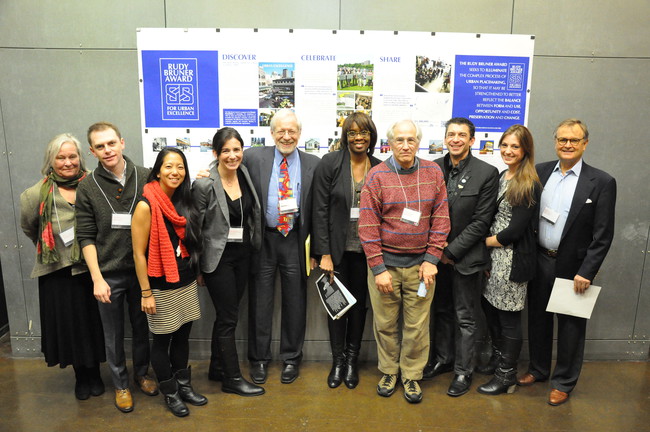
From left to right: Sally Young, Loeb Fellowship; Nicholas Hamilton, The American Assembly; Esther Yang, J. Max Bond Center; Anne-Marie Lubenau, Bruner Foundation; Jim Stockard, Loeb Fellowship; Toni Griffin, J. Max Bond Center; Simeon Bruner, Bruner Foundation; Dan Pitera and Krista Wilson, Detroit Collaborative Design Center; and David Mortimer, The American Assembly

The fine art of reimagining what post-industrial cities can become through better design took the spotlight last week at the 2013 Bruner Loeb Forum, held in Detroit, Michigan. Organized in partnership with the J. Max Bond Center on Design for the Just City, the Detroit Collaborative Design Center, and The American Assembly at Columbia University, the symposium drew an invitation-only roster of about 100 architects and planners, developers, government staffers, academics, and media to share best design practices and innovations from cities that struggle with chronic population loss and land vacancy.

The social impacts of urban redesign was a key theme. Resident involvement can prove particularly important in legacy cities because any project invariably encroaches on people already living there. Roberta Feldman of the University of Illinois at Chicago recounted the story of citizen involvement in the remaking of Chicago’s Cabrini-Green housing project, razed and rebuilt as mostly market rate housing. Feldman said she and other advocates of public interest architecture were able to inject some democratic design strategies in what threatened to be just another yuppie upscale development. Residences for moderate income people from the old Cabrini-Green were included, as well as playgrounds, which the redevelopers had initially left out of their design plan for young professionals.

A popular theme during the work sessions was the removal of the expressways that had sliced and diced cities a generation or two ago. Case studies from Syracuse, Milwaukee, and other cities illustrated the trend. “Like weeds, the freeway in the city is the wrong thing. It’s a failed experiment in America,” said urban planner Peter J. Park. “When you take freeways out of cities, they get better.”

A willingness to experiment with short-term pop-up installations found a lot of acceptance at Legacy Cities Design. The practitioners remained humbled by the lessons of previous city builders, when hubris led to massive projects that often wounded cities deeply. One antidote is a reliance on temporary projects as a city feels its was toward a new solution. “I think we have to admit we don’t really know what’s going to happen to a lot of these cities,” said Terry Schwarz, director of the Cleveland Urban Design Collaborative at Kent State University.

Toni L. Griffin, director of the J. Max Bond Center, said the forum achieved key goals, including producing a more robust catalogue of real-world projects now underway in legacy cities and bringing people together who normally worked independently in their separate communities. “I think we want to continue the conversation in a way that deepens the amount of knowledge that we have about these cities and the design opportunities,” she said. “And I hope that we can continue to follow up in some way as an advocate for why design matters in these cities.”

Share This Story

Looking for a reprint of this article?
From high-res PDFs to custom plaques, order your copy today!

Post a comment to this article

Report Abusive Comment

Subscription Center
  • Create an Account
  • Start a Subscription
  • Manage My Account
  • Sign Up for Newsletters
  • Visit Customer Service
  • Update Preferences

More Videos

Sponsored Content

Sponsored Content is a special paid section where industry companies provide high quality, objective, non-commercial content around topics of interest to the Architectural Record audience. All Sponsored Content is supplied by the advertising company and any opinions expressed in this article are those of the author and not necessarily reflect the views of Architectural Record or its parent company, BNP Media. Interested in participating in our Sponsored Content section? Contact your local rep!

close
  • 3D configurator
    Sponsored byDoorBird

    How DoorBird’s 3D Configurator Is Redefining Customization Across Residential and Commercial Design

  • interior of modern office
    Sponsored byCurrent

    The Downlight's Second Life: Why Below-Ceiling Serviceability Is the Specification Detail That Matters Most

  • cold storage facility
    Sponsored byCarlisle SynTec Systems

    How Architects Can Design More Continuous Cold Storage Envelopes

DESIGN:ED Podcast
Listen to Architectural Record’s DESIGN:ED Podcast

Events

July 22, 2026

Water Containment Waterproofing: Best Practices and System Selection

Credits: 1 AIA LU/HSW; 1 AIBD P-CE; 0.1 ICC CEU

Examine waterproofing strategies for water containment structures that enhance durability, prevent failures, and support long-term building performance.

July 29, 2026

Adaptive Reuse Reimagined: Designing Multifamily Housing from Existing Buildings

Credits: 1 AIA LU/HSW; 1 AIBD P-CE; 0.1 ICC CEU; 1 IIBEC CEH

Examine adaptive reuse envelope strategies that improve energy performance, preserve architectural character, and transform existing buildings into high-performing multifamily housing.

View All Submit An Event

Products

2026 Architect's Square Foot Costbook

2026 Architect's Square Foot Costbook

See More Products

Popular Stories

7480 N Delaware

A Portland Apartment Building by Daniel Toole Architecture Stands as a Study in Adaptation

Home Spirit apartment building exterior

Outdoor Access Drives the Design of a French Apartment Building

Bergen complex frontage

Brooklyn’s Bergen Establishes Place with a Modulated Concrete Facade and an Idyllic Garden

Chacarita Alta Housing

In Paraguay’s Capital, MOS and Adamo-Faiden Rethink Public Housing for Residents of Informal Settlements

The Mark and Hive Glenrock, LOHA

Two Student Residences Continue LOHA’s Decades-long Reimagination of the L.A. Lifestyle

Water Containment Waterproofing: Best Practices and System Selection - Free Webinar - July 22, 2026

Related Articles

  • Learning from the Hutong of Beijing and the Lilong of Shanghai

    See More
  • archival photo of denise scott brown with las vegas in the background

    Fifty Years After ‘Learning from Las Vegas,’ Denise Scott Brown Gets Her Due

    See More
  • Learning from the Hutong of Beijing and the Lilong of Shanghai

    See More

Related Products

See More Products
  • Web-Legacy16-1920x1125.jpg

    Legacy

  • superlux.jpg

    SuperLux: Smart Light Art, Design & Architecture for Cities

See More Products
×

The latest news and information

#1 Source for Architectural Design, News and Products

SUBSCRIBE
  • RESOURCES
    • Advertise
    • Contact Us
    • Submit
    • Store
  • ACCOUNT CENTER
    • Create an Account
    • Start a Subscription
    • Manage My Account
    • Sign Up for Newsletters
    • Visit Customer Service
    • Update Preferences
  • PRIVACY
    • PRIVACY POLICY
    • TERMS & CONDITIONS
    • DO NOT SELL MY PERSONAL INFORMATION
    • PRIVACY REQUEST
    • ACCESSIBILITY
  • SERVICES
    • Marketing Services
    • Reprints
    • Market Research
    • List Rental
    • Survey/Respondent Access
  • STAY CONNECTED
    • Linkedin
    • Facebook
    • Instagram
    • YouTube
    • X (Twitter)

Copyright ©2026. All Rights Reserved BNP Media, Inc. and BNP Media II, LLC.

Design, CMS, Hosting & Web Development :: ePublishing