Architectural Record
search
cart
facebook twitter linkedin youtube
  • Sign In
  • Subscribe
  • Sign Out
  • My Account
Architectural Record
  • NEWS
    • Latest News
    • Awards
    • Interviews
    • Obituaries
    • Podcasts
      • Design:Ed Podcast
      • Sponsored Podcasts
  • OPINION
    • Book Reviews / Excerpts
    • Exhibition Reviews
    • Forum
  • EXCLUSIVES
    • Videos
    • Design Vanguard
    • Top 300 Firms
    • Sponsored Content
    • Sponsored eBooks
    • From the Archives
  • CONTINUING ED
    • Editorial Continuing Ed
    • CE Center
    • CE Academies
  • PROJECTS
    • Buildings By Type
    • Reuse & Renovation
    • Museums & Arts Centers
    • Colleges & Universities
    • Multifamily Housing
    • Interiors
    • Lighting
    • Kitchen & Bath
  • HOUSES
    • Record Houses
    • House of the Month
    • Featured Houses
  • PRODUCTS
    • Products by Category
    • Record Products of the Year
    • Latest Products
  • EVENTS
    • Dates & Events
    • Record on the Road
    • Innovation Conference
    • Sustainability in Practice
    • Women In Architecture
    • Webinars
    • Ad Excellence Awards
    • Submit an Event
  • CONNECT
    • Ask RECORD AI
    • Newsletters
    • Contact
    • Advertise
    • Editorial Calendar
    • Store
    • Customer Service
  • SUBMIT
    • Submission Guidelines
    • RECORD Competitions
  • MAGAZINE
    • Subscribe
    • My Account
    • Digital Edition
    • Current Issue
    • Firm Pass
    • Historic Archive
Architecture News

Commentary: Give Calatrava a Chance
By Fred A. Bernstein
WTC Transit Hub
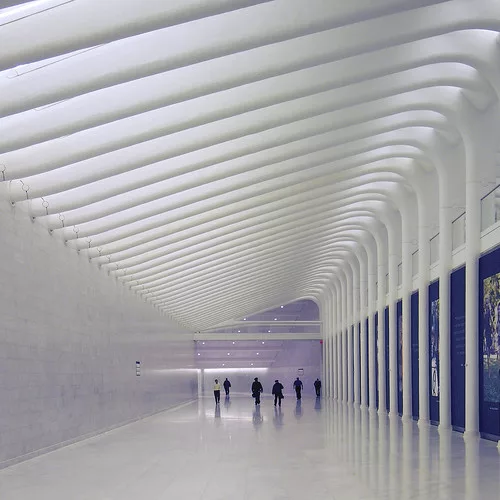
The West Concourse of Santiago Calatrava's PATH station at the World Trade Center opened on October 22. Shown here is its marble-lined walkway.
 
Photo © John Hill
WTC Transit Hub
The West Concourse of Santiago Calatrava's PATH station at the World Trade Center opened on October 22. Shown here is its marble-lined walkway.
 
Photo © John Hill
WTC Transit Hub
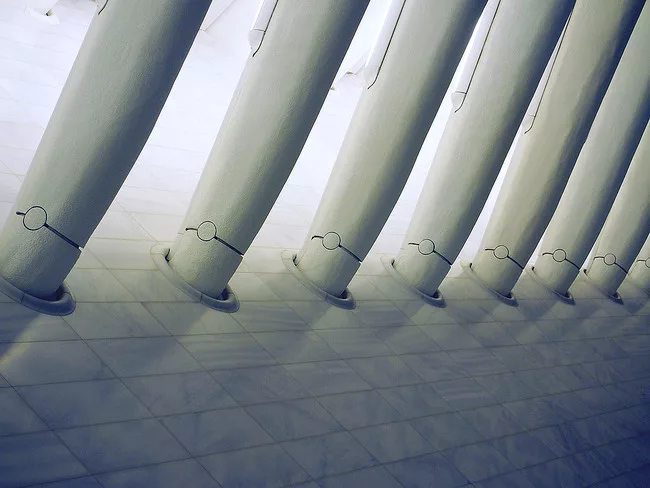
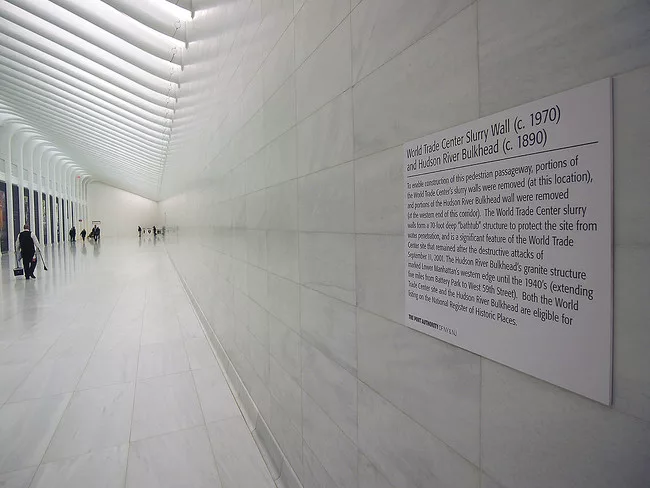
The West Concourse of Santiago Calatrava's PATH station at the World Trade Center opened on October 22. Shown here is a detail from the marble-lined walkway.
 
Photo © John Hill
WTC Transit Hub
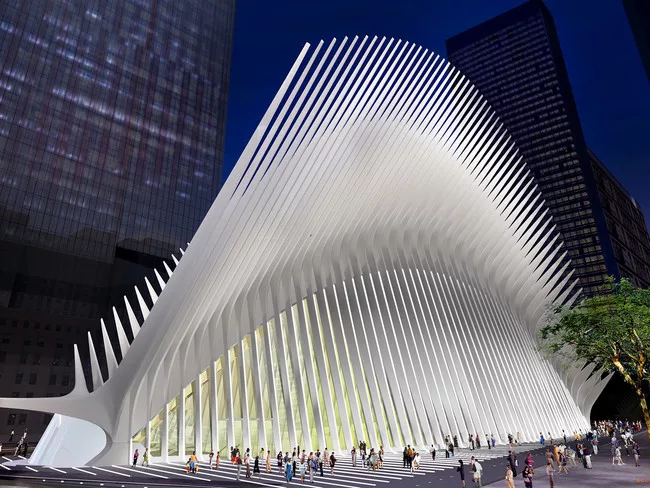
A rendering of Santiago Calatrava's World Trade Center transportation hub at street level.
 
Image © Santiago Calatrava/courtesy Silverstein Properties
WTC Transit Hub
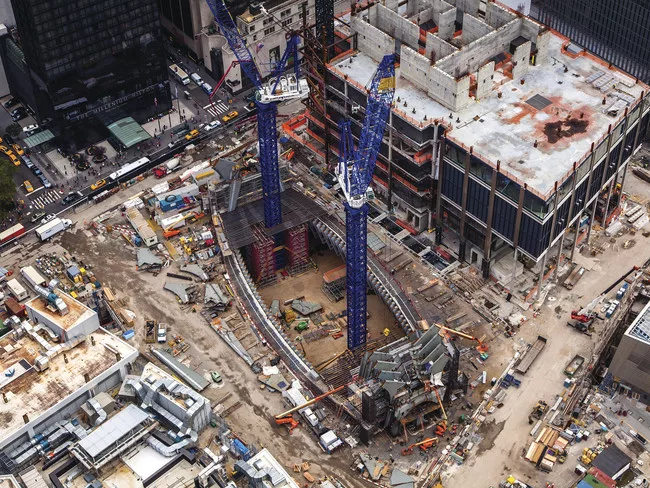
Santiago Calatrava's World Trade Center transportation hub under construction (September 1, 2013).
 
Photo © Joel Woolhead/courtesy Silverstein Properties
WTC Transit Hub
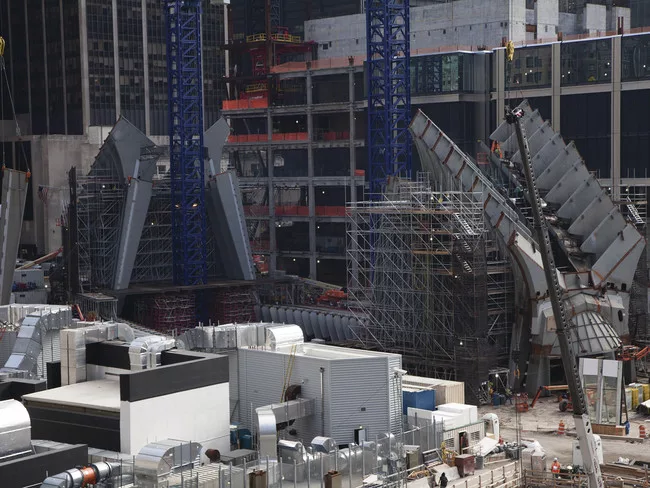
Santiago Calatrava's World Trade Center transportation hub under construction (October 31, 2013).
 
Photo © Joel Woolhead/courtesy Silverstein Properties
WTC Transit Hub
WTC Transit Hub
WTC Transit Hub
WTC Transit Hub
WTC Transit Hub
WTC Transit Hub
November 18, 2013

Architects & Firms

Santiago Calatrava

As I slid into the back seat of a taxi in Valencia, Spain, earlier this year, I didn’t know how I was going to direct the driver to my destination. I speak no Spanish. But when I formed my palms into a sphere, the driver nodded, then sped off to the City of Arts and Sciences, the complex that includes not one, but two huge, domed buildings by Santiago Calatrava—buildings that are, like many of Calatrava’s extravagantly expressive structures, more easily described with gestures than with words.

The buildings that form the complex—the domed opera house and planetarium, plus a vast science museum and a conference center—are stunning white-on-white confections, exemplars of a style that has made Calatrava one of the best-known and wealthiest architects ever. Still, it’s hard to avoid the feeling that he has given Valencia, where he grew up, a kind of ghost town. Only one of the buildings on the 85-acre site, the science museum, was open on a recent afternoon; visitors were scarce and much of the vast interior was inaccessible—the “residual spaces” beneath Calatrava’s eccentrically shaped roofs.

Given the prominence of the nearly empty buildings, at a time of austerity in Spain, Calatrava has become an easy target; he is blamed for bankrupting the local government, the subject of front-page articles around the world. And when he speaks (as he did with me last year), he tends to make things worse, describing his 90-million-Euro fee for designing the Valencia complex as “very modest” and the charges against him as “a political maneuver by the communists.”

In fact, the costs are outrageous, and the technical problems (like a tiled roof that has been dripping tiles), inexcusable. But despite all that, I find the buildings thrilling. Walking around the Cite, I wanted to see every one of them from every angle. The organic, almost skeletal forms, in many cases reach skyward like the vaults of Gothic cathedrals, but streamlined and rendered in the whitest white, are awe-inspiring. My head tells me one thing, but my heart tells me another.

Over the years, I have visited dozens of Calatrava buildings, from a bridge in Calgary to an opera house in Tenerife, and they have affected me the way Hoover Dam, the Golden Gate Bridge, and the TWA Terminal at JFK have affected me: Each is a utilitarian structure raised to the level of art. There’s a reason Herbert Muschamp, the late New York Times architecture critic, hailed Calatrava as our “leading poet of transportation architecture.” Poet! True, Calatrava’s work has precedents. Among those he has quoted are the Swiss bridge designer Robert Maillart; the American architect Eero Saarinen; the Japanese-American architect Minoru Yamasaki; the Spanish architect Antonio Gaudi (whose experiments in structure are almost exact precursors of Calatrava’s); and the Italian polymath Pier Luigi Nervi. (He is also known for recycling his own designs.)

Meanwhile, among engineers, the consensus is that Calatrava’s structures aren’t “elegant” because they use more steel and concrete (sometimes far more) than is necessary. That’s surely true, but what if his steel and concrete provide not just support, but inspiration?

I’m not an apologist for Calatrava, with his leaky roofs, projectile-tiles, and tendency to bankrupt clients; in fact, I have been one of his harshest critics. Buildings need to work, and—if the public is paying for them—need to come in on, or close to, budget. He responds to complaints about the Valencia overruns with astonishing arrogance. “They are not attacking the Alhambra in Granada,” he told me of his critics. They are not attacking the cathedral in Santiago de Compostela. They are not attacking the Prado in Madrid.” But, bad as it sounds, he has a point: No one thinks now about the costs of the Prado or the Alhambra, or even of 20th century buildings that have captured the public’s imagination.

Calatrava’s PATH station at the World Trade Center is now budgeted at some $4 billion, or about $70,000 for each of its expected daily riders. The Port Authority of New York and New Jersey is struggling to pay the bills, which is one reason the tolls at Hudson River crossings have skyrocketed (prompting the American Automobile Association to sue the Port Authority, claiming illegal diversion of funds to non-transportation uses). As a taxpayer, and occasional toll payer, I am outraged.

But when I visited the site a few months ago, I forgot about those things. The centerpiece of the station is a giant oval, 320 feet long and 100 feet wide, topped by a pair of glass-and-steel wings reaching 160 feet into the sky. I was transported back to Valencia, to Tenerife, and most of all to Milwaukee. There, Calatrava’s addition to the Milwaukee Art Museum went about 300 percent over budget, and was delayed by highly-publicized construction problems. But on a sunny day, there is no more glorious place to be than in Calatrava’s room overlooking Lake Michigan, the Quadracci Pavilion, with its movable wings—and try finding a Milwaukeean who doesn’t think so. New Yorkers deserve no less.

True, there are a couple of reasons the station may not provide that thrill Calatrava intended. First, fire codes required that the steel be covered in an intumescent coating, a kind of paint that expands in response to heat, insulating and emitting moisture. But the coating gives a cottage-cheesy appearance to much of the structure. 

And for safety reasons, the steel ribs of the oculus are thicker than in Calatrava’s original design—so much so that the ribs largely obscure views through the glass panes. The feeling of being in a space open to the sky is diminished.

And yet, despite all its problems, I am betting that the PATH Station, scheduled to debut in 2015, will become a symbol of Lower Manhattan, rivaling the Statue of Liberty and eclipsing the ungainly Freedom Tower. New Yorkers who can’t get to Milwaukee, much less Valencia or Tenerife, will get a chance to see how electrifying Calatrava’s work can be. There are lots of good reasons to criticize the architect. It’s the architecture I’m rooting for.

KEYWORDS: WTC Transit Hub

Share This Story

Looking for a reprint of this article?
From high-res PDFs to custom plaques, order your copy today!
Fred Bernstein studied architecture at Princeton and law at NYU and writes about both subjects.

Post a comment to this article

Report Abusive Comment

Subscription Center
  • Create an Account
  • Start a Subscription
  • Manage My Account
  • Sign Up for Newsletters
  • Visit Customer Service
  • Update Preferences

More Videos

Sponsored Content

Sponsored Content is a special paid section where industry companies provide high quality, objective, non-commercial content around topics of interest to the Architectural Record audience. All Sponsored Content is supplied by the advertising company and any opinions expressed in this article are those of the author and not necessarily reflect the views of Architectural Record or its parent company, BNP Media. Interested in participating in our Sponsored Content section? Contact your local rep!

close
  • TAMLYN XtremeTrim Exterior Trim
    Sponsored byTamlyn

    Designing Cleaner Panel Facades: Why Exterior Trim Details Matter

  • Building with Vapor Barriers
    Sponsored byReef Industries, Inc.

    Vapor Barriers Help Control Moisture in Tighter Building Designs

  • Duct Interior with Prodeq System
    Sponsored byHenry, a Carlisle Company

    Designing Resilient Water Containment Systems

DESIGN:ED Podcast
Listen to Architectural Record’s DESIGN:ED Podcast

Events

June 10, 2026

Rethinking Stormwater – The Power of Porous Paving

Credits: 1 AIA LU/HSW; 1 AIBD P-CE; 0.1 ICC CEU

Learn how porous paving systems support stormwater management, reduce heat island effects, and enhance sustainable site design performance.

June 11, 2026

Very Early Warning Fire Detection for Mission-Critical Facilities

Credits: 1 AIA LU/HSW; 1 AIBD P-CE; 0.1 ICC CEU

Examine advanced fire detection strategies that support uptime and enhance safety in data centers and other mission-critical facilities.

View All Submit An Event

Products

2026 Architect's Square Foot Costbook

2026 Architect's Square Foot Costbook

See More Products

Popular Stories

Practice Matters illustration

What’s in a (Firm’s) Name? Thinking About Succession and Legacy

Practice Matters illustration

By the Numbers: Counting America's Architects

House on a Hill

Design Vanguard 2026: Forma

Crane Cove, ONO

Design Vanguard 2026 Winners

KRESA by DLR

In Kalamazoo, DLR Group Completes a Mass-Timber Hub for Career and Technical Education Programs

Broader Sustainability of CMU - Free Webinar - May 21, 2026

Related Articles

  • Architectural Forecast from Monterey: Overcast With A Chance of Hubris

    See More
  • St. Nicholas Greek Orthodox_result2.jpg

    Calatrava’s New St. Nicholas Church Opens at Ground Zero

    See More
  • Calatrava's WTC Transit Hub Pared Down

    See More

Related Products

See More Products
  • book3.jpg

    If Architecture is a Language, Then a Building is a Story

  • 0470126736.gif

    Modern Sustainable Residential Design: A Guide for Design Professionals

  • image7.jpg

    Contemporary Architecture in China Towards A Critical Pragmatism

See More Products
×

The latest news and information

#1 Source for Architectural Design, News and Products

SUBSCRIBE
  • RESOURCES
    • Advertise
    • Contact Us
    • Submit
    • Store
  • ACCOUNT CENTER
    • Create an Account
    • Start a Subscription
    • Manage My Account
    • Sign Up for Newsletters
    • Visit Customer Service
    • Update Preferences
  • PRIVACY
    • PRIVACY POLICY
    • TERMS & CONDITIONS
    • DO NOT SELL MY PERSONAL INFORMATION
    • PRIVACY REQUEST
    • ACCESSIBILITY
  • SERVICES
    • Marketing Services
    • Reprints
    • Market Research
    • List Rental
    • Survey/Respondent Access
  • STAY CONNECTED
    • Linkedin
    • Facebook
    • Instagram
    • YouTube
    • X (Twitter)

Copyright ©2026. All Rights Reserved BNP Media, Inc. and BNP Media II, LLC.

Design, CMS, Hosting & Web Development :: ePublishing