Exhibition Review: Close Encounters at the Lisbon Architecture Triennale
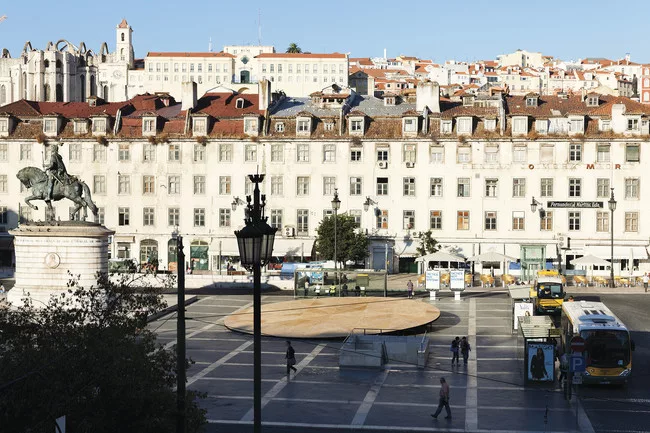
Frida Escobedo’s Civic Stage set up in Lisbon’s Praça da Figueira
Photo © Catarina Botelho
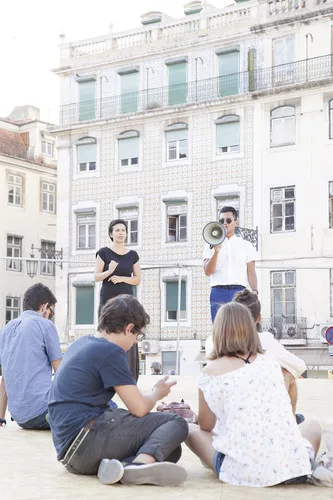
Curator José Esparza Chong Cuy (holding bullhorn) introduces a performance on Frida Escobedo’s Civic Stage.
Photo © Luke Hayes
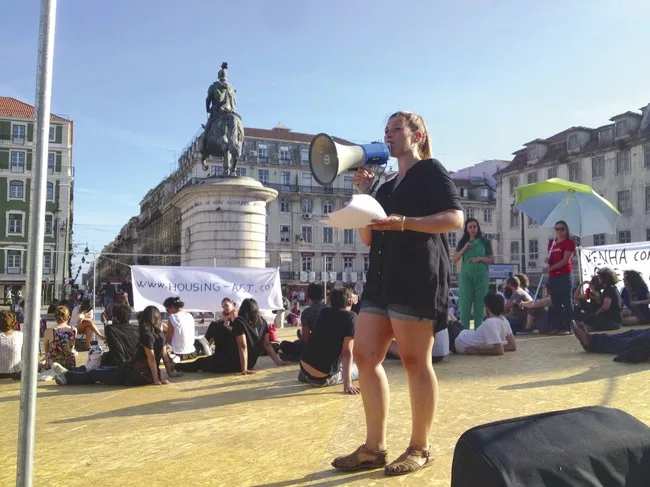
A participant reads from a script during a performance of The Housing Act by Daniel Fernández Pascual.
Photo © Architectural Record
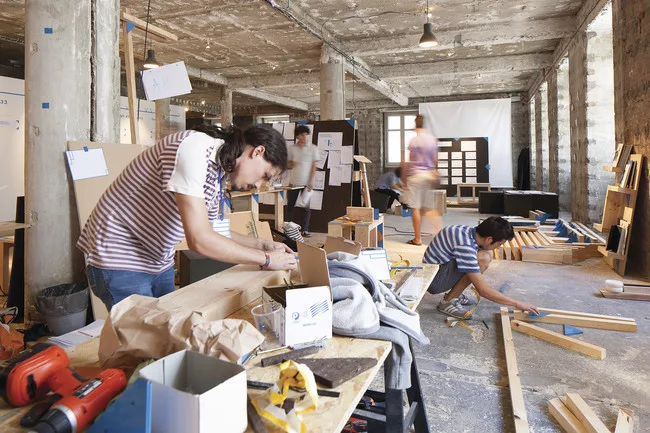
Members of the Treviso, Italy design group Fabrica build modular partitions to be configured for each residency in the exhibition.
Photo © Luke Hayes
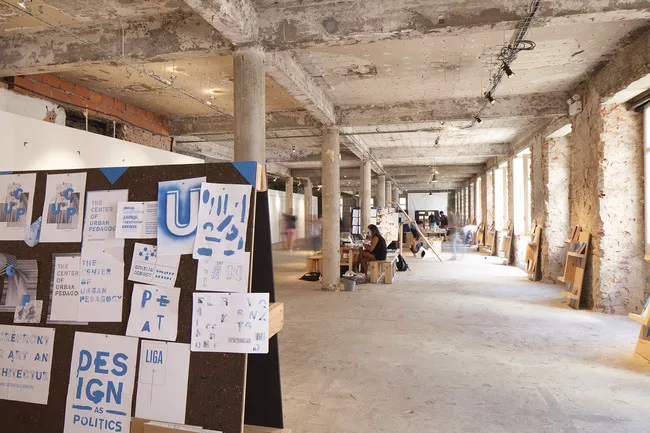
The MUDE Fashion and Design Museum transformed into a workshop for exhibition venues, publications, and curatorial groups.
Photo © Luke Hayes
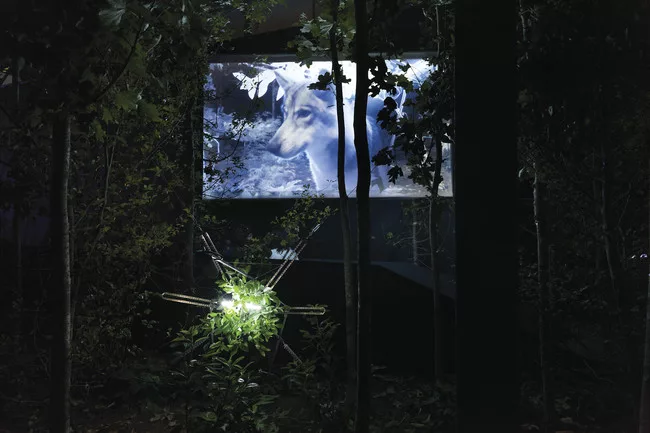
For the work And Nowhere a Shadow (2013) by Revital Cohen and Tuur Van Balen, the London-based duo built an artificial forest and then let a wolf wander through it, snacking on blueberries hung among the trees. Brushing past mechanical devices in the landscape, the wolf powered the surveillance cameras that captured video of its exploration of the forest, which in turn is presented to visitors making their own way through the exhibition—long after the predatory star has been led away. The designers are currently experimenting with genetically modifying the blueberries to administer a rabies vaccine.
Photo © Catarina Botelho
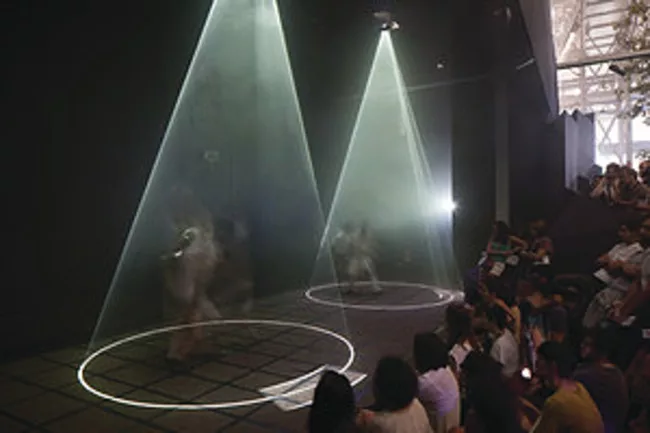
A dance performance by Marshmallow Laser Feast.
Photo © Luke Hayes
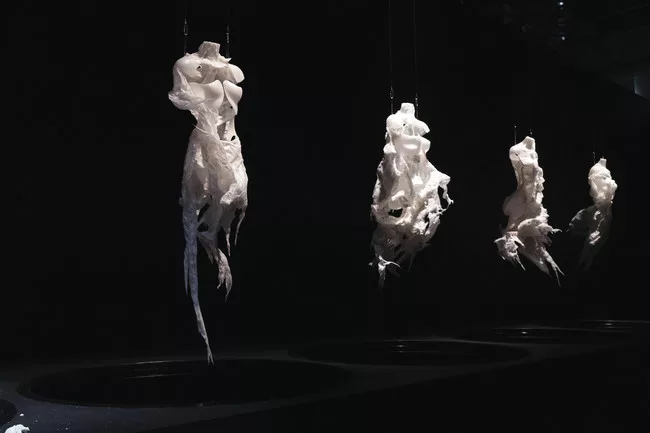
Bart Hess created his Digital Artifacts (2013) by dipping a woman’s body in hot wax, which was then cracked away and reassembled.
Photo © Catarina Botelho
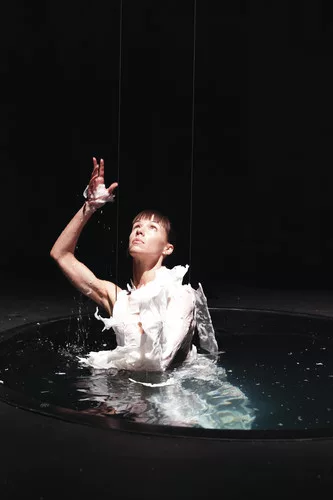
Bart Hess created his Digital Artifacts (2013) by dipping a woman’s body in hot wax, which was then cracked away and reassembled.
Photo © Catarina Botelho
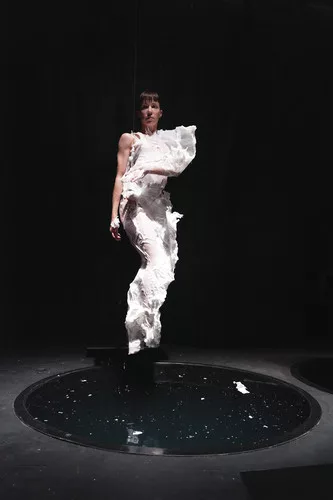
Bart Hess created his Digital Artifacts (2013) by dipping a woman’s body in hot wax, which was then cracked away and reassembled.
Photo © Catarina Botelho
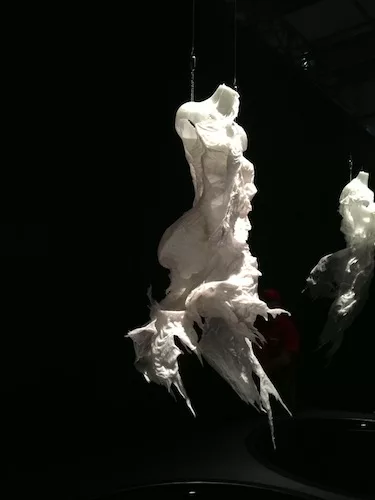
Bart Hess created his Digital Artifacts (2013) by dipping a woman’s body in hot wax, which was then cracked away and reassembled.
Photo © Architectural Record
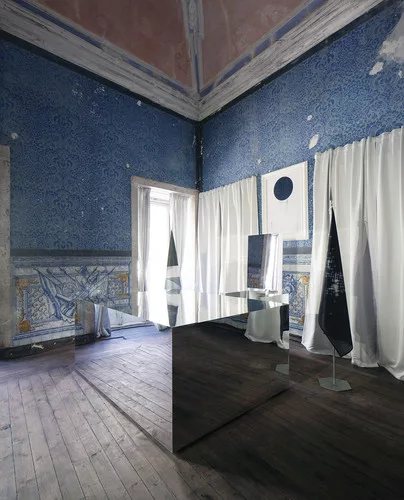
The installation Living Room of the Nation (2013) by Paul Moreira and Kiluanji Kia Henda at the Palácio Pombal.
Photo © Luke Hayes
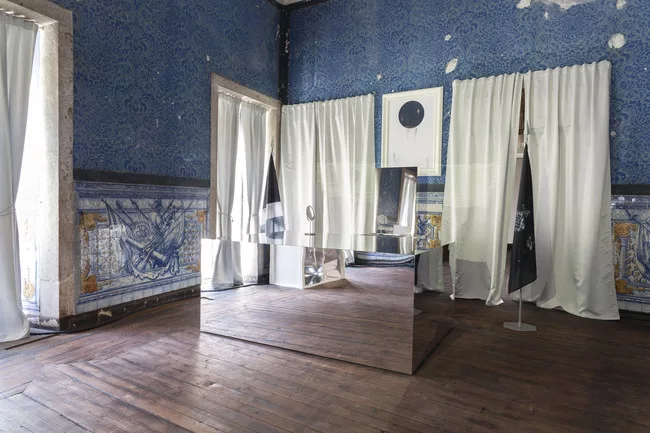
The installation Living Room of the Nation (2013) by Paul Moreira and Kiluanji Kia Henda at the Palácio Pombal.
Photo © Catarina Botelho
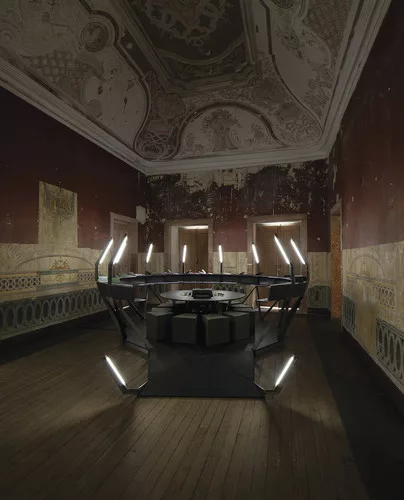
Friendly Fire’s ‘zine-making station, titled Sonda Espacial L.Q.F.U.B. (2013).
Photo © Luke Hayes
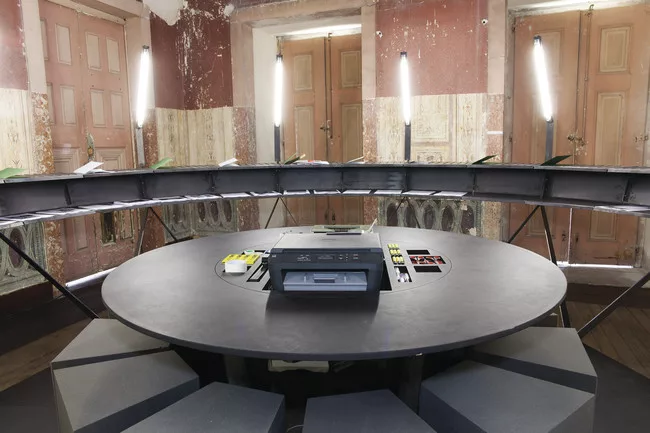
Friendly Fire’s ‘zine-making station, titled Sonda Espacial L.Q.F.U.B. (2013).
Photo © Catarina Botelho
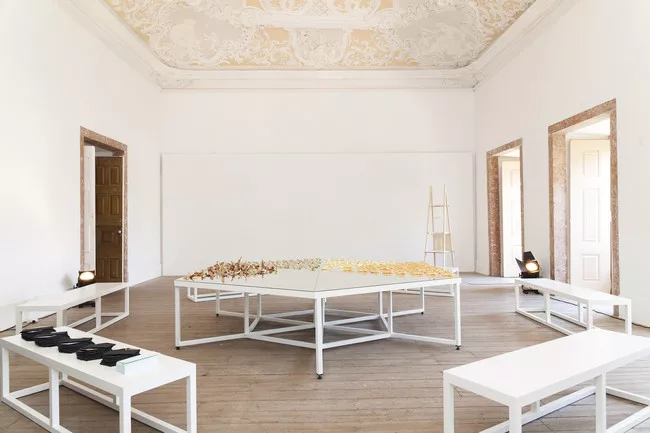
The Planetary Sculpture Supper Club (2013), a series of dinners and conversations hosted by the Center for Genomic Gastronomy.
Photo © Catarina Botelho
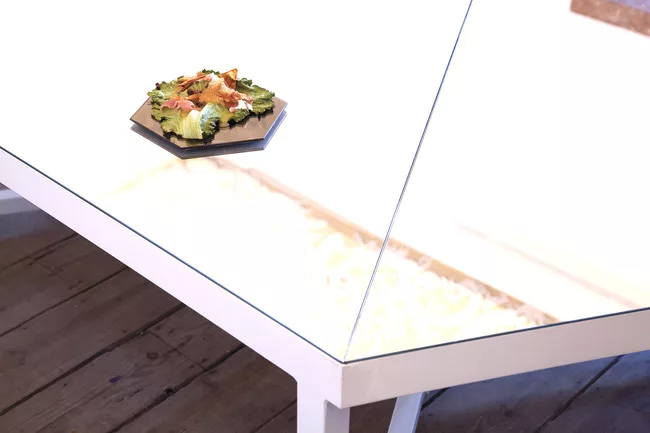
The Planetary Sculpture Supper Club (2013), a series of dinners and conversations hosted by the Center for Genomic Gastronomy.
Photo © Luke Hayes
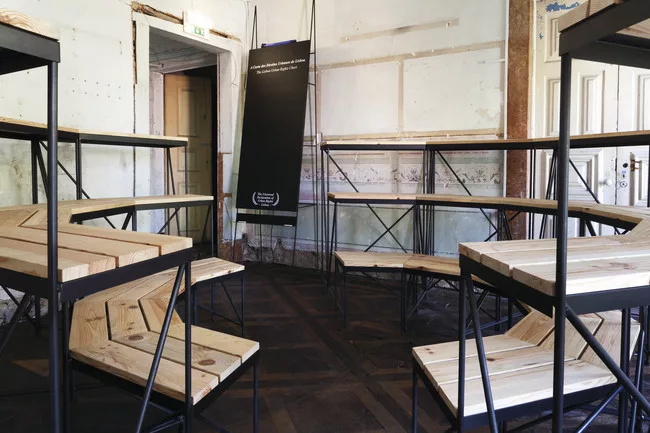
Zuloark’s Universal Declaration of Urban Rights (2013) installation at the Palácio Pombal.
Photo © Catarina Botelho
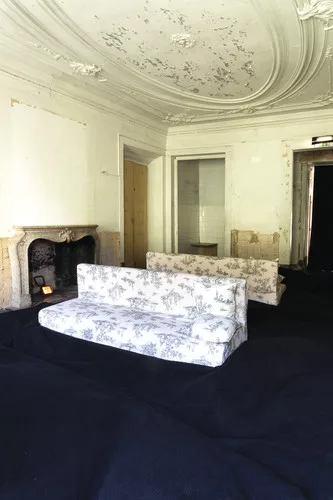
Alex Schweder, Slowly Ceiling (2013)
Photo © Catarina Botelho
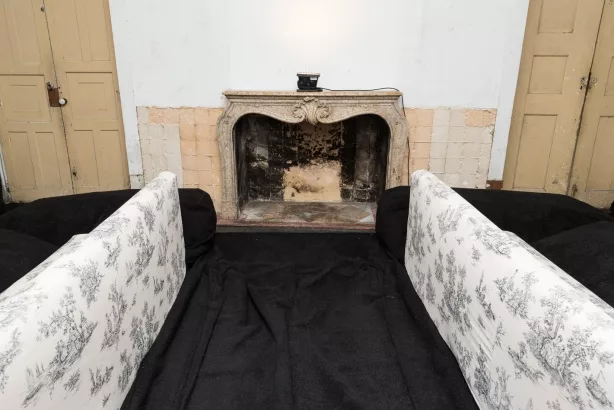
Alex Schweder, Slowly Ceiling (2013)
Photo © Delfino Legnani
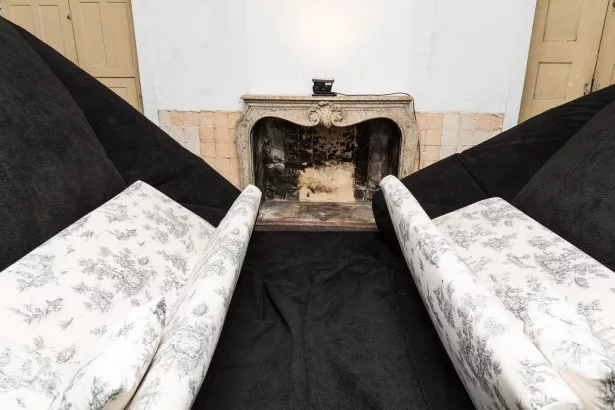
Alex Schweder, Slowly Ceiling (2013)
Photo © Delfino Legnani
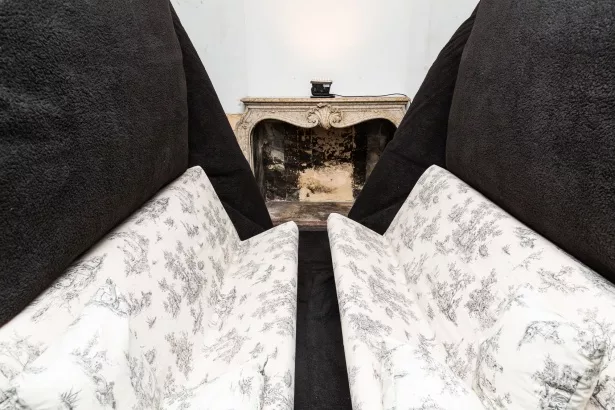
Alex Schweder, Slowly Ceiling (2013)
Photo © Delfino Legnani
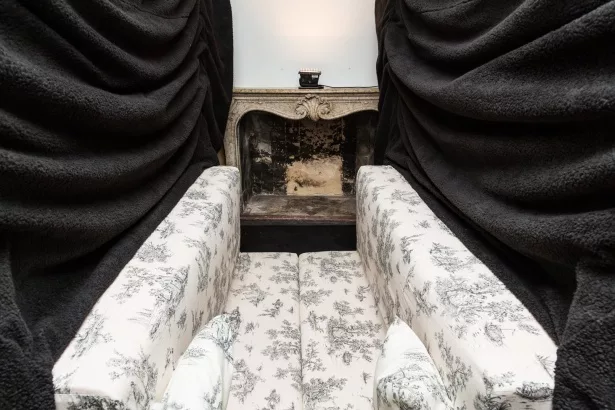
Alex Schweder, Slowly Ceiling (2013)
Photo © Delfino Legnani
The 2013 Lisbon Architecture Triennale feels like a work in progress. But that’s the idea, according Beatrice Galilee, the London-based editor and curator who organized the exhibition. The show, which opened in September and runs through December 15, consists of an ongoing calendar of workshops, performances, and other public events as much as it does installations and gallery presentations of architectural objects. This is largely because the organizers had an austere budget that was slashed dramatically after the European financial crisis hit already-hurting Portugal. But Galilee and her curatorial team also used that constraint as an opportunity to avoid the pitfalls of similar shows that tend to open with much hype to a visiting class of international connoisseurs but do little to involve people living in the host city throughout their run. Even the slightly clumsy title—Close, Closer—is meant to suggest the act of moving toward and engaging with something.
The triennale sprawls through several locations in central Lisbon, but it is concentrated in four primary venues that each host thematically related but discrete programs organized by four different curators. Three of the organizers—Dani Admiss, Mariana Pestana, and Liam Young—are based in the United Kingdom, while former Domus editor José Esparza Chong Cuy is currently based in Mexico City, and all of them, like Galilee, are under 40. Together they have crafted a youthful, messy, and ad-hoc presentation—with high highs, and a few low lows—that, despite its unevenness, pulses with a scrappy energy.
Rather than displays of architectural work, The Institute Effect, Admiss’s section of the triennale highlights the act of selecting and displaying. The curator has turned the second floor of the MUDE Fashion and Design Museum—a former bank building renovated by Ricardo Carvalho + Joana Vilhena—into a workshop for exhibition venues, publications, and other groups in the business of presenting design work. Twelve organizations—from New York’s Storefront for Art and Architecture and Center for Urban Pedagogy to Moscow’s Strelka Institute and Portugal’s own Jornal Arquitectos—have been given successive residencies there throughout the exhibition to bring their specific brand of curatorial work and public programming to the museum. Furniture and partitions designed by Fabrica—a Treviso, Italy design and communications think tank—are reconfigured for each residency, and the results of each project are displayed along a timeline painted on a side wall.
In contrast to The Institute Effect’s short term residencies, the most traditionally object-focused show in the exhibition also contains some of its most disappointing moments. Housed in the Museu da Eletricidade, an impressive former power plant on the bank of the Tagus River, Future Perfect presents a “fictional, future city” with a series of works set in an artificial landscape. Visitors follow a winding pathway around an ersatz forest designed by Revital Cohen and Tuur Van Balen where they encounter different “districts” of the imagined city. One of them, “The Supercomputer,” is a performance in which members of the British group Marshmallow Laser Feast dance among shifting beams of light—picture an Anthony McCall projector installation—in a not-very-subtle metaphor for the intertwining of human and electronic systems in urban spaces.
The city’s “Garment District” veers into kitsch with a work by Dutch designer Bart Hess, for which, in a series of events during the opening week, he suspended a harnessed female performer from overhead rigging and then dipped her into a pool of hot wax. Pulled back up, her body was covered in a hardened white skein, which she cracked off for Hess to reassemble into hanging sculptures. Intended to evoke surveillance and glitchy virtual avatars—traces of personhood imprefectly reconstructed on the Internet—the performances instead recalled Yves Klein’s Anthropometries of the Blue, complete with the cringe-worthy 1950s gender dynamic. Like the rest of the work in the show, the piece evokes a Blade Runner-style dystopian futurism, which could be a fun and rewarding frame for speculation about urban conditions, but the investigation unfortunately never goes more than skin deep.
More successful is The Real and Other Fictions, the component of the Triennial organized by Mariana Pestana. Installed in the 16th-century Palácio Pombal, once the residence of the first Marquis of Pombal and later an embassy, the exhibition riffs on notions of state hospitality as it wanders through palatial rooms in varying states of preservation and decay. A salon with restrained Rococo details and tile wainscoting is appointed with a mirrored desk and throne by Paulo Moreira and Kiluanji Kia Henda. Symbols of political authority, they dematerialize as they reflect both the tattered décor as well as the visitor. A similarly mirrored table reflects an ornate plaster ceiling and hosts a series of small dinners and conversations organized by the Center for Genomic Gastronomy throughout the Triennale.
As the show critiques official protocols of institutional power, it also celebrates platforms for cooking up alternate forms of political and social organization. For a narrow anteroom, the Spanish organization Zuloark has designed a series of steeply tiered bleachers used for a program of debates about urban politics, while the Portugese architecture collective Friendly Fire has set up a ‘zine-making station, where a ring of seating and cantilevered fluorescent lighting surround a photocopier and a selection of standard office supplies, its aesthetic of contemporary technical efficiency contrasting with the peeling pomp of the room.
In an adjacent space, Alex Schweder has engineered a collaborative environment of a more intimate type. The designer has covered the floor in a black drop cloth and place two toile-covered couches back-to-back in front of the room’s fireplace. When two people lie on the couches, the floor folds upward on either side, closing toward the center like a book. The sofas combine into a single bed, their occupants dumped toward one another.
The Triennale’s simplest platform for performances, dialogues, and other event-based work, is also its most public and its most compelling. In Lisbon’s Praça da Figueira, a historic center of the city and the site, one year ago, of massive protests against austerity-focused economic policies, the exhibition’s organizers have erected a stage designed by Mexican architect Frida Escobedo. A simple wooden circle, about 20 feet in diameter, it is raised on one side to create a gradually sloping surface, clearly a stage but also part of the street—it has been a hit with skateboarders in heavily cobblestoned Lisbon.
Fort the stage, Chong Cuy has organized New Publics, a series of performances that have ranged from the directly political—a debate among Lisbon mayoral candidates inaugurated the stage in September—to the dramatic, including Andrés Jaque’s homage to Charles and Ray Eames, “Superpowers of 10.” Along the way, programming has included a presentation detailing a scheme for helping people in Portugal in danger of losing their homes to the ailing economy, a golf game as a metaphor for claiming public space, and a regular presentations by local civic organizations.
In the square, the successes of the Triennale are clear. Against the backdrop of economic hardship, the diverse programming takes more from a strain of socially engaged art practice than large, Venice-style installations. Rather than presenting an architecture of bombastic baubles or technological spectacles, much of the work instead tries its best to draw visitors into discussions about the political and social potential of design, asking how architecture and architectural thinking can be used to ends beyond building. The results are sometimes humble, but in a place heavy with the malaise of high unemployment and economic agita, these conversations reverberate with possibility.
Looking for a reprint of this article?
From high-res PDFs to custom plaques, order your copy today!