Architectural Record
search
cart
facebook twitter linkedin youtube
  • Sign In
  • Subscribe
  • Sign Out
  • My Account
Architectural Record
  • NEWS
    • Latest News
    • Awards
    • Interviews
    • Obituaries
    • Podcasts
      • Design:Ed Podcast
      • Sponsored Podcasts
  • OPINION
    • Book Reviews / Excerpts
    • Exhibition Reviews
    • Forum
  • EXCLUSIVES
    • Videos
    • Design Vanguard
    • Top 300 Firms
    • Sponsored Content
    • Sponsored eBooks
    • From the Archives
  • CONTINUING ED
    • Editorial Continuing Ed
    • CE Center
    • CE Academies
  • PROJECTS
    • Buildings By Type
    • Reuse & Renovation
    • Museums & Arts Centers
    • Colleges & Universities
    • Multifamily Housing
    • Interiors
    • Lighting
    • Kitchen & Bath
  • HOUSES
    • Record Houses
    • House of the Month
    • Featured Houses
  • PRODUCTS
    • Products by Category
    • Record Products of the Year
    • Latest Products
  • EVENTS
    • Dates & Events
    • Record on the Road
    • Innovation Conference
    • Sustainability in Practice
    • Women In Architecture
    • Webinars
    • Ad Excellence Awards
    • Submit an Event
  • CONNECT
    • Ask RECORD AI
    • Newsletters
    • Contact
    • Advertise
    • Editorial Calendar
    • Store
    • Customer Service
  • SUBMIT
    • Submission Guidelines
    • RECORD Competitions
  • MAGAZINE
    • Subscribe
    • My Account
    • Digital Edition
    • Current Issue
    • Firm Pass
    • Historic Archive
Architecture NewsInterviews

Newsmakers: Sheila O'Donnell and John Tuomey

By Hugh Pearman
October 16, 2014


Sheila O'Donnell John Tuomey
Photo © Amelia Stein
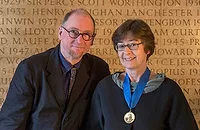
John Tuomey and Sheila O'Donnell of O'Donnell + Tuomey Architects.

The premiere architecture award in the UK—trumping even the annual Stirling Prize for best building—is the Royal Gold Medal, the annual award for individual long-term excellence that has existed since 1848. It is presented by the Royal Institute of British Architects (RIBA) with the approval of the monarch, and counts everyone from Le Corbusier and Louis Kahn to Richard Rogers and Archigram among its recipients. Each year a new name is chiseled into the stone-lined foyer of RIBA’s London headquarters—as will be, in early 2015, the names of Dublin-based pair Sheila O’Donnell and John Tuomey.

It’s a tribute to the respect and affection in which they are held: husband-and-wife partners who—having cut their teeth working for James Stirling and Michael Wilford, among other practices in London—returned to Dublin at the start of the 1980s to set up their own studio. With like-minded colleagues of the same generation in the Group 91 collective, they jointly master-planned the revival of the Temple Bar district, then threatened with demolition. Their practice evolved through a series of much-lauded buildings, in both the Republic and Northern Ireland. Finally they landed back in London, most notably with their Saw Swee Hock Student Centre for the London School of Economics.

What does winning the medal mean to you? 

O’Donnell: We were totally surprised. When Stephen Hodder (RIBA president) phoned us, I was completely gobsmacked. I hadn’t seen this in the ether at all. But I was honored and delighted, because the Royal Gold Medal has a position in one’s mind as a remarkably significant thing. The names on the wall . . .

Tuomey: We’ve had hundreds and hundreds of letters, cards, and e-mails from people in all corners of the world. They seem to think that it says something about the recognition of architects of our kind. The medal has got a ranking in the world, it feels like it has credibility, integrity.

You made a conscious decision to return to Dublin in uncertain economic times, rather than continue to work for others in London. Did you have a clear goal?

Tuomey: We certainly did. It was the early 1980s. Had we stayed in London, we would have been creatively engaged and usefully employed. I would have been made an associate in Stirling’s office. But I thought, now is the time to go. We had a sense of mission, to put some meaning into unformed Irish architecture. We were worried that the architecture we’d grown up with in Ireland had lost its European character and scale.

O’Donnell: John came back in 1980; I did in 1981. At the time, it seemed an unpromising environment in which to make architecture. We were part of a movement in London in the late 1970s and early 1980s. The history of the European city was starting to impact architecture. But people were using history as shorthand, as motif. Perhaps part of coming back was a return to essentials—not what history looked like, but what it meant, how architecture grows out of context and culture.

How important is Stirling to you today?

O’Donnell: There’s the sense of his tenacity, of hanging onto an idea, but also his work method and the culture of his office. We made huge 1:50 drawings, gradually building up the layers on a key drawing that showed everything. We took that with us when we set up our own practice. We decided that was the way to make things.

Tuomey: Stirling’s office model underpins our practice. He was involved in every single aspect. We see ourselves as being like that:
I should know every railing on every half-landing. You can hold the whole scheme in your hand or head.

You are known for small- to medium-scale projects. Do you hanker after a megaproject?

Tuomey: Absolutely. We haven’t yet had that reach, but that’s not our choice. We would like to think about things on a larger scale.
We don’t want to feel confined or defined by what we have done.

O’Donnell: A piece of city, yes. But also single buildings that are larger than the often complex single buildings we’ve already done! There’s as much work and detail in them as there is in a building five times the size. And housing: wouldn’t it be great to do the equivalent of a Georgian square?

So what will be your next significant project?

O'Donnell: We’re designing the Central European University in Budapest, in a World Heritage site. It’s an international English-language postgraduate university. It has something of the feeling of an American university, of the kind where we’ve done a lot of teaching. It’s a mixture of re-use and new buildings. Big, compared to the scale of Georgian Dublin.

KEYWORDS: RIBA Gold Medal

Share This Story

Looking for a reprint of this article?
From high-res PDFs to custom plaques, order your copy today!

London-based Hugh Pearman is the editor of the RIBA Journal.

Post a comment to this article

Report Abusive Comment

Subscription Center
  • Create an Account
  • Start a Subscription
  • Manage My Account
  • Sign Up for Newsletters
  • Visit Customer Service
  • Update Preferences

More Videos

Sponsored Content

Sponsored Content is a special paid section where industry companies provide high quality, objective, non-commercial content around topics of interest to the Architectural Record audience. All Sponsored Content is supplied by the advertising company and any opinions expressed in this article are those of the author and not necessarily reflect the views of Architectural Record or its parent company, BNP Media. Interested in participating in our Sponsored Content section? Contact your local rep!

close
  • TAMLYN XtremeTrim Exterior Trim
    Sponsored byTamlyn

    Designing Cleaner Panel Facades: Why Exterior Trim Details Matter

  • Building with Vapor Barriers
    Sponsored byReef Industries, Inc.

    Vapor Barriers Help Control Moisture in Tighter Building Designs

  • Duct Interior with Prodeq System
    Sponsored byHenry, a Carlisle Company

    Designing Resilient Water Containment Systems

DESIGN:ED Podcast
Listen to Architectural Record’s DESIGN:ED Podcast

Events

June 10, 2026

Rethinking Stormwater – The Power of Porous Paving

Credits: 1 AIA LU/HSW; 1 AIBD P-CE; 0.1 ICC CEU

Learn how porous paving systems support stormwater management, reduce heat island effects, and enhance sustainable site design performance.

June 11, 2026

Very Early Warning Fire Detection for Mission-Critical Facilities

Credits: 1 AIA LU/HSW; 1 AIBD P-CE; 0.1 ICC CEU

Examine advanced fire detection strategies that support uptime and enhance safety in data centers and other mission-critical facilities.

View All Submit An Event

Products

2026 Architect's Square Foot Costbook

2026 Architect's Square Foot Costbook

See More Products

Popular Stories

Practice Matters illustration

What’s in a (Firm’s) Name? Thinking About Succession and Legacy

Practice Matters illustration

By the Numbers: Counting America's Architects

House on a Hill

Design Vanguard 2026: Forma

Crane Cove, ONO

Design Vanguard 2026 Winners

House A on a Hill

Design Vanguard 2026: Santiago Valdivieso

Broader Sustainability of CMU - Free Webinar - May 21, 2026

Related Articles

  • Sheila O'Donnell

    Sheila O’Donnell Named Architect of the Year by Architects' Journal and The Architectural Review

    See More
  • V&A East

    The O’Donnell + Tuomey–Designed V&A East Museum Engages London with a Couturier-Inspired Facade

    See More
×

The latest news and information

#1 Source for Architectural Design, News and Products

SUBSCRIBE
  • RESOURCES
    • Advertise
    • Contact Us
    • Submit
    • Store
  • ACCOUNT CENTER
    • Create an Account
    • Start a Subscription
    • Manage My Account
    • Sign Up for Newsletters
    • Visit Customer Service
    • Update Preferences
  • PRIVACY
    • PRIVACY POLICY
    • TERMS & CONDITIONS
    • DO NOT SELL MY PERSONAL INFORMATION
    • PRIVACY REQUEST
    • ACCESSIBILITY
  • SERVICES
    • Marketing Services
    • Reprints
    • Market Research
    • List Rental
    • Survey/Respondent Access
  • STAY CONNECTED
    • Linkedin
    • Facebook
    • Instagram
    • YouTube
    • X (Twitter)

Copyright ©2026. All Rights Reserved BNP Media, Inc. and BNP Media II, LLC.

Design, CMS, Hosting & Web Development :: ePublishing