Architectural Record
search
cart
facebook twitter linkedin youtube
  • Sign In
  • Subscribe
  • Sign Out
  • My Account
Architectural Record
  • NEWS
    • Latest News
    • Awards
    • Interviews
    • Obituaries
    • Podcasts
      • Design:Ed Podcast
      • Sponsored Podcasts
  • OPINION
    • Book Reviews / Excerpts
    • Exhibition Reviews
    • Forum
  • EXCLUSIVES
    • Videos
    • Design Vanguard
    • Top 300 Firms
    • Sponsored Content
    • Sponsored eBooks
    • From the Archives
  • CONTINUING ED
    • Editorial Continuing Ed
    • CE Center
    • CE Academies
  • PROJECTS
    • Buildings By Type
    • Reuse & Renovation
    • Museums & Arts Centers
    • Colleges & Universities
    • Multifamily Housing
    • Interiors
    • Lighting
    • Kitchen & Bath
  • HOUSES
    • Record Houses
    • House of the Month
    • Featured Houses
  • PRODUCTS
    • Products by Category
    • Record Products of the Year
    • Latest Products
  • EVENTS
    • Dates & Events
    • Record on the Road
    • Innovation Conference
    • Sustainability in Practice
    • Women In Architecture
    • Webinars
    • Ad Excellence Awards
    • Submit an Event
  • CONNECT
    • Ask RECORD AI
    • Newsletters
    • Contact
    • Advertise
    • Editorial Calendar
    • Store
    • Customer Service
  • SUBMIT
    • Submission Guidelines
    • RECORD Competitions
  • MAGAZINE
    • Subscribe
    • My Account
    • Digital Edition
    • Current Issue
    • Firm Pass
    • Historic Archive
Architecture NewsInterviews

Newsmaker: Greg Lynn

By Zachary Edelson
Greg Lynn
Newsmaker: Greg Lynn
Greg Lynn
Photograph by David Lai, Hello Design
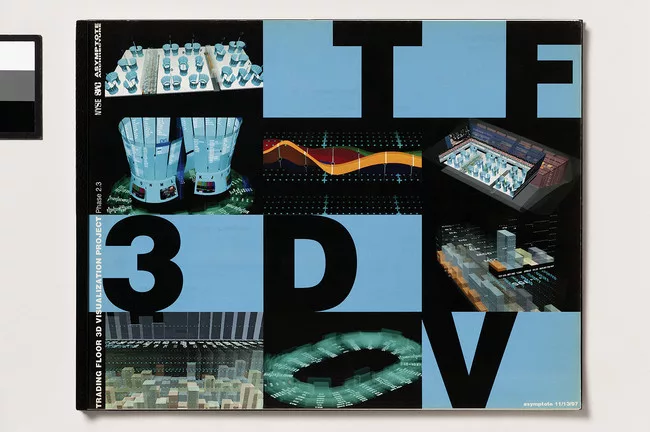
Asymptote Architecture's (Hani Rashid, Lise Anne Couture) trading floor visualization project of the Virtual Trading Floor<em>,</em> phase 2.3 documentation, 1997&#8211;1999, Electrostatic colour prin
Newsmaker: Greg Lynn
Asymptote Architecture's (Hani Rashid, Lise Anne Couture) trading floor visualization project of the Virtual Trading Floor, phase 2.3 documentation, 1997–1999, Electrostatic colour print, 1997.

Image © Asymptote
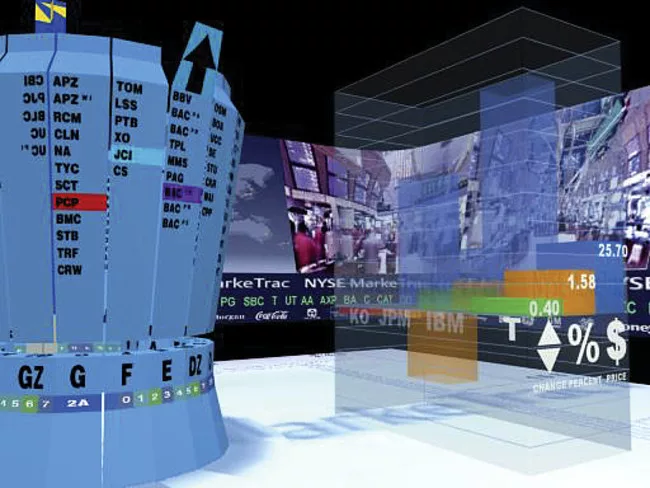
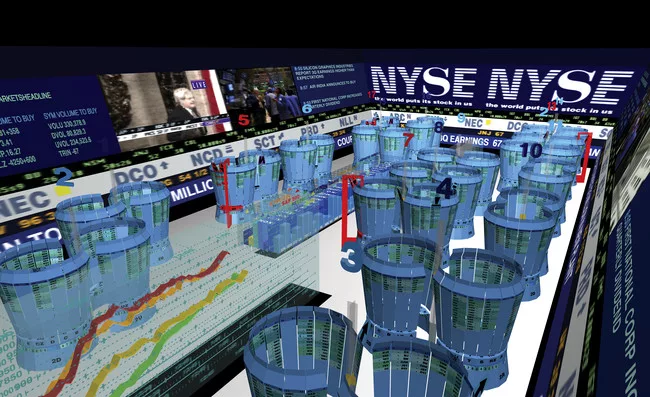
Asymptote Architecture's MarkeTrac web environment for the New York Stock Exchange, 1997&#8211;1999, 2001.<br /><div id='_mcePaste'>&#65279;&#65279;
Newsmaker: Greg Lynn
Asymptote Architecture's MarkeTrac web environment for the New York Stock Exchange, 1997–1999, 2001.

Image © Asymptote
Asymptote Architecture's trading floor visualization project of the Virtual Trading Floor, 1997&#8211;1999.<div id='_mcePaste'>&#65279;&#65279;
Newsmaker: Greg Lynn
Asymptote Architecture's trading floor visualization project of the Virtual Trading Floor, 1997–1999.

Image © Asymptote
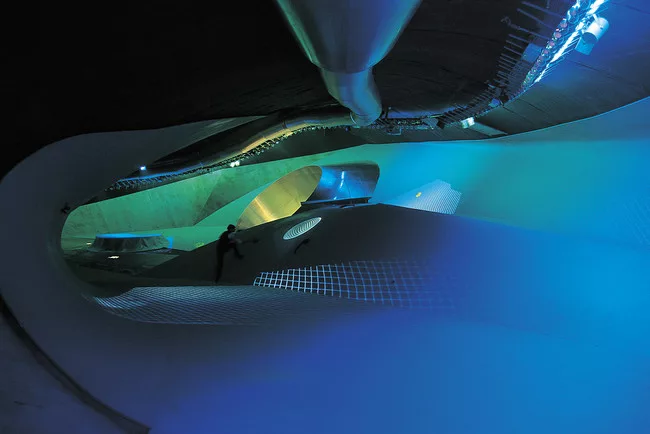
NOX's (Lars Spyubroek) interior photograph of the building <em>H2Oexpo</em> Neeltje Jans, The Netherlands, 1993&#8211;1997.<br />&#169; NOX<div id='_mcePaste'>&#65279;&#65279;
Newsmaker: Greg Lynn
NOX's (Lars Spyubroek) interior photograph of the building H2Oexpo Neeltje Jans, The Netherlands, 1993–1997.
© NOX

Image © NOX
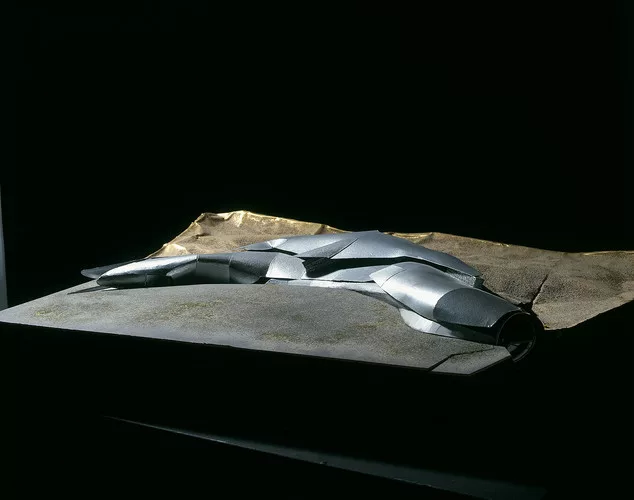
NOX's study model of <em>H2Oexpo</em>, Neeltje Jans, Pays-Bas, 1994. Wood, aluminum, sheet metal, cardboard, plastic, paper, metallic paint, air hardening modeling paste.<br />
Newsmaker: Greg Lynn
NOX's study model of H2Oexpo, Neeltje Jans, Pays-Bas, 1994. Wood, aluminum, sheet metal, cardboard, plastic, paper, metallic paint, air hardening modeling paste.
Image courtesy FRAC Centre
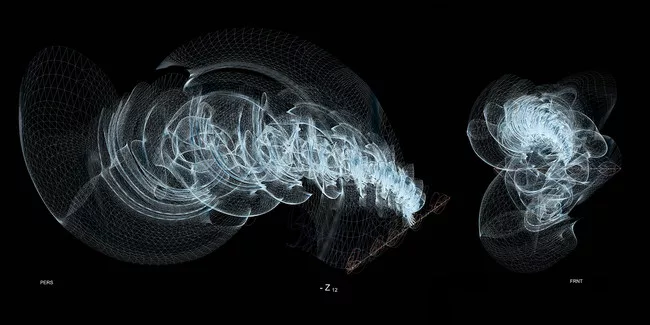
Karl Chu's <em>X Phylum</em>, -Z rule-set lofted splines in perspective (left) and frontal elevation (right), 1999.<div id='_mcePaste'>&#65279;&#65279;
Newsmaker: Greg Lynn
Karl Chu's X Phylum, -Z rule-set lofted splines in perspective (left) and frontal elevation (right), 1999.

Image © Karl Chu
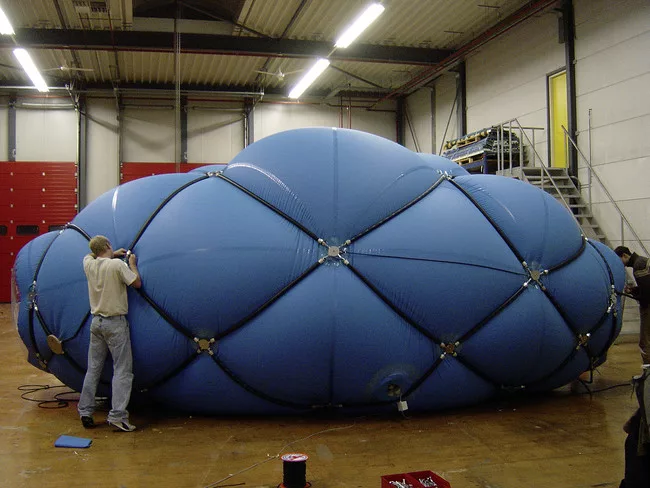
ONL's (Oosterhuis_L&#233;n&#224;rd: Kas Oosterhuis, Ilona L&#233;n&#224;rd) view of the prototype of the <em>NSA Muscle</em> at TU Delft, 2003.<div id='_mcePaste'>&#65279;&#65279;
Newsmaker: Greg Lynn
ONL's (Oosterhuis_Lénàrd: Kas Oosterhuis, Ilona Lénàrd) view of the prototype of the NSA Muscle at TU Delft, 2003.

Photo © ONL
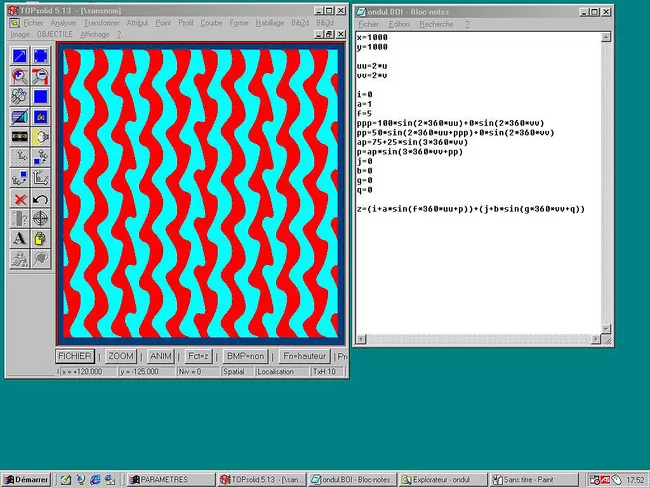
Objectile's (Bernard Cache) screenshot of TopSolid&#8482; version 5 interface showing variations of surfaces by manipulation of a parametric equation, 1998.<div id='_mcePaste'>&#65279;&#65279;
Newsmaker: Greg Lynn
Objectile's (Bernard Cache) screenshot of TopSolid™ version 5 interface showing variations of surfaces by manipulation of a parametric equation, 1998.

Image © Bernard Cache
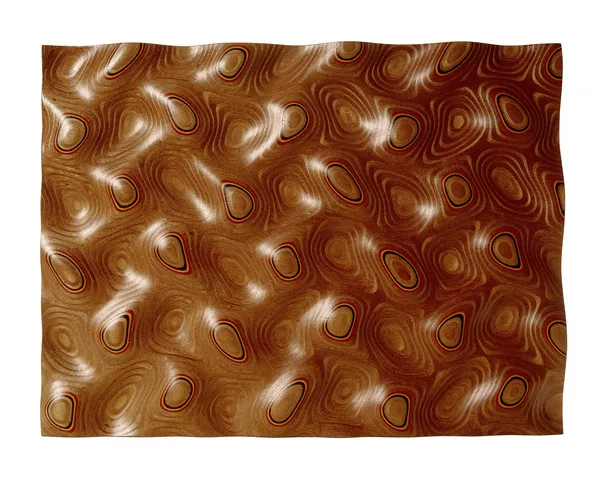
Objectile's decorative wood panel manufactured by a computer numerical command machine-tool, 1998. Varnished wood and MDF.<br /><div id='_mcePaste'>&#65279;&#65279;
Newsmaker: Greg Lynn
Objectile's decorative wood panel manufactured by a computer numerical command machine-tool, 1998. Varnished wood and MDF.

Image courtesy FRAC Centre
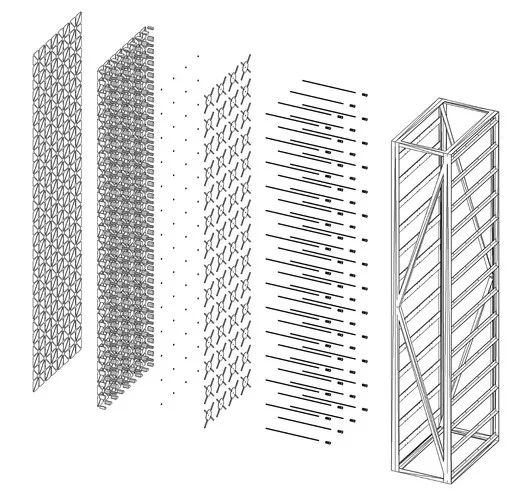
dECOi Architects's (Mark Goulthorpe) <em>HypoSurface</em>, exploded axonometric drawing of the metal skin, rubber squid connectors and spring stabilisers, 2001.<div id='_mcePaste'>&#65279;&#65279;
Newsmaker: Greg Lynn
dECOi Architects's (Mark Goulthorpe) HypoSurface, exploded axonometric drawing of the metal skin, rubber squid connectors and spring stabilisers, 2001.

Image © Mark Goulthorpe
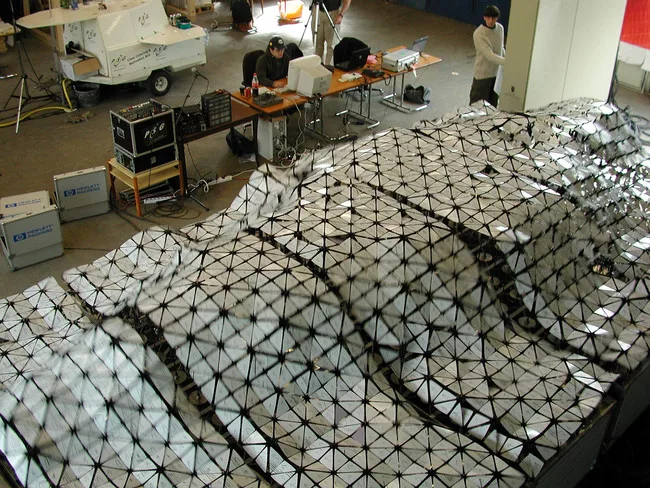
dECOi Architects' <em>HypoSurface</em>, view of the testing of the installation, 2004.<br /><div id='_mcePaste'>&#65279;&#65279;
Newsmaker: Greg Lynn
dECOi Architects' HypoSurface, view of the testing of the installation, 2004.

Photo © Mark Goulthorpe
Greg Lynn
Asymptote Architecture's (Hani Rashid, Lise Anne Couture) trading floor visualization project of the Virtual Trading Floor<em>,</em> phase 2.3 documentation, 1997&#8211;1999, Electrostatic colour prin
Asymptote Architecture's MarkeTrac web environment for the New York Stock Exchange, 1997&#8211;1999, 2001.<br /><div id='_mcePaste'>&#65279;&#65279;
Asymptote Architecture's trading floor visualization project of the Virtual Trading Floor, 1997&#8211;1999.<div id='_mcePaste'>&#65279;&#65279;
NOX's (Lars Spyubroek) interior photograph of the building <em>H2Oexpo</em> Neeltje Jans, The Netherlands, 1993&#8211;1997.<br />&#169; NOX<div id='_mcePaste'>&#65279;&#65279;
NOX's study model of <em>H2Oexpo</em>, Neeltje Jans, Pays-Bas, 1994. Wood, aluminum, sheet metal, cardboard, plastic, paper, metallic paint, air hardening modeling paste.<br />
Karl Chu's <em>X Phylum</em>, -Z rule-set lofted splines in perspective (left) and frontal elevation (right), 1999.<div id='_mcePaste'>&#65279;&#65279;
ONL's (Oosterhuis_L&#233;n&#224;rd: Kas Oosterhuis, Ilona L&#233;n&#224;rd) view of the prototype of the <em>NSA Muscle</em> at TU Delft, 2003.<div id='_mcePaste'>&#65279;&#65279;
Objectile's (Bernard Cache) screenshot of TopSolid&#8482; version 5 interface showing variations of surfaces by manipulation of a parametric equation, 1998.<div id='_mcePaste'>&#65279;&#65279;
Objectile's decorative wood panel manufactured by a computer numerical command machine-tool, 1998. Varnished wood and MDF.<br /><div id='_mcePaste'>&#65279;&#65279;
dECOi Architects's (Mark Goulthorpe) <em>HypoSurface</em>, exploded axonometric drawing of the metal skin, rubber squid connectors and spring stabilisers, 2001.<div id='_mcePaste'>&#65279;&#65279;
dECOi Architects' <em>HypoSurface</em>, view of the testing of the installation, 2004.<br /><div id='_mcePaste'>&#65279;&#65279;
December 16, 2014

Greg Lynn

No single tool has become more critical to architectural practice than the computer. In fewer than 30 years, CAD software and related products have become an entire industry by catering to the needs of designers. But the early years of architects’ use of digital tools are little known. Greg Lynn, founder of Greg Lynn FORM and a professor at UCLA, has curated exhibitions that explore this early architectural experimentation. The exhibition, the second of three on this theme, Archaeology of the Digital: Media and Machines, originally at the Canadian Centre for Architecture, is now at the Yale School of Architecture (through May 1, 2015), where Lynn is the Davenport Visiting Professor.

What spurred you to conduct an Archaeology of the Digital?

The exhibitions are part of an archival project at the CCA. It started years ago when they acquired my Embryological House project, with its physical and digital material. That prompted a discussion of what their policy on digital material should be—the scope of their efforts and how to save the material. Another big part of the exhibition is interviews with the architects, collaborators, and technologists, to build an oral history. It’s too early to write the history of digital architecture, but without this information, nobody can.

So the exhibition contains some unconventional architectural material?

We included a lot of interactive mechanical elements that people won’t be used to seeing. For example, there’s ONL’s NSA Muscle hanging on the wall, pumping away when visitors walk up to it. The HypoSurface by dECOi Architects isn’t interactive, but it’s exciting to see that big robotic wall moving. Along with Karl Chu’s Catastrophe Machine, these are robots that change the space and make things dynamic.

What stands out in this period of early experimentation, now 20 years old?

For me, what was amazing was how people were looking to the computer for formal or fabrication possibilities even as others looked for an architectural response to large-scale media and interactivity. For whatever reason, most architectural interest in digital technology then shifted to fabrication. Now everyone’s looking to smart and interactive environments. Google and Amazon have picked up a lot of the interests of this exhibition’s architects. If somebody had spent the last 15 years working on those interests, they would be insanely successful right now. A lot of the architects’ collaborators ended up pivoting toward apps and the Web.

What will different generations see in this exhibition?

The projects, and the period they come from, are probably unknown to most. We received a lot of custom software and machines for interfaces from these architects. It’s remarkable to see that, even 30 years ago, architects were already developing technology in-house. The myth is that architects just use or misuse software, but the reality is that certain architects were the ones who developed the technology. There was no off-the-shelf architecture software back then; it was very bespoke.

So much of what enabled the projects is ephemeral: programs and scripts that have been lost or can’t be read by most of today’s computers. Did curating these projects present special challenges?

The first exhibition was interesting because a lot of people associate the advent of digital technology with people of my generation but it was really two generations ahead of us. That older material was the most fragile, un-openable, and a lot of it had disappeared. It’s a huge challenge.

There’s an ongoing conversation about how we let digital tools shape architectural designs. You’ve been a part of that debate from its beginnings, writing about biomorphic architecture and using calculus in designing your architecture. Does this exhibition offer some perspective on that discussion?

In the 80s there was a rich culture of intellectual exchange between historians, writers, intellectuals, outside the architecture field. It was an amazing time, and digital technology entered into that whole dialogue and really took center stage. Theorists, historians, practitioners became very interested in the computer. And then the whole bottom dropped out, and I don’t know exactly why. Theorists retreated into histories of postwar modernism and stopped speculating on contemporary work. Architects stopped talking to cultural and intellectual audiences. They just started to have shoptalk about fabrication. It became very vocational. What I’m hoping for with these shows is to provoke a new generation to reengage with that material. Most historians were trained in, at least, perspective, plans, and section. They had a working knowledge of the tools, so they could write a history of it. Most historians aren’t trained in these digital tools, and they have to resort to platitudes or retreat from the discussion.

You’re currently working in an experimental robotics studio. Is that what’s next for you?

It is. I would credit the CCA with reigniting my interest in robotics: not just for manufacturing, but for building dynamic spaces. At UCLA we’ve got a new facility with the ability to move around walls and floors and large-scale things like that. It really came out of looking at this period.

Share This Story

Looking for a reprint of this article?
From high-res PDFs to custom plaques, order your copy today!

Post a comment to this article

Report Abusive Comment

Subscription Center
  • Create an Account
  • Start a Subscription
  • Manage My Account
  • Sign Up for Newsletters
  • Visit Customer Service
  • Update Preferences

More Videos

Sponsored Content

Sponsored Content is a special paid section where industry companies provide high quality, objective, non-commercial content around topics of interest to the Architectural Record audience. All Sponsored Content is supplied by the advertising company and any opinions expressed in this article are those of the author and not necessarily reflect the views of Architectural Record or its parent company, BNP Media. Interested in participating in our Sponsored Content section? Contact your local rep!

close
  • TAMLYN XtremeTrim Exterior Trim
    Sponsored byTamlyn

    Designing Cleaner Panel Facades: Why Exterior Trim Details Matter

  • Building with Vapor Barriers
    Sponsored byReef Industries, Inc.

    Vapor Barriers Help Control Moisture in Tighter Building Designs

  • Duct Interior with Prodeq System
    Sponsored byHenry, a Carlisle Company

    Designing Resilient Water Containment Systems

DESIGN:ED Podcast
Listen to Architectural Record’s DESIGN:ED Podcast

Events

June 10, 2026

Rethinking Stormwater – The Power of Porous Paving

Credits: 1 AIA LU/HSW; 1 AIBD P-CE; 0.1 ICC CEU

Learn how porous paving systems support stormwater management, reduce heat island effects, and enhance sustainable site design performance.

June 11, 2026

Very Early Warning Fire Detection for Mission-Critical Facilities

Credits: 1 AIA LU/HSW; 1 AIBD P-CE; 0.1 ICC CEU

Examine advanced fire detection strategies that support uptime and enhance safety in data centers and other mission-critical facilities.

View All Submit An Event

Products

2026 Architect's Square Foot Costbook

2026 Architect's Square Foot Costbook

See More Products

Popular Stories

Practice Matters illustration

What’s in a (Firm’s) Name? Thinking About Succession and Legacy

Practice Matters illustration

By the Numbers: Counting America's Architects

Riverdale House by Studio Lau

Riverdale House by Studio Lau

House on a Hill

Design Vanguard 2026: Forma

Crane Cove, ONO

Design Vanguard 2026 Winners

Broader Sustainability of CMU - Free Webinar - May 21, 2026

Related Articles

  • Greg Lynn, Teddy Cruz Win $50,000 USA Awards

    See More
  • Gita

    Meet Gita, Greg Lynn’s Cargo Robot for Piaggio

    See More
  • Newsmaker: Lynn Richards

    See More

Related Products

See More Products
  • 1118522532.gif

    Future Details of Architecture

See More Products
×

The latest news and information

#1 Source for Architectural Design, News and Products

SUBSCRIBE
  • RESOURCES
    • Advertise
    • Contact Us
    • Submit
    • Store
  • ACCOUNT CENTER
    • Create an Account
    • Start a Subscription
    • Manage My Account
    • Sign Up for Newsletters
    • Visit Customer Service
    • Update Preferences
  • PRIVACY
    • PRIVACY POLICY
    • TERMS & CONDITIONS
    • DO NOT SELL MY PERSONAL INFORMATION
    • PRIVACY REQUEST
    • ACCESSIBILITY
  • SERVICES
    • Marketing Services
    • Reprints
    • Market Research
    • List Rental
    • Survey/Respondent Access
  • STAY CONNECTED
    • Linkedin
    • Facebook
    • Instagram
    • YouTube
    • X (Twitter)

Copyright ©2026. All Rights Reserved BNP Media, Inc. and BNP Media II, LLC.

Design, CMS, Hosting & Web Development :: ePublishing