Architectural Record
search
cart
facebook twitter linkedin youtube
  • Sign In
  • Subscribe
  • Sign Out
  • My Account
Architectural Record
  • NEWS
    • Latest News
    • Awards
    • Interviews
    • Obituaries
    • Podcasts
      • Design:Ed Podcast
      • Sponsored Podcasts
  • OPINION
    • Book Reviews / Excerpts
    • Exhibition Reviews
    • Forum
  • EXCLUSIVES
    • Videos
    • Design Vanguard
    • Top 300 Firms
    • Sponsored Content
    • Sponsored eBooks
    • From the Archives
  • CONTINUING ED
    • Editorial Continuing Ed
    • CE Center
    • CE Academies
  • PROJECTS
    • Buildings By Type
    • Reuse & Renovation
    • Museums & Arts Centers
    • Colleges & Universities
    • Multifamily Housing
    • Interiors
    • Lighting
    • Kitchen & Bath
  • HOUSES
    • Record Houses
    • House of the Month
    • Featured Houses
  • PRODUCTS
    • Products by Category
    • Record Products of the Year
    • Latest Products
  • EVENTS
    • Dates & Events
    • Record on the Road
    • Innovation Conference
    • Sustainability in Practice
    • Women In Architecture
    • Webinars
    • Ad Excellence Awards
    • Submit an Event
  • CONNECT
    • Ask RECORD AI
    • Newsletters
    • Contact
    • Advertise
    • Editorial Calendar
    • Store
    • Customer Service
  • SUBMIT
    • Submission Guidelines
    • RECORD Competitions
  • MAGAZINE
    • Subscribe
    • My Account
    • Digital Edition
    • Current Issue
    • Firm Pass
    • Historic Archive
Architecture News

Meet Gita, Greg Lynn’s Cargo Robot for Piaggio

By Michael Leighton Beaman
Gita

Gita can operate on roadways and sidewalks or inside buildings.

Photo courtesy Piaggio Fasst Forward

Gita

A transmitter belt enables Gita to follow its owner at a specified distance.

Photo courtesy Piaggio Fasst Forward
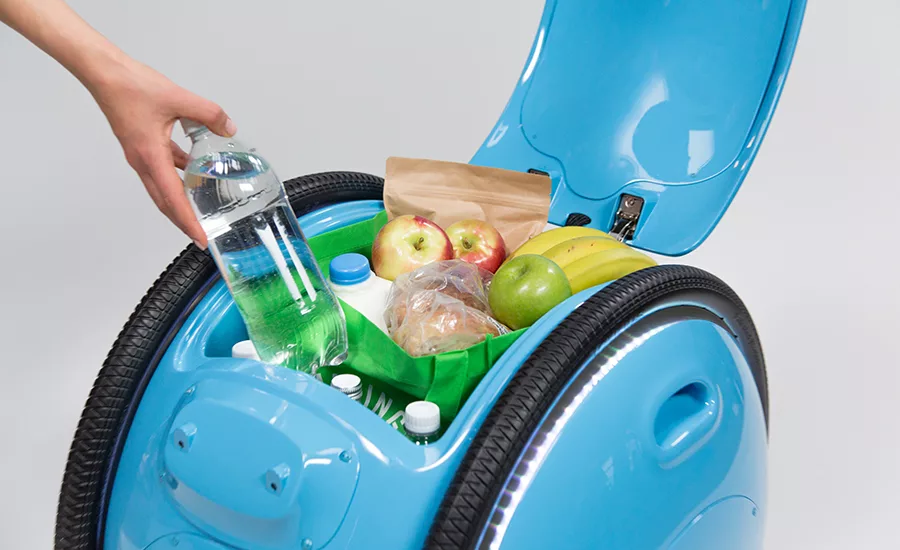
Gita

Gita can carry up to 40 pounds of cargo.

Photo courtesy Piaggio Fasst Forward

Gita
Gita
Gita
February 21, 2017

Video

“Intelligent machines should collaborate with people, not compete with them,” says Greg Lynn, a pioneer of digital design and fabrication techniques in architecture.

He’s talking about the motivation behind Gita, a 22-pound semi-autonomous, two-wheeled vehicle that can carry 40 pounds of cargo at speeds of up to 26 miles per hour. It is the first product from Piaggio Fast Forward (PFF), an eighteen-month-old division of Piaggio Group, the parent company of small two-, three- and four-wheeled vehicle brands, such as Vespa and Moto Guzzi.

Lynn, PFF’s chief creative officer, is working with a group of designers, engineers, and roboticists from various backgrounds, including architecture and urban design, to rethink urban transportation options. Gita represents what PFF calls “granular mobility,” or vehicles that operate as companions to human-powered movement. 

A prototype for Gita was unveiled earlier this month at a press event in Boston, where PFF is headquartered. With its circular profile, filleted corners and candy-coated exterior, the device looks like a cross between a Vespa Sprint and R2D2. The effect is intentional. “You can think about it as a kind of pet,” says Jeffrey Schnapp, PFF’s CEO and the founder of Harvard University’s metaLAB.

The battery-powered Gita, which can operate for eight hours of continuous use on a single three-hour charge, is designed to go where humans go: along paths, on ramps, into buildings and up elevators. It can “navigate any ADA-compliant space,” according to Schnapp.  A transmitter belt enables the device to follow its owner at a specified distance. In addition, Gita can work in concert with other Gita vehicles to create a convoy for larger payloads. Its creators are also developing the capability for Gita to work independently, so that it can perform tasks like picking up dinner or dropping off the dry-cleaning on its own.

Lynn suggests that in the near future, American cities may look more like Hanoi or Mumbai, where the lines between vehicular and pedestrian paths are blurred. It is within this context that small and agile companion vehicles like Gita, which can operate on roadways, sidewalks, and inside buildings, offer an alternative to traditional motorized vehicles as well as to self-driving cars and trucks.

Over the next few months, PFF will further develop Gita and its larger sibling, Kilo. It will test the vehicles in real-world conditions before offering them for sale to businesses and consumers. Pricing has not yet been announced.

Looking for quick answers on architecture and design topics?
Try Ask RECORD, our new smart AI search tool.
Ask RECORD →


The vehicle can navigate any ADA-compliant space.

Video courtesy Piaggio Fasst Forward

KEYWORDS: autonomous vehicles Software for Architecture

Share This Story

Looking for a reprint of this article?
From high-res PDFs to custom plaques, order your copy today!
Michael Leighton Beaman, a visiting design and technology critic at the Rhode Island School of Design, is principal of the firms Beta-field and GA Collaborative.

Post a comment to this article

Report Abusive Comment

Subscription Center
  • Create an Account
  • Start a Subscription
  • Manage My Account
  • Sign Up for Newsletters
  • Visit Customer Service
  • Update Preferences

More Videos

Sponsored Content

Sponsored Content is a special paid section where industry companies provide high quality, objective, non-commercial content around topics of interest to the Architectural Record audience. All Sponsored Content is supplied by the advertising company and any opinions expressed in this article are those of the author and not necessarily reflect the views of Architectural Record or its parent company, BNP Media. Interested in participating in our Sponsored Content section? Contact your local rep!

close
  • TAMLYN XtremeTrim Exterior Trim
    Sponsored byTamlyn

    Designing Cleaner Panel Facades: Why Exterior Trim Details Matter

  • Building with Vapor Barriers
    Sponsored byReef Industries, Inc.

    Vapor Barriers Help Control Moisture in Tighter Building Designs

  • Duct Interior with Prodeq System
    Sponsored byHenry, a Carlisle Company

    Designing Resilient Water Containment Systems

DESIGN:ED Podcast
Listen to Architectural Record’s DESIGN:ED Podcast

Events

June 10, 2026

Rethinking Stormwater – The Power of Porous Paving

Credits: 1 AIA LU/HSW; 1 AIBD P-CE; 0.1 ICC CEU

Learn how porous paving systems support stormwater management, reduce heat island effects, and enhance sustainable site design performance.

June 11, 2026

Very Early Warning Fire Detection for Mission-Critical Facilities

Credits: 1 AIA LU/HSW; 1 AIBD P-CE; 0.1 ICC CEU

Examine advanced fire detection strategies that support uptime and enhance safety in data centers and other mission-critical facilities.

View All Submit An Event

Products

2026 Architect's Square Foot Costbook

2026 Architect's Square Foot Costbook

See More Products

Popular Stories

Coronado Bridge

The Architect’s Guide to San Diego

Practice Matters illustration

What’s in a (Firm’s) Name? Thinking About Succession and Legacy

Practice Matters illustration

By the Numbers: Counting America's Architects

Inward House

Inward House by VeeV Design Studio

Riverdale House by Studio Lau

Riverdale House by Studio Lau

Broader Sustainability of CMU - Free Webinar - May 21, 2026

Related Articles

  • Greg Lynn, Teddy Cruz Win $50,000 USA Awards

    See More
  • Newsmaker: Greg Lynn

    See More
  • Autodesk Releases LIVE

    Autodesk releases LIVE, an Interactive Visualization Tool for Revit

    See More

Related Products

See More Products
  • 1118522532.gif

    Future Details of Architecture

  • 9 ways.jpg

    9 Ways To Make Housing for People

See More Products

Events

View AllSubmit An Event
  • November 20, 2025

    A Roundtable Discussion: Designing to Meet Resilient Building Challenges with Stainless Steel

    NOW ON DEMANDCredits: 1 AIA LU/HSW; 1 AIBD P-CE; 0.1 ICC CEU; 0.1 IACET CEU; 1 PDHExplore innovative façade and material strategies that advance building resilience and sustainability through insights from experts in metals, fabrication, and engineering.
  • June 25, 2026

    Designing Glass Railing Systems that Enhance Aesthetics and Meet Code

    Credits: 1 AIA LU/HSW; 1 AIBD P-CE; 0.1 ICC CEU Upon course completion, participants will possess a deeper understanding of glass railings to help ensure that safety, aesthetic, and performance objectives are achieved.
View AllSubmit An Event
×

The latest news and information

#1 Source for Architectural Design, News and Products

SUBSCRIBE
  • RESOURCES
    • Advertise
    • Contact Us
    • Submit
    • Store
  • ACCOUNT CENTER
    • Create an Account
    • Start a Subscription
    • Manage My Account
    • Sign Up for Newsletters
    • Visit Customer Service
    • Update Preferences
  • PRIVACY
    • PRIVACY POLICY
    • TERMS & CONDITIONS
    • DO NOT SELL MY PERSONAL INFORMATION
    • PRIVACY REQUEST
    • ACCESSIBILITY
  • SERVICES
    • Marketing Services
    • Reprints
    • Market Research
    • List Rental
    • Survey/Respondent Access
  • STAY CONNECTED
    • Linkedin
    • Facebook
    • Instagram
    • YouTube
    • X (Twitter)

Copyright ©2026. All Rights Reserved BNP Media, Inc. and BNP Media II, LLC.

Design, CMS, Hosting & Web Development :: ePublishing