Architectural Record
search
cart
facebook twitter linkedin youtube
  • Sign In
  • Subscribe
  • Sign Out
  • My Account
Architectural Record
  • NEWS
    • Latest News
    • Awards
    • Interviews
    • Obituaries
    • Podcasts
      • Design:Ed Podcast
      • Sponsored Podcasts
  • OPINION
    • Book Reviews / Excerpts
    • Exhibition Reviews
    • Forum
  • EXCLUSIVES
    • Videos
    • Design Vanguard
    • Top 300 Firms
    • Sponsored Content
    • Sponsored eBooks
    • From the Archives
  • CONTINUING ED
    • Editorial Continuing Ed
    • CE Center
    • CE Academies
  • PROJECTS
    • Buildings By Type
    • Reuse & Renovation
    • Museums & Arts Centers
    • Colleges & Universities
    • Multifamily Housing
    • Interiors
    • Lighting
    • Kitchen & Bath
  • HOUSES
    • Record Houses
    • House of the Month
    • Featured Houses
  • PRODUCTS
    • Products by Category
    • Record Products of the Year
    • Latest Products
  • EVENTS
    • Dates & Events
    • Record on the Road
    • Innovation Conference
    • Sustainability in Practice
    • Women In Architecture
    • Webinars
    • Ad Excellence Awards
    • Submit an Event
  • CONNECT
    • Ask RECORD AI
    • Newsletters
    • Contact
    • Advertise
    • Editorial Calendar
    • Store
    • Customer Service
  • SUBMIT
    • Submission Guidelines
    • RECORD Competitions
  • MAGAZINE
    • Subscribe
    • My Account
    • Digital Edition
    • Current Issue
    • Firm Pass
    • Historic Archive
Architecture News

Pittsburgh's New Arena: Back to the Future?
By Dianna Dilworth
Pittsburgh's New Arena

Pittsburgh's New Arena

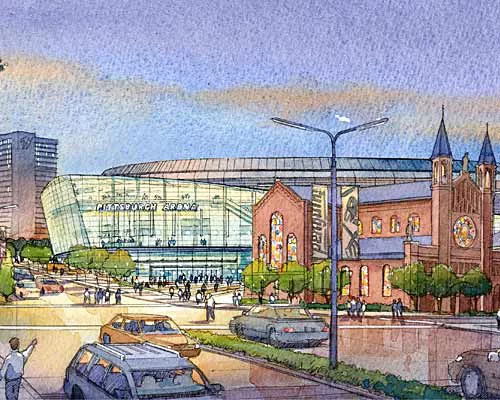
HOK Sport has designed a new, 18,000-seat arena for the Pittsburgh Penguins. The building presents an 80-foot-tall crystalline entry volume toward the historic Epiphany Church on Centre Avenue.

Image: Courtesy HOK Sport 

Pittsburgh's New Arena

Pittsburgh's New Arena

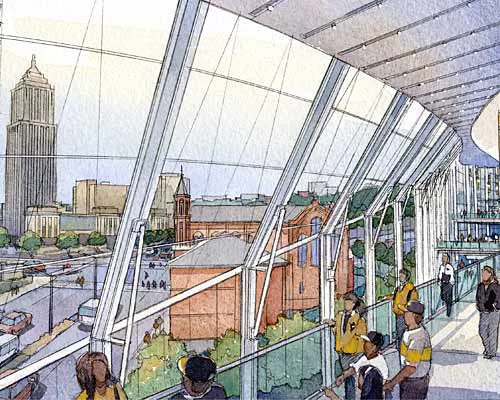
On the arena's lower Fifth Avenue elevation, a masonry facade-some 130 feet long and 55 feet high-alludes to the aesthetic of the few remaining historic structures along that street.

Image: Courtesy HOK Sport 
Pittsburgh's New Arena

Pittsburgh's New Arena

The new building will be located in the Lower Hill District at the eastern edge of downtown Pittsburgh. Most of this once African-American neighborhood was razed during the 1950's to make way for a largely unrealized cultural and residential redevelopment. Adjoining areas continue to struggle economically and community resentment runs high.

Image: Courtesy HOK Sport 
Pittsburgh's New Arena

Pittsburgh's New Arena

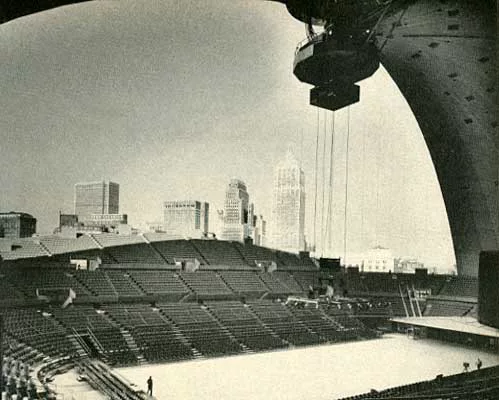
The Penguins' current home, the Melon Arena, was designed by Mitchell and Ritchey. It opened in 1961 and as RECORD reported in its November issue that year, the building featured the world's first retractable roof.

Photo: © Joseph W. Molitor 
Pittsburgh's New Arena

Pittsburgh's New Arena

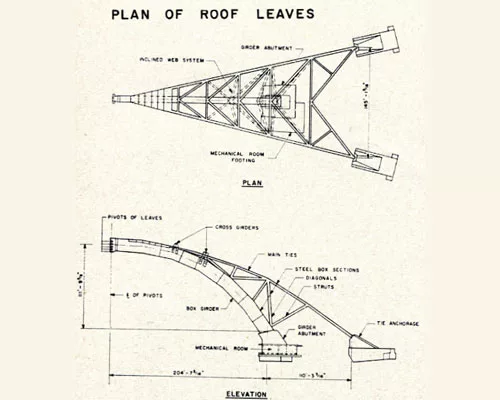
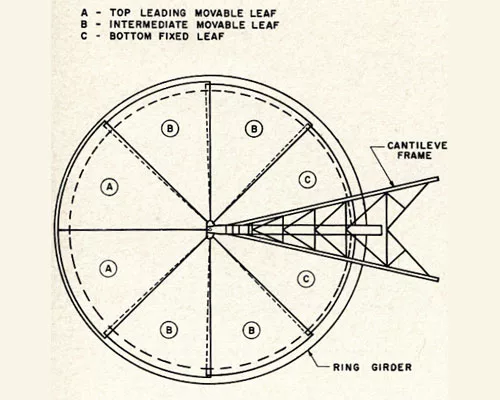
Diagrams, published in RECORD's November 1961 issue, of the retractable roof mechanism on the existing Melon Arena. The building's consulting engineer was Ammann & Whitney; Robert A. Zern was the structural engineer.
Pittsburgh's New Arena

Pittsburgh's New Arena

Diagrams, published in RECORD's November 1961 issue, of the retractable roof mechanism on the existing Melon Arena. The building's consulting engineer was Ammann & Whitney; Robert A. Zern was the structural engineer.

Pittsburgh's New Arena
August 30, 2007
HOK Sport unveiled conceptual plans on Tuesday for a new $290 million hockey arena in Pittsburgh’s Hill District, at the eastern edge of downtown. When the city’s Sports and Exhibition Authority (SEA) and the Pittsburgh Penguins announced the project earlier this year, it reopened old wounds in the contentious relationship between development authorities and residents of the city’s storied Hill District.
 
The existing Mellon Arena, designed by Mitchell and Ritchey, is hockey’s oldest operating arena, opened in 1961. As RECORD reported in its November issue that year, the stainless steel building’s retractable roof was a first. But the Penguins, who have played there since 1967, threatened to leave Pittsburgh unless they got a new, publicly subsidized venue. The team’s owners complain about the building’s poor sightlines and outdated mechanical equipment—not to mention an insufficient number of luxury boxes.
 
In HOK Sport’s preliminary renderings of the new building, a metal- and glass-clad oval-shaped arena—with an estimated seating capacity of 18,000—fits tightly into its sloping urban site. It presents an 80-foot-tall crystalline entry volume to Centre Avenue, adjacent to Epiphany Church. On its Fifth Avenue elevation, a masonry facade—some 130 feet long and 55 feet high—alludes to the aesthetic of the few remaining historic structures nearby. Final designs could be ready as early as this fall and the building is scheduled to open in 2010.
 
Under an agreement brokered with help from Pennsylvania governor Ed Rendell, the bond issue will be paid with revenue from a soon-to-be-built casino on Pittsburgh’s North Side, owned and operated by PITG Gaming. The deal also gives the Penguins rights and a $15 million incentive to redevelop the old arena’s site.
 
That land, at the eastern edge of downtown, resulted from demolishing the culturally rich, primarily African American Lower Hill District during the 1950s to make way for a largely unrealized cultural and residential redevelopment. Adjoining neighborhoods continue to struggle economically and resentment runs high.
 
“The Penguins have never been a friend of the Hill District, as far as I’m concerned,” Lois M. Cain, a long-time Hill resident and activist, said at a public meeting in June. As to any agreements about community benefits and accommodations from a new stadium, she warned, “You better make sure it’s legal and it’s in writing.”
 
Neighborhood groups, led by the One Hill Community Benefits Agreement Coalition, are lobbying for grants, a share of development funds, and 30 percent minority hiring in development projects. Thus far, there are only agreements for the Penguins but not for the community.
 
To follow a city-mandated process, the Penguins and the SEA hired Don Carter, FAIA, of Urban Design Associates Architects, to conduct a separate series of community meetings. Numerous groups hope to give their input. Among them is Preservation Pittsburgh, whose executive director, Steven Paul, laments the demolition of historic properties earlier this year under an outdated master plan formulated in 2005 for a proposed casino that was never built. His group supports a plan to identify and preserve remaining historic properties such as the childhood house of playwright August Wilson, and the New Granada Theater, an Art Deco movie house that hosted both musical performances and political rallies.
 
But Carter cautioned that his community meetings will address only topics that relate directly to the arena, “not the 28 acres [of redevelopment] or the Community Benefits Agreement.” While many observers find these negotiations a welcome step, they believe that the current master plan, adjacent development, and the Community Benefits Agreement must be considered more holistically to avoid repeating mistakes of the past.


Share This Story

Looking for a reprint of this article?
From high-res PDFs to custom plaques, order your copy today!
Post a comment to this article

Report Abusive Comment

Subscription Center
  • Create an Account
  • Start a Subscription
  • Manage My Account
  • Sign Up for Newsletters
  • Visit Customer Service
  • Update Preferences

More Videos

Sponsored Content

Sponsored Content is a special paid section where industry companies provide high quality, objective, non-commercial content around topics of interest to the Architectural Record audience. All Sponsored Content is supplied by the advertising company and any opinions expressed in this article are those of the author and not necessarily reflect the views of Architectural Record or its parent company, BNP Media. Interested in participating in our Sponsored Content section? Contact your local rep!

close
  • 3D configurator
    Sponsored byDoorBird

    How DoorBird’s 3D Configurator Is Redefining Customization Across Residential and Commercial Design

  • interior of modern office
    Sponsored byCurrent

    The Downlight's Second Life: Why Below-Ceiling Serviceability Is the Specification Detail That Matters Most

  • cold storage facility
    Sponsored byCarlisle SynTec Systems

    How Architects Can Design More Continuous Cold Storage Envelopes

DESIGN:ED Podcast
Listen to Architectural Record’s DESIGN:ED Podcast

Events

July 14, 2026

Designing Toilet Partitions for User Comfort and Utility

Credits: 1 AIA LU/HSW; 1 AIBD P-CE; 0.1 ICC CEU

Evaluate emerging restroom design strategies, materials, and specification options that enhance functionality, inclusivity, user comfort, and sustainability.

July 16, 2026

Fit, Form, Function: Rethinking Privacy Curtains for Modern Spaces

Credits: 1 AIA LU/HSW; 1 AIBD P-CE; 0.1 ICC CEU

Explore how privacy curtain systems can enhance occupant comfort, operational efficiency, and sustainability across healthcare, education, hospitality, and senior living environments.

View All Submit An Event

Products

2026 Architect's Square Foot Costbook

2026 Architect's Square Foot Costbook

See More Products

Popular Stories

Most Significant Works of American Architecture

For the Semiquincentennial, Practitioners and Scholars Survey 250 Years of American Architecture

Home Spirit apartment building exterior

Outdoor Access Drives the Design of a French Apartment Building

Theodore Roosevelt Presidential Library

The Theodore Roosevelt Presidential Library, Designed by Snøhetta, Is Set to Open in the North Dakota Badlands

Goldring Woldenberg Park

Continuing Education: Postindustrial Waterfronts

Dallas City Hall

World Monuments Fund Reveals Irreplaceable America List

Co-Intelligence: The Architect's AI Advantage - Free Webinar - July 8, 2026

Related Articles

  • Back to the Future

    See More
  • Krisel Houses Take Palm Springs Back to the Future

    See More
  • Yaddo Art Colony

    Yaddo Artists’ Colony, Host to Capote, Arendt, Foster Wallace, Looks to the Future

    See More

Related Products

See More Products
  • 3dthinking.jpg

    3D Thinking in Design and Architecture: From Antiquity to the Future

  • 1118522532.gif

    Future Details of Architecture

See More Products
×

The latest news and information

#1 Source for Architectural Design, News and Products

SUBSCRIBE
  • RESOURCES
    • Advertise
    • Contact Us
    • Submit
    • Store
  • ACCOUNT CENTER
    • Create an Account
    • Start a Subscription
    • Manage My Account
    • Sign Up for Newsletters
    • Visit Customer Service
    • Update Preferences
  • PRIVACY
    • PRIVACY POLICY
    • TERMS & CONDITIONS
    • DO NOT SELL MY PERSONAL INFORMATION
    • PRIVACY REQUEST
    • ACCESSIBILITY
  • SERVICES
    • Marketing Services
    • Reprints
    • Market Research
    • List Rental
    • Survey/Respondent Access
  • STAY CONNECTED
    • Linkedin
    • Facebook
    • Instagram
    • YouTube
    • X (Twitter)

Copyright ©2026. All Rights Reserved BNP Media, Inc. and BNP Media II, LLC.

Design, CMS, Hosting & Web Development :: ePublishing