Architectural Record
search
cart
facebook twitter linkedin youtube
  • Sign In
  • Subscribe
  • Sign Out
  • My Account
Architectural Record
  • NEWS
    • Latest News
    • Awards
    • Interviews
    • Obituaries
    • Podcasts
      • Design:Ed Podcast
      • Sponsored Podcasts
  • OPINION
    • Book Reviews / Excerpts
    • Exhibition Reviews
    • Forum
  • EXCLUSIVES
    • Videos
    • Design Vanguard
    • Top 300 Firms
    • Sponsored Content
    • Sponsored eBooks
    • From the Archives
  • CONTINUING ED
    • Editorial Continuing Ed
    • CE Center
    • CE Academies
  • PROJECTS
    • Buildings By Type
    • Reuse & Renovation
    • Museums & Arts Centers
    • Colleges & Universities
    • Multifamily Housing
    • Interiors
    • Lighting
    • Kitchen & Bath
  • HOUSES
    • Record Houses
    • House of the Month
    • Featured Houses
  • PRODUCTS
    • Products by Category
    • Record Products of the Year
    • Latest Products
  • EVENTS
    • Dates & Events
    • Record on the Road
    • Innovation Conference
    • Sustainability in Practice
    • Women In Architecture
    • Webinars
    • Ad Excellence Awards
    • Submit an Event
  • CONNECT
    • Ask RECORD AI
    • Newsletters
    • Contact
    • Advertise
    • Editorial Calendar
    • Store
    • Customer Service
  • SUBMIT
    • Submission Guidelines
    • RECORD Competitions
  • MAGAZINE
    • Subscribe
    • My Account
    • Digital Edition
    • Current Issue
    • Firm Pass
    • Historic Archive
Architecture News

Ich Bin Ein New Yorker

By Alec Appelbaum
November 8, 2007

Berlin, the capital of Germany, acknowledges the darkest chapters in its history by dispersing Holocaust artifacts amid vestigial Communist buildings and parks. New York City is struggling to remember its own trauma—September 11, 2001—amid new towers and fast-changing neighborhoods downtown. What might these cities say to one another?
Berlin-New York Dialogues
a project by architect Hafner/Jimenez
Photos: Courtesy the Center for Architecture

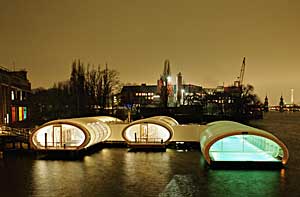
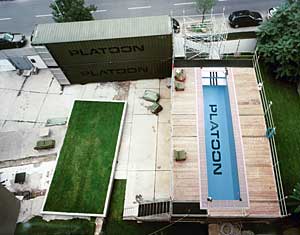
The show 'Berlin-New York Dialogues,' at New York City's Center for Architecture, features images of this bridge in Berlin. Wilk-Salinas Architekten with Thomas Freiwald designed this bridge across the Spree River with a swimming pool in a boat whose planes of sight suggest a river dip; every winter since 2005, a temporary roof of elliptical wooden trusses and a double-layered translucent membrane covers the space to allow locals to swim year-round (top). Also featured is a project by architect Hafner/Jimenez, who filled an empty bracket along the old Berlin Wall with a swimming pool and a pedestrian connection to the nearby river; the park is due to open next year (above).

Daniel Libeskind and others broached this subject and elusive principles of memorial design during a panel discussion on Monday evening at the German Consulate in Manhattan. It was part of a festival this fall that seeks to compare the two cities’ cultures. Another event, the exhibition “Berlin-New York Dialogues, Building in Context,” kicks off at 4:30 p.m. today when a 100-person dance troupe will wend its way from Washington Square Park to the AIA New York Chapter’s Center for Architecture.

Images in at the Center portray how German architects have reinvented the Berlin Wall—which began coming down nearly eight years ago to the day, November 9, 1989—as cheery public space without erasing historical marks. This same concept figured in Monday’s symposium. Panelists agreed that urban planners should create memorial spaces that invite people to talk. Libeskind, for instance, linked his Jewish Museum in Berlin to his competition-winning master plan for rebuilding New York’s World Trade Center site. He said that he uses “silence,” signified by voids such as an empty room or the shell of a building, to mark “very difficult” events, maintaining vistas to adjacent neighborhoods to engage visitors who never knew these events.

But sometimes future generations want to banish the past, said HG Merz, a German architect who specializes in adapting historic sites. He showed his update of Sachsenhausen, a Nazi death camp hidden behind suburban houses on Berlin’s outskirts that he turned into a museum. After the Communist regime later recast the gas chamber as a park, Merz converted it to a place whose windowless rooms make museum visitors confront the annihilation. “There is no interpretation here,” he said of the unfathomable space.

The amount of information that a memorial should encode prompted some dispute among panelists. Metropolis editor Susan Szenasy argued that our culture drowns people in computer software, buildings, and commerce that require too much explanation. She urged architects to design simple, traversable monuments that speak for themselves. And Lance Brown, FAIA, the design coordinator at City College of New York and an expert in how cities respond to disasters, said that he had grown weary of governments bickering over how to arrange the names of the deceased on various memorials “for fear that interpretation would take place.” But eventually, he added, the most honorable memorials are the ones that become stages for unscripted future events: “The social spaces that result from memorials are the ones that sustain us.”

Share This Story

Looking for a reprint of this article?
From high-res PDFs to custom plaques, order your copy today!

Post a comment to this article

Report Abusive Comment

Subscription Center
  • Create an Account
  • Start a Subscription
  • Manage My Account
  • Sign Up for Newsletters
  • Visit Customer Service
  • Update Preferences

More Videos

Sponsored Content

Sponsored Content is a special paid section where industry companies provide high quality, objective, non-commercial content around topics of interest to the Architectural Record audience. All Sponsored Content is supplied by the advertising company and any opinions expressed in this article are those of the author and not necessarily reflect the views of Architectural Record or its parent company, BNP Media. Interested in participating in our Sponsored Content section? Contact your local rep!

close
  • 3D configurator
    Sponsored byDoorBird

    How DoorBird’s 3D Configurator Is Redefining Customization Across Residential and Commercial Design

  • interior of modern office
    Sponsored byCurrent

    The Downlight's Second Life: Why Below-Ceiling Serviceability Is the Specification Detail That Matters Most

  • cold storage facility
    Sponsored byCarlisle SynTec Systems

    How Architects Can Design More Continuous Cold Storage Envelopes

DESIGN:ED Podcast
Listen to Architectural Record’s DESIGN:ED Podcast

Events

July 14, 2026

Designing Toilet Partitions for User Comfort and Utility

Credits: 1 AIA LU/HSW; 1 AIBD P-CE; 0.1 ICC CEU

Evaluate emerging restroom design strategies, materials, and specification options that enhance functionality, inclusivity, user comfort, and sustainability.

July 16, 2026

Fit, Form, Function: Rethinking Privacy Curtains for Modern Spaces

Credits: 1 AIA LU/HSW; 1 AIBD P-CE; 0.1 ICC CEU

Explore how privacy curtain systems can enhance occupant comfort, operational efficiency, and sustainability across healthcare, education, hospitality, and senior living environments.

View All Submit An Event

Products

2026 Architect's Square Foot Costbook

2026 Architect's Square Foot Costbook

See More Products

Popular Stories

Most Significant Works of American Architecture

For the Semiquincentennial, Practitioners and Scholars Survey 250 Years of American Architecture

Home Spirit apartment building exterior

Outdoor Access Drives the Design of a French Apartment Building

Theodore Roosevelt Presidential Library

The Theodore Roosevelt Presidential Library, Designed by Snøhetta, Is Set to Open in the North Dakota Badlands

Goldring Woldenberg Park

Continuing Education: Postindustrial Waterfronts

Dallas City Hall

World Monuments Fund Reveals Irreplaceable America List

Co-Intelligence: The Architect's AI Advantage - Free Webinar - July 8, 2026

Related Articles

  • New Yorker archi-critic Paul Goldberger leaving for Vanity Fair

    See More
  • VOTE: Who Should Succeed Paul Goldberger as Resident Architecture Critic at The New Yorker?

    See More
  • U.S. Soldier Architect in Afghanistan Shares Perspective on Osama Bin Laden's Death

    See More
×

The latest news and information

#1 Source for Architectural Design, News and Products

SUBSCRIBE
  • RESOURCES
    • Advertise
    • Contact Us
    • Submit
    • Store
  • ACCOUNT CENTER
    • Create an Account
    • Start a Subscription
    • Manage My Account
    • Sign Up for Newsletters
    • Visit Customer Service
    • Update Preferences
  • PRIVACY
    • PRIVACY POLICY
    • TERMS & CONDITIONS
    • DO NOT SELL MY PERSONAL INFORMATION
    • PRIVACY REQUEST
    • ACCESSIBILITY
  • SERVICES
    • Marketing Services
    • Reprints
    • Market Research
    • List Rental
    • Survey/Respondent Access
  • STAY CONNECTED
    • Linkedin
    • Facebook
    • Instagram
    • YouTube
    • X (Twitter)

Copyright ©2026. All Rights Reserved BNP Media, Inc. and BNP Media II, LLC.

Design, CMS, Hosting & Web Development :: ePublishing