Landscape/Architecture Firms Growing Closer
When SWA Group was brought in as the landscape architect for the California Academy of Sciences, located in San Francisco’s Golden Gate Park, the challenge was to create one of the most efficient and sustainable buildings in the Bay Area. Renzo Piano’s design called for a green roof that would essentially lift a piece of the park and place it atop the building: seven earth mounds that would serve as a research facility.
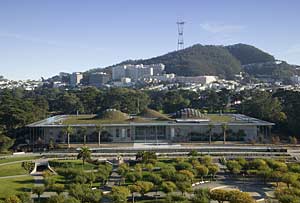
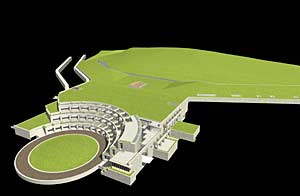
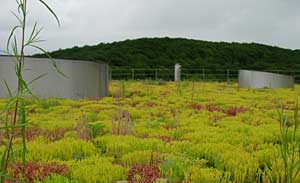
Images courtesy SWA Group (top); BAR Architects (middle); Michael Van Valkenburgh Associates (above).
The California Academy of Sciences Building, in San Francisco, by Renzo Piano and SWA Group (top). The National Audio-Visual Conservation Center, a former Federal Reserve System bunker in Culpepper, Virginia, repurposed by SWA Group and BAR Architects (middle). The lush green roof of the Whitney Water Treatment facility, in New Haven, Connecticut, designed by Michael Van Valkenburgh Associates and Steven Holl Architects (above).
“Implementing the architect’s conceptual plan for the roof mounds was initially seen as a significant technical challenge because the planting surface was steeper than had been attempted before, almost 55 degrees at certain points,” says John Loomis, a principal of SWA.
As architects attempt ever more ambitious feats with green projects, the collaborative relationship between members of a design team is becoming more important. Landscape architects, in particular, are codifying their role and taking on additional responsibilities. “It is not about just dressing something that the architect gives us,” Loomis says. “We would always like to be in there right at the same time the architect starts on the project, if possible.”
At the California Academy of Sciences, for instance, one of SWA’s early ideas called for concentric earth rings that stepped down from the slopes. But these circular patterns ran counter to the architects’ intent to maintain the grid of the building structure as an exposed reflection of the ceiling plan. SWA solved the problem by designing a semi-rigid framework that is laid across the roof to hold the sections of soil systems in place within a 24-foot grid of gabion curbs, which are wire baskets filled with volcanic scoria rock that are linked together. A interconnecting subsystem of epoxy-coated rebar and reinforced nylon strapping to maintain the alignment of the curbs. The grid is strong enough to hold the soil systems in place on the sharp inclines of the slopes, yet accommodates water runoff even at high rates during winter storms.
The structure of the collaboration between SWA and Piano’s office required lots of back and forth to deal with issues including soil systems, irrigation, HVAC venting, and insulation. “As we got up specifically on the roof, it is really a piece of (Piano’s) building, so we had a lot of meetings about how to make that roof work with his office,” says Lawrence Reed, a principal of SWA.
SWA also worked closely with BAR Architects at the National Audio-Visual Conservation Center, a former Federal Reserve System bunker in Culpepper, Virginia, that underwent a $155 million transformation into an archive for the Library of Congress. The client was concerned that a 400,000-square-foot building would overwhelm its rural location. Accordingly, BAR decided to make use of an existing bunker and construct a new structure partially into a hillside. This required two types of green roofs: a deeper one for the bunker and a more conventional, shallow one for the new building.
“Having the two different types of green roof and the different plantings that would go on those two types of roofs were things that we were working really quite closely in conjunction with SWA on,” says Earl Wilson, a principal of BAR.
The entire 5.5-acre site harnesses the region’s native plants and is insulated with 23 varieties of sedum to reduce HVAC usage and provide storm water management. “We spent a lot of time refining plant lists and making sure we have the right plant material for the individual circumstance,” Reed says. SWA met with regional experts in green roof type plants, meadow grass restoration, as well as forest restoration.
Green roofs also require collaboration when it comes to building drainage systems and repurposing storm water. Landscape firm Michael Van Valkenburgh Associates recently worked with Steven Holl Architects on the Whitney Water Treatment facility, in New Haven, to design a green roof that is as complex as the water treatment center itself in its repurposing of storm water.
Holl’s intention was to have a roof that collects rainwater, which could be routed back into the landscapes and planted area, as opposed to being directed into the piping and going into the storm drainage. “We would create the details that we thought would make the building more sustainable and present them to the architects,” says Robert Rock, an associate at Van Valkenburgh, adding that the architects in turn presented the designs to structural and mechanical engineers.
Rock’s design called for a roofing slab that acts like a shallow bathtub. On top of the slab is waterproofing, insulation, and a drainage mat that covers the structure and drains out to the roof’s edges. Covering all of this is a 4-inch layer of 3/8” pea gravel, which is used as the drainage medium. As water comes down through the soil on the surface, it passes into the granular layer that has larger pore spaces between the particles, where the water can be stored until it is absorbed by the plant material. Above the gravel layer are six to eight inches of soil that has vermiculite and Perelite mixed into it, which helps lighten the concentrated load.
Water coming down onto the roof then drains to the perimeter from where it is reintegrated into the site. The highest elevations are all graded so that they converge into a vegetative swale that empties into a pond on the east side of the building. That pond is then connected to the groundwater table and holds that water on site. By incorporating that pond on site with the roof drainage system, all the rainwater that falls on the site stays there, as opposed to being dumped into the nearest body of water.
As the environmental details of sites become more integrated into architectural design, be it to store water or to absorb the impact of a large building, landscape design is becoming a major part of the architecture. And as green roofs are growing up in our own backyards, the relationship between architect and landscape architect is sure to blossom.
Looking for a reprint of this article?
From high-res PDFs to custom plaques, order your copy today!