Architectural Record
search
cart
facebook twitter linkedin youtube
  • Sign In
  • Subscribe
  • Sign Out
  • My Account
Architectural Record
  • NEWS
    • Latest News
    • Awards
    • Interviews
    • Obituaries
    • Podcasts
      • Design:Ed Podcast
      • Sponsored Podcasts
  • OPINION
    • Book Reviews / Excerpts
    • Exhibition Reviews
    • Forum
  • EXCLUSIVES
    • Videos
    • Design Vanguard
    • Top 300 Firms
    • Sponsored Content
    • Sponsored eBooks
    • From the Archives
  • CONTINUING ED
    • Editorial Continuing Ed
    • CE Center
    • CE Academies
  • PROJECTS
    • Buildings By Type
    • Reuse & Renovation
    • Museums & Arts Centers
    • Colleges & Universities
    • Multifamily Housing
    • Interiors
    • Lighting
    • Kitchen & Bath
  • HOUSES
    • Record Houses
    • House of the Month
    • Featured Houses
  • PRODUCTS
    • Products by Category
    • Record Products of the Year
    • Latest Products
  • EVENTS
    • Dates & Events
    • Record on the Road
    • Innovation Conference
    • Sustainability in Practice
    • Women In Architecture
    • Webinars
    • Ad Excellence Awards
    • Submit an Event
  • CONNECT
    • Ask RECORD AI
    • Newsletters
    • Contact
    • Advertise
    • Editorial Calendar
    • Store
    • Customer Service
  • SUBMIT
    • Submission Guidelines
    • RECORD Competitions
  • MAGAZINE
    • Subscribe
    • My Account
    • Digital Edition
    • Current Issue
    • Firm Pass
    • Historic Archive
Architecture News

Architects Propose Alternative Ideas for Spending Federal Dollars

By C. J. Hughes
March 6, 2009

When unveiled a few months ago, the federal economic stimulus bill tantalizingly hinted at heaps of jobs for architects building schools and retrofitting federal buildings to make them more energy efficient.

The $787 billion version that ultimately became law in mid-February, though, had fewer opportunities for design professionals, at least explicitly, as lawmakers had pared it along the way to garner support. Specifically, school construction-aid was removed from the final bill.
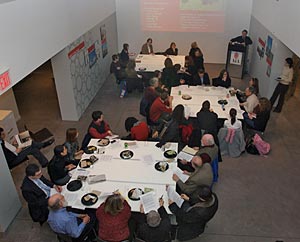
forums at the Center for Architecture in New York
Photo ' Danielle Austen/Architectural Record

Ideas for how the federal government can help create work for architects have been discussed during recent forums at the Center for Architecture in New York. The forums are part of a series of events, dubbed Not Business as Usual.

On March 11 at the New York Center for Architecture, a representative from the New York State Energy Research and Development Authority (NYSERDA) will give a presentation on conducting energy surveys. The event is part of the AIA New York’s Not Business As Usual initiative, a series of events geared toward helping architects during these troubled times. Register here.
Related Links:
How Architects Can Land a Government Contract Paul Seletsky Discusses BIM

In the near future, the construction industry is more likely to benefit from the stimulus package than the design profession, suggests Rick Bell, executive director of the New York chapter of the American Institute of Architects. “But there will be opportunities for architects in the wake of these projects,” says Bell, singling out bridge, roadway, and mass-transit projects. “It’s a good start.”

In the meantime, there may be other ways that the federal government can help create paying jobs for out-of-work architects. A few ideas have been kicking around since December, when they were introduced at a roundtable at the Center for Architecture in New York. The forum was part of a series of events, dubbed Not Business as Usual, geared toward helping architects during these troubled times.

BIM Database
The government could hire architects to catalogue federal buildings with cutting-edge building information modeling, or BIM, an idea put forth by Paul Seletsky, director of digital design for the New York office of Skidmore, Owings and Merrill. 

The BIM database concept is similar to the ongoing Historic American Buildings Survey, launched in 1933 and overseen by the National Park Service. While HABS is fairly limited to line drawings and photographs, the data-rich BIM models would meticulously assess features like layouts, roofs, and cladding, which could come in handy in the event of a fire or security breach, says Seletsky. 

If, for instance, terrorists attacked the Supreme Court in Washington, D.C., SWAT teams could quickly tap into the digital model to figure how to navigate the court’s warren of chambers. “There will no scrambling in an emergency to see who has the floor plans,” Seletsky explains.

Energy Audits
The federal government could also launch a sweeping energy audit of existing federal buildings, Bell explains.

Classifying the types of windows, doors, and insulation found in airports, federal agencies, and public museums could go a long way toward figuring out how much heat and cool air they retain. Moreover, information gleaned from these audits could help landlords make informed purchasing decisions. When it came time to replace a window, for instance, they could easily assess which type is better: a single-glazed model or a more eco-friendly version with two glass sheets.

“Energy surveys aren’t rocket science,” Bell says. “But they could still put tens of thousands of architects to work.”

Design Corps
A third option being bandied about is the creation of a “Design Corps” to undertake public construction projects in the spirit of the Great Depression’s Works Progress Administration.

It could be folded into the AmeriCorps program, which will be tripled in size under the stimulus package, from 75,000 to 225,000 positions. Ideally, 10 percent of those jobs would go to architects, says Maurice Cox, design director for the National Endowment for the Arts. Cox has been a chief proponent of the Design Corps idea.

What type of work could architects perform? In the case of building affordable housing, for instance, designers could help ensure homes are sturdy, stylish, and environmentally friendly, Cox says. “It’s about raising the bar on design excellence,” he says, “and insuring that the larger agenda of greening our national infrastructure is threaded throughout all the projects.”

The federal program would be similar in spirit to the Raleigh-based Design Corps, a nonprofit that provides architecture and planning services to communities in need. The organization pays fellows—typically recent graduates—a modest stipend to carry out the work. The federal Design Corps program could potentially offer full salaries, advocates say.

Read more economic news, including stories related to the federal stimulus plan, in our Recession and Recovery special section.

Share This Story

Looking for a reprint of this article?
From high-res PDFs to custom plaques, order your copy today!


Post a comment to this article

Report Abusive Comment

Subscription Center
  • Create an Account
  • Start a Subscription
  • Manage My Account
  • Sign Up for Newsletters
  • Visit Customer Service
  • Update Preferences

More Videos

Sponsored Content

Sponsored Content is a special paid section where industry companies provide high quality, objective, non-commercial content around topics of interest to the Architectural Record audience. All Sponsored Content is supplied by the advertising company and any opinions expressed in this article are those of the author and not necessarily reflect the views of Architectural Record or its parent company, BNP Media. Interested in participating in our Sponsored Content section? Contact your local rep!

close
  • TAMLYN XtremeTrim Exterior Trim
    Sponsored byTamlyn

    Designing Cleaner Panel Facades: Why Exterior Trim Details Matter

  • Building with Vapor Barriers
    Sponsored byReef Industries, Inc.

    Vapor Barriers Help Control Moisture in Tighter Building Designs

  • Duct Interior with Prodeq System
    Sponsored byHenry, a Carlisle Company

    Designing Resilient Water Containment Systems

DESIGN:ED Podcast
Listen to Architectural Record’s DESIGN:ED Podcast

Events

June 10, 2026

Rethinking Stormwater – The Power of Porous Paving

Credits: 1 AIA LU/HSW; 1 AIBD P-CE; 0.1 ICC CEU

Learn how porous paving systems support stormwater management, reduce heat island effects, and enhance sustainable site design performance.

June 11, 2026

Very Early Warning Fire Detection for Mission-Critical Facilities

Credits: 1 AIA LU/HSW; 1 AIBD P-CE; 0.1 ICC CEU

Examine advanced fire detection strategies that support uptime and enhance safety in data centers and other mission-critical facilities.

View All Submit An Event

Products

2026 Architect's Square Foot Costbook

2026 Architect's Square Foot Costbook

See More Products

Popular Stories

Practice Matters illustration

What’s in a (Firm’s) Name? Thinking About Succession and Legacy

Practice Matters illustration

By the Numbers: Counting America's Architects

Riverdale House by Studio Lau

Riverdale House by Studio Lau

House on a Hill

Design Vanguard 2026: Forma

Crane Cove, ONO

Design Vanguard 2026 Winners

Broader Sustainability of CMU - Free Webinar - May 21, 2026

Related Articles

  • Federal Dollars for School Construction, Round Two

    See More
  • Penn Station Proposal

    Architects Propose Facelifts for Two Major New York City Transit Hubs

    See More
  • Architects Propose Design Solutions for Equitable Restrooms

    Architects Propose Design Solutions for Equitable Restrooms

    See More
×

The latest news and information

#1 Source for Architectural Design, News and Products

SUBSCRIBE
  • RESOURCES
    • Advertise
    • Contact Us
    • Submit
    • Store
  • ACCOUNT CENTER
    • Create an Account
    • Start a Subscription
    • Manage My Account
    • Sign Up for Newsletters
    • Visit Customer Service
    • Update Preferences
  • PRIVACY
    • PRIVACY POLICY
    • TERMS & CONDITIONS
    • DO NOT SELL MY PERSONAL INFORMATION
    • PRIVACY REQUEST
    • ACCESSIBILITY
  • SERVICES
    • Marketing Services
    • Reprints
    • Market Research
    • List Rental
    • Survey/Respondent Access
  • STAY CONNECTED
    • Linkedin
    • Facebook
    • Instagram
    • YouTube
    • X (Twitter)

Copyright ©2026. All Rights Reserved BNP Media, Inc. and BNP Media II, LLC.

Design, CMS, Hosting & Web Development :: ePublishing