Two Views: Lord Rogers vs. Prince Charles
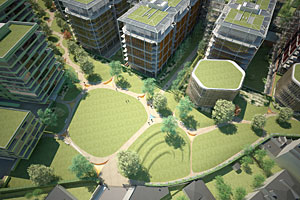
Rogers' design for Chelsea Barracks, in west London, called for a series of glass-and-steel buildings.
Image courtesy Rogers Stirk Harbour + Partners
The British architect Richard Rogers recently made headlines when he lambasted Prince Charles for interfering with the democratic planning process.
Specifically, Lord Rogers was displeased with the prince's involvement in scuttling one of the 75-year-old architect's major commissions, Chelsea Barracks, which called for the construction of a dozen-plus glass-and-steel buildings in west London. The prince, who opposes modern architecture, reportedly contacted the project's principal backer, the Emir of Qatar, to express his disappointment in the design. Soon after, Rogers' plan was scrapped. The Qataris announced that they would devise a new scheme with the help of The Prince's Foundation for the Built Environment, an architecture and planning organization overseen by Prince Charles.
Here, two prominent U.K. critics share their views on the controversy.
Pro Prince
There was jubilation among the locals buying organic vegetables in the Chelsea Farmers’ Market recently as the news that the Qatari royal family had essentially sacked starchitect Richard Rogers and canceled his proposed scheme for the huge Chelsea Barracks site because—it was said—of a letter Prince Charles had written to the Emir of Qatar expressing his disquiet at the plan.
To read the English newspapers about the resulting storm is to mistakenly think that Prince Charles was alone and old-fogeyish in his concern about the Rogers steel towers and their relationship with the adjacent Royal Hospital, built by that Modernist of his day, Christopher Wren. In fact, before the Prince came on the scene, the opposition to the Rogers plan mobilized over 50,000 residents of Chelsea.
This wasn’t a debate about Modernist versus Traditional, as Rogers and his allies tried to turn it into. It was much more basic than that. The 36-meter high towers—mini skyscrapers—would have cut out sunlight. The plan was far too dense, housing 3,000 new people in the area with no infrastructure to support them. Current narrow roads would have had to take 1,500 more vehicles, and there were no streets in the Rogers development to reduce the strain. Open spaces? Hardly. Only 1.3 acres on the 13.5-acre site. Not enough residents’ parking, limited public transport… the Chelsea Barracks Action Group had very good local-interest points indeed.
But the rationale, and a petition with more than 50,000 signatures, were not good enough for Westminster Planning, which was about to rubber stamp the Rogers plan. At the last minute Prince Charles stepped in, putting his own candidate, the traditionalist Quinlan Terry, forward to the Qataris. The Prince told the site’s owner Qatar Diar, a development company controlled by the Qatari royal family, he thought the plan was “unsympathetic” and “unsuitable” and “would clash with the architecture of the area.” All hell immediately broke loose in the starchitect establishment—Modernists to a man.
Himself a resident of Chelsea where he lives in two early l9th-century houses facing the Royal Hospital that he has completely gutted and “Rogersised,” Lord Rogers said that the Prince’s intervention was an unconstitutional abuse of power: “He always goes round the back to wield his influence, using phone calls or, in the case of the Chelsea barracks a private letter,” he told a British newspaper, attempting to politicize the issue.
The royal family is not meant to air its political views publicly so in trying to turn the turn-down into a political debate, Lord Rogers was playing a shrewd end-game. It did not work. In spite of a stern letter to The Times—signed by Frank Gehry, Zaha Hadid, Norman Foster, and Renzo Piano—decrying Charles’ “private comments and behind-the-scenes lobbying,” the residents of Chelsea, with their early l9th-century neighborhood no longer threatened by mini-skyscrapers nor choked streets, are breathing great sighs of relief. Anything, visitors to the farmers’ market said, will be better for the neighborhood.
And Lord Rogers? A bad loser. “I think (Prince Charles) pursues these topics because he is looking for a job,” Rogers said. “He is actually an unemployed individual, which says something about the state of the royal family.”
Pro Rogers

The Chelsea Barracks farrago in London—Prince versus Lord, Charles versus Rogers—is more about density than style. And now that the brief has changed, Rogers deserves a second chance.
I am anti-Charles because I do not believe that important decisions on what does or does not get built in London should be made on the basis of letters sent between princes, which is what happened here. Those who say it was the local protestors who defeated Rogers are deluded. Without Charles’ intervention, I do not believe that this project, which had already been heavily modified in response to local opinion, would have been withdrawn.
But being anti-Charles does not mean that I am full of praise for the Rogers design. Lord Rogers has said it is one of the best things his office has produced. I think that he, too, is deluded. He has done far better architecture than this. His office is not particularly noted for residential work, though to his credit he designs “affordable” homes as well as the upmarket stuff. At Chelsea, his way of achieving the high densities demanded resulted in a rather diagrammatic series of long slabs and stumpy towers plus—following a redesign at the start of 2009—landscaped open space. The detailing looked promising, and it’s perfectly okay, but it’s not exactly great.
So when I support Rogers, it is for other reasons. I believe, for instance, that when the site is redesigned (a plum consultancy role for the Prince’s Foundation, though unpaid) the required density will be reduced. The foundation’s director, Hank Dittmar, has already hinted at this. Over-density was the real problem in the first place. That goes back to the colossal price of the site—£1 billion before the credit crunch—which the developers obviously wanted to claw back. The protests, and reports of the protests, confused the matter of style with the matter of density.
The design that now emerges, which will be on the mansion-block principle, with several architects involved, will therefore be produced on a rather different brief than the one given to Rogers. The developers will be prepared to take a hit on unit numbers in order to avoid further controversy. It will thus not be fair to compare the Rogers project with its replacement.
There is an easy way to test this. Once the new brief is drawn up, let Rogers be invited to resubmit along with other invited architects. Let’s see how he compares. In all the talk of democracy that has surrounded this debate, that would be a fair and equitable way to move forward. But will it happen? Of course not. The Prince hates Rogers, Rogers hates the Prince. It’s as simple and as crude as that.
Prince Charles photo courtesy Wikipedia; Richard Rogers courtesy Rogers Stirk Harbour + Partners
Looking for a reprint of this article?
From high-res PDFs to custom plaques, order your copy today!