Newsmaker: Charles Gwathmey
|

As he tells the story, when Charles Gwathmey, FAIA, first learned that Yale University had commissioned his firm to restore Paul Rudolph’s 1963 Art and Architecture Building and design an addition, he turned to associate partner Thomas Levering, AIA, and said, “This is going to kill us.”
Gwathmey is no stranger to the challenges of a joint restoration and addition project: His firm, Gwathmey Siegel & Associates Architects, has done many such projects, including an addition to the Fogg Museum at Harvard and a much-acclaimed 1992 renovation and addition for Frank Lloyd Wright’s Solomon R. Guggenheim museum in New York.
Nor is he a stranger to the particular challenges that come with Rudolph’s Art and Architecture Building—as a student at the Yale School of Architecture in the early 1960s, Gwathmey studied under Rudolph and assisted him with drawings of the building while it was in the design phase.
Famous for its heavy “corduroy” concrete, the A&A suffered from a fire in 1969. Inserted cubicles marred its open studios for years. And its concrete forms were long considered overly brutal and unlovely.
Updating the building for the 21st century and restoring not only its structure but also its reputation was a daunting task, requiring a mix of careful intervention and technological innovation, says Gwathmey. For example, in order to make the most of the space and allow for a complete overhaul of the mechanical systems, Gwathmey broke through the windows on every floor, connecting the existing building to his new Jeffrey H. Loria Center for the History of Art.
Since its unveiling, critics have praised the renovation—with its paprika-colored carpets and original lighting fixtures, eight-foot wide glass windows, and European-made radiant ceiling. It is also on track to earn LEED-silver certification.
But while the soon-to-be rededicated Paul Rudolph Hall is glowing in the limelight, how is its newly built next-door neighbor faring? I took a few minutes at the end of a Yale-hosted press tour to speak with Gwathmey about his design and his double role as restorer and creator.
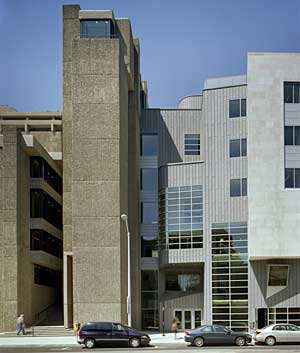

A segment of zinc cladding joins Charles Gwathmey’s new Loria Center (top at right) to Paul Rudolph’s 1963 Art and Architecture Building (top at left). The interior of Rudolph’s building, showing restored lighting fixtures and dropped ceiling (above).
Anya Kaplan-Seem: I wonder if the double mandate you had to renovate this building and to create the new one put you at odds with yourself. Did the desire to restore conflict with the need to make interventions?
Charles Gwathmey: I think you have to understand and respect the original building and to speculate in your design or addition how to both reinforce it, enrich it, and establish a dialogue. To replicate [the Rudolph building] would have been programmatically impossible because [the new building] has a whole different use and a whole different psychology—to replicate Rudolph wouldn’t have been, I don’t think, responsible.
And as a modern architect, I felt that the collage and the site condition of the next series of buildings, which are the old Yale buildings, caused our building to become a bridge. It’s an addition, it’s a bridge, and it’s a transition to the Yale campus.
The zinc became the sort of knitted fabric that related to the British arts center. The zinc didn’t emulate the Rudolph building, but it’s a real material—it patinas, it’s a mined metal, it’s LEED positive—and it becomes like a recessive shadow that allows our limestone piece, which is the farthest distance way from Rudolph, to be the anchor.
And the whole gesture of the rotation on the front façade, angling it back toward Rudolph, is meant to express his core tower three-dimensionally rather than engage it frontally. That was not a gesture of deference, but I think a sensitive gesture.
AKS: The new building is in an extraordinary site—next to Paul Rudolph’s building, across from Louis Kahn’s building. How, in approaching your design, did you deal with the stature of these buildings as iconic works of Modern architecture?
CG: I’m a modern architect. I was taught by Paul Rudolph, so I’ve always had a sculptural, formal ethic in my work.
Constraint is a funny word, but the givens of the Rudolph building were, in my mind, positive, because they allowed us to establish a parti which zoned the two towers and maintained the transparency between buildings, and they allowed us also to sculpt our building as a piece of this collage.
It would have been easy just to say, “Okay, this is the end of this building, here’s a new site,” and not do the weaving. But you couldn’t, because you had to maintain the integrity of this building, you had to acknowledge the next site, you had to configure the puzzle.
I don’t want to say that our building is resultant. But it is, in a sense, predetermined in its organization by the program of public space and private space and then also the interconnectivity between the two buildings.
It’s sort of amazing that Rudolph’s building was never really acknowledged as well as it should have been. Now it’s rediscovered—the wonder of the world! And now our building is up for the critique. So you take your risk, you believe in what you do, and you hope you’ve been both respectful and established a kind of enrichment, a dialogue between the two that’s reinforcing.
Looking for a reprint of this article?
From high-res PDFs to custom plaques, order your copy today!