Oklahoma City
Fueled by public initiatives and energy dollars, a plains city calls on design to improve quality of life
 |
| Photo © Thomas Tucker |
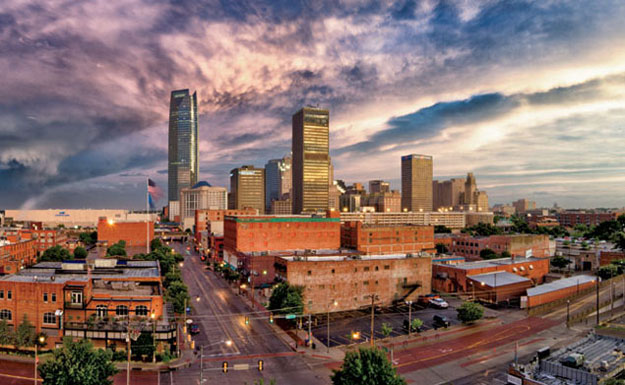
Even with temperatures in the low 100s, Oklahoma City residents gathered in droves this summer to enjoy weekly outdoor movies on a grand lawn just beyond the glimmering new 50-story Devon Energy Center and marvel at the ongoing transformation of their downtown.
Oklahoma City, a sprawling, vehicle-addicted community long known for big-box architecture and chain stores rather than boutique shopping and style, is celebrating a renewed emphasis on architecture and design. A downtown declared dead in 1989 by city-council members is now home to a growing population that routinely gathers for independent-film screenings, live musical performances, and other cultural events. It has not just survived but thrived through the 'great recession' of 2009. It ranked seventh in the nation for private-job growth between 2010 and 2011, with a 2.75 percent jump of 12,000 new jobs (and placed third, at 3.68 percent, for new retail jobs). Population growth last year ranked 34th nationally, while a 4.9 percent unemployment rate is the lowest in the country among metropolitan areas with more than 1 million residents. OKC once briefly lost its orchestra, yet recently ranked in the top 10 percent of all U.S. cities in arts and entertainment employment. A mix of energy companies, aviation, and biosciences firms are credited with placing the metropolis of 1.2 million atop this year's Gallup Job Creation Index.
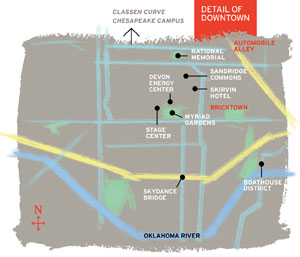
At the heart of it all, the new Devon Energy Center punctuates a skyline undergoing dramatic change, and another $100 million redevelopment is under way nearby at SandRidge Energy. To the south, sleek, sharp-edged boathouses now line the once-derided Oklahoma River, home to a growing mix of amateur, collegiate, and Olympic rowing enthusiasts.
Jeff Speck, author of Suburban Nation and the forthcoming Walkable City, applauds how quickly Oklahoma City is making over its downtown streets and sidewalks with Project 180. The $115 million initiative is funded through a tax-increment-financing district created with the construction of Devon Energy Center. In just four years, all one-way streets are being converted to two-way, and curbside parking spots, bicycle lanes, landscaping, lighting, and other amenities are being added. 'Of the automobile-oriented cities in which I've been working, none has made such a dramatic commitment to reorganizing its street structure around welcoming pedestrians and bicycles in the way Oklahoma City has,' Speck says.
Energy dollars are driving part of this renaissance, but architects argue that the transformation is more nuanced'and rooted in public initiatives pursued 20 years ago. Hans Butzer, who recently followed up his award-winning design of the Oklahoma City National Memorial (in honor of the victims of the 1995 bombing of the Murrah Federal Building) with a pedestrian highway crossing dubbed SkyDance Bridge, sees a once-drab Plains city aspiring to increasingly ambitious design. He credits planning advocates, young and veteran architects, civic leaders, and grassroots groups with collaborating to shape the city's growth. 'There are a lot of forces at play here coming together for a perfect storm on the Plains, putting us on the cusp of a great age in design for Oklahoma City,' Butzer says. 'We just happen to be fortunate enough to have some energy companies that share the understanding of how encouraging better architecture and better planning creates a healthy community socially, economically, and culturally.' Some of the country's top designers are being drawn to Oklahoma City to work on the headquarters for its energy employers. Devon employed Connecticut firm Pickard Chilton and San Francisco'based Gensler, while New York'based Rogers Marvel was commissioned to make over the Pietro Belluschi'designed Kerr-McGee Tower as well as the historic former Braniff Airlines building and combine them with new construction and park space into one cohesive campus for SandRidge Energy.
Perhaps no local architect has benefited more from the influx of energy dollars than Rand Elliott, who was commissioned by Chesapeake Energy chief executive officer Aubrey McClendon to oversee master planning and architecture for the company's 50-acre neo-Georgian campus (and its subsequent modern interventions) and the design of OKC's first contemporary shopping center, Classen Curve (page 90). With backing from Chesapeake and Devon, Elliott has also recently designed three boathouses along the riverfront that kicked off development on this previously neglected waterway.
Interestingly, Elliott famously criticized the architectural legacy of energy companies during the 1980s boom. 'The early '80s brought to Oklahoma City those seeking fame and fortune,' he said back then. 'They saw us as a Class C city, and they gave us what they felt we should have. We were an easy mark. Oil-boom boxes sprang up everywhere. It happened so quickly we hardly stopped to question the long-term impact.' Now, notes Elliott, the city has matured, and design along with it. 'I've never imagined Oklahoma City playing as a team like it is right now,' he says. 'In the 1980s, a small group of influential people were in charge. Now leadership is much broader. The '80s was about personal gain. Today is more about collective benefit.'
The change in Oklahoma City's approach toward its built environment is widely credited to voters' 1993 passage of Metropolitan Area Projects (MAPS), a penny sales tax for high-profile capital improvements. Oklahoma City has a history of big dreams, starting with the arrival of 10,000 people on April 23, 1889, when the community sprang up overnight with the Oklahoma Land Run. The skyline rose in great spurts, first in 1910, then in the early 1930s (the first OKC boom sparked by oil). But with MAPS, for the first time since the city's brief embrace of the City Beautiful movement in the 1930s, civic leaders worked to improve quality of life, not just by building new public amenities but by focusing on projects to add architectural flair with an eye on urban design and planning.
The 2001 renovation by local architect Richard Brown and New York'based Polshek Partnership Architects (now Ennead) of the Art Deco Civic Center Music Hall, itself a legacy of the City Beautiful movement, stands out as one of the MAPS improvements that led this latest transformation. Bricktown Canal, a San Antonio River Walk'style passage, and streetscape improvements connect the various MAPS projects, which pumped life into the city's wan design community. Developers followed the city's lead and renovated many historic buildings in the Bricktown warehouse district and Automobile Alley, once home to dozens of car dealerships. The emergence of these areas, which are now filled with restaurants, shops, offices, and entertainment venues, further proved that residents craved a community in which they could congregate, shop, and enjoy the city's new urban vibe.
These changes, in turn, attracted the return of some of the design community's prodigal sons. They include Wade Scaramucci, who came back after years abroad, and whose latest project, Level Urban Apartments, has introduced modern, cost-efficient design not previously seen downtown. Architect Anthony McDermid is at work on the similarly modernistic Aloft Hotel, across the street from Level. McDermid's OKC firm, TAP Architecture, is also designing a new downtown elementary school and a mixed-use parking garage. The architect sees opportunities to recast the feel and look of the city with both projects'and has received unprecedented support for looking forward instead of maintaining the status quo. 'The general public has a lot of confidence they've never had before,' he says. 'They had confidence in voting themselves a tax, and projects were delivered.'
Based on the success of MAPS, voters passed two sequels: the MAPS for Kids overhaul of city schools, in 2001, and MAPS 3, in 2009, to fund a new streetcar system, park, convention center, and further improvements along the Oklahoma River. Such rising self-esteem was evident with the completion of the first MAPS projects'but it was not yet enough to convince talented young design professionals to stay in their hometown. By the time Butzer's work on the memorial was recognized by Time magazine as one of the top 10 best designs in 2000, he noticed a troubling trend among first- and second-year students he taught at the University of Oklahoma. When he polled them about their postgraduate future, 90 percent responded they planned to leave the state. Butzer switched to teaching fifth-year design studios and sought out real-life projects being contemplated in the urban core. In these studios, students have had their work reviewed by chief executives of some of the city's largest corporations, and Butzer believes the talent drain is now a trickle.
Chesapeake's McClendon and Devon Energy executive chairman Larry Nichols both have their say in the city's transformation through their contributions toward the development of the boathouse district as well as their headquarters and other local investments. They've also supported the creation of amenities designed to appeal to a younger generation focused on sustainability. An underground garage with a green roof is Elliott's latest addition to the Chesapeake campus, while Nichols has supported Project 180's addition of bike lanes, electric-vehicle charging stations, and a makeover of the downtown Myriad Gardens'a project guided by the Office of James Burnett, landscape architect Scott Murase, and Gensler. A public discussion on this evolution continues, with hundreds of residents showing up for town-hall meetings about the design of a new downtown boulevard. 'There's a recognition now,' says Butzer, 'that having more voices at the table for these decisions is a win-win situation.'
Looking for a reprint of this article?
From high-res PDFs to custom plaques, order your copy today!