Pittsburgh
The former Steel Town embraces its rivers and green design
 |
| Image © Jason Varney |
Pittsburgh's identity has always been its work. Thirty years ago, when it lost the steel mills that had forged its 20th-century reputation, it became part of the Rust Belt, with a fractured economy and three polluted rivers: the Ohio, Monongahela, and Allegheny.

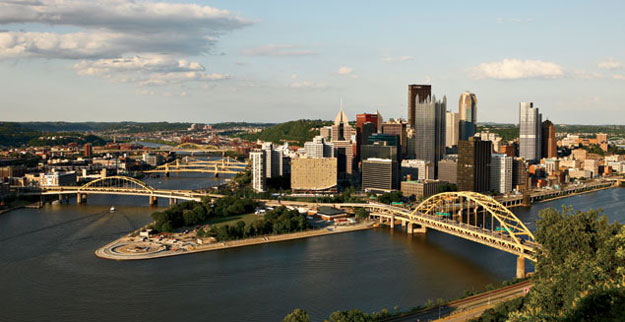
Today, locals use the rivers for play as well as work. On sunny summer weekends, the water buzzes with kayaks and pleasure boats, thousands flock to outdoor festivals at refurbished Point State Park at the confluence of the rivers, and cyclists zip past golden bridges and black-and-gold-clad sports fans. The region is reclaiming its riverfront, embracing a new name suggested by architect and Carnegie Mellon University faculty member Don Carter: the Water Belt.
Emphasizing urban design and environmental protection, the southwestern Pennsylvania city has leveraged a $124 million investment in publicly accessible riverfront into $4 billion in corporate, public, nonprofit, and entertainment activity downtown, according to Riverlife, the city's nonprofit think tank for waterfront design. With a quarter-century of renewal behind it, Pittsburgh is now doubling down on sustainable investment with a deeper commitment to public spaces: softening the edges of the waterfront, finding long-term solutions for stormwater management and water quality, strengthening the central core, and extending its eds-and-meds-based growth into old neighborhoods.
Heavy industry's demise had one salutary effect: It forced Pittsburgh to clean and repurpose the brownfields that claimed prime riverfront acreage. By the 1990s, Mayor Tom Murphy was championing public access to the rivers with the first recreation trails. Riverlife then created and implemented a comprehensive plan for Three Rivers Park, 13 miles of public green space and trails along downtown's shorelines. 'We've shown the power of urban design and scale to open up riverfronts to everyone and rebrand Pittsburgh as a river city,' says Lisa Schroeder, Riverlife CEO.
Pittsburgh has revived its economy as well as its riverfront. While other regions struggle, southwestern Pennsylvania posted a job-growth rate of 3.9 percent between the first quarter of 2010 and the beginning of 2012. The region now boasts more jobs than it had at the start of the national recession in 2008. In the past six years, Pittsburgh has added $5 billion in capital investment in its central business district, most notably in new construction by PNC Financial Services Group. And while the city population of 305,000 is down from the mid-20th-century peak of 680,000, it is growing'and growing smarter. Pittsburgh, along with Washington, D.C., has the nation's highest percentage of young adults with graduate degrees. Meanwhile, the Marcellus Shale discovery has turned Pittsburgh into the largest city atop the world's second-largest natural-gas field.
A decade's worth of public-private projects are now complete. In addition to the recreational trails, the city completed Rivers Casino and two new sports stadiums, PNC Park and Heinz Field, along the north shore of the Allegheny. Nearby, the city's cultural district reclaimed 14 historic blocks from a red-light eyesore. The Pittsburgh Cultural Trust now manages over 1 million square feet of property there, adjacent to the city's 2003 convention center, designed by Rafael Vi'oly. It is the only convention center with dual LEED certification: Gold for new construction and Platinum for operations. On the southern bank of the Monongahela, SouthSide Works, named for the 44-acre steel mill that occupied the site until 1985, is a successful mixed-use neighborhood developed by the Soffer Organization that extends the city's traditional street grid and bridges.
On the opposite bank, the city's two major research institutions, the University of Pittsburgh and Carnegie Mellon University, are outgrowing space in Pittsburgh Technology Center, less than a mile from their campuses. They are expanding medical and high-tech lab space in another East End neighborhood, East Liberty, following successful transit-oriented developments near an express-bus station. Two-year-old Bakery Square, created in a former Nabisco factory there, includes a health club, a hotel, and retail space, and is home to Google's Pittsburgh office. Pittsburgh-based Astorino designed the red-brick complex's LEED Platinum renovation, while another local firm, Strada, designed Google's space, retaining original details like the plant's industrial mixers. In August, developer Walnut Capital announced Bakery Square 2.0, a $120 million expansion with a master plan by Strada.
A number of recent projects join government and developers with local philanthropies, including those founded by 19th-century fortunes like Mellon and Heinz. 'Foundations made a collective decision to invest not only in downtown, but also in the neighborhoods,' says Carnegie Mellon University's Carter, director of the school's Remaking Cities Institute. With consistent support from the city's Green Building Alliance, foundations have set high standards for development with ambitious projects like the recently completed Center for Sustainable Landscapes by The Design Alliance Architects at the Phipps Conservatory and Botanical Gardens (page 102). The $12 million education and research facility received a $2.6 million grant for design from the Heinz Endowments.
Despite budget deficits that have kept the city under state oversight since 2004, Pittsburgh and surrounding Allegheny County have provided direction, if not dollars, through policies and incentives, particularly those to encourage LEED-certified development. The Tower at PNC Plaza, the bank's under-construction 33-story headquarters (page 100), is its third major LEED project in the core. Designed by Gensler, the tower is planned to exceed Platinum standards. The new building at Phipps is targeting certification through several green-building programs, including the ultra-stringent Living Building Challenge. Downtown property owners also recently created a 2030 District, making Pittsburgh the third U.S. city (behind Seattle and Cleveland) to commit to carbon neutrality by that year. Over 23 million square feet and 61 properties are included in the program.
A pressing priority for the Three Rivers watershed is managing stormwater and combined-sewer overflow. Alcosan, the sewer authority, has signaled a willingness to consider green projects as a means of improving river-water quality and as an alternative to costly infrastructure replacement. The Allegheny Riverfront Green Boulevard plan, approved by the city in 2010 and designed with $1.5 million in federal funds, incorporates water capture on public and private land in a corridor along the northern edge of downtown. The scheme by Sasaki Associates and Perkins Eastman envisions habitat restoration along a 6.45-mile rail-with-trail that would accommodate an existing rail freight line and add passenger use.
Along the Ohio, another plan envisions the use of a riverfront parcel between the Carnegie Science Center and the Rivers Casino. NBBJ's Headwaters Lagoon master plan calls for a hotel and public space adjoining Three Rivers Park and a completed multimodal transit station. The design relies on existing stormwater holding tanks and has naturally filtered fountains cascading into the river, creating what Riverlife's Schroeder calls 'a national model' for watershed management. Local foundations including the Heinz Endowments and the Buhl Foundation have made $1 million in grants for project planning and design.
On the Monongahela, Pittsburgh's foundations and sustainable-design advocates are collaborating on a 180-acre capstone to riverfront redevelopment. Four local foundations, including Heinz, put up $10 million to adapt the former Jones & Laughlin steel mill in Hazelwood, about 3.5 miles east of downtown. A sustainable master plan developed by Rothschild Doyno Collaborative focuses on office space for high-tech research and development, plus industrial and residential use, on the last large riverfront site in the city. Foundations have committed another $10 million for infrastructure improvements. The project will incorporate industrial remnants, such as a railyard roundhouse and a 1,300-foot-long steel mill, and will extend an existing riverfront trail. 'Facing the river is something we should be celebrating,' says Dan Rothschild, a principal of the firm.
Closer to the central business district, a field of rubble in the shadow of the city's tallest building, the former U.S. Steel headquarters, could soon extend the city's core. Here the National Hockey League's Pittsburgh Penguins will develop the 28-acre site of their former arena, demolished last year. A conceptual redevelopment plan by Urban Design Associates targets LEED for Neighborhood Development certification and calls for 1,200 units of housing, office and retail space, and parks. The Penguins, now playing next door at the LEED Gold'certified Consol Energy Center, have hired Jones Lang LaSalle to engage the community and later market the project to investors. Unlike large development sites in other Rust Belt cities, the old arena's empty plot sits next to the central business district, points out Craig Dunham, president of Dunham reGroup, the owner's representative. 'This isn't fringe,' he says. The location, 'coupled with Pittsburgh's overall strength and the activity going on downtown, make it unique.'
The new neighborhood will draw more residents to live in the core, where recreation and cultural amenities continue to expand. In 30 years the city's steel heritage will be a distant memory. Its new identity, in sustainable and smart growth, will be its work.
New York Times, Washington Post, National Geographic Traveler
Looking for a reprint of this article?
From high-res PDFs to custom plaques, order your copy today!