Going for the Green
Can London oust the ghosts of Olympics past and find ways to reuse its venues?




Architects & Firms
Assuming the dreams of London's Olympic planners come true, London 2012 will be as much a regeneration project as a global athletic event. From the outset, its defining mantras have been regeneration and 'legacy''East London's future. The location of the Olympic Park, straddling four of the city's poorest boroughs in East London's Lea River Valley, is far removed from the royal palaces and leafy residential squares of West London. During the early planning for the Olympic bid, a brief flirtation with a northwest London site centered on Foster + Partners' Wembley Stadium, which was under construction at the time. But then Mayor Ken Livingstone (who was defeated again by Mayor Boris Johnson last month in a run for a second term) was adamant that if London were to host the Games, the occasion should be used to redress the city's long history of economic disparity between east and west.
Closer to the mouth of the Thames, East London was historically the city's port, an area of docks, industries related to shipbuilding, and the working-class neighborhoods that supported them. It has also been the city's service zone, fragmented by transport and utility infrastructure as well as the first foothold for waves of immigrants arriving in the capital. The burning question is whether the Olympic and Paralympic Games can kick-start economic regeneration in this postindustrial landscape, approximately seven miles east of Big Ben.
Transit connectivity in Stratford, in the London borough of Newham, was the tipping point that made the Games in East London viable. Stratford International Station, underway prior to the Olympic bid, will eventually become a stop on the Channel Tunnel Rail Link to Europe. Another Stratford station serves two London underground lines, a light-rail system, and numerous national and commuter rail lines. Before the Olympics bid, a private consortium of developers had already eyed the area's potential and submitted a planning application for Stratford City, a 74-acre mixed-use scheme.
The master plan for the Olympic Park precinct must be seen in light of London's overall development. A decade earlier, the UK Government's Urban Task Force, chaired by architect Richard Rogers, had promoted a vision for London's future as a compact, connected city. Redevelopment of brownfield sites was prioritized over encroachment on the surrounding greenbelt, and expansion eastward was identified as London's optimum growth corridor. Yet the master plan for the Games could have taken many forms. As in Beijing, Athens, and Sydney, the plan could have focused primarily on the architecture of the venues.
But the master plan that emerged in 2004'led by EDAW (now AECOM) with Allies & Morrison, Foreign Office Architects (FOA), and HOK Sport (now Populous)'married ecology and green infrastructure with urban design and regeneration. Protection and enhancement of the natural environment played a determining role in the location and design of new transit and utility infrastructure, as did connectivity. More than 30 new bridges in and around the Olympic Park were to link neighborhoods across the Lea Valley, knitting together an urban fabric long severed by waterways and infrastructure. FOA's proposal for a sinuous landscape centered on the waterways forcefully articulated the idea that a powerful landscape design would be at the heart of the plans. While the proposed park formed part of a 16-mile green spine, linking Hertfordshire in the North to the Thames along the Lea River Valley, that master plan still lacked a compelling concept that would secure the Games for London.
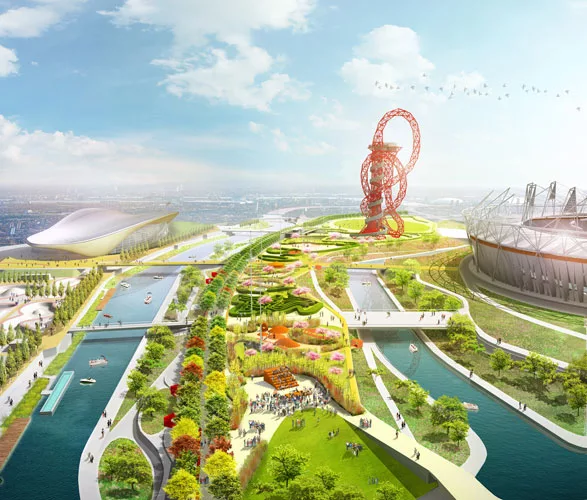
The notion of a One Planet Olympics, which would minimize the impact of the Games themselves and focus on creating exemplary low-carbon buildings and legacy communities, provided the missing allure. Use of London's historic sites and existing arenas was central to this approach and permanent venues would be built only when justified by a sound business plan and long-term community potential. Temporary facilities would be used to fill the shortfall. Events will be held throughout greater London and beyond, including beach volleyball at a temporary stand on Horse Guards Parade, not far from Buckingham Palace, and equestrian competitions at Greenwich Park. The heart of the Games centers on the new Olympic Park, built in the grand tradition of London's Royal Parks but responding to 21st-century challenges of climate change. The detailed landscape design by George Hargreaves and Associates and LDA Design merges water management and biodiversity, while ornamental planting and herbaceous borders, the mainstays of British horticulture, are limited to show gardens on the main concourse.
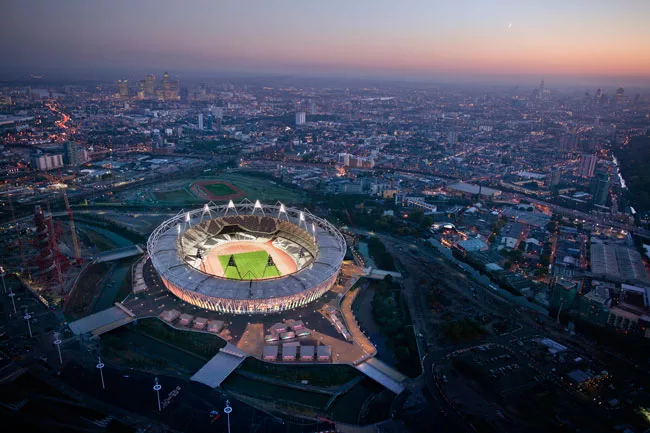
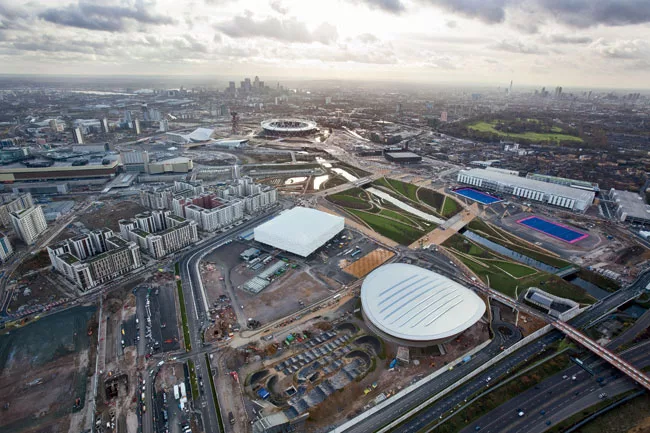
What type of architecture would give form to London's lean and green ambitions? How could the major sporting venues, particularly the big three'the Olympic Stadium, the Aquatics Centre, and the Velodrome'sit comfortably in the sustainable, walkable city of the future envisioned by London's planners? A consensus emerged for demountable structures so that the arenas would be appropriately sized for long-term community use [page 92]. The stadium could be reduced in size from its 80,000 Olympic capacity to 25,000 seats after the Games; the Aquatics Centre would have temporary wings so that an additional 15,000 would complement its 2,500 permanent seats during the Games. Only the Velodrome, to be operated in legacy by the Lea Valley Regional Park Authority, would retain its initial capacity of 6,000 seats.
Looking for quick answers on architecture and design topics?
Try Ask RECORD, our new smart AI search tool.
Ask RECORD →
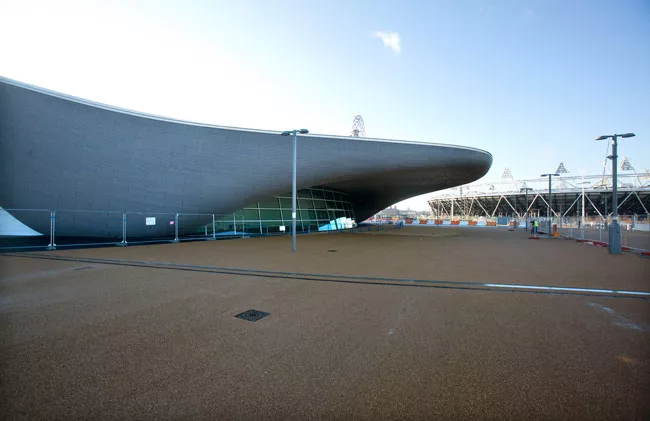
But the story became more complex when competing agendas and the financial crisis erupted mid-course during the building of the Olympic Park. Due to the lack of Olympic swimming pools in the London area, Livingstone had promised an Olympic swimming pool to East Enders, wanting to leave improvements in the Lea Valley even if London lost the bid. A design competition for an Aquatics Centre, with a jury led by Richard Rogers, took place in 2004'before the environmental agenda that informed the design briefs for subsequent buildings was fully developed. Iconic architecture that would help secure the Olympics for London took precedence, and a dramatic sculptural building with a double-curvature roof by Zaha Hadid Architects was selected over leaner schemes by Behnisch Architekten and Bennetts Associates.
After London won the bid in July 2005, the Olympic Delivery Authority (ODA) was established as the publicly funded entity to build the necessary 2012 infrastructure and venues. Critical at this early stage was the rerouting of infrastructure and cleaning up the heavily contaminated site. The Olympic Park master plan was reconsidered, together with the plans for the adjacent Stratford City development, to coordinate infrastructure investment and provide for the Athletes' Village, largely within the boundary of the private development. The ODA translated the bid's One Planet aspirations into target metrics that were then written into planning and design contracts. The Aquatics Centre was significantly reduced in scope but its steel-intensive double-curvature roof remained. Hopkins Architects' Velodrome proved to be London 2012's flagship sustainable venue. The key to its success was an integrated working relationship between Hopkins and its structural and environmental engineers, Expedition Engineering and BDSP Partnership.
Along with the Velodrome, another of London 2012's significant architectural achievements is its approach to infrastructure buildings. Certain to become landmarks in the new East London, these include a district energy and biomass plant by John McAslan + Partners, responsible for the refurbishment of King's Cross Station [page 72], a sewage pumping station and water recycling plant by John Lyall Architects (now Lyall, Bills & Young), and the Glasgow practice NORD's electricity substation.
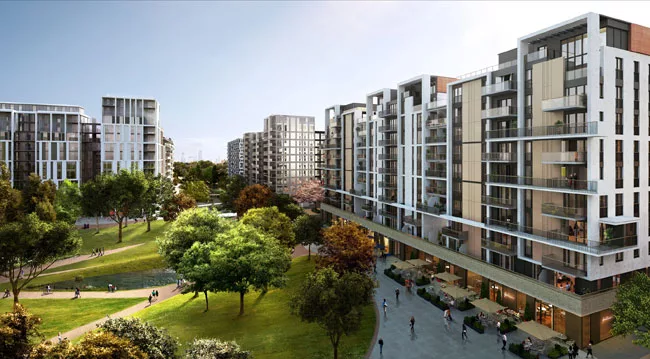
But it will be the housing, schools, and community facilities that form the backbone of the regenerated area. The Athletes' Village housing will be converted into more than 2,800 mixed-income apartments. Unfortunately, due to budget constraints when the economy soured, the early schemes for four-to-eight-story buildings were rationalized into 10-to-12-story courtyard blocks on a podium of parking'a dense urban-housing type unfamiliar to Londoners. Despite detailed envelope design by various well-known architectural firms, the overall impression of the housing is soulless. After the Games, many new development sites will become available: Current plans call for approximately 11,000 new units, including more traditional terraced housing to front the park with denser housing along the canals.
Although the timeline for much of the Stratford City development slowed after the 2008 financial crisis, Westfield Stratford City, a 1.9-square-foot retail complex, billed as the largest urban shopping center in the European Union, opened in September 2011. An outdoor pedestrian route through the mall will be the gateway for approximately 70 percent of visitors to the Olympic Park during the Games'and for many beyond. The proximity of Westfield's retail and leisure facilities to the Olympic Park should provide approximately 9,500 jobs, in spite of its offering a quite noticeable commercial image at the front door to the Games.
As the Games draw to a close, the integration of the Olympic Park with the surrounding city'through improvements in the public realm and thoughtful programming of park activities to attract nearby residents and other Londoners'will be critical. A team led by James Corner Field Operations will mastermind the transformation of the pivotal southern area of the park between the Stadium and the Aquatics Centre. New York's High Line'also designed by a Corner-led team'is proof that landscape can be an urban game changer, and the new Queen Elizabeth Olympic Park is a powerful starting point.
But design and planning are not enough to create a vibrant place. To secure a dynamic future for the Lea River Valley, investment in jobs, schools, and other community facilities must follow. City building is a matter of decades. Only time will tell how the new East London will fare after the Olympic flame moves on.
Hattie Hartman, an American architect, is sustainability editor at the Architects' Journal and author of London 2012: Sustainable Design, available in the U.K.
Looking for a reprint of this article?
From high-res PDFs to custom plaques, order your copy today!