Architectural Record
search
cart
facebook twitter linkedin youtube
  • Sign In
  • Subscribe
  • Sign Out
  • My Account
Architectural Record
  • NEWS
    • Latest News
    • Awards
    • Interviews
    • Obituaries
    • Podcasts
      • Design:Ed Podcast
      • Sponsored Podcasts
  • OPINION
    • Book Reviews / Excerpts
    • Exhibition Reviews
    • Forum
  • EXCLUSIVES
    • Videos
    • Design Vanguard
    • Top 300 Firms
    • Sponsored Content
    • Sponsored eBooks
    • From the Archives
  • CONTINUING ED
    • Editorial Continuing Ed
    • CE Center
    • CE Academies
  • PROJECTS
    • Buildings By Type
    • Reuse & Renovation
    • Museums & Arts Centers
    • Colleges & Universities
    • Multifamily Housing
    • Interiors
    • Lighting
    • Kitchen & Bath
  • HOUSES
    • Record Houses
    • House of the Month
    • Featured Houses
  • PRODUCTS
    • Products by Category
    • Record Products of the Year
    • Latest Products
  • EVENTS
    • Dates & Events
    • Record on the Road
    • Innovation Conference
    • Sustainability in Practice
    • Women In Architecture
    • Webinars
    • Ad Excellence Awards
    • Submit an Event
  • CONNECT
    • Ask RECORD AI
    • Newsletters
    • Contact
    • Advertise
    • Editorial Calendar
    • Store
    • Customer Service
  • SUBMIT
    • Submission Guidelines
    • RECORD Competitions
  • MAGAZINE
    • Subscribe
    • My Account
    • Digital Edition
    • Current Issue
    • Firm Pass
    • Historic Archive
Commentary & Criticism

Beyond Architecture

As the world's population of informal-settlement dwellers races to the 1.5 billion mark, designers and planners must play a central, if redefined, role.
By Flavie Halais
A string of six open-air escalators carries residents 12 stories up the hillside of Medellín's notorious Communa 13 district. Completed in 2012 for about $7 million, it is part of a l
Beyond Architecture
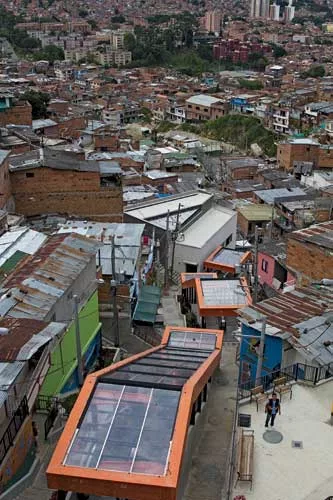
A string of six open-air escalators carries residents 12 stories up the hillside of Medellín's notorious Communa 13 district. Completed in 2012 for about $7 million, it is part of a larger public-works effort to connect neighborhoods, public spaces, and public transport through a series of infrastructure projects.
Photo © Flavie Halais
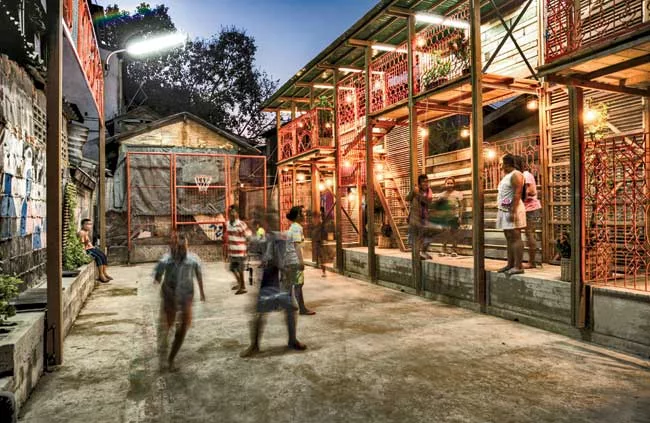
Collaborating with local residents and students, Norwegian architects TYIN Tegnestue created Community Lantern in Bangkok's largest informal settlement, Klong Toey. The 980-square-foot des
Beyond Architecture
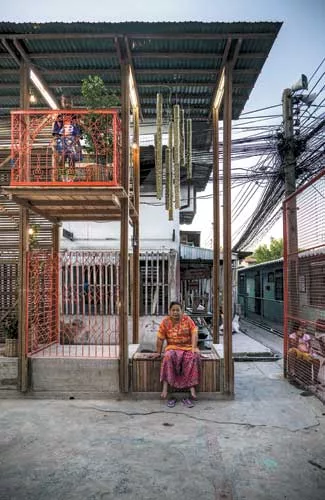
Collaborating with local residents and students, Norwegian architects TYIN Tegnestue created Community Lantern in Bangkok's largest informal settlement, Klong Toey. The 980-square-foot design-build project, completed in 2011, is made of salvaged wood and concrete. With a price tag of just $6,000, it provides a space for recreation and repose—with basketball hoops, a stage, and a playground—on a lot once strewn with detritus.
Photo © Pasi Aalto
Collaborating with local residents and students, Norwegian architects TYIN Tegnestue created Community Lantern in Bangkok's largest informal settlement, Klong Toey. The 980-square-foot design&
Beyond Architecture
Collaborating with local residents and students, Norwegian architects TYIN Tegnestue created Community Lantern in Bangkok's largest informal settlement, Klong Toey. The 980-square-foot design-build project, completed in 2011, is made of salvaged wood and concrete. With a price tag of just $6,000, it provides a space for recreation and repose—with basketball hoops, a stage, and a playground—on a lot once strewn with detritus.
Photo © Pasi Aalto
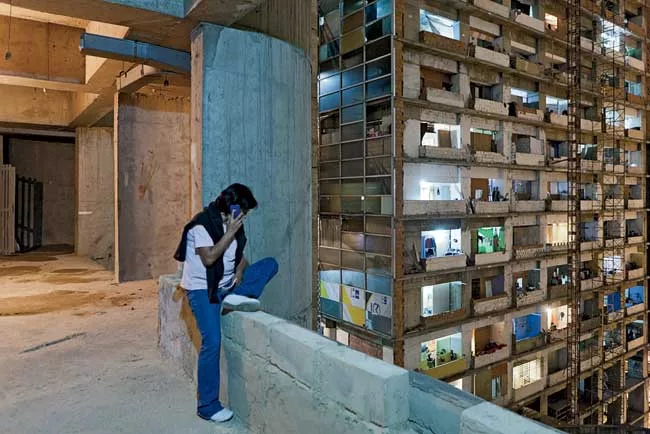
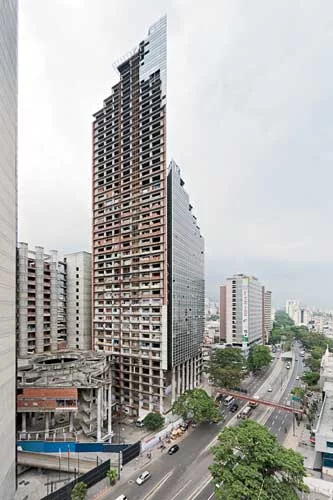
Rising 45 stories, Torre David is the world's tallest informal settlement, housing an estimated 3,000 residents. The tower was planned for commercial use, but construction stopped in the early 199
Beyond Architecture
Rising 45 stories, Torre David is the world's tallest informal settlement, housing an estimated 3,000 residents. The tower was planned for commercial use, but construction stopped in the early 1990s and squatting began in 2007. Since then a community has emerged, repurposing the building with living spaces, a church, a gym, and shops.
Photo © Iwan Baan
Rising 45 stories, Torre David is the world's tallest informal settlement, housing an estimated 3,000 residents. The tower was planned for commercial use, but construction stopped in the early 199
Beyond Architecture
Rising 45 stories, Torre David is the world's tallest informal settlement, housing an estimated 3,000 residents. The tower was planned for commercial use, but construction stopped in the early 1990s and squatting began in 2007. Since then a community has emerged, repurposing the building with living spaces, a church, a gym, and shops.
Photo © Iwan Baan
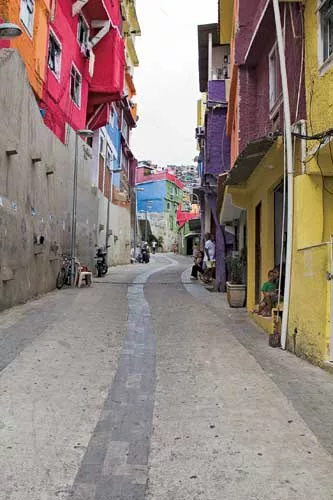
The wide, paved walkway and painted houses in this section of Rio's most populous favela, Rocinha, are the result of the federally funded Growth Acceleration Program, which entered its second phas
Beyond Architecture
The wide, paved walkway and painted houses in this section of Rio's most populous favela, Rocinha, are the result of the federally funded Growth Acceleration Program, which entered its second phase in 2010. The project includes widening of footpaths (some previously just 2 feet across), improving public spaces, and increasing safety. Residents displaced by the street widening were relocated to nearby social housing.
Photo © Flavie Halais
The result of a collaboration between Kenyan-born British architect James Howard Archer and Kenyan architect Mumo Musuva, the Community Cooker is a refuse-burning stove for food preparation in
Beyond Architecture
The result of a collaboration between Kenyan-born British architect James Howard Archer and Kenyan architect Mumo Musuva, the Community Cooker is a refuse-burning stove for food preparation in the Laini Saba section of Kibera, Nairobi's largest informal settlement. Featured in the Cooper-Hewitt National Design Museum's recent exhibition Design With the Other 90%: Cities, the stove, powered by the never-ending supply of trash, offers an alternative to traditional charcoal- and wood-fueled versions.
Photo © Community Cooker-Jikoya Jamii
A string of six open-air escalators carries residents 12 stories up the hillside of Medellín's notorious Communa 13 district. Completed in 2012 for about $7 million, it is part of a l
Collaborating with local residents and students, Norwegian architects TYIN Tegnestue created Community Lantern in Bangkok's largest informal settlement, Klong Toey. The 980-square-foot des
Collaborating with local residents and students, Norwegian architects TYIN Tegnestue created Community Lantern in Bangkok's largest informal settlement, Klong Toey. The 980-square-foot design&
Rising 45 stories, Torre David is the world's tallest informal settlement, housing an estimated 3,000 residents. The tower was planned for commercial use, but construction stopped in the early 199
The wide, paved walkway and painted houses in this section of Rio's most populous favela, Rocinha, are the result of the federally funded Growth Acceleration Program, which entered its second phas
The result of a collaboration between Kenyan-born British architect James Howard Archer and Kenyan architect Mumo Musuva, the Community Cooker is a refuse-burning stove for food preparation in
March 16, 2013

This century's biggest architectural challenge is taking place in the developing world. There, already overcrowded cities must absorb a constant influx of migrants fleeing the lack of economic opportunities or the armed conflicts plaguing their rural hometowns. Soon the world will house 1.5 billion slum dwellers, half of them in Asia, with the 2 billion mark scheduled to be reached by 2030.

In large settlements such as Rio de Janeiro's Rocinha, Nairobi's Kibera, or Mumbai's Dharavi, hundreds of thousands of residents coexist in the highest densities ever seen, often squatting on the land where they built their makeshift homes. Living conditions engender poor sanitation, a dire lack of public services, and gang-induced violence. Quick, cheap, and efficient infrastructure solutions for the urban poor were needed yesterday. However daunting, the challenges have been made more bearable by the past successes of municipality-initiated upgrading programs such as the recent one in Medellín, Colombia, and in Rio's Favela-Bairro, as well as the community-based Orangi Pilot Project in Karachi, Pakistan, led by architect Arif Hasan in the 1980s.

These programs have revealed that, more than ever, architects and planners are needed to play a central, though largely redefined, role in the development of substandard neighborhoods. In the slums of this world, problem solving and creativity are favored over design in its purest form; vernacular aesthetics over an architect's distinctive style; community participation over unilateral decisions. The approach to architectural practice that these qualities suggest can be at once thankless and deeply gratifying, as a single project holds the potential to dramatically affect the lives of thousands.

Over the years, architects have risen to the challenge and have led projects whose influence resonates in the work of today's practitioners. Two initiatives in India–Charles Correa's small Artist Village in Belapur (1983-86) and B.V. Doshi's Aranya in Indore (1989)–stand out as early examples of incremental-housing programs, in which communities are built with minimal infrastructure and designed for future expansion by their inhabitants. In the minds of these architects, neighborhoods and cities should flourish over time.

The idea that informal settlements should be seen not as a problem but rather as a natural step toward the formation of vibrant metropolises is what led Rio to launch its ambitious Favela-Bairro program. With funding from the Inter-American Development Bank (IADB), the scheme (which ran from 1994 to 2007) focused on small-scale, targeted infrastructure creation and upgrading such as street paving, rather than on dwellings themselves. The federal Growth Acceleration Program later added another layer of public works, with larger projects, like social housing. “By upgrading favelas and investing in them, the public sector sent a message to residents, which was: 'We're investing in you,' ” says Theresa Williamson, who heads the Rio-based NGO Catalytic Communities, dedicated to integrating favelas into the formal city.

Favela-Bairro's successor, Morar Carioca, is even more ambitious. The $4 billion initiative, also backed by the IADB, was launched in 2010 in anticipation of the 2016 Summer Olympics. Forty architecture firms, selected after a citywide competition, have submitted substantial upgrading plans slated for completion over the next seven years. But while seeking to resolve Favela-Bairro's shortcomings, namely a lack of public participation and poor maintenance, Morar Carioca does not address the unlawful evictions that have taken place to “sanitize” the city in preparation for the upcoming World Cup, Olympics, and other mega-events. In the small hillside community of Providência, Rio's oldest favela, 671 families have been notified of their upcoming eviction to make way for projects—branded as Morar Carioca—which they say were planned by the city without their input, including an eye-catching cable-car line. A local advocacy group estimates that 30,000 residents will be removed ahead of the World Cup and Olympics, with the municipality claiming infrastructure construction as the reason. Relocation programs mainly consist of sending families to faraway, poorly built social-housing projects.

In places like Rio, where land speculation strangles low-cost housing development and links between developers and politicians are inextricable, even the best-intentioned initiatives can't entirely escape the effects of corruption and poor governance. With the potential to affect thousands of residents, politicians can use large-scale top-down programs as straw favors. In her book Cities With 'Slums,' Marie Huchzermeyer of the School of Architecture and Planning at the University of the Witwatersrand, in Johannesburg, describes how the repeated use of the slogan “cities without slums” and the word “slum-free” by UN-Habitat and its offshoot agency Cities Alliance led certain African countries to put aggressive removal programs into place. UN-Habitat, she writes, failed to properly monitor the implementation of the U.N. Millennium Development Goals to improve the living conditions of 100 million slum dwellers by 2020, which the “cities without slums” campaign was intended to promote.

By contrast, some of the latest innovative approaches for housing construction are more modest in scale, in part as a way to limit political interference. Two recent examples of incremental housing—one by Alejandro Aravena's Chilean firm Elemental, the other by an international team of architects led by Stockholm-based Filipe Balestra and Sara G'ransson—have taken Correa's and Doshi's concepts a step further. The houses come with minimal programmed space, enabling future expansion by tenants. This replicates the slow but organic building process of families without access to loans and mortgages. While Elemental's units have been used in orderly-looking government housing projects across Latin America, Balestra and Göransson's strategy is being implemented in dense areas of Mumbai and Pune, India, in partnership with the local NGO SPARC and Mahila Milan, a grassroots, women-run organization managing credit and savings activities.

In Mumbai's sprawling, chaotic Dharavi slum, Matias Echanove and Rahul Srivastava run URBZ, a design practice dedicated to consultancy (one of their current projects, a community mosque, is being developed in collaboration with the Italian architecture firm Studio Marc). Conception and implementation, they say, can mostly be achieved by drawing from the community's pool of resources and the technical know-how of contractors. Traditional tools used by professionals, such as maps and drawings, can lose their value in areas with strong traditions of oral communication. “We feel there must be another model for affordable housing based on local construction logistics,” Echanove says. “It already exists, but it's not recognized or invested in by municipalities.”

The careful, localized approach taken by this new generation of practitioners reflects the difficulty of establishing best practices and a clear housing model to be replicated universally on a large-scale basis, as each community must respond to site-specific circumstances and needs. Effective approaches must first seek to understand such variables as the urban fabric and the use of private and public space before moving on to the design stage.

In informal settlements, the role of the architect, planner, and anthropologist can intersect in complex but often advantageous ways, and traditional roles and responsibilities must be put aside. Here individual clients are virtually nonexistent; practitioners serve communities and, beyond that, a cause. “The role of professionals is to be the voice of the people who have no voice themselves,” says British architect and urban-development consultant Geoffrey Payne. To some, architectural practice in these places can be unsettling. To others, it is deeply exhilarating.

KEYWORDS: Balkrishna Doshi cities urban planning

Share This Story

Looking for a reprint of this article?
From high-res PDFs to custom plaques, order your copy today!


Post a comment to this article

Report Abusive Comment

Subscription Center
  • Create an Account
  • Start a Subscription
  • Manage My Account
  • Sign Up for Newsletters
  • Visit Customer Service
  • Update Preferences

More Videos

Sponsored Content

Sponsored Content is a special paid section where industry companies provide high quality, objective, non-commercial content around topics of interest to the Architectural Record audience. All Sponsored Content is supplied by the advertising company and any opinions expressed in this article are those of the author and not necessarily reflect the views of Architectural Record or its parent company, BNP Media. Interested in participating in our Sponsored Content section? Contact your local rep!

close
  • TAMLYN XtremeTrim Exterior Trim
    Sponsored byTamlyn

    Designing Cleaner Panel Facades: Why Exterior Trim Details Matter

  • Building with Vapor Barriers
    Sponsored byReef Industries, Inc.

    Vapor Barriers Help Control Moisture in Tighter Building Designs

  • Duct Interior with Prodeq System
    Sponsored byHenry, a Carlisle Company

    Designing Resilient Water Containment Systems

DESIGN:ED Podcast
Listen to Architectural Record’s DESIGN:ED Podcast

Events

June 10, 2026

Rethinking Stormwater – The Power of Porous Paving

Credits: 1 AIA LU/HSW; 1 AIBD P-CE; 0.1 ICC CEU

Learn how porous paving systems support stormwater management, reduce heat island effects, and enhance sustainable site design performance.

June 11, 2026

Very Early Warning Fire Detection for Mission-Critical Facilities

Credits: 1 AIA LU/HSW; 1 AIBD P-CE; 0.1 ICC CEU

Examine advanced fire detection strategies that support uptime and enhance safety in data centers and other mission-critical facilities.

View All Submit An Event

Products

2026 Architect's Square Foot Costbook

2026 Architect's Square Foot Costbook

See More Products

Popular Stories

Practice Matters illustration

What’s in a (Firm’s) Name? Thinking About Succession and Legacy

Practice Matters illustration

By the Numbers: Counting America's Architects

Riverdale House by Studio Lau

Riverdale House by Studio Lau

House on a Hill

Design Vanguard 2026: Forma

Crane Cove, ONO

Design Vanguard 2026 Winners

Broader Sustainability of CMU - Free Webinar - May 21, 2026

Related Articles

  • Guggenheim Museum

    In ‘Beyond Architecture,’ Critics and Practitioners Reflect on the Legacy and Future of Historic Preservation

    See More
  • Beyond Shelter: Architecture and Human Dignity

    See More
  • Energy-Advancement-and-Innovation-Center.jpg

    Countdown to 2030: Architecture and Planning Beyond Politics

    See More

Related Products

See More Products
  • ribbonarch.jpg

    Ribbon Architecture: Light, Shadow, and Reflection in Architecture

  • screen_shot_.png

    Casting Architecture: Ventilation Blocks

See More Products

Events

View AllSubmit An Event
  • July 15, 2025

    Beyond the Numbers: How Benchmarking is Driving Smarter Decisions in Architecture Firms

    NOW ON DEMANDCredits: 1 AIA LU/Elective; 1 AIBD P-CE; 0.1 ICC CEU; 0.1 IACET CEUThis webinar explores how benchmarking empowers architecture leaders to meet these challenges with clarity and confidence.
View AllSubmit An Event
×

The latest news and information

#1 Source for Architectural Design, News and Products

SUBSCRIBE
  • RESOURCES
    • Advertise
    • Contact Us
    • Submit
    • Store
  • ACCOUNT CENTER
    • Create an Account
    • Start a Subscription
    • Manage My Account
    • Sign Up for Newsletters
    • Visit Customer Service
    • Update Preferences
  • PRIVACY
    • PRIVACY POLICY
    • TERMS & CONDITIONS
    • DO NOT SELL MY PERSONAL INFORMATION
    • PRIVACY REQUEST
    • ACCESSIBILITY
  • SERVICES
    • Marketing Services
    • Reprints
    • Market Research
    • List Rental
    • Survey/Respondent Access
  • STAY CONNECTED
    • Linkedin
    • Facebook
    • Instagram
    • YouTube
    • X (Twitter)

Copyright ©2026. All Rights Reserved BNP Media, Inc. and BNP Media II, LLC.

Design, CMS, Hosting & Web Development :: ePublishing