Architectural Record
search
cart
facebook twitter linkedin youtube
  • Sign In
  • Subscribe
  • Sign Out
  • My Account
Architectural Record
  • NEWS
    • Latest News
    • Awards
    • Interviews
    • Obituaries
    • Podcasts
      • Design:Ed Podcast
      • Sponsored Podcasts
  • OPINION
    • Book Reviews / Excerpts
    • Exhibition Reviews
    • Forum
  • EXCLUSIVES
    • Videos
    • Design Vanguard
    • Top 300 Firms
    • Sponsored Content
    • Sponsored eBooks
    • From the Archives
  • CONTINUING ED
    • Editorial Continuing Ed
    • CE Center
    • CE Academies
  • PROJECTS
    • Buildings By Type
    • Reuse & Renovation
    • Museums & Arts Centers
    • Colleges & Universities
    • Multifamily Housing
    • Interiors
    • Lighting
    • Kitchen & Bath
  • HOUSES
    • Record Houses
    • House of the Month
    • Featured Houses
  • PRODUCTS
    • Products by Category
    • Record Products of the Year
    • Latest Products
  • EVENTS
    • Dates & Events
    • Record on the Road
    • Innovation Conference
    • Sustainability in Practice
    • Women In Architecture
    • Webinars
    • Ad Excellence Awards
    • Submit an Event
  • CONNECT
    • Ask RECORD AI
    • Newsletters
    • Contact
    • Advertise
    • Editorial Calendar
    • Store
    • Customer Service
  • SUBMIT
    • Submission Guidelines
    • RECORD Competitions
  • MAGAZINE
    • Subscribe
    • My Account
    • Digital Edition
    • Current Issue
    • Firm Pass
    • Historic Archive

Renewed Promise

By Chris Foges
Sliding screens, operable windows, and solar curtains now animate Bois-le-Pr'tre's exterior.
Bois-le-Pêtre
Lacaton & Vassal and Frédéric Druot
Paris
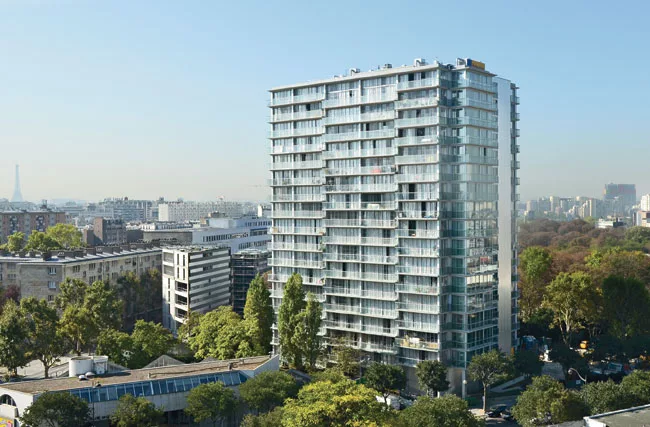
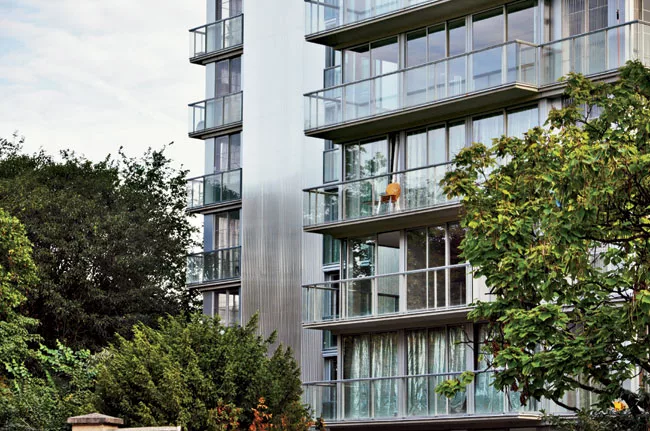
Sliding screens, operable windows, and solar curtains now animate Bois-le-Pêtre's exterior.
Photo © Druot, Lacaton & Vassal
Originally, the 17-story Bois-le-Pêtre was clad in a lively combination of aluminum and glass.
Bois-le-Pêtre
Lacaton & Vassal and Frédéric Druot
Paris
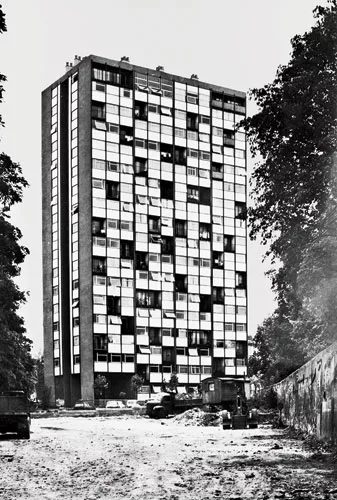
Originally, the 17-story Bois-le-Pêtre was clad in a lively combination of aluminum and glass.
Photo © Druot, Lacaton & Vassal
In the 1980s, this facade was covered over with insulated panels in an attempt to improve thermal performance.
Bois-le-Pêtre
Lacaton & Vassal and Frédéric Druot
Paris
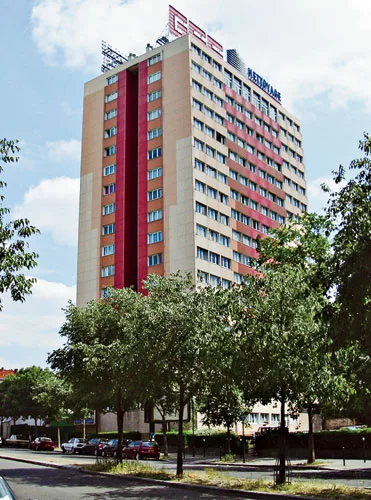
In the 1980s, this facade was covered over with insulated panels in an attempt to improve thermal performance.
Photo © Druot, Lacaton & Vassal
Bois-le-Pêtre
Lacaton & Vassal and Frédéric Druot
Paris
In the 1980s, this facade was covered over with insulated panels in an attempt to improve thermal performance.
Photo © Druot, Lacaton & Vassal
The new facade includes a 10-foot-deep extension to the building on all four sides. It was erected as a framework of story-tall columns and 24-foot-6-inch-wide floor decks over the course of several m
Bois-le-Pr'tre
Lacaton & Vassal and Fr'd'ric Druot
Paris
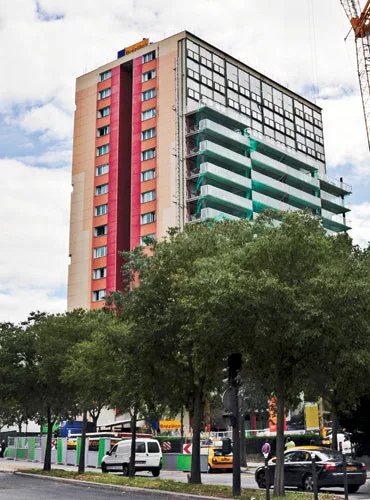
The new facade includes a 10-foot-deep extension to the building on all four sides. It was erected as a framework of story-tall columns and 24-foot-6-inch-wide floor decks over the course of several months.
Photo © Druot, Lacaton & Vassal
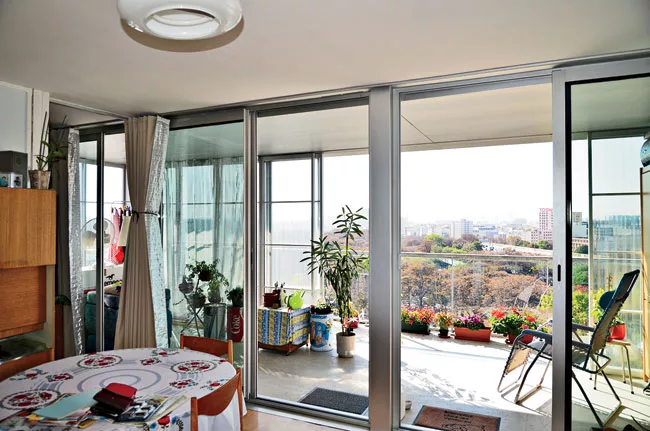
The extensions provide unconditioned winter gardens and new balconies.
Bois-le-Pr'tre
Lacaton & Vassal and Fr'd'ric Druot
Paris
The extensions provide unconditioned winter gardens and new balconies.
Photo © Druot, Lacaton & Vassal
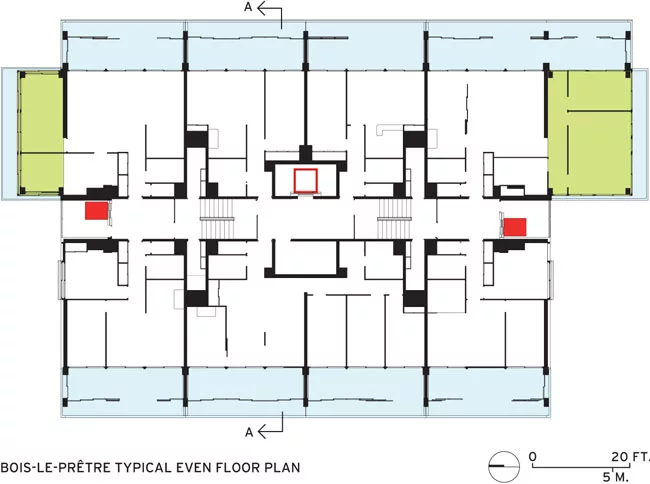
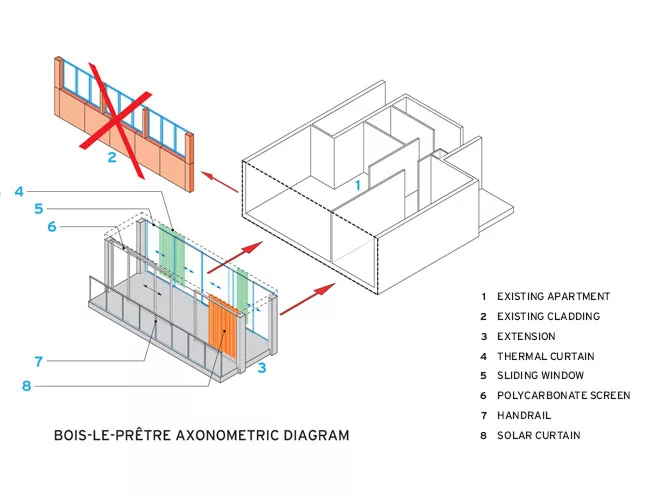
The renovation approach added 242 square feet of usable space to a typical one-bedroom apartment without modifications to the building's interior.
Bois-le-Pr'tre
Lacaton & Vassal and Fr'd'ric Druot
Paris
The renovation approach added 242 square feet of usable space to a typical one-bedroom apartment without modifications to the building's interior.
Image courtesy Lacaton & Vassal and Fr'd'ric Druot
Renewed Promise
Bois-le-Pr'tre
Lacaton & Vassal and Fr'd'ric Druot
Paris
Image courtesy Lacaton & Vassal and Fr'd'ric Druot
Renewed Promise
Bois-le-Pr'tre
Lacaton & Vassal and Fr'd'ric Druot
Paris
Image courtesy Lacaton & Vassal and Fr'd'ric Druot
Renewed Promise
Bois-le-Pr'tre
Lacaton & Vassal and Fr'd'ric Druot
Paris
Image courtesy Lacaton & Vassal and Fr'd'ric Druot
Sliding screens, operable windows, and solar curtains now animate Bois-le-Pr'tre's exterior.
Originally, the 17-story Bois-le-Pêtre was clad in a lively combination of aluminum and glass.
In the 1980s, this facade was covered over with insulated panels in an attempt to improve thermal performance.
The new facade includes a 10-foot-deep extension to the building on all four sides. It was erected as a framework of story-tall columns and 24-foot-6-inch-wide floor decks over the course of several m
The extensions provide unconditioned winter gardens and new balconies.
The renovation approach added 242 square feet of usable space to a typical one-bedroom apartment without modifications to the building's interior.
Renewed Promise
Renewed Promise
Renewed Promise
March 16, 2013
 

Two teams of architects employ very different strategies to reinvigorate a pair of ambitious 1960s apartment projects, one in the north of England and the other in Paris.

Bois-le-Pêtre, Paris

The $15.4 million overhaul of Bois-le-Pêtre, completed in 2011, is a more explicit manifesto for renovation. Its roots are in a combined response by Lacaton & Vassal and Frédéric Druot to the French government's 2003 demolition plan: 'We were shocked by the idea that nothing could be done except tabula rasa redevelopment,' recalls Anne Lacaton. The two architecture firms embarked on a published research project which concluded that such buildings could be repaired and expanded for half the cost of replacement. Two years later, in 2006, the authors won a competition run by the government-funded social-housing provider Paris Habitat'OPH for the renovation of the tower and put their ideas into action.


Designed by Raymond Lopez, Bois-le-Pêtre was completed in 1961, predating the adjacent eight-lane Périphérique that encircles the inner city. A facade of glass and aluminum with recessed balconies wrapped its 17-story precast-concrete frame. But in the 1980s, this lively Miesian skin was overclad with insulated panels in an attempt to improve thermal performance, shrinking the windows and lending the block a defensive air that earned it the nickname 'Alcatraz.'

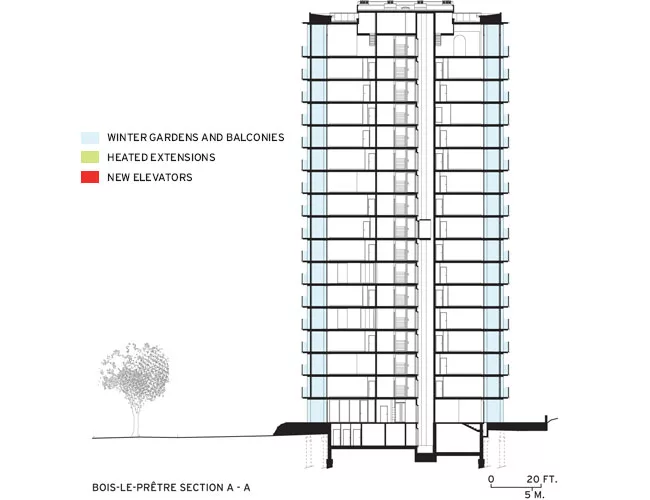
It is now transformed in every respect, spatial, technical, and aesthetic, by an approximately 10-foot-deep extension on all four sides. The east and west facades were replaced with aluminum-framed double-glazed sliding doors, occupying the full width of each apartment and opening onto 6-foot-7-inch-deep winter gardens. From these enclosed, unheated terraces, sliding polycarbonate screens lead onto 3-foot-3-inch-deep balconies with glass balustrades. On the narrower north and south facades, double-glazed extensions create additional internal space, allowing an increase to the number of apartments from 96 to 100 without reducing any in size. The building has a tripartite stepped section, with floor levels at the ends a half-story above the middle. New elevators at each end make it fully wheelchair-accessible.

Enlarged from 95,800 to 134,100 square feet, the building now touches the site's street edge to the north and stretches as far as regulations allow toward a cemetery to the south. The extensions add 242 square feet of usable outdoor space to 452-square-foot one-bedroom apartments, while larger corner apartments gain 290 square feet of outdoor space and up to 430 square feet of indoor space. This increase is the key to making reuse preferable to rebuilding, says Lacaton: 'More space means more pleasure, freedom, and peace for the family.' Thanks to an agreement brokered by the architects, rents remain the same: a 1,450-square-foot, five-room apartment goes for about $950 a month.

The cost, approximately $150,000 per apartment, was higher than estimated in the architects' earlier research but compares favorably with the typical figure of over $200,000 for demolition and rebuilding. Extensive internal renovations also offer poor value in comparison with extension, says Lacaton, and involve significant disruption and expense, since residents must be moved into temporary housing. Bois-le-Pêtre's 400 residents, ranging from young families to retirees, remained in the building throughout.

To minimize disturbance, the architects designed the extension as a self-supporting steel frame, tied to the concrete frame with steel brackets. Their initial intention was to assemble it as fully prefabricated modules, including replacement facades, which would be stacked on-site, each forming a working platform for the removal of the old facade. When it became clear how long it would take to manufacture 150 modules, the plan was revised, and only the insulated steel-and-concrete floor decks were fabricated off-site.

The asbestos-ridden overcladding was stripped from each facade before the original skin was removed, apartment by apartment, with new glazing installed the same day. The framework of 24-foot-6-inch-wide floor decks and story-tall steel columns was assembled over several months. Once in place, the polycarbonate outer facades were fitted.

Large areas of glazing and operable windows are in counterpoint to much contemporary architecture, where energy efficiency is pursued through increasing airtightness and insulation, an approach that prioritizes energy performance over well-being, says Lacaton. "We try to push another way of thinking, which has the same goals but works with the sun and natural ventilation, and gives the user the responsibility to decide when to open or close windows."

Bois-le-Pêtre's extensions are part of an environmental strategy that has reduced heating-energy demand by 60 percent, says Lacaton. They shade apartments from the high summer sun, while the low winter sun penetrates the enlarged areas of glazing. In spring and fall, the winter gardens work like greenhouses, producing welcome solar gain.

The operation of the double facade is supported by two further flexible layers. The first, a half-inch-thick thermal curtain, hangs inside the glass sliding doors. Made of wool with a reflective outer face of aluminum foil, it keeps heat inside on winter nights and out on hot summer days. The second, a thin, reflective solar curtain, hangs inside the loose-fit enclosure of the winter garden. When closed, it permits views out through close-spaced vertical stripes of mesh, while its foil outer face reflects most solar radiation. In summer, when residents ventilate their apartments by opening both sets of doors with the solar curtain closed, the internal temperature can be cooler than outside by up to 10 degrees Fahrenheit; on a winter morning, with both doors closed and the curtain open, up to 20 degrees warmer.

The solar curtains are manufactured for use in commercial greenhouses. Other materials more commonly found in agricultural or industrial structures were also specified, says Lacaton, because they are easy to use and inexpensive, with minimal structural requirements. The unusual application required commitment, however; the engineer was initially reluctant to include the thermal curtains' insulating properties in calculations, since their proper use could not be guaranteed. An assumption that half the curtains will be closed on winter nights as intended was eventually agreed on.

Folds of silvery fabric, sliding screens, and signs of occupancy animate the building's layered carapace, whose refinement supports the architects' belief that an appropriate outward appearance will ensue from concern for quality of life inside. As with Bois-le-Pêtre, the renovation of Bois-le-Pêtre restores something of the building's original promise, more space, great views, and a well-tempered environment, and, through the outward manifestation of change, gives something to the city. Both are buildings first conceived in a spirit of optimism, revived by another dose.

London-based Chris Foges is editor of Architecture Today and an Architectural Record international correspondent.

People

Location:
Boulevard Bois-le-Prêtre, Paris 17ème, France

Completion Date:
October 2011

Gross square footage:
12 460 m2  (8 900 m2 existing tower, + 3 560 m2 extension)

Total construction cost:
€11,25 million net

Owner:
Paris Habitat (OPAC of Paris)

Architect:
Frédéric Druot architecture
14, avenue de l'Opéra 75001
Paris, France
Phone: +33 1 47 03 47 44
Fax: +33 1 47 03 46 74

Lacaton & Vassal architectes 
206, rue La Fayette, 75010
Paris, France
Phone: +33 1 47 23 49 09
Fax: +33 1 47 23 49 17

Personnel in architect's firm who should receive special credit:
Frédéric Druot, Anne Lacaton & Jean Philippe Vassal, architects
with Adis Tatarevic, Florian De Pous, Miho Nagashima, architects
and Yuko Ohashi, models
All are registered architects.

Engineer(s):
VP Green, structure
Inex, utilities
Gui Jourdan, acoustics

Photographer(s))
Druot, Lacaton & Vassal

Philippe Ruault
e-mail: philippe.ruault@numericable.fr
phone: + 33 607 609 606,
fax: + 33 240 082 596

Renderer(s):
Druot, Lacaton & Vassal


Products

Exterior cladding
Curtain wall: Renovinyl / www.renovinyl.fr

Glazing
Glass: Technal (glass facade) / www.technal.fr


Share This Story

Looking for a reprint of this article?
From high-res PDFs to custom plaques, order your copy today!
Chris Foges is a writer and editor working in architecture and the built environment, based in London. He is contributing editor at the RIBA Journal and was formerly editor of Architecture Today magazine. His books include Imagination and The City Works.

Post a comment to this article

Report Abusive Comment

Subscription Center
  • Create an Account
  • Start a Subscription
  • Manage My Account
  • Sign Up for Newsletters
  • Visit Customer Service
  • Update Preferences

More Videos

Sponsored Content

Sponsored Content is a special paid section where industry companies provide high quality, objective, non-commercial content around topics of interest to the Architectural Record audience. All Sponsored Content is supplied by the advertising company and any opinions expressed in this article are those of the author and not necessarily reflect the views of Architectural Record or its parent company, BNP Media. Interested in participating in our Sponsored Content section? Contact your local rep!

close
  • cold storage facility
    Sponsored byCarlisle SynTec Systems

    How Architects Can Design More Continuous Cold Storage Envelopes

  • TAMLYN XtremeTrim Exterior Trim
    Sponsored byTamlyn

    Designing Cleaner Panel Facades: Why Exterior Trim Details Matter

  • Building with Vapor Barriers
    Sponsored byReef Industries, Inc.

    Vapor Barriers Help Control Moisture in Tighter Building Designs

DESIGN:ED Podcast
Listen to Architectural Record’s DESIGN:ED Podcast

Events

June 23, 2026

Enhancing Fire Resistance with Advanced PVC Solutions

Credits: 1 AIA LU/HSW; 1 AIBD P-CE; 0.1 ICC CEU; 1 IIBEC CEH

Evaluate advanced PVC solutions that improve fire resistance, support WUI compliance, and enhance resilience in residential and commercial building design.

June 25, 2026

Designing Glass Railing Systems that Enhance Aesthetics and Meet Code

Credits: 1 AIA LU/HSW; 1 AIBD P-CE; 0.1 ICC CEU

Upon course completion, participants will possess a deeper understanding of glass railings to help ensure that safety, aesthetic, and performance objectives are achieved.

View All Submit An Event

Products

2026 Architect's Square Foot Costbook

2026 Architect's Square Foot Costbook

See More Products

Popular Stories

Lorcan O' Herilhy

California Architect Lorcan O’Herlihy Has Died, Age 66

Obama Presidential Center, Chicago

The Obama Presidential Center Opens on Chicago’s South Side

Spoonbill Ranch

Johnsen Schmaling Architects Integrates Spoonbill Ranch into a Pristine Landscape

Image of Bruce Springsteen Center for American Music

The CookFox-designed Bruce Springsteen Center for American Music Opens in New Jersey

Three Courtyards House

Design Vanguard 2026: Balsa Crosetto Piazzi

Enhancing Fire Resistance with Advanced PVC Solutions - Free Webinar - June 23, 2026

Related Articles

  • Renewed Promise

    See More
  • Basel Convention Center'New Hall

    See More
  • Serpentine Pavilion 2018

    Frida Escobedo’s 2018 Serpentine Pavilion Opens in London

    See More
×

The latest news and information

#1 Source for Architectural Design, News and Products

SUBSCRIBE
  • RESOURCES
    • Advertise
    • Contact Us
    • Submit
    • Store
  • ACCOUNT CENTER
    • Create an Account
    • Start a Subscription
    • Manage My Account
    • Sign Up for Newsletters
    • Visit Customer Service
    • Update Preferences
  • PRIVACY
    • PRIVACY POLICY
    • TERMS & CONDITIONS
    • DO NOT SELL MY PERSONAL INFORMATION
    • PRIVACY REQUEST
    • ACCESSIBILITY
  • SERVICES
    • Marketing Services
    • Reprints
    • Market Research
    • List Rental
    • Survey/Respondent Access
  • STAY CONNECTED
    • Linkedin
    • Facebook
    • Instagram
    • YouTube
    • X (Twitter)

Copyright ©2026. All Rights Reserved BNP Media, Inc. and BNP Media II, LLC.

Design, CMS, Hosting & Web Development :: ePublishing