The Architect's Dilemma: When to Say No
What are the factors—political, social, or environmental—that architects should consider when deciding if they should turn down or resign from a job?
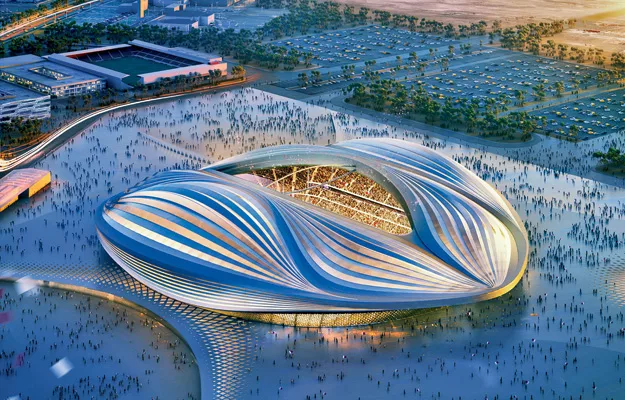
The al-Wakrah stadium by Zaha Hadid will be one of the featured venues at the 2022 World Cup complex in Qatar. Since January 2012, almost 900 workers have died during construction on the complex, according to The Guardian.
Rendering courtesy Zaha Hadid Architects
Architects & Firms
Following an earlier effort to persuade designers to refuse prison work altogether, Architects/Designers/Planners for Social Responsibility is now conducting a campaign to have the AIA revise its code of ethics to enjoin architects from designing spaces for the worst aspects of our penal system: execution chambers and solitary-confinement cells. The San Francisco, Portland, and Boston chapters have voted in support of this, but New York just said no and proposes instead a subcommittee be appointed to develop “Best Practice Guidelines: Design for Humane, Effective, Segregation,” which sounds like a classic bureaucratic way of evading the issue, at least for the time being. But prisons are just one egregious instance of architecture’s moral dilemma. The act of building—which is directly engaged in setting and supporting virtually everything we do—is implicated on every side by choices about our own participation and complicity with evil.
The web recently has gone viral with a statement by Zaha Hadid in which she dismisses any collateral responsibility for the huge number of worker deaths—nearly 900, according to The Guardian—on World Cup construction sites in Qatar, where she is building a stadium. She claims, “It’s not my duty as an architect to look at it . . . I have nothing to do with the workers.” Her partner, Patrik Schumacher, has taken this stance even further, arguing for a narrowed notion of architecture’s conceptual and operational autonomy that simply excludes such social and political concerns. Schumacher has been advocating what he calls “free market urbanism” as an ethical touchstone and writes, “architects are in charge of the form for the built environment, not its content.” Setting aside the weaselly notion of what it means to be “in charge,” does anyone actually believe this evasion? Certainly not the many artists who have been boycotting the new Abu Dhabi Guggenheim over the issue of worker exploitation and who launched a series of protests at a recent opening at the New York museum. Certainly not the authors of the professional codes of ethics that charge architects with upholding standards of health and safety in their buildings. Certainly not the families of the dead laborers.
Many of us have made our peace with working on projects in countries that do not fully conform to our standards of democracy and human rights, and most of us, I think, try to make some ethical distinctions, just as we do here at home. My own office works extensively in China and—as everywhere—there’s always a double decision to be made: first about the project itself, and then about its political setting. Of course, we’d no more do a prison camp in Mongolia than we would in Montana, but there’s no doubt that Chinese labor practices—including the employment at low wages of huge numbers of a floating population of “illegals” who come to the cities without proper papers (another issue)—are far from what a union worker would expect in New York. There’s also endemic corruption, a very fraught relationship to intellectual property, and plenty of questionable environmental practices. But having made the decision to enter this arena, our policy is the physician’s: first do no harm.
Some architects do enjoy playing it closer to the edge: Rem Koolhaas offered an explicitly political rationale for his CCTV building in Beijing, claiming that what is, in effect, the ministry of propaganda (in a country without a free press) is actually a likely conduit to a more democratic flow of information, citing its broadcasts in English. While this disingenuous contention is typical Koolhaasian tightrope-walking naughtiness, it can be difficult to distinguish what pushes boundaries and what defends them. Are there societies in which one should never work? Sure—Nazi Germany. But what about slum improvements for a black community group in apartheid South Africa? I’d do a project in Israel, but not an Israeli project in the West Bank, although I’d undertake a Palestinian one there. There are those who’d call this a sellout.
China—given the astonishing complexity of the scene and its actors and remarkable pace of change, and given my many friendships and students there—is not an issue for me, especially since my colleagues there are as frank in their criticism and analysis as my cohort here is of our own failings. In a terrain of porous ethical boundaries, one turns to the example of moral authorities: Ai Weiwei teamed with Herzog & de Meuron to design the Bird’s Nest, the highest-profile building at the 2008 Beijing Olympics, on behalf of a government that later jailed him. (He disavowed the project afterward, but not other work he had done in China.) For me, working in Xi’an or Wuhan isn’t just compromise with moral hazard: I am thrilled by several Chinese commissions we’ve had for urban projects that demand thinking at a scale and a level of sustainability almost never sought elsewhere in the world.
If I call out Zaha and Rem for the slipperiness of their positions, rather than assail the heads-down professionals who actually specialize in prison design, nuclear installations, or bomb factories, it’s because we look to our most talented and public representatives to lead. They have both the platform and the duty to speak out—especially since neither is reticent about exploiting their stardom to make a fortune. Their exacting myopia—the sealing off of architecture from its program, mode of production, and circumstances of use—is an old dodge (It’s not my department, says Werner von Braun). But ambiguity at the margins is no excuse for evading responsibility at the clear center. Raise your voices!
As our collective environment degrades, we all must take a planetary view of architecture’s impact. This requires not just an ethical compass but knowledge, commitment, and nuance: architecture is part of a distributive system that assigns spatial and material resources and creates the physical circumstances for both public and private life. We are among the leading stewards of the health of the planet, and we’re derelict if we fail to educate and persuade our clients to do what we know to be the right thing.
Zaha’s imperious statement begs the question of how far down the line our obligation lies. While there should be no difficulty in refusing to design a death chamber or Guantanamo, it does get a little harder thinking a few links along the chain: about the scarcity of materials, the cruelties in their production, the energy they embody, the risk to users, and other architectural “externalities.” And, yes, labor conditions and construction safety are part of the remit. It’s callow or cowardly not to speak out or walk off the job if the situation is acute.
Looking for a reprint of this article?
From high-res PDFs to custom plaques, order your copy today!