Crossover Artist?
Frank Gehry weighs in on his friendships with artists, how he designs for art—and why he resists certain labels.
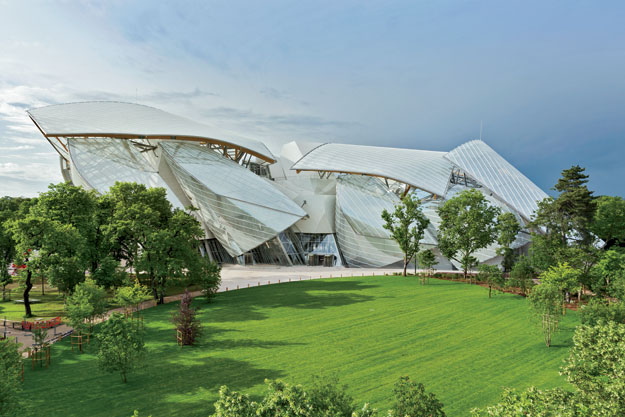 |
| Photo © Iwan Baan |
| A new art museum by Frank Gehry, the Fondation Louis Vuitton in the Bois de Boulogne in Paris, will open this October. |
There are few major American architects who have been more closely linked to art and artists than Frank Gehry—he's often talked about the inspiration he found in a circle of Los Angeles artists in the early days of his career. He's designed artists' studios, gallery installations, and, of course, art museums, most recently the Fondation Louis Vuitton, an arresting 126,000-square-foot exhibition center in Paris that will open in October. Last month, the Philadelphia Museum of Art opened an exhibition of his planned expansion of their facility (he appeared at the museum, above). Over the years, critics have used art metaphors to describe his architecture—though the term “sculptural” is one that he now rejects. Gehry spoke with RECORD editor in chief Cathleen McGuigan about his connection to the art world—and whether an architect can also be called an artist.
Architectural Record: How did you become so involved with art?
Frank Gehry: When I was a child in Toronto, even though my family was very poor, my mother took me to art galleries. Later, growing up in the L.A. architectural scene, the Japanese and Asian influence was very big, so I studied Asian art and I got very involved with woodcut drawings. Of course, Frank Lloyd Wright had a collection of those woodcuts, and so there was a linkage between art and Wright.
In architecture school at USC, the art school was in the same building. I was taking art classes and architecture, so I knew people on both sides of that fence.
Then, in the early '60s, I was doing the Danziger studio on Melrose in Los Angeles. While it was under construction, this funny guy came around and started talking to me. His name was Ed Moses. So he's an L.A. artist, and then he brought other artists by, like Billy Al Bengston and Ken Price. He invited me to his house for dinner, and I got to know the whole culture of the L.A. art scene. I was kind of an outsider—I mean, they wouldn't have used the word sycophant, but I was kind of a nice guy who was hanging around and was really excited about their work. I met a lot of New York artists who came to L.A. too, like Jasper Johns and then Bob Rauschenberg—I spent a lot of time with him.
What impact did the art scene have on you?
It was hard not to be influenced by it all, because they were making things—they had a process. If they wanted to do something and there was no way to do it, they would invent the technology. I learned that way back then from those guys. And we still do that, like the tapestry for Eisenhower [metal screens designed for the Eisenhower Memorial in Washington, D.C.]. Nobody had done it before—we invented the machine and made it. I mean, I don't do it myself. There are people in the office with their own particular kind of genius.
So you don't not do something because it hasn't been done.
Oh, no, no, no—come on! I jump off the cliff.
Many years ago, in 1980, you were quoted as saying that you approached each building “as a sculptural object,” but you would no longer put it that way.
When you say I was approaching the building as sculpture—not really. I was approaching the building as a building, with the responsibility to the community it was being built in and all that self-righteous stuff. That's how I did it. I believed in all that and still do.
I wasn't the one who said you approached a building as sculpture. I'm just quoting you, from a long time ago.
I know, I know. I say a lot of things—it depends when.
But can architecture be approached as art?
So here's the issue. The history of architecture, in my opinion, shows that it has a long lineage as sculpture, as art. There is an art of architecture. And it comes from Phidias, the guy who did the Parthenon, and before him, all the way to the present.
There is an art to it. You have to decide what proportion, what shape, what color. And in those past cultures, certain rules of the game applied—they had fluted columns and capitals and all that stuff, but there was a lot of variety in it. Somebody was making choices, and it didn't all look the same.
A lot of it played outside the so-called box, for its time. So if you go to the Pazzi Chapel in Florence by Brunelleschi, you say, “Where the hell did that come from?” Or the dome that he did. These are very big innovations, and they're in the service of architecture in creating space, but if they're not art, I don't know what is.
But we don't talk about architects as artists in that way today.
So there's a certain period in the culture, today, where artists are saying, no, you're not an artist. When you get that kind of response, you either go up to them and argue about it or you just say OK.
So when somebody asks me if I'm an artist, I always say no, I'm an architect. Because the social mores today are that architecture is not an art. It's the engineering, matter-of-fact stuff to solve housing and provide offices and things like that. So I don't see it as that, but if the rest of the world wants to see it that way, maybe it's their lack of interest in it today that allows every city in the world to look crappy.
You have created so much important work for showing art in your designs for museums and galleries.
Well, for me it's been based on talking to the artists all these years. Most of the artists that I like and grew up with were not people who made a case to have neutral white galleries. I remember Daniel Buren and Michael Asher and a few others telling me, you know, that's the last thing they wanted.
The most pristine white galleries are very toxic to a lot of artists because the purity overcomes their impurity. So Arte Povera, for instance, would not be good in those galleries.
Now, for the Guggenheim Bilbao, you made a variety of different kinds of galleries.
Yeah, and the art world or the museum world hated it. I think I did one museum after that. Renzo did 24. I was told that my kind of museum is not what they wanted.
But Cy Twombly had a show that traveled before he died. And he was told, “Stay away from Bilbao.” So finally his last show did go to Bilbao. I never got to see it, but he called me from there to tell me how wonderful it was and everything.
You've designed a number of art exhibitions, most recently a subtle and sensitive installation of small works by Alexander Calder that just closed at Renzo Piano's Resnick Pavilion at the Los Angeles County Museum of Art. You brought them beautifully to life.
Well, I grew up in a time when Calder reigned supreme. There was a show in the '60s at the Guggenheim in New York where he showed the Circus and he worked on the installation. And I remember just falling in love with his work there. And that's what encouraged me to make curved walls for this exhibition.
Aha! The Guggenheim's walls.
Yeah. The walls were curved. So it was clear that that was helping it at that time.
Designing an art installation is not exactly like designing an entire museum. Why do you do it?
It's a labor of love. For the Calder, we made models of the building. We did the whole thing and actually made scale models of each piece.
You've talked about the process of art and architecture—about being influenced by the making, the invention that you see in artists' work.
I see my artist friends work very diligently with engineers and with contractors and builders to get their work done. And a lot of them, because it's smaller stuff, have resorted to having their own factories, like Jeff Koons, because they can. But it's the same as what we do with the general contractors, only we're at a larger scale.
But I think there's a lot of emotion and feeling in the process. And when that emotion and feeling isn't there, it isn't in the building, and you can tell.
Yes, you've said before, architecture has to have emotion in it—you can't drain it of emotion. Isn't that a property it shares with great art?
Yes, ma'am. But I don't want to claim myself an artist, a mediocre one or a great one. That's not my game. It is what it is. At any point in time, the culture will call it whatever they call things like that. And that's going to be it.
Looking for a reprint of this article?
From high-res PDFs to custom plaques, order your copy today!