Architectural Record
search
cart
facebook twitter linkedin youtube
  • Sign In
  • Subscribe
  • Sign Out
  • My Account
Architectural Record
  • NEWS
    • Latest News
    • Awards
    • Interviews
    • Obituaries
    • Podcasts
      • Design:Ed Podcast
      • Sponsored Podcasts
  • OPINION
    • Book Reviews / Excerpts
    • Exhibition Reviews
    • Forum
  • EXCLUSIVES
    • Videos
    • Design Vanguard
    • Top 300 Firms
    • Sponsored Content
    • Sponsored eBooks
    • From the Archives
  • CONTINUING ED
    • Editorial Continuing Ed
    • CE Center
    • CE Academies
  • PROJECTS
    • Buildings By Type
    • Reuse & Renovation
    • Museums & Arts Centers
    • Colleges & Universities
    • Multifamily Housing
    • Interiors
    • Lighting
    • Kitchen & Bath
  • HOUSES
    • Record Houses
    • House of the Month
    • Featured Houses
  • PRODUCTS
    • Products by Category
    • Record Products of the Year
    • Latest Products
  • EVENTS
    • Dates & Events
    • Record on the Road
    • Innovation Conference
    • Sustainability in Practice
    • Women In Architecture
    • Webinars
    • Ad Excellence Awards
    • Submit an Event
  • CONNECT
    • Ask RECORD AI
    • Newsletters
    • Contact
    • Advertise
    • Editorial Calendar
    • Store
    • Customer Service
  • SUBMIT
    • Submission Guidelines
    • RECORD Competitions
  • MAGAZINE
    • Subscribe
    • My Account
    • Digital Edition
    • Current Issue
    • Firm Pass
    • Historic Archive
Architect Continuing Education

Innovations in Glass

Continuing Education: Double-Skin Buildings

Thick-Skinned: Two very different buildings deploy double curtain walls to satisfy the competing demands of transparency, efficiency and comfort.


By Joann Gonchar, FAIA
Double-Skin Buildings
At 121 stories and 2,073 feet, the Shanghai Tower will be the world's second-tallest skyscraper when completed later this year.
 
Photo © Shen Zonghai
Double-Skin Buildings
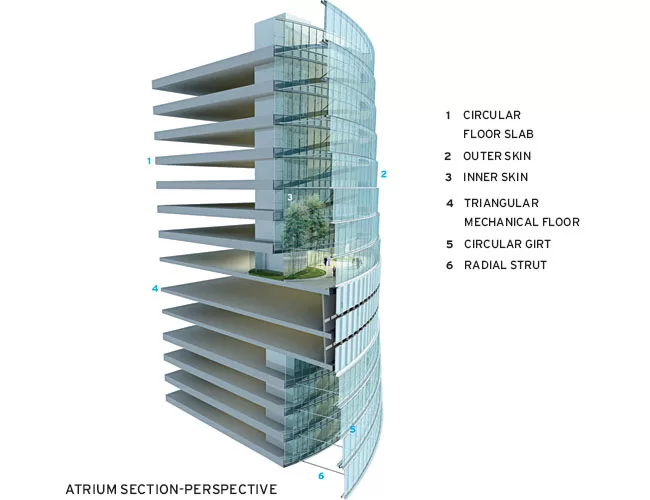
The skyscraper has two curtain walls: an outer one that defines its tapering and twisting form and is supported by radial struts and encircling girts, and an inner one supported by the circular floor plates. Between the two are 21 approximately 190-foot-tall atria.
 
Image courtesy Gensler
Double-Skin Buildings
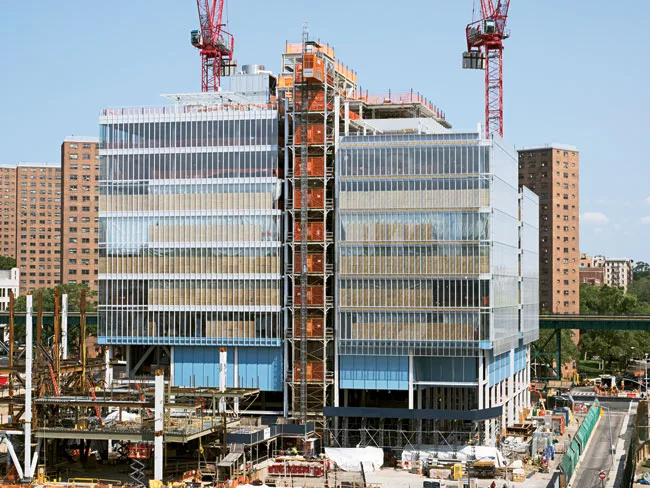
Renzo Piano Building Workshop is enclosing its new lab building for New York's Columbia University in a highly transparent double skin.
 
Image courtesy Gensler
Double-Skin Buildings
Renzo Piano Building Workshop is enclosing its new lab building for New York's Columbia University in a highly transparent double skin.
 
Photo © Enclos
Double-Skin Buildings
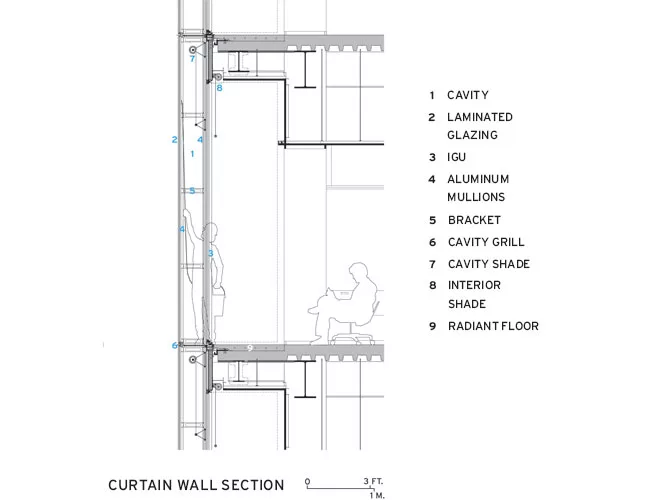
The 16-inch-deep unitized curtain wall arrived at the site assembled into panels 7 feet, 10½ inches wide and two stories tall. These included both skins as well as cavity shades.
 
Photo © Enclos
Double-Skin Buildings
Image courtesy Renzo Piano Building Workshop
Double-Skin Buildings
March 1, 2015
Continuing Education
 
The double-skin curtain wall'an enclosure system that consists of two facades separated by a cavity'has long been a popular approach to all-glass buildings in Europe, in part due to higher energy prices and tougher energy codes there. But such walls have begun to proliferate in other parts of the world as a way to satisfy the sometimes competing goals of transparency, efficiency, and occupant comfort.

One of the highest-profile double-skin buildings under construction now is Gensler's tapering and twisting Shanghai Tower. At 121 stories and 2,073 feet, it will be the world's second-tallest skyscraper when completed later this year. The building, which includes office space, a hotel, and a conference center, is organized like a tiered wedding cake: nine cylinders with gradually smaller diameters'each between 12- and 15-floors tall'are stacked one on top of the other. Between each zone, triangular two-story mechanical floors serve as platforms for 21 public atria or 'gardens in the sky,' enclosed by the tower's outer and inner curtain walls.

The outer skin, which helps define the skyscraper's serpentine form, consists of laminated glass within aluminum extrusions supported by radial struts and encircling girts. The inner skin's aluminum curtain wall, supported by the office and hotel floors' circular slabs, is made up of insulated glass units (IGUs).

The atria in between the two layers will do more than offer office workers a place to eat lunch. The spaces will also perform as a climatic buffer, explains Alan Hung, a principal at Cosentini Associates, the tower's mechanical engineer. These spaces will be maintained at temperatures that are cooler than the outdoors in summer by taking advantage of so-called 'spill air': used air from the tower's interior that will be recirculated through atrium. In the winter, when the recirculated air is warmer than outdoor temperatures, the strategy will reduce the amount of heating needed. And since only the lowest 8 feet of each roughly 190-foot-tall atrium is occupied, the space can be kept comfortable 'with very little energy input,' points out Benedict Tranel, a Gensler principal.

In New York, architects from Renzo Piano Building Workshop (RPBW) are using a double skin to enclose the Jerome L. Greene Science Center'a 9-story, 450,000-square-foot neuroscience lab under construction on Columbia University's new campus in northern Manhattan. Here the skin is the logical result of the 17-acre academic precinct's master plan designed by RPBW and Skidmore, Owings & Merrill which is intended to be permeable to the neighborhood around it. The plan has such features as publicly accessible green spaces and ground-floor retail. 'The transparent building envelope is an extension of this philosophy,' says Philip Pitruzzello, Columbia's vice president in charge of the new campus's development.

Though RPBW's building is shorter and has a different program from Gensler's tower, the composition of its curtain-wall elements is similar, though not identical. The envelope's outer skin consists of laminated glass, while the inner one is an IGU, albeit one with an interior-facing lite that is laminated. This additional layer helps keep out sounds such as the rumbling of a train that passes by the building on elevated tracks, explains Mic Patterson, vice president at Enclos, the curtain wall's fabricator and installer.

The primary difference between the configuration of the curtain walls on the two buildings is the distance between the inner and outer skin. In New York they are separated by only a 16-inch cavity rather than by occupiable space, a cavity just wide enough to house automated shades that prevent solar gain (the building will also have interior automated shades to mitigate glare). Like Shanghai's atria, although much narrower, the cavity still makes use of spill air to create a thermal buffer. The strategy is especially appropriate for labs because of their high ventilation requirements, points out Scott Frank, a partner at Jaros, Baum & Bolles, the project's mechanical engineer. This air, which would typically be vented from the building, is essentially a 'free resource,' he says.

Because of the buffer that the envelope system provides'along with a host of other features, including heat recovery, state-of-the-art lighting controls, and chilled beams'Columbia's new lab building is expected to be about 30 percent more efficient than required by code. For the Shanghai Tower, such savings are predicted to be about 21 percent. But efficiency isn't the only reason to use a double curtain wall'at least not for Gensler's Tranel. 'It provides the opportunity to create something spatial,' he says. 'It's an architectural solution rather than a technical one."


CE logo

To earn one AIA learning unit (LU), including one hour of health, safety, and welfare (HSW) credit, read each of the articles below and complete the test online. Upon passing, you will receive a certificate of completion and your credit will automatically be reported to the AIA. Find additional information regarding credit-reporting and continuing-education requirements at ce.construction.com, under “requirements.”

Innovations In Glass

  • Straight Story On Curves
  • Reflections on the Box
  • Bigger, Flatter, Clearer
  • Dynamic Glass
  • The Future Is Crystal Clear

Learning Objectives

  1. Discuss glass manufacturing processes as well as fabrication options and limitations that architects should take into account while designing glazed building skins.
  2. Define terms relevant to glass and glazing selection, such as VLT, U-value, and solar heat gain coefficient.
  3. Discuss how architects like SANAA and Foster + Partners have overcome the detailing challenges presented by curved glass.
  4. Describe how technologies such as electrochromic glazing and double skins work to improve energy efficiency.

AIA/CES Course K1503A

Take the Continuing Education Test

KEYWORDS: innovation

Share This Story

Looking for a reprint of this article?
From high-res PDFs to custom plaques, order your copy today!


Joann gonchar

Joann Gonchar, FAIA, LEED AP, is deputy editor at Architectural Record. She joined RECORD in 2006, after working for eight years at its sister publication, Engineering News-Record. Before starting her career as a journalist, Joann worked for several architecture firms and spent three years in Kobe, Japan, with the firm Team Zoo, Atelier Iruka. She earned a Master of Architecture degree from the University of Pennsylvania and a Bachelor of Arts from Brown University. She is licensed to practice architecture in New York State.

Post a comment to this article

Report Abusive Comment

Subscription Center
  • Create an Account
  • Start a Subscription
  • Manage My Account
  • Sign Up for Newsletters
  • Visit Customer Service
  • Update Preferences

More Videos

Sponsored Content

Sponsored Content is a special paid section where industry companies provide high quality, objective, non-commercial content around topics of interest to the Architectural Record audience. All Sponsored Content is supplied by the advertising company and any opinions expressed in this article are those of the author and not necessarily reflect the views of Architectural Record or its parent company, BNP Media. Interested in participating in our Sponsored Content section? Contact your local rep!

close
  • TAMLYN XtremeTrim Exterior Trim
    Sponsored byTamlyn

    Designing Cleaner Panel Facades: Why Exterior Trim Details Matter

  • Building with Vapor Barriers
    Sponsored byReef Industries, Inc.

    Vapor Barriers Help Control Moisture in Tighter Building Designs

  • Duct Interior with Prodeq System
    Sponsored byHenry, a Carlisle Company

    Designing Resilient Water Containment Systems

DESIGN:ED Podcast
Listen to Architectural Record’s DESIGN:ED Podcast

Events

June 18, 2026

Rebooting the Aging Office Building

Credits: 1 AIA LU/HSW; 1 AIBD P-CE; 0.1 ICC CEU; 1 PDH

Explore façade retrofit strategies and award-winning design concepts that can transform aging office buildings into healthier, higher-performing workplaces for today’s hybrid workforce.

June 23, 2026

Enhancing Fire Resistance with Advanced PVC Solutions

Credits: 1 AIA LU/HSW; 1 AIBD P-CE; 0.1 ICC CEU; 1 IIBEC CEH

Evaluate advanced PVC solutions that improve fire resistance, support WUI compliance, and enhance resilience in residential and commercial building design.

View All Submit An Event

Products

2026 Architect's Square Foot Costbook

2026 Architect's Square Foot Costbook

See More Products

Popular Stories

SanDiegoAirport

Top 300 Architecture Firms of 2026

Coronado Bridge

The Architect’s Guide to San Diego

Lorcan O' Herilhy

California Architect Lorcan O’Herlihy Has Died, Age 66

CCA, Studio Gang

The Winners of the AIA’s 2026 Architecture Award Range from Collegiate Rowing Hubs to Housing for the Homeless

Dusk House

Design Vanguard 2026: ONO

Rebooting the Aging Office Building - Free Webinar - June 18, 2026

Related Articles

  • Airports of the Future

    Continuing Education: Airports of the Future

    See More
  • Wellness in the Workplace

    Continuing Education: Wellness in the Workplace

    See More
  • Timber Grows Up

    Continuing Education: Tall Mass Timber Construction

    See More

Events

View AllSubmit An Event
  • December 2, 2025

    Future Proofing Life Safety Communications for Smarter, Safer Buildings

    NOW ON DEMANDCredits: 1 AIA LU/HSW; 1 AIBD P-CE; 0.1 ICC CEU; 0.1 IACET CEUDiscover how software-enabled communication devices enhance efficiency, compliance, and safety in life safety systems across hospitals, schools, hotels, warehouses, and other facilities.
  • November 6, 2025

    Architectural Metal Plate Systems: Durable Design for Today's Buildings

    NOW ON DEMANDCredits: 1 AIA LU/HSW; 1 AIBD P-CE; 0.1 ICC CEU; 0.1 IACET CEU; 1 IIBEC CEHThis course will address architectural metal plate systems and how they can be used in the design and construction of commercial buildings.
View AllSubmit An Event
×

The latest news and information

#1 Source for Architectural Design, News and Products

SUBSCRIBE
  • RESOURCES
    • Advertise
    • Contact Us
    • Submit
    • Store
  • ACCOUNT CENTER
    • Create an Account
    • Start a Subscription
    • Manage My Account
    • Sign Up for Newsletters
    • Visit Customer Service
    • Update Preferences
  • PRIVACY
    • PRIVACY POLICY
    • TERMS & CONDITIONS
    • DO NOT SELL MY PERSONAL INFORMATION
    • PRIVACY REQUEST
    • ACCESSIBILITY
  • SERVICES
    • Marketing Services
    • Reprints
    • Market Research
    • List Rental
    • Survey/Respondent Access
  • STAY CONNECTED
    • Linkedin
    • Facebook
    • Instagram
    • YouTube
    • X (Twitter)

Copyright ©2026. All Rights Reserved BNP Media, Inc. and BNP Media II, LLC.

Design, CMS, Hosting & Web Development :: ePublishing