What Will Happen to Charity Hospital and Other Endangered Projects?
A fresh look at the state of historic preservation.
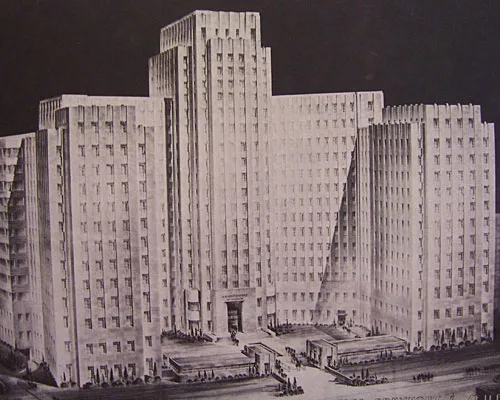
Rendering of original design by Weiss, Dreyfous & Seiferth, 1939. The firm also designed the Louisiana State Capitol and buildings at Louisiana State University in Baton Rouge.
Image courtesy NTHP
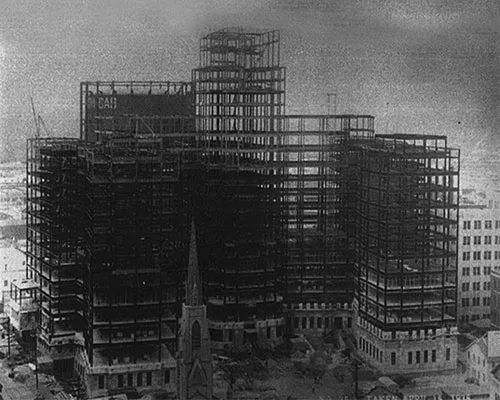
The steel structure of Charity Hospital, during construction in 1938.
Image courtesy NTHP
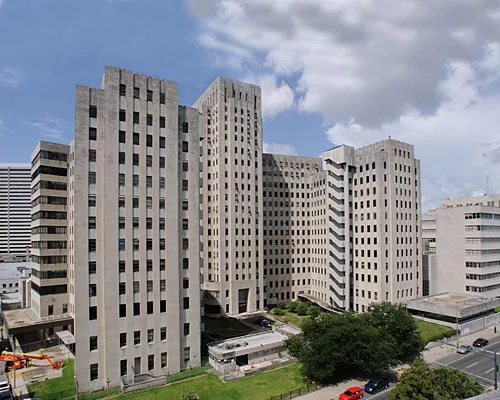
Charity Hospital in 2008.
Image courtesy RMJM
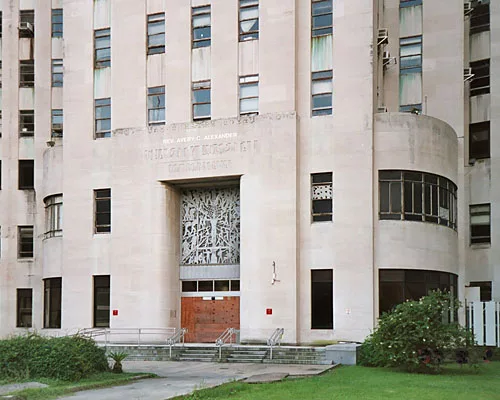
Main entrance to Charity Hospital, boarded, 2007.
Image courtesy NTHP / Todd Callender
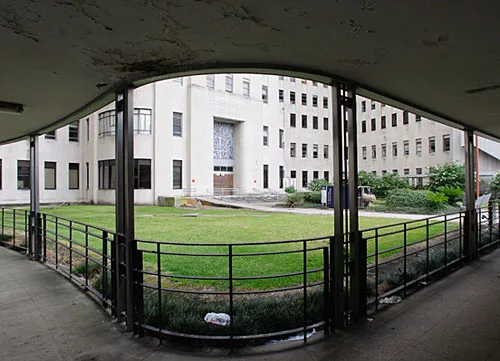
Interior courtyard at Charity Hospital, 2007.
Image courtesy RMJM
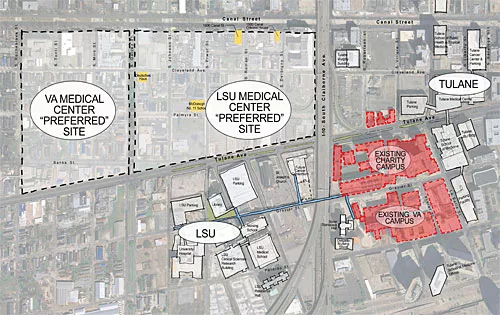
Louisiana’s existing plan for two new campuses for the Louisiana State University Medical Center and Veterans’ Affairs Medical Center.
Image courtesy RMJM
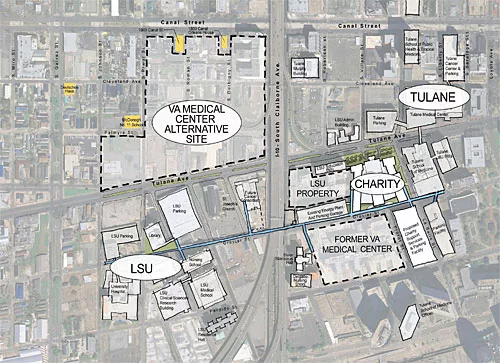
Alternative plan for medical campus, including the refurbishment of Charity Hospital as the Louisiana State University Medical Center.
Image courtesy RMJM
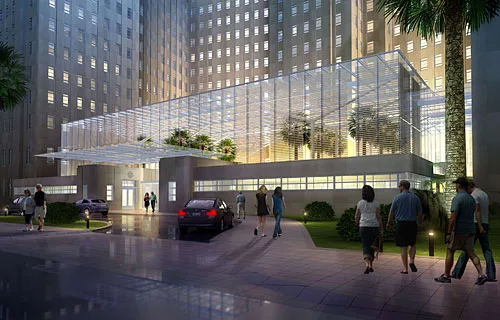
Proposed new entry to Charity Hospital.
Image courtesy RMJM
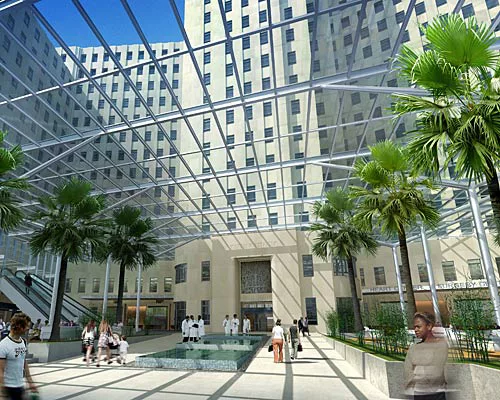
Proposed entry atrium.
Image courtesy RMJM
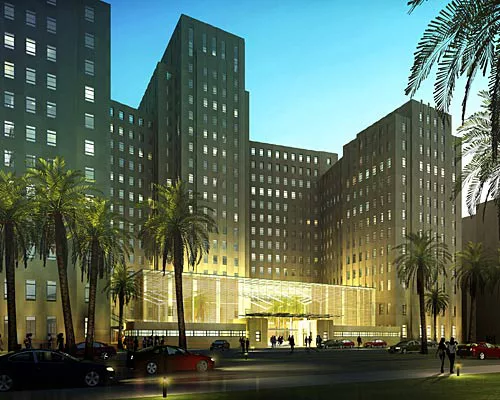
Proposed view from Tulane Avenue.
Image courtesy RMJM
Today's Challenges
Far beyond the small, precious numbers who initially saved individual houses, today’s preservation movement has been radically democratized. With the shift in demographics of the United States, and a wider visibility of Hispanic, Asian), and African-American populations, preservation has had to address the philosophical questions of representation, with an increasing need to clearly answer the question: Who is telling the story? Richard Moe, the longtime president of the National Trust for Historic Preservation, underscores this fact by saying that “preservation is threatening to become mainstream.”
With each generation, the rationale for preservation tends to shift to reflect changing perceptions and needs. For today’s audience, Moe mentions a plethora of reasons, including sustainability. “Preservation is the most sustainable of the building arts,” he says. Preservationists cite the embodied energy present in existing structures as one rationale that allies their cause with the green movement. In addition, they sometimes refer to a historic property’s regional and climatic adaptation, such as its thermal mass derived from thick brick walls, or its overhanging roofs. As an example of preservation’s relevance for a more recent project, Moe gives the example of a property currently on the trust’s 2009 “11 Most Endangered Places” list—the Century Plaza Hotel in Century City, Los Angeles.
A classic Midcentury Modern building, this geometric arc of a structure was built in 1966 and designed by the Japanese architect Minoru Yamasaki, who would later design the twin towers of the World Trade Center in New York City (1975). Developers hope to demolish the original hotel and erect two 600-foot towers in its place, a wasteful action, according to Moe: “If we calculated the 800,000 square feet in that building, and the energy it took to manufacture it, the result would be 7 million gallons of gasoline.” He also points out the energy that would be required to tear down, cart off, or rebuild the Century Plaza. At this frugal moment, when economies and limited energy are combining in a perfect storm, and buildings produce an estimated 43 percent of all carbon emissions, sustainability may prove to be preservation’s strongest new argument.
The Century Plaza illustrates the conundrum of scores of buildings from the recent past—those typically averaging 50 years old or less that have been threatened with demolition. Midcentury Modern buildings, which occasionally rose to high standards of design, tend not to be designated on historic resource lists. John Mott, FAIA, a principal at the firm John Milner Associates, which specializes in historic preservation, admits that the problem of buildings from the 1950s and ’60s is often compounded by their construction. “Buildings from the 1950s and ’60s require more scientific thinking,” he says, than comparable structures from the 19th century. The new, flat-roofed buildings often were “not that well built,” requiring our creativity to arrive at new materials and methods to bring them to contemporary standards. One example is Modernist architects’ attempts to blur the line between indoors and out. Their technological means weren’t always up to the task, and old glazing systems often require reconsideration and reconstitution with improved thermal characteristics.
Mott’s remarks on construction quality hark back to the basic arguments propounded by the dean of 20th-century preservationists, James Marston Fitch (see page 41). Fitch, who would have turned 100 this year, was a writer for this magazine and for Architectural Forum, as well as the founder of Columbia University’s master’s degree program in historic preservation, the country’s first. He propounded basic environmental and construction principles in his seminal work, American Building: The Environmental Forces That Shape It (1948/1972). In his preface to the 1972 edition, he decried the fact that “American architecture today pays less attention to ecological, microclimatic, and psychosomatic considerations than it did a quarter of a century ago.”
While Fitch espoused an approach to preservation that avoids too heavy a reliance on sheer technology to solve preservation’s problems, in the ensuing years, large teams of experts routinely address preservation’s current techno-heavy questions. For complex or important projects, such as Mount Vernon, the actual number has swollen to include not only architects, but archaeologists, material conservators, architectural historians, interior designers, and others—all of whom share a preservation background. Frederick Bland, FAIA, the managing partner at Beyer Blinder Belle, the firm Fitch joined after leaving Columbia, amplifies preservation’s role when he says that, ideally, preservation should not be a specialty, but an integrated part of urbanism, in which architecture, urban design, and planning all coincide.
Fast forward to New Orleans. George Skarmeas, AIA, a student of Fitch, served as the preservation architect for the team from RMJM given the task of assessing the existing Charity Hospital structure. Skarmeas, together with structural engineer Robert Silman, proved the building’s structural stability with a thorough “nondestructive” analysis, which used high-tech means such as thermal imaging, ground penetrating radar, and ultrasound. Further questions lay in its adaptability as a state-of-the-art hospital, a question answered in the affirmative by other architects in his company. Skarmeas admits that today, preservation may rely on technical advances and specialized training to address “how historic buildings behave and how to treat them.” Like Fitch, however, he maintains that preservation still involves architecture, “with the same challenges to do good design, sensible design, sustainable design.” He decries a “dogmatic” approach and relies instead on “facts, not emotions.”
Despite technological advances, emotions run high when community development and power politics collide over historic properties. At a time of climatic and economic change, when the built legacy of this country, and the larger world, offers a wealth of preexisting structures in need of adaptation for a new generation, architects will find themselves increasingly called into the fray. Regardless of the outcome in New Orleans for Charity Hospital, and despite the shifting role of professionals in historic preservation, architects will be party to the solution—for good or ill. Richard Moe has the last word: “The important thing is that the ethic for preservation is growing, and it hasn’t always been there.”
Looking for quick answers on architecture and design topics?
Try Ask RECORD, our new smart AI search tool.
Ask RECORD →
Looking for a reprint of this article?
From high-res PDFs to custom plaques, order your copy today!

