Architectural Record
search
cart
facebook twitter linkedin youtube
  • Sign In
  • Subscribe
  • Sign Out
  • My Account
Architectural Record
  • NEWS
    • Latest News
    • Awards
    • Interviews
    • Obituaries
    • Podcasts
      • Design:Ed Podcast
      • Sponsored Podcasts
  • OPINION
    • Book Reviews / Excerpts
    • Exhibition Reviews
    • Forum
  • EXCLUSIVES
    • Videos
    • Design Vanguard
    • Top 300 Firms
    • Sponsored Content
    • Sponsored eBooks
    • From the Archives
  • CONTINUING ED
    • Editorial Continuing Ed
    • CE Center
    • CE Academies
  • PROJECTS
    • Buildings By Type
    • Reuse & Renovation
    • Museums & Arts Centers
    • Colleges & Universities
    • Multifamily Housing
    • Interiors
    • Lighting
    • Kitchen & Bath
  • HOUSES
    • Record Houses
    • House of the Month
    • Featured Houses
  • PRODUCTS
    • Products by Category
    • Record Products of the Year
    • Latest Products
  • EVENTS
    • Dates & Events
    • Record on the Road
    • Innovation Conference
    • Sustainability in Practice
    • Women In Architecture
    • Webinars
    • Ad Excellence Awards
    • Submit an Event
  • CONNECT
    • Ask RECORD AI
    • Newsletters
    • Contact
    • Advertise
    • Editorial Calendar
    • Store
    • Customer Service
  • SUBMIT
    • Submission Guidelines
    • RECORD Competitions
  • MAGAZINE
    • Subscribe
    • My Account
    • Digital Edition
    • Current Issue
    • Firm Pass
    • Historic Archive
Commentary & Criticism

The Four Seasons: Serving Up a Heady Cocktail of Gravitas and Glamour

By Martin Filler
August 16, 2009

In New York City, where restaurants last an average of two years and seldom more than seven, a dining establishment that survives for half a century might seem a culinary Methuselah. However, the 2009 Zagat guide lists no fewer than 75 Gotham restaurants at least 50 years old, a roster to which must now be added the Four Seasons, which opened on July 20, 1959, on the ground floor of Ludwig Mies van der Rohe and Philip Johnson’s Seagram Building. Two hundred seasons later, this visionary fusion of high-style American design and haute American cuisine offers another object lesson: As our civic realm is increasingly compromised by commercialism, the enduringly elevated tone of the The Four Seasons makes it a loftier enterprise than some cultural institutions.

Unrelated to the eponymous hotel chain founded in 1961, The Four Seasons recast luxury dining in an entirely new scenario, with contemporary design given the starring role. Though usually ascribed to Johnson alone, this complex project was actually a collaboration among several of Midcentury Modernism’s brightest lights: interior decorator William Pahlmann, a follower of Jean-Michel Frank, who made a Minimalist water feature the epicenter of the restaurant’s jaw-dropping Pool Room; industrial designer L. Garth Huxtable (husband of Ada Louise, pioneering New York Times architecture critic), whose suavely modeled table settings feature what I consider the Martini glass of the century; plus landscape architect Karl Linn and horticulturist Everett Lawson Conklin, whose wow-inducing plantings underscored the restaurant’s seasonal conceit.

Also involved were Richard Kelly, Johnson’s longtime mood-lighting specialist; textile designer Marie Nichols, who had done innovative auto upholstery for the short-lived Kaiser-Frazer Corporation; and two groovy young graphic designers — Elaine Lustig Cohen, who devised the building’s crisp signage, and Emil Antonucci, who created the restaurant’s enchanting logo, a quartet of sprightly stylized trees. And hovering above them all was the godlike Mies himself, whose classic chrome-framed Brno chair was reissued as dining-room seating.

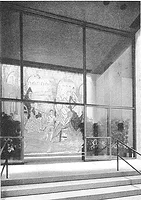
The Four Seasons’ fine art program was commensurately ambitious. Alfred H. Barr, Jr., the Museum of Modern Art’s legendary founding director, persuaded his old friend Pablo Picasso to sell the fore-curtain he created for Sergei Diaghilev’s 1919 ballet The Three-Cornered Hat. That monumental masterwork, acquired for $75,000, still ennobles the long, narrow corridor linking the main dining rooms.

The sculptor Richard Lippold, then at the height of his renown, made two ceiling-hung pieces. A rising art star, Mark Rothko, agreed to paint a series of brooding, color-saturated abstractions. But in a fit of class-conscious paranoia after dining at the restaurant, Rothko balked, refunded his fee, and the majority of his 30 Seagram Murals are now in London’s Tate Modern.

However, the true auteur of The Four Seasons was Johnson, who coordinated its manifold components so deftly that the result seems the work of a single hand. He demonstrated as never before how Modern architecture, interiors, and art could be marshaled to transform a quotidian activity into a social event that renders a commercial context irrelevant. This was one of Johnson’s very few indisputably first-rate works, and its status as the finest International Style public interior in America was a consensus well before the restaurant became a New York City landmark in 1988, the first Modernist decorative ensemble to be so honored.

Beyond protection under municipal statute, The Four Seasons has made it to 50 because of its gradual evolution into a New York social institution of seminal significance. For generations, the city’s WASP and Jewish elites had entertained at exclusionary private clubs and deemed public restaurants the province of parvenus. But by the third quarter of the 20th century, that old order had passed and New York’s ascendant media-oriented meritocracy needed a new kind of gathering place, more inclusive and better suited to the seismic changes wrought by the 1960s.

KEYWORDS: The Four Seasons Restaurant

Share This Story

Looking for a reprint of this article?
From high-res PDFs to custom plaques, order your copy today!

Previous 1 2 Next

Post a comment to this article

Report Abusive Comment

Subscription Center
  • Create an Account
  • Start a Subscription
  • Manage My Account
  • Sign Up for Newsletters
  • Visit Customer Service
  • Update Preferences

More Videos

Sponsored Content

Sponsored Content is a special paid section where industry companies provide high quality, objective, non-commercial content around topics of interest to the Architectural Record audience. All Sponsored Content is supplied by the advertising company and any opinions expressed in this article are those of the author and not necessarily reflect the views of Architectural Record or its parent company, BNP Media. Interested in participating in our Sponsored Content section? Contact your local rep!

close
  • cold storage facility
    Sponsored byCarlisle SynTec Systems

    How Architects Can Design More Continuous Cold Storage Envelopes

  • TAMLYN XtremeTrim Exterior Trim
    Sponsored byTamlyn

    Designing Cleaner Panel Facades: Why Exterior Trim Details Matter

  • Building with Vapor Barriers
    Sponsored byReef Industries, Inc.

    Vapor Barriers Help Control Moisture in Tighter Building Designs

DESIGN:ED Podcast
Listen to Architectural Record’s DESIGN:ED Podcast

Events

June 25, 2026

Designing Glass Railing Systems that Enhance Aesthetics and Meet Code

Credits: 1 AIA LU/HSW; 1 AIBD P-CE; 0.1 ICC CEU

Upon course completion, participants will possess a deeper understanding of glass railings to help ensure that safety, aesthetic, and performance objectives are achieved.

June 30, 2026

Generator Selection and Sizing for Outage-Ready Homes

Credits: 1 AIA LU/HSW; 1 AIBD P-CE; 0.1 ICC CEU

Explore how propane-powered systems and whole-home generators can improve energy resilience, reduce electrical loads, and lower long-term residential costs.

View All Submit An Event

Products

2026 Architect's Square Foot Costbook

2026 Architect's Square Foot Costbook

See More Products

Popular Stories

Lorcan O' Herilhy

California Architect Lorcan O’Herlihy Has Died, Age 66

Obama Presidential Center, Chicago

The Obama Presidential Center Opens on Chicago’s South Side

Spoonbill Ranch

Johnsen Schmaling Architects Integrates Spoonbill Ranch into a Pristine Landscape

Image of Bruce Springsteen Center for American Music

The CookFox-designed Bruce Springsteen Center for American Music Opens in New Jersey

Three Courtyards House

Design Vanguard 2026: Balsa Crosetto Piazzi

Designing Glass Railing Systems that Enhance Aesthetics and Meet Code - Free Webinar - June 25, 2026

Related Articles

  • Four Season Restaurant

    More Elegance at the House of Seagram: The Four Seasons Restaurant

    See More
  • Four Seasons Auction

    Sneak Peek of the Four Seasons Auction

    See More

Related Products

See More Products
  • 1444336282.gif

    The Handbook of Interior Design

  • experience of arc.jpg

    The Experience of Architecture

See More Products
×

The latest news and information

#1 Source for Architectural Design, News and Products

SUBSCRIBE
  • RESOURCES
    • Advertise
    • Contact Us
    • Submit
    • Store
  • ACCOUNT CENTER
    • Create an Account
    • Start a Subscription
    • Manage My Account
    • Sign Up for Newsletters
    • Visit Customer Service
    • Update Preferences
  • PRIVACY
    • PRIVACY POLICY
    • TERMS & CONDITIONS
    • DO NOT SELL MY PERSONAL INFORMATION
    • PRIVACY REQUEST
    • ACCESSIBILITY
  • SERVICES
    • Marketing Services
    • Reprints
    • Market Research
    • List Rental
    • Survey/Respondent Access
  • STAY CONNECTED
    • Linkedin
    • Facebook
    • Instagram
    • YouTube
    • X (Twitter)

Copyright ©2026. All Rights Reserved BNP Media, Inc. and BNP Media II, LLC.

Design, CMS, Hosting & Web Development :: ePublishing