Architectural Record
search
cart
facebook twitter linkedin youtube
  • Sign In
  • Subscribe
  • Sign Out
  • My Account
Architectural Record
  • NEWS
    • Latest News
    • Awards
    • Interviews
    • Obituaries
    • Podcasts
      • Design:Ed Podcast
      • Sponsored Podcasts
  • OPINION
    • Book Reviews / Excerpts
    • Exhibition Reviews
    • Forum
  • EXCLUSIVES
    • Videos
    • Design Vanguard
    • Top 300 Firms
    • Sponsored Content
    • Sponsored eBooks
    • From the Archives
  • CONTINUING ED
    • Editorial Continuing Ed
    • CE Center
    • CE Academies
  • PROJECTS
    • Buildings By Type
    • Reuse & Renovation
    • Museums & Arts Centers
    • Colleges & Universities
    • Multifamily Housing
    • Interiors
    • Lighting
    • Kitchen & Bath
  • HOUSES
    • Record Houses
    • House of the Month
    • Featured Houses
  • PRODUCTS
    • Products by Category
    • Record Products of the Year
    • Latest Products
  • EVENTS
    • Dates & Events
    • Record on the Road
    • Innovation Conference
    • Sustainability in Practice
    • Women In Architecture
    • Webinars
    • Ad Excellence Awards
    • Submit an Event
  • CONNECT
    • Ask RECORD AI
    • Newsletters
    • Contact
    • Advertise
    • Editorial Calendar
    • Store
    • Customer Service
  • SUBMIT
    • Submission Guidelines
    • RECORD Competitions
  • MAGAZINE
    • Subscribe
    • My Account
    • Digital Edition
    • Current Issue
    • Firm Pass
    • Historic Archive
Commentary & Criticism

The Afterlife of Drawing
By Joann Gonchar, FAIA
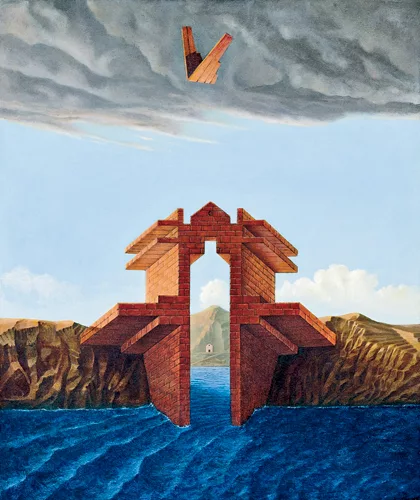
Massimo Scolari’s fantastical compositions, like the oil painting Gate for a Maritime City, are remarkable for their almost-obsessive detail, not because they depict buildable form.
The Afterlife of Drawing
Massimo Scolari’s fantastical compositions, like the oil painting Gate for a Maritime City, are remarkable for their almost-obsessive detail, not because they depict buildable form.
Image ' Massimo Scolari
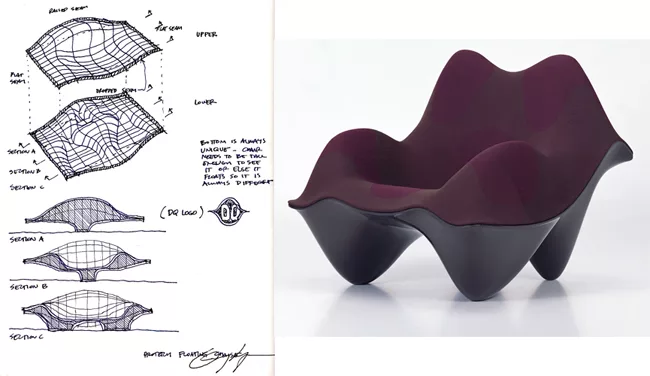
Greg Lynn sketches by hand, but typically after first digitally modeling an idea. In his drawing of the Ravioli Chair, designed for Vitra, he describes form with a gridlike mesh.
The Afterlife of Drawing
Greg Lynn sketches by hand, but typically after first digitally modeling an idea. In his drawing of the Ravioli Chair, designed for Vitra, he describes form with a gridlike mesh.
Images © Greg Lynn FORM
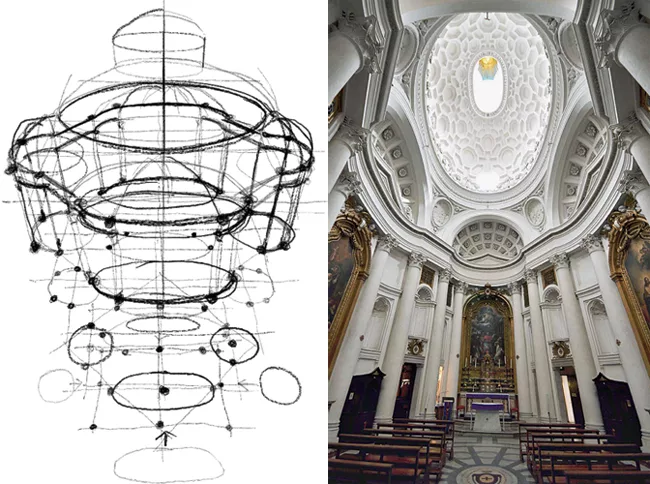
“Mental Canvas” is a conceptual-design tool that allows users to combine several 2-D drawings and then explore the assembled sketches by panning, tilting, and zooming. The program’s
The Afterlife of Drawing
“Mental Canvas” is a conceptual-design tool that allows users to combine several 2-D drawings and then explore the assembled sketches by panning, tilting, and zooming. The program’s development team used it to analyze San Carlo alle Quattro Fontane, a 17th-century church by Francesco Borromini, in Rome.
Drawing © Soo-Hyun Kim, Yale University
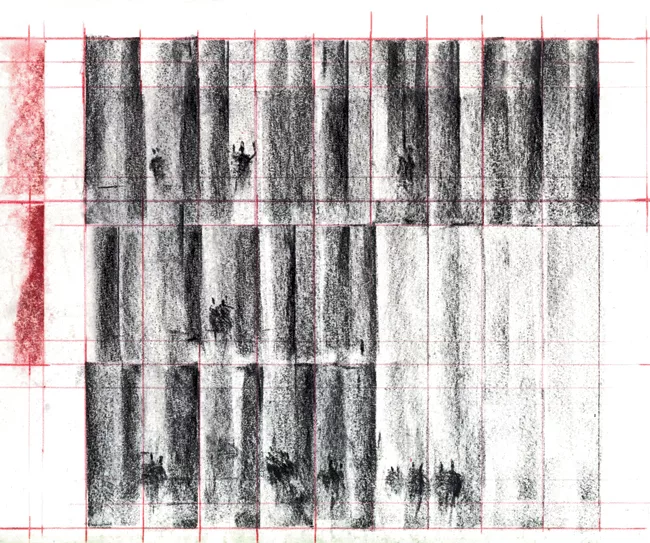
As part of her design process, Marion Weiss, of Weiss/Manfredi, moves back and forth between hand sketches, digital tools, and physical models. Drawings for the firm’s student center at Barnard
The Afterlife of Drawing
As part of her design process, Marion Weiss, of Weiss/Manfredi, moves back and forth between hand sketches, digital tools, and physical models. Drawings for the firm’s student center at Barnard College, which is clad in acid-etched glass, included a set of charcoal facade studies.
Image © Weiss/Manfredi
Massimo Scolari’s fantastical compositions, like the oil painting Gate for a Maritime City, are remarkable for their almost-obsessive detail, not because they depict buildable form.
Greg Lynn sketches by hand, but typically after first digitally modeling an idea. In his drawing of the Ravioli Chair, designed for Vitra, he describes form with a gridlike mesh.
“Mental Canvas” is a conceptual-design tool that allows users to combine several 2-D drawings and then explore the assembled sketches by panning, tilting, and zooming. The program’s
As part of her design process, Marion Weiss, of Weiss/Manfredi, moves back and forth between hand sketches, digital tools, and physical models. Drawings for the firm’s student center at Barnard
April 16, 2012
There are many types of architectural drawings. Travel sketches, like those Michael Graves is known for, can serve as a form of note-taking, as fuel for the imagination, and as training for the eye. Depictions of fantastical environments, such as the precisely detailed watercolors and oils created by Italian architect Massimo Scolari, are detached from constructed reality but record the inventiveness of the mind. And, finally, design sketches help architects conceive, develop, and express their ideas.
 
But with the increasing sophistication of digital tools for modeling, parametric design, and rendering, is drawing by hand destined to become a lost art? That was the question posed by Is Drawing Dead?, a recent symposium at the Yale School of Architecture which attracted more than 450 attendees with a roster of speakers that included Archigram founder Peter Cook, Zaha Hadid Architects director Patrik Schumacher, and Andrew Witt, director of research at Gehry Technologies.
 
Despite its provocative title, the February 9'11 conference was “not intended to be a sentimental homage to hand drawing,” according to Victor Agran, a lecturer at the school. The goal was to combat “a loss of visual literacy” in academia and in the profession, said Agran, who organized the event with fellow faculty member George Knight.
 
A few of the symposium’s presenters feared hand drawing was especially vulnerable in the face of proliferating digital tools. Finnish architect Juhani Pallasmaa, for instance, made the case for sketching as a tactile tool for discovery. While drawing, an architect isn’t focused on the individual lines he or she is creating, but is instead “occupying that space, as if touching all its surfaces,” said Pallasmaa. Such a kinesthetic connection is “difficult, if not impossible, to simulate with computers,” he said.
 
Although such an impassioned defense implies an adversarial relationship between drawing and software, sketching still plays a vital role, even in some of the most technologically advanced practices. For example, the digital design and fabrication pioneer Greg Lynn draws by hand, but often after first quickly modeling an idea with the computer. Sketching, for Lynn, is a method for clarifying ideas, he explained at Yale’s event. Curiously, his hand drawings sometimes mimic computer graphic techniques: In a sketch of the Ravioli Chair designed for Vitra, Lynn defines the shape of its upholstery-covered plastic shell with gridlike contours, much in the same way 3-D modeling software does.
 
Design is an iterative process, and many architects move back and forth between digital and hand-drawn modes of representation and exploration as a project progresses. Marion Weiss, principal of Weiss/Manfredi, provided glimpses of such a design process as part of her Is Drawing Dead? presentation. Among the drawings she showed was a series of charcoal sketches produced at various points in the development of a scheme for the Diana Center at Barnard College, including a set of facade studies. For Weiss, discoveries made while drawing, and the choice of the sketching medium, helped guide decision making. At Barnard, the selection of acid-etched glass cladding panels was an attempt to maintain a “whisper of the charcoal” in the completed building, she said.
 
Like many other firms, Weiss/Manfredi relies heavily on model building as part of its design process. “Analog, digital, and physical studies form an important triad,” said Weiss, with each medium having its own advantages, but also limits.
 
One of the undeniable advantages of digital tools is that they allow the quick examination of a space or object from multiple vantage points. However, most 3-D programs require the specification of a well-defined geometry, making them cumbersome for conceptual-design exploration. But a computer graphics system that combines digital tools’ dynamic visualization capabilities and the spontaneity associated with hand sketching could be commercially available within the next year. As part of the drawing conference, Julie Dorsey, a Yale professor of computer science, demonstrated “Mental Canvas”—the program she is developing with a team of researchers from several universities.
 
The program promises to allow users to create 2-D sketches on a pressure-sensitive tablet, position them on virtual planar surfaces, and then combine the drawings in 3-D. According to Dorsey, designers will be able to easily adapt and refine their sketches, but also explore the spatial and volumetric implications of the assembled drawings through panning, tilting, and zooming.
 
In architectural schools, there is greater emphasis than ever on digital tools. For example, at Columbia University’s Graduate School of Architecture and Planning (GSAP), former dean Bernard Tschumi took the radical step of creating so-called “paperless studios” in the mid-1990s. Now, however, the computer is “just a given,” noted Laura Kurgan, associate professor and director of visual studies. In the first semester’s required drawing and representation course, graduate architecture students are introduced to modeling, while in the second semester’s course they study the relationship of hand drawing and digital design. But by the time students graduate from the GSAP program, they have command of between 12 and 15 types of software, estimated Kurgan.
 
Increasingly, students like those at Columbia and digitally savvy practitioners are actively modifying the tools created for them by software developers. Architects are writing their own scripts within programs like Rhino and Maya as a way of loosening often-hidden constraints that can restrict the creative process. “Software has built-in parameters that create invisible boundaries,” said Cammy Brothers, an architectural historian and associate professor at the University of Virginia. But by adapting the software, architects can gain a stronger command of these tools, taking control of them much in the same way they would manipulate a stick of charcoal, a pen, or a pencil. “You can make a computer as open as a pencil,” said Brothers, “but you have to push at it.”

Share This Story

Looking for a reprint of this article?
From high-res PDFs to custom plaques, order your copy today!


Joann gonchar

Joann Gonchar, FAIA, LEED AP, is deputy editor at Architectural Record. She joined RECORD in 2006, after working for eight years at its sister publication, Engineering News-Record. Before starting her career as a journalist, Joann worked for several architecture firms and spent three years in Kobe, Japan, with the firm Team Zoo, Atelier Iruka. She earned a Master of Architecture degree from the University of Pennsylvania and a Bachelor of Arts from Brown University. She is licensed to practice architecture in New York State.

Post a comment to this article

Report Abusive Comment

Subscription Center
  • Create an Account
  • Start a Subscription
  • Manage My Account
  • Sign Up for Newsletters
  • Visit Customer Service
  • Update Preferences

More Videos

Sponsored Content

Sponsored Content is a special paid section where industry companies provide high quality, objective, non-commercial content around topics of interest to the Architectural Record audience. All Sponsored Content is supplied by the advertising company and any opinions expressed in this article are those of the author and not necessarily reflect the views of Architectural Record or its parent company, BNP Media. Interested in participating in our Sponsored Content section? Contact your local rep!

close
  • TAMLYN XtremeTrim Exterior Trim
    Sponsored byTamlyn

    Designing Cleaner Panel Facades: Why Exterior Trim Details Matter

  • Building with Vapor Barriers
    Sponsored byReef Industries, Inc.

    Vapor Barriers Help Control Moisture in Tighter Building Designs

  • Duct Interior with Prodeq System
    Sponsored byHenry, a Carlisle Company

    Designing Resilient Water Containment Systems

DESIGN:ED Podcast
Listen to Architectural Record’s DESIGN:ED Podcast

Events

June 16, 2026

Focus on the Façade: Exploring Steel, Timber & Fire-Rated Curtain Walls and Channel Glass Systems

Credits: 1 AIA LU/HSW; 1 AIBD P-CE; 0.1 ICC CEU

Explore modern façade and glazing systems that enhance daylighting, fire safety, and thermal performance while expanding architectural design possibilities.

June 18, 2026

Rebooting the Aging Office Building

Credits: 1 AIA LU/HSW; 1 AIBD P-CE; 0.1 ICC CEU; 1 PDH

Explore façade retrofit strategies and award-winning design concepts that can transform aging office buildings into healthier, higher-performing workplaces for today’s hybrid workforce.

View All Submit An Event

Products

2026 Architect's Square Foot Costbook

2026 Architect's Square Foot Costbook

See More Products

Popular Stories

SanDiegoAirport

Top 300 Architecture Firms of 2026

Coronado Bridge

The Architect’s Guide to San Diego

House A on a Hill

Design Vanguard 2026: Santiago Valdivieso

Dusk House

Design Vanguard 2026: ONO

Crystal Bridges Museum of American Art expansion

Safdie Architects Returns to the Crystal Bridges Museum of American Art for Major Expansion

Focus on the Facade - Free Webinar - June 16, 2026

Related Articles

  • (de)luxe Living

    2025 Architectural Record Awards Winner: (de)luxe Living: The Afterlife of Plumbed Space

    See More
  • The Death of Drawing: Architecture in the Age of Simulation

    See More
  • Soane Drawing Office

    Snapshot: The Soane Museum in London Opens the Drawing Office to the Public

    See More

Related Products

See More Products
  • drawingfrommodel.jpg

    Drawing from the Model: Fundamentals of Digital Drawing, 3D Modeling, and Visual Programming in Architectural Design

  • Architectural Record - February 2026

    Architectural Record February 2026 Issue

See More Products
×

The latest news and information

#1 Source for Architectural Design, News and Products

SUBSCRIBE
  • RESOURCES
    • Advertise
    • Contact Us
    • Submit
    • Store
  • ACCOUNT CENTER
    • Create an Account
    • Start a Subscription
    • Manage My Account
    • Sign Up for Newsletters
    • Visit Customer Service
    • Update Preferences
  • PRIVACY
    • PRIVACY POLICY
    • TERMS & CONDITIONS
    • DO NOT SELL MY PERSONAL INFORMATION
    • PRIVACY REQUEST
    • ACCESSIBILITY
  • SERVICES
    • Marketing Services
    • Reprints
    • Market Research
    • List Rental
    • Survey/Respondent Access
  • STAY CONNECTED
    • Linkedin
    • Facebook
    • Instagram
    • YouTube
    • X (Twitter)

Copyright ©2026. All Rights Reserved BNP Media, Inc. and BNP Media II, LLC.

Design, CMS, Hosting & Web Development :: ePublishing