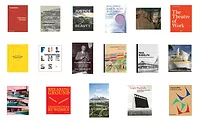
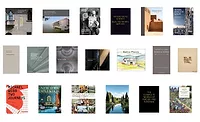
2014 Books Roundup
Every year, hundreds of new architecture books find their way to Record's offices. Editors look at all of them, albeit some longer than others. Here are some of the ones that grabbed our attention in 2014.
 | Notations: Diagrams & Sequences, by Bernard Tschumi.Artifice Books, August 2014, 304 pages, $40. An extensive collection of previously unpublished drawings, this book is beautifully bound in a red cloth cover, Tschumi’s signature color. It presents the conceptual “notations” behind a range of projects, arranged chronologically, from the Parc de la Villette in Paris to the New Acropolis Museum in Athens. Tschumi’s expressive drawings, sketches, and diagrams help us understand his design process and how “drawing is thinking” for him. |
 | Shigeru Ban: Humanitarian Architecture, foreword by Heidi Zuckerman Jacobson, text by Claude Bruderlein, Naomi Pollack, Eyal Weizman, Michael Kimmelman, Koh Kitayama, and Brad Pitt. Aspen Art Press/D.A.P, October 2014, 280 pages, $60. The catalog for an inaugural exhibition at the Shigeru Ban-designed Aspen Art Museum, this hardcover book is a detailed compendium of the architect’s commitment to building for the public good. His use of innovative materials and construction processes make this title by the 2014 Pritzker Prize winner a necessary addition to any architect’s library. Photographs, drawings, and construction manuals illustrate the projects featured in the book. |
 | Shooting Space: Architecture in Contemporary Photography, by Elias Redstone, with texts by Kate Bush and Pedro Gadanho. Phaidon Press, October 2014, 240 pages, $60. This book is a showcase of more than 400 examples of the best in contemporary architectural photography. Drawn from an international pool of images, the shots draw attention to the relationships between architecture and its environs. The book includes work by such photographers as Iwan Baan, Andreas Gursky, Catherine Opie, Wolfgang Tillmans, Thomas Ruff, and Hiroshi Sugimoto and looks at building at various scales, from that of the city down to a small portion of sidewalk. |
 | An Eloquent Modernist: E. Stewart Williams, Architect, edited by Sidney Williams, with texts by Lauren Bricker, Elizabeth Edwards Harris, Erin Hyman, Volker M. Welter, Sidney Williams, and Wim de Wit. Palm Springs Art Museum, 2014, 210 pages, $59. This monograph details the life of architect E. Stewart Williams, who was responsible for iconic mid-20th-century buildings in and around Palm Springs, California. The book shares insight into the architect’s ideas about site-specific architecture and the need to integrate buildings with the local environment. His Santa Fe Federal Savings and Loan building (1961) was recently converted by Marmol Radziner into the Palm Springs Art Museum’s Architecture and Design Center; this hardbound book accompanies an exhibition at the museum. |
 | Saint John’s Abbey Church: Marcel Breuer and the Creation of a Modern Sacred Space, by Victoria M. Young. University of Minnesota Press, November 2014, 240 pages, $35. This hardcover book provides a thorough account of Marcel Breuer’s design of the Saint John’s Abbey Church, a masterpiece of Modernist architecture completed in 1961 in Collegeville, Minnesota. Breuer challenged traditional notions of what religious architecture is and could be with his sculptural concrete chapel. Letters, drawings, and other archival materials have been collected to fully document the design process. |
 | Futebol: Urban Euphoria in Brazil, photographs by Leonardo Finotti and Ed Viggiani, text by Afonso Celso Gárcia Reis and Luís Antonio Jorge. Lars Müller Publishers, July 2014, 80 pages, $29. This flexi-bound book documents how soccer figures directly into Brazil’s national identity. Football pitches pop up wherever there is room within the crowded urban landscape, some of them manicured and regulation-size, others merely clearings of dusty land with goals demarcated by scraps of wood. Aerial shots show how these playing fields fit between buildings and weave themselves into the fabric of the city. |
 | Building As Ornament: Iconography in Contemporary Architecture, by Michiel van Raaij. Nai010 Publishers, May 2014, 240 pages, $25. For more than a century, ornament in architecture was anathema in the Calvinist Netherlands—and elsewhere too. In his book Building as Ornament: Iconography in Contemporary Architecture, Michiel van Raaij, who is the editor in chief of the online architecture platform Architectenweb, interviews 10 well-known architects and architectural historians to reveal how this attitude has changed since the 1990s. |
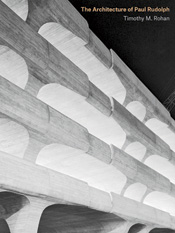 | The Architecture of Paul Rudolph, by Timothy M. Rohan. Yale University Press, July 2014, 300 pages, $65. Paul Rudolph, who died in 1997, had the reputation of being a difficult architect who designed difficult buildings. Assessing his life and work has also proven to be a tough challenge for scholars. But nearly two decades since Rudolph's death, Timothy Rohan has finally given us a scholarly monograph that is critical, accessible, and comprehensive. |
 | What If…? The Architecture and Design of David Rockwell, edited by Chee Pearlman, with texts by Justin Davidson, Elizabeth Diller, John Guare, and Jack O’Brien. Metropolis Books, December 2014, 352 pages, $45. This hard-bound book is a colorful compendium of Rockwell’s designs for hotels, restaurants, the theater and beyond. The question “what if?” is applied to each project, probing the ways in which materials might be applied, functions reimagined, or light used in an interior space. Rockwell’s creative mind is captured on the page. |
 | Ettore Sottsass, by Philippe Thome. Phaidon Press, May 2014, 470 pages, $150. With its intriguing cover, Phaidon’s monograph chronicles the Italian architect and designer Ettore Sottsass’s unbridled creativity. Whether working as a design consultant for Olivetti in the 1950s or designing vibrant furniture, ceramics, and lighting for the Memphis Group in the Post-Modernist 1980s, Sottsass’s work was always original, playful, and ahead of its time. |
 | Midcentury Houses Today, by Lorenzo Ottaviani, Jeffrey Matz, and Cristina A. Ross, with photographs by Michael Biondo. Monacelli Press, October 2014, 240 pages, $65. This elegant hardcover book showcases a selection of midcentury architecture in New Canaan, Connecticut. Each chapter focuses on a specific house, showing plentiful photographs of both the interior and exterior, while providing background information. The book takes a close look at residential modernism and how it has been adapted to contemporary life. |
 | Cubed: A Secret History of the Workplace, by Nikil Saval. Doubleday, April 2014, 368 pages, $27. This engaging book takes an in-depth look at the spaces in which many of us work. It offers a detailed history of the origin of the modern workspace and its presence in popular culture. Culling from literature, films, and business history, Saval documents how our workplaces came to be, and how we might improve them. |
Looking for a reprint of this article?
From high-res PDFs to custom plaques, order your copy today!