Architectural Record
search
cart
facebook twitter linkedin youtube
  • Sign In
  • Subscribe
  • Sign Out
  • My Account
Architectural Record
  • NEWS
    • Latest News
    • Awards
    • Interviews
    • Obituaries
    • Podcasts
      • Design:Ed Podcast
      • Sponsored Podcasts
  • OPINION
    • Book Reviews / Excerpts
    • Exhibition Reviews
    • Forum
  • EXCLUSIVES
    • Videos
    • Design Vanguard
    • Top 300 Firms
    • Sponsored Content
    • Sponsored eBooks
    • From the Archives
  • CONTINUING ED
    • Editorial Continuing Ed
    • CE Center
    • CE Academies
  • PROJECTS
    • Buildings By Type
    • Reuse & Renovation
    • Museums & Arts Centers
    • Colleges & Universities
    • Multifamily Housing
    • Interiors
    • Lighting
    • Kitchen & Bath
  • HOUSES
    • Record Houses
    • House of the Month
    • Featured Houses
  • PRODUCTS
    • Products by Category
    • Record Products of the Year
    • Latest Products
  • EVENTS
    • Dates & Events
    • Record on the Road
    • Innovation Conference
    • Sustainability in Practice
    • Women In Architecture
    • Webinars
    • Ad Excellence Awards
    • Submit an Event
  • CONNECT
    • Ask RECORD AI
    • Newsletters
    • Contact
    • Advertise
    • Editorial Calendar
    • Store
    • Customer Service
  • SUBMIT
    • Submission Guidelines
    • RECORD Competitions
  • MAGAZINE
    • Subscribe
    • My Account
    • Digital Edition
    • Current Issue
    • Firm Pass
    • Historic Archive
Opinion

New Orleans Under Reconstruction: The Crisis of Planning

By Martin C. Pedersen
February 1, 2015
Edited by Carol McMichael Reese, Michael Sorkin, and Anthony Fontenot. Verso, May 2014, 544 pages, $50.

Can the Good Times Roll After the Flood Waters Recede?
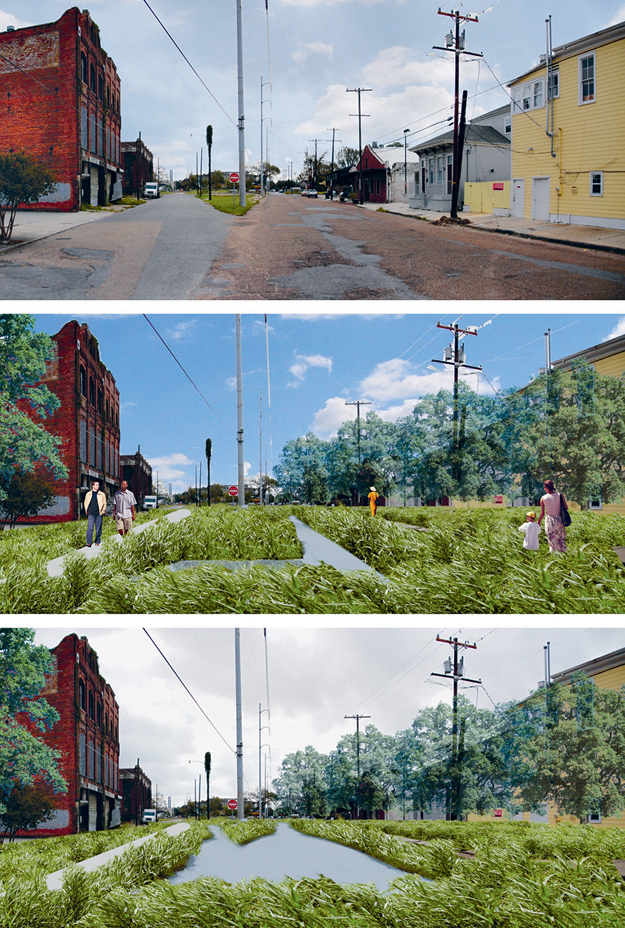
Architects at Waggonner & Ball devised plans for the Hoffman Triangle area that change its current state (top) into one that accommodates various water-storage options (above).
Images courtesy Waggonner & Ball
Architects at Waggonner & Ball devised plans for the Hoffman Triangle area that change its current state (top) into one that accommodates various water-storage options (above).

The subtitle here is a bit of a spoiler. News flash: equitable, sound, socially responsible planning did not happen in post-Katrina New Orleans. This won't shock anyone who watched HBO's Treme on a regular basis. But that's the message conveyed by the book's editors right at the outset, in their lively, polemical introduction. Fortunately, their rueful pessimism tells an incomplete and still-evolving story, as they will be the first to concede. New Orleans, nine years after the flood, remains a work in progress.

In the immediate aftermath of the storm, it seemed as if the entire world of architecture and planning had descended on the besieged city. Exactly who and what they would design and plan for was uncertain at that point. There was a feeble, corrupt (as it later turned out) mayor ostensibly in charge, along with an almost tragic lack of government leadership, and no clear lines of author-ity. The design schools arrived soon after, working on a parallel track, armed with foundation grants, good but often misguided intentions, and the willful naivet' typical of architecture and planning students (and their professors).

As recounted by essays early in the book, the official planning process got off to a bumpy start in January 2006, with the Bring New Orleans Back commission, which recommended shrinking the city's footprint and not redeveloping six low-lying neighborhoods. The communities slated for elimination (the infamous green dots) took vocal exception, and the plan died a quick death. Two other major planning efforts were launched, while the real power brokers pushed a different redevelopment agenda: the abandonment of Charity Hospital (in favor of a mammoth suburban-style replacement near the French Quarter), the dismantling of the public schools in favor of a charter system, and the unnecessary demolition of much of the city's public housing. Eventually these initiatives became official policy.

Meanwhile, in the absence of municipal leadership, something more promising began unfolding in the neighborhoods. "What was amazing about the UNOP [Unified New Orleans Plan] process was the phenomenal level of grassroots engagement," writes Derek James Hoeferlin in his essay on the rebuilding. "The real work happened-and succeeded-at the neighborhood and district level." Broadmoor, a racially and economically diverse neighborhood, was particularly well organized, spearheading efforts to save its own branch library and build an award-winning addition, designed by Eskew Dumez + Ripple.

The book-a huge doorstop that might have been considerably improved with judicious pruning-tells that messy, complicated story. It includes solid essays by Denise Scott Brown, Naomi Klein, Rebecca Solnit, and Melissa Harris-Perry and William M. Harris, as well as interviews with notable local players, including the architects David Waggonner and the late Allen Eskew, and a particularly cogent and clear-eyed assessment of things by community activist Jeanne P. Nathan. Providing a kind of academic snapshot of Katrina-as-learning-experience, it also includes dozens of largely unrealized design projects by leading practitioners and students. Taken together, the book is fragmentary and something of a free-for-all, but should provide an indispensable roadmap for future historians, and is fascinating in that regard. As a reading experience, however, it's a mixed bag, elegant and engaging in some places, lumpy and academic in others.

And yet despite the book's all-too-accurate subtitle, the city is in the midst of a continuing renaissance. It's an uneven revival, as is typical of the Crescent City, but the energy here remains real and palpable. The music and food scenes, in particular, have come roaring back. This raises an uncomfortable question for planners: did the rebirth of New Orleans happen in spite of them? Does "official" planning even matter? For its part, the book offers up some consolation, featuring a smattering of real-world projects, modest victories, that are all small-scale and community-based. It was here in the neighborhoods where the authentic seeds for renewal were planted. As it turns out, top-down planning did, in fact, fail New Orleans, but citizen activists surely saved it.

Martin C. Pedersen, former executive editor of Metropolis, is a writer and editor living in New Orleans.

Share This Story

Looking for a reprint of this article?
From high-res PDFs to custom plaques, order your copy today!


Martin C. Pedersen runs the architecture and design website Common Edge (commonedge.org). He lives in New Orleans.

Post a comment to this article

Report Abusive Comment

Subscription Center
  • Create an Account
  • Start a Subscription
  • Manage My Account
  • Sign Up for Newsletters
  • Visit Customer Service
  • Update Preferences

More Videos

Sponsored Content

Sponsored Content is a special paid section where industry companies provide high quality, objective, non-commercial content around topics of interest to the Architectural Record audience. All Sponsored Content is supplied by the advertising company and any opinions expressed in this article are those of the author and not necessarily reflect the views of Architectural Record or its parent company, BNP Media. Interested in participating in our Sponsored Content section? Contact your local rep!

close
  • TAMLYN XtremeTrim Exterior Trim
    Sponsored byTamlyn

    Designing Cleaner Panel Facades: Why Exterior Trim Details Matter

  • Building with Vapor Barriers
    Sponsored byReef Industries, Inc.

    Vapor Barriers Help Control Moisture in Tighter Building Designs

  • Duct Interior with Prodeq System
    Sponsored byHenry, a Carlisle Company

    Designing Resilient Water Containment Systems

DESIGN:ED Podcast
Listen to Architectural Record’s DESIGN:ED Podcast

Events

June 10, 2026

Rethinking Stormwater – The Power of Porous Paving

Credits: 1 AIA LU/HSW; 1 AIBD P-CE; 0.1 ICC CEU

Learn how porous paving systems support stormwater management, reduce heat island effects, and enhance sustainable site design performance.

June 11, 2026

Very Early Warning Fire Detection for Mission-Critical Facilities

Credits: 1 AIA LU/HSW; 1 AIBD P-CE; 0.1 ICC CEU

Examine advanced fire detection strategies that support uptime and enhance safety in data centers and other mission-critical facilities.

View All Submit An Event

Products

2026 Architect's Square Foot Costbook

2026 Architect's Square Foot Costbook

See More Products

Popular Stories

Coronado Bridge

The Architect’s Guide to San Diego

Practice Matters illustration

What’s in a (Firm’s) Name? Thinking About Succession and Legacy

Practice Matters illustration

By the Numbers: Counting America's Architects

Inward House

Inward House by VeeV Design Studio

Riverdale House by Studio Lau

Riverdale House by Studio Lau

Broader Sustainability of CMU - Free Webinar - May 21, 2026

Related Articles

  • Lake Verret.

    Climate Change and the Crisis of Inequity

    See More
  • Cathleen McGuigan

    July 2020 Editorial: Architects Must Respond to the Ongoing Crisis of Racism in America

    See More
  • New Orleans.

    New Orleans by Martin Pedersen

    See More

Related Products

See More Products
  • book5.jpg

    Contemporary Market Architecture Planning and Design

See More Products
×

The latest news and information

#1 Source for Architectural Design, News and Products

SUBSCRIBE
  • RESOURCES
    • Advertise
    • Contact Us
    • Submit
    • Store
  • ACCOUNT CENTER
    • Create an Account
    • Start a Subscription
    • Manage My Account
    • Sign Up for Newsletters
    • Visit Customer Service
    • Update Preferences
  • PRIVACY
    • PRIVACY POLICY
    • TERMS & CONDITIONS
    • DO NOT SELL MY PERSONAL INFORMATION
    • PRIVACY REQUEST
    • ACCESSIBILITY
  • SERVICES
    • Marketing Services
    • Reprints
    • Market Research
    • List Rental
    • Survey/Respondent Access
  • STAY CONNECTED
    • Linkedin
    • Facebook
    • Instagram
    • YouTube
    • X (Twitter)

Copyright ©2026. All Rights Reserved BNP Media, Inc. and BNP Media II, LLC.

Design, CMS, Hosting & Web Development :: ePublishing