Architectural Record
search
cart
facebook twitter linkedin youtube
  • Sign In
  • Subscribe
  • Sign Out
  • My Account
Architectural Record
  • NEWS
    • Latest News
    • Awards
    • Interviews
    • Obituaries
    • Podcasts
      • Design:Ed Podcast
      • Sponsored Podcasts
  • OPINION
    • Book Reviews / Excerpts
    • Exhibition Reviews
    • Forum
  • EXCLUSIVES
    • Videos
    • Design Vanguard
    • Top 300 Firms
    • Sponsored Content
    • Sponsored eBooks
    • From the Archives
  • CONTINUING ED
    • Editorial Continuing Ed
    • CE Center
    • CE Academies
  • PROJECTS
    • Buildings By Type
    • Reuse & Renovation
    • Museums & Arts Centers
    • Colleges & Universities
    • Multifamily Housing
    • Interiors
    • Lighting
    • Kitchen & Bath
  • HOUSES
    • Record Houses
    • House of the Month
    • Featured Houses
  • PRODUCTS
    • Products by Category
    • Record Products of the Year
    • Latest Products
  • EVENTS
    • Dates & Events
    • Record on the Road
    • Innovation Conference
    • Sustainability in Practice
    • Women In Architecture
    • Webinars
    • Ad Excellence Awards
    • Submit an Event
  • CONNECT
    • Ask RECORD AI
    • Newsletters
    • Contact
    • Advertise
    • Editorial Calendar
    • Store
    • Customer Service
  • SUBMIT
    • Submission Guidelines
    • RECORD Competitions
  • MAGAZINE
    • Subscribe
    • My Account
    • Digital Edition
    • Current Issue
    • Firm Pass
    • Historic Archive
Opinion

Educating Architects: How Tomorrow's Practitioners Will Learn Today

By Reviewed by
May 16, 2015
Edited by Neil Spiller and Nic Clear. Thames & Hudson, November 2014, 352 pages, $50 (hardcover).

This is actually three books in one. As a collection of 40 essays by 35 different authors, it is, first, an advertisement for the University of Greenwich's Department of Architecture and Landscape in its new location at the Maritime Greenwich World Heritage Site outside of London and its assumed new relevance. It is, alternatively, a platform for schools of architecture that indulge “radicality,” “innovation,” and visions of the “future.” And, finally, it is a history of various schools offering alternative (read: anti-institutional) modes of education.
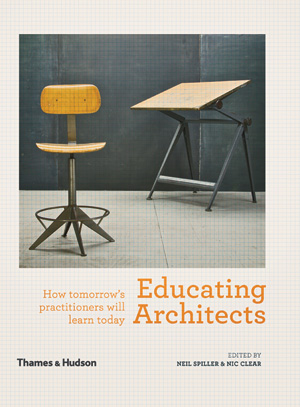
Educating Architects: How Tomorrow’s Practitioners Will Learn Today

The first of these is rather charming as you see Neil Spiller and Nic Clear, who edited the book and teach at Greenwich, pour their enthusiasm for a type of education—a mix of the approaches of the Architectural Association (AA), SCI-Arc, and the University of Applied Arts in Vienna—into the pedagogy of their new department. Their anticipation of bypassing leaden, myopic, and risk-averse academia is clear, even if you, as a reader, feel a bit queasy about their self-promotion. The third “book” is also enlightening. The histories of the AA, and architecture programs at UCLA, the Berlage, and Cornell, for example, though not unknown, are told here by current teachers at these schools who offer insights into the struggle to simultaneously build on and transcend institutional legacies. It is the second “book” that is troubling, since it assumes that teaching formal radicality is “how tomorrow's practitioners will learn today.” In other words, prejudice masquerades as a list of relevant schools.

The introduction by Spiller is quite inspiring, in part because of his optimism. “Architectural education is a delicate ecology, but thankfully it is in the hands of deans and directors . . . who vigorously defend its integrity . . . and students from the vicissitudes and strange economies of academia,” he writes. He also indicates that innovation won't be equated with software pyrotechnics. He says he has learned “that the world is not in thrall with parametricism, and the nagging fear that it has become a fashionable rash across the world is unfounded.” But the preponderance of chapters, pedogogies, and images celebrating unusual forms—nay, formal imagery— for their own sake belies those statements.

This may or may not be cause for dismissal. A reader could mark the inconsistency and just move on to read about how Hernan Diaz Alonso, Hani Rashid, Evan Douglis, or a host of others are pushing disciplinary boundaries. Or one could note that, tucked into the book, are outliers who have smart things to say about contemporary architectural education. For example, Ben Nicholson's short essay, “Wot got left out,” moves beyond platitudes of envisioning the future. “I mean, how in all consciousness can we design a boat house on the Thames, while half the residents of the globe live on $2 a day?” he asks. Similarly, Mark Burry describes how his Spatial Information Architecture Laboratory at RMIT inserts practitioners into education and mixes academia with industry. Mark Morris's essay on Cornell reveals that school's struggles for digital relevance and raises the issue of online courses for architecture. Nigel Coates examines the elephant in the room: the disproportion between the cost of architectural education and its marginal power. In a book preaching globalism, the editors recognize that there might be Chinese educators, so they include an essay by Kongjian Yu on Peking University.

But it is depressing to read that future-oriented pedagogy looks so much like the past. Yes, the architectural forms in the book are different from those we saw 40 years ago, but the paradigms have barely budged. Here, the AA under Alvin Boyarsky is still the model. The Archigrammy “just play” rhetoric of Peter Cook at the Bartlett still excites. The imperative to create “sublime architectures that are personal” is still a means to usher in the future. It is so yesterday. We await the book on architectural education that sees that the world today offers architects so much meat that avoiding it to skip to the future is silly. We want the book that understands the need for truly different strategies, ones that empower the architect to change—not just imagine—our future built environment.

Share This Story

Looking for a reprint of this article?
From high-res PDFs to custom plaques, order your copy today!

Post a comment to this article

Report Abusive Comment

Subscription Center
  • Create an Account
  • Start a Subscription
  • Manage My Account
  • Sign Up for Newsletters
  • Visit Customer Service
  • Update Preferences

More Videos

Sponsored Content

Sponsored Content is a special paid section where industry companies provide high quality, objective, non-commercial content around topics of interest to the Architectural Record audience. All Sponsored Content is supplied by the advertising company and any opinions expressed in this article are those of the author and not necessarily reflect the views of Architectural Record or its parent company, BNP Media. Interested in participating in our Sponsored Content section? Contact your local rep!

close
  • cold storage facility
    Sponsored byCarlisle SynTec Systems

    How Architects Can Design More Continuous Cold Storage Envelopes

  • TAMLYN XtremeTrim Exterior Trim
    Sponsored byTamlyn

    Designing Cleaner Panel Facades: Why Exterior Trim Details Matter

  • Building with Vapor Barriers
    Sponsored byReef Industries, Inc.

    Vapor Barriers Help Control Moisture in Tighter Building Designs

DESIGN:ED Podcast
Listen to Architectural Record’s DESIGN:ED Podcast

Events

June 30, 2026

Generator Selection and Sizing for Outage-Ready Homes

Credits: 1 AIA LU/HSW; 1 AIBD P-CE; 0.1 ICC CEU

Explore how propane-powered systems and whole-home generators can improve energy resilience, reduce electrical loads, and lower long-term residential costs.

July 1, 2026

Hospitality in Higher Education

Credits: 1 AIA LU/HSW; 1 AIBD P-CE; 0.1 ICC CEU

Explore how hospitality-driven campus design can strengthen belonging, wellbeing, and community connection in higher education environments.

View All Submit An Event

Products

2026 Architect's Square Foot Costbook

2026 Architect's Square Foot Costbook

See More Products

Popular Stories

Obama Presidential Center, Chicago

The Obama Presidential Center Opens on Chicago’s South Side

Spoonbill Ranch

Johnsen Schmaling Architects Integrates Spoonbill Ranch into a Pristine Landscape

Kìwekì Point, Ottawa, Canada

Perched High Above the Ottawa River, Kìwekì Point Showcases Sweeping Views of the Canadian Capital Region

Baileywick Park

An Elegant Pavilion by In Situ Studio Adds Sheltered Courts and a Gateway to a Public Park in Raleigh

Ayn Rand Center rendering

John Ronan Architects Designs Cultural and Education Hub for the Ayn Rand Institute in Austin

Generator Selection and Sizing for Outage-Ready Homes - Free Webinar - June 30, 2026

Related Articles

  • How Architects Can Land a Government Contract

    See More
  • cold storage facility

    How Architects Can Design More Continuous Cold Storage Envelopes

    See More
  • Africa Today and Tomorrow

    See More
×

The latest news and information

#1 Source for Architectural Design, News and Products

SUBSCRIBE
  • RESOURCES
    • Advertise
    • Contact Us
    • Submit
    • Store
  • ACCOUNT CENTER
    • Create an Account
    • Start a Subscription
    • Manage My Account
    • Sign Up for Newsletters
    • Visit Customer Service
    • Update Preferences
  • PRIVACY
    • PRIVACY POLICY
    • TERMS & CONDITIONS
    • DO NOT SELL MY PERSONAL INFORMATION
    • PRIVACY REQUEST
    • ACCESSIBILITY
  • SERVICES
    • Marketing Services
    • Reprints
    • Market Research
    • List Rental
    • Survey/Respondent Access
  • STAY CONNECTED
    • Linkedin
    • Facebook
    • Instagram
    • YouTube
    • X (Twitter)

Copyright ©2026. All Rights Reserved BNP Media, Inc. and BNP Media II, LLC.

Design, CMS, Hosting & Web Development :: ePublishing