Architectural Record
search
cart
facebook twitter linkedin youtube
  • Sign In
  • Subscribe
  • Sign Out
  • My Account
Architectural Record
  • NEWS
    • Latest News
    • Awards
    • Interviews
    • Obituaries
    • Podcasts
      • Design:Ed Podcast
      • Sponsored Podcasts
  • OPINION
    • Book Reviews / Excerpts
    • Exhibition Reviews
    • Forum
  • EXCLUSIVES
    • Videos
    • Design Vanguard
    • Top 300 Firms
    • Sponsored Content
    • Sponsored eBooks
    • From the Archives
  • CONTINUING ED
    • Editorial Continuing Ed
    • CE Center
    • CE Academies
  • PROJECTS
    • Buildings By Type
    • Reuse & Renovation
    • Museums & Arts Centers
    • Colleges & Universities
    • Multifamily Housing
    • Interiors
    • Lighting
    • Kitchen & Bath
  • HOUSES
    • Record Houses
    • House of the Month
    • Featured Houses
  • PRODUCTS
    • Products by Category
    • Record Products of the Year
    • Latest Products
  • EVENTS
    • Dates & Events
    • Record on the Road
    • Innovation Conference
    • Sustainability in Practice
    • Women In Architecture
    • Webinars
    • Ad Excellence Awards
    • Submit an Event
  • CONNECT
    • Ask RECORD AI
    • Newsletters
    • Contact
    • Advertise
    • Editorial Calendar
    • Store
    • Customer Service
  • SUBMIT
    • Submission Guidelines
    • RECORD Competitions
  • MAGAZINE
    • Subscribe
    • My Account
    • Digital Edition
    • Current Issue
    • Firm Pass
    • Historic Archive
Opinion

Informal Urbanism

By Reviewed by
June 16, 2015

Villages in the City: A Guide to South China’s Informal Settlements, edited by Stefan Al. Hong Kong University Press and University of Hawaii Press, October 2014, 216 pages, $28.

Handmade Urbanism: From Community Initiatives to Participatory Models, edited by Marcos Rosa and Ute Weiland. Jovis, October 2013, 224 pages, $40.

Tactical Urbanism: Short-term Action for Long-term Change, by Mike Lydon and Anthony Garcia. Island Press, March 2015, 256 pages, $25.
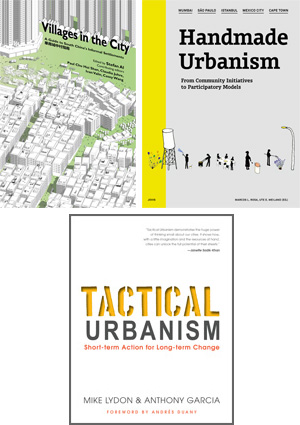
Informal Urbanism: Villages in the City; Handmade Urbanism; Tactical Urbanism

From the slum settlements of burgeoning megacities to the guerrilla gardening and pop-up everything we celebrate in the United States, recent years have seen a growing interest in creative and informal urbanisms of a wide variety. Several new books offer contributions to this discourse on the bottom-up.

One of the best is Villages in the City edited by Stefan Al. This “guide to South China's informal settlements” looks at villages enveloped by the rapid growth of nearby “western style” cities. The formerly rural residents have profited from the development of agricultural lands as they densified their dwellings and rented them to recent migrants. Despite the adaptive nature of this process in places that long predate the surrounding development, the resulting areas are viewed as messy, crime-ridden “tumors” in the otherwise rational city, and are now being destroyed.

Al and his contributors aim to document, theorize, and defend these curious places, and do so to great effect through an artful assemblage of photographs, illustrations, maps, and essays. Indeed, while Villages in the City is a fabulous piece of architecture and design graphica, written contributions from Marco Cenzatti, Margaret Crawford, Jiong Wu, and others offer vital considerations of the histories and contexts of the phenomenon. The book succeeds by investigating and advocating for the informal without fetishizing it.

Marcos Rosa and Ute Weiland's Handmade Urbanism is a fun tour of community-based initiatives in Mumbai, São Paulo, Istanbul, Mexico City, and Cape Town that received the Deutsche Bank Urban Age Award for public-private collaborations that improve urban places and lives. The book is organized by city and presents photos, statistics, illustrated summaries, and interviews for each. In Mexico City, for instance, once-warring street gangs worked to reduce violence through graffiti contests and sports; in Cape Town, a community organization built an agricultural- education complex. Many initiatives converted neglected land into thriving public spaces.

Handmade Urbanism has the feel of a clever, even cartoony textbook: the aesthetic is accessible, texts are short, facts are simple. It even includes a DVD documentary. This approachableness is a strength, as are some powerful photos and thoughtful contributions from noted urbanists including Richard Sennett and Ricky Burdett. But other pieces are clumsy and hyperbolic at times, celebrating these local efforts without really assessing them.

Tactical Urbanism, by Mike Lydon and Anthony Garcia, is about creative placemaking in the global north. The book takes as its subject simple but bold streetscape interventions that lead to powerful changes. Think of the rapid pedestrianization of Times Square or San Francisco's popular “parklets.” Lydon and Garcia have popularized the term tactical urbanism in recent years and work here to define it, explore its history and successes, and proselytize for its continuing application.

The book focuses on citizen-planning initiatives that have found support and success, such as Build a Better Block, a streetscaping effort that started in a single Dallas neighborhood and is now an international model. Lydon and Garcia make an array of interesting connections in a section on tactical urbanism's precursors, including mail-order bungalows and the first late-night diner. The “how-to” guide that constitutes the fifth chapter presents advice from the authors, who combine professional training with experience in creating their own tactical interventions.

Ironically, what these three books on informal urbanism all demonstrate is the inescap- ability of formal processes. China's urbanized villages were enabled by policy and are now threatened by it; the Urban Age Awards projects explicitly integrate the grassroots with the public and private sectors; tactical urbanism is a way for citizens and planners to leverage informal approaches for official results by demonstrating the impacts of innovations without (or at least before) the encumbrances of regulatory hand-wringing.

It could also be said that the three books, all unwavering proponents of their subjects, lack sufficient cautions and critiques. There are simple issues of safety and responsibility for projects that walk a line between unsanctioned and sanctioned. But there are also questions to ask about rewarding these efforts when many people want for basic shelter and services. This critical perspective is still missing from the conversation.

Share This Story

Looking for a reprint of this article?
From high-res PDFs to custom plaques, order your copy today!
Post a comment to this article

Report Abusive Comment

Subscription Center
  • Create an Account
  • Start a Subscription
  • Manage My Account
  • Sign Up for Newsletters
  • Visit Customer Service
  • Update Preferences

More Videos

Sponsored Content

Sponsored Content is a special paid section where industry companies provide high quality, objective, non-commercial content around topics of interest to the Architectural Record audience. All Sponsored Content is supplied by the advertising company and any opinions expressed in this article are those of the author and not necessarily reflect the views of Architectural Record or its parent company, BNP Media. Interested in participating in our Sponsored Content section? Contact your local rep!

close
  • TAMLYN XtremeTrim Exterior Trim
    Sponsored byTamlyn

    Designing Cleaner Panel Facades: Why Exterior Trim Details Matter

  • Building with Vapor Barriers
    Sponsored byReef Industries, Inc.

    Vapor Barriers Help Control Moisture in Tighter Building Designs

  • Duct Interior with Prodeq System
    Sponsored byHenry, a Carlisle Company

    Designing Resilient Water Containment Systems

DESIGN:ED Podcast
Listen to Architectural Record’s DESIGN:ED Podcast

Events

June 10, 2026

Rethinking Stormwater – The Power of Porous Paving

Credits: 1 AIA LU/HSW; 1 AIBD P-CE; 0.1 ICC CEU

Learn how porous paving systems support stormwater management, reduce heat island effects, and enhance sustainable site design performance.

June 11, 2026

Very Early Warning Fire Detection for Mission-Critical Facilities

Credits: 1 AIA LU/HSW; 1 AIBD P-CE; 0.1 ICC CEU

Examine advanced fire detection strategies that support uptime and enhance safety in data centers and other mission-critical facilities.

View All Submit An Event

Products

2026 Architect's Square Foot Costbook

2026 Architect's Square Foot Costbook

See More Products

Popular Stories

Practice Matters illustration

What’s in a (Firm’s) Name? Thinking About Succession and Legacy

Practice Matters illustration

By the Numbers: Counting America's Architects

House on a Hill

Design Vanguard 2026: Forma

Crane Cove, ONO

Design Vanguard 2026 Winners

House A on a Hill

Design Vanguard 2026: Santiago Valdivieso

Broader Sustainability of CMU - Free Webinar - May 21, 2026

Related Articles

  • Johannesburg Exhibition Takes on the Challenges of Informal Settlements

    See More
  • Bigger! Faster! Urbanism in Asia

    See More
  • A Marriage of Serious Architecture and an Informal Setting

    See More

Related Products

See More Products
  • 047177751X.gif

    Sustainable Urbanism: Urban Design With Nature

  • image7.jpg

    Contemporary Architecture in China Towards A Critical Pragmatism

See More Products
×

The latest news and information

#1 Source for Architectural Design, News and Products

SUBSCRIBE
  • RESOURCES
    • Advertise
    • Contact Us
    • Submit
    • Store
  • ACCOUNT CENTER
    • Create an Account
    • Start a Subscription
    • Manage My Account
    • Sign Up for Newsletters
    • Visit Customer Service
    • Update Preferences
  • PRIVACY
    • PRIVACY POLICY
    • TERMS & CONDITIONS
    • DO NOT SELL MY PERSONAL INFORMATION
    • PRIVACY REQUEST
    • ACCESSIBILITY
  • SERVICES
    • Marketing Services
    • Reprints
    • Market Research
    • List Rental
    • Survey/Respondent Access
  • STAY CONNECTED
    • Linkedin
    • Facebook
    • Instagram
    • YouTube
    • X (Twitter)

Copyright ©2026. All Rights Reserved BNP Media, Inc. and BNP Media II, LLC.

Design, CMS, Hosting & Web Development :: ePublishing