Architectural Record
search
cart
facebook twitter linkedin youtube
  • Sign In
  • Subscribe
  • Sign Out
  • My Account
Architectural Record
  • NEWS
    • Latest News
    • Awards
    • Interviews
    • Obituaries
    • Podcasts
      • Design:Ed Podcast
      • Sponsored Podcasts
  • OPINION
    • Book Reviews / Excerpts
    • Exhibition Reviews
    • Forum
  • EXCLUSIVES
    • Videos
    • Design Vanguard
    • Top 300 Firms
    • Sponsored Content
    • Sponsored eBooks
    • From the Archives
  • CONTINUING ED
    • Editorial Continuing Ed
    • CE Center
    • CE Academies
  • PROJECTS
    • Buildings By Type
    • Reuse & Renovation
    • Museums & Arts Centers
    • Colleges & Universities
    • Multifamily Housing
    • Interiors
    • Lighting
    • Kitchen & Bath
  • HOUSES
    • Record Houses
    • House of the Month
    • Featured Houses
  • PRODUCTS
    • Products by Category
    • Record Products of the Year
    • Latest Products
  • EVENTS
    • Dates & Events
    • Record on the Road
    • Innovation Conference
    • Sustainability in Practice
    • Women In Architecture
    • Webinars
    • Ad Excellence Awards
    • Submit an Event
  • CONNECT
    • Ask RECORD AI
    • Newsletters
    • Contact
    • Advertise
    • Editorial Calendar
    • Store
    • Customer Service
  • SUBMIT
    • Submission Guidelines
    • RECORD Competitions
  • MAGAZINE
    • Subscribe
    • My Account
    • Digital Edition
    • Current Issue
    • Firm Pass
    • Historic Archive
Design Vanguard

De Leon and Primmer Architecture Workshop

A pair of Harvard-educated architects find acceptance in Kentucky while drawing inspiration from the state's tobacco barns and vernacular buildings.

By Ingrid Spencer
Located on a 2,000-acre agricultural property that includes two barns, a grain silo, and wildlife conservation areas, this operations facility is used for farm equipment servicing, refueling, and seas
Mason Lane Farm
Located on a 2,000-acre agricultural property that includes two barns, a grain silo, and wildlife conservation areas, this operations facility is used for farm equipment servicing, refueling, and seasonal storage for grain and hay. Submitted for LEED Gold certification, the project respects the client's sense of stewardship of the land and employs simple, primarily passive approaches in its design and construction.The two main buildings frame an outdoor work courtyard. Barn A, a 7,540-square-foot structure with fully enclosed storage and work areas, uses a standard prefabricated wood-truss frame clad with corrugated metal panels. Emphasizing the layering of construction, it reveals building elements that are typically hidden and turns them into design features. A house fan provides ventilation in concert with floor-to-ceiling operable windows. For Barn B, a 9,160-square-foot covered shed used to store hay and equipment, the architects clad the structure with a lattice of locally harvested bamboo. Since Barn B is an open-air structure vulnerable to wind uplift, concrete drainage channels below its eaves also function as counterweights connected via an interlocking detail to the column concrete footings below grade. The architects used recycled and regionally sourced materials throughout the project and ended up landscaping a courtyard and surrounding areas with local limestone, locally sourced decomposed granite, and native or regionally adapted plants that require no irrigation.
Photo courtesy de Leon & Primmer Architecture Workshop
Located on a 2,000-acre agricultural property that includes two barns, a grain silo, and wildlife conservation areas, this operations facility is used for farm equipment servicing, refueling, and seas
Mason Lane Farm
Located on a 2,000-acre agricultural property that includes two barns, a grain silo, and wildlife conservation areas, this operations facility is used for farm equipment servicing, refueling, and seasonal storage for grain and hay. Submitted for LEED Gold certification, the project respects the client's sense of stewardship of the land and employs simple, primarily passive approaches in its design and construction.The two main buildings frame an outdoor work courtyard. Barn A, a 7,540-square-foot structure with fully enclosed storage and work areas, uses a standard prefabricated wood-truss frame clad with corrugated metal panels. Emphasizing the layering of construction, it reveals building elements that are typically hidden and turns them into design features. A house fan provides ventilation in concert with floor-to-ceiling operable windows. For Barn B, a 9,160-square-foot covered shed used to store hay and equipment, the architects clad the structure with a lattice of locally harvested bamboo. Since Barn B is an open-air structure vulnerable to wind uplift, concrete drainage channels below its eaves also function as counterweights connected via an interlocking detail to the column concrete footings below grade. The architects used recycled and regionally sourced materials throughout the project and ended up landscaping a courtyard and surrounding areas with local limestone, locally sourced decomposed granite, and native or regionally adapted plants that require no irrigation.
Photo courtesy de Leon & Primmer Architecture Workshop
This 4,677-square-foot, mixed-use building located in a downtown neighborhood houses De Leon & Primmer's own offices on the ground floor, two apartments on the second floor, a guest suite, and an outd
Urban Barn
This 4,677-square-foot, mixed-use building located in a downtown neighborhood houses De Leon & Primmer's own offices on the ground floor, two apartments on the second floor, a guest suite, and an outdoor courtyard garden. The building's simple barnlike volume uses common pole-barn construction with pressure-treated wood framing arranged on a standard 12-foot column grid with prefinished, corrugated metal siding. To relate contextually with the building's neighbors, pedestrian-scaled elements such as an elongated bench and a storefront window engage the street, while filigree details on large shutters add a touch of elegance and formality.
Photo courtesy de Leon & Primmer Architecture Workshop
This 4,677-square-foot, mixed-use building located in a downtown neighborhood houses De Leon & Primmer's own offices on the ground floor, two apartments on the second floor, a guest suite, and an outd
Urban Barn
This 4,677-square-foot, mixed-use building located in a downtown neighborhood houses De Leon & Primmer's own offices on the ground floor, two apartments on the second floor, a guest suite, and an outdoor courtyard garden. The building's simple barnlike volume uses common pole-barn construction with pressure-treated wood framing arranged on a standard 12-foot column grid with prefinished, corrugated metal siding. To relate contextually with the building's neighbors, pedestrian-scaled elements such as an elongated bench and a storefront window engage the street, while filigree details on large shutters add a touch of elegance and formality.
Photo courtesy de Leon & Primmer Architecture Workshop
The master plan for this 70- acre park reconnects the surrounding community with the Ohio River, using four types of landscapes: active, civic, natural, and playful. Located at the convergence of seve
Riverview Park
The master plan for this 70- acre park reconnects the surrounding community with the Ohio River, using four types of landscapes: active, civic, natural, and playful. Located at the convergence of several natural and constructed elements, including a levee and a rail line, the plan engages visitors with interactive nodes and shelters that will help reinforce an experiential, narrative understanding of the site.
Photo courtesy de Leon & Primmer Architecture Workshop
The master plan for this 70- acre park reconnects the surrounding community with the Ohio River, using four types of landscapes: active, civic, natural, and playful. Located at the convergence of seve
Riverview Park
The master plan for this 70- acre park reconnects the surrounding community with the Ohio River, using four types of landscapes: active, civic, natural, and playful. Located at the convergence of several natural and constructed elements, including a levee and a rail line, the plan engages visitors with interactive nodes and shelters that will help reinforce an experiential, narrative understanding of the site.
Photo courtesy de Leon & Primmer Architecture Workshop
Yew Dell Botanical Gardens is a 33-acre historic property that serves as a major center for gardening, research, and education. For the Visitor Center, De Leon & Primmer renovated a 1,842-square-foot
Yew Dell Gardens
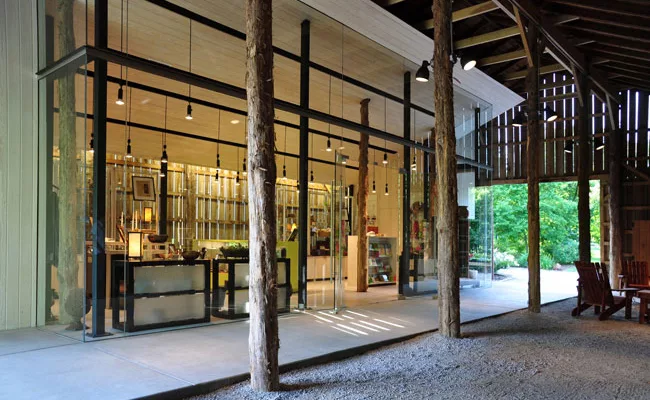
Yew Dell Botanical Gardens is a 33-acre historic property that serves as a major center for gardening, research, and education. For the Visitor Center, De Leon & Primmer renovated a 1,842-square-foot tobacco barn near the entrance to the property, turning it into a reception hall with ticket sales, gift shop, group-tour meeting zone, and Internet sales office. Preserving the exterior shell as an independent shade structure, the firm consolidated conditioned spaces to one side of the barn and separated them from the rest of the spaces with frameless glass doors. The architects used tongue-and-groove pine siding, tempered glass, and sealed concrete floors to create a simple but graceful interior. At night, the building glows like a lantern in the gardens, with light filtering through gaps in the outer layer of wood siding.
Photo courtesy de Leon & Primmer Architecture Workshop
Yew Dell Botanical Gardens is a 33-acre historic property that serves as a major center for gardening, research, and education. For the Visitor Center, De Leon & Primmer renovated a 1,842-square-foot
Yew Dell Gardens
Yew Dell Botanical Gardens is a 33-acre historic property that serves as a major center for gardening, research, and education. For the Visitor Center, De Leon & Primmer renovated a 1,842-square-foot tobacco barn near the entrance to the property, turning it into a reception hall with ticket sales, gift shop, group-tour meeting zone, and Internet sales office. Preserving the exterior shell as an independent shade structure, the firm consolidated conditioned spaces to one side of the barn and separated them from the rest of the spaces with frameless glass doors. The architects used tongue-and-groove pine siding, tempered glass, and sealed concrete floors to create a simple but graceful interior. At night, the building glows like a lantern in the gardens, with light filtering through gaps in the outer layer of wood siding.
Photo courtesy de Leon & Primmer Architecture Workshop
Located on a 2,000-acre agricultural property that includes two barns, a grain silo, and wildlife conservation areas, this operations facility is used for farm equipment servicing, refueling, and seas
This 4,677-square-foot, mixed-use building located in a downtown neighborhood houses De Leon & Primmer's own offices on the ground floor, two apartments on the second floor, a guest suite, and an outd
The master plan for this 70- acre park reconnects the surrounding community with the Ohio River, using four types of landscapes: active, civic, natural, and playful. Located at the convergence of seve
Yew Dell Botanical Gardens is a 33-acre historic property that serves as a major center for gardening, research, and education. For the Visitor Center, De Leon & Primmer renovated a 1,842-square-foot
December 16, 2010

Louisville, Kentucky

There are some people who fashion their lives in response to happy accidents. Neither Roberto de Leon, Jr., AIA, nor M. Ross Primmer, AIA, is one of those people. Instead the co-principals of Louisville, Kentucky–based De Leon & Primmer Architecture Workshop carefully research and strategically plan everything, leaving nothing to chance. After obtaining their M.Arch. degrees from Harvard, de Leon and Primmer decided to move somewhere that they could make an impact. Reading economic reports of U.S. cities, they discovered that Louisville was one of the top three cities on the brink of an economic upswing. The two architects, who had done some fieldwork in Las Vegas (“It was poised for growth, with a university nearby — a city trying to establish and nurture a creative class,” says de Leon) and Charlotte, North Carolina (same as Vegas), hatched a strategy to set up an architecture firm that would specialize in cultural and nonprofit projects and do so in a city that was gritty but educated enough to appreciate new ideas. They chose Louisville and launched their firm in 2003. “It wasn’t random, but we had no ties here at all,” says Primmer. “Louisville was a mid-tier city that was changing from an industrial-based economy to a service-based economy. Our strengths are in consensus building, and we have an interest in corralling boards. So we decided to focus on nonprofit and cultural organizations. Louisville seemed like a place where we could have a voice.”

Seven years later, their five-person practice is immersed in and sparked by the history and traditions of the region. It is hard at work putting Louisville on the cultural map. De Leon and Primmer have stuck to their original strategy, and the city has embraced their temerity as well as their design prowess. With several institutional and recreational projects moving forward, including the Riverview Park master plan (a $33 million program with sports fields, trails, event venues, a steamboat landing, and shelters on a 70-acre site on the Ohio River, now in construction) and the Children’s Healing Garden (a 6,000-square-foot outdoor interactive environment at Kosair Children’s Hospital), the firm is enriching the community in a very public way.

 De Leon and Primmer have found inspiration in the vernacular architecture of their adopted region, as seen in several of their completed projects. For example, at the Yew Dell Botanical Gardens, the Urban Barn, and the Mason Lane Farm Operations Facility, the architects reference the primitive and barnlike structures scattered throughout the region and used as tobacco-drying sheds and agricultural buildings. Other projects — such as the Filson Historical Society lecture hall, archives, and museum (currently in schematic design) and the United Mail Corporate Headquarters, a mail services facility — nod to common local materials, craftwork, and fabrication, as well as vernacular forms and scale. Using a contemporary palette that relates to the Kentucky context — a dark bronze anodized aluminum facade that evokes traditional red brick, for example, for the Filson Historical Society, or a conference room tower composed of hand-stacked, painted-wood planks for United Mail — these transplanted designers recall local antecedents while employing a Modernist vocabulary and a dash of whimsy.

“Originally we thought the points of inspiration in Louisville might be limiting,” says de Leon. “But that has not been the case. We’ve found it so rich here. There’s a lot to draw on.” Primmer agrees. “We find that our clients expect something interesting, super modern, and new,” he says, adding that there’s a bumper-sticker motto in town that says “Louisville: It’s not Kentucky.” “It’s an educated town hungry for work that’s not just good looking but intellectually engaging.”

De Leon and Primmer Architecture Workshop

LOCATION: Louisville, Kentucky

FOUNDED: 2003

DESIGN STAFF: 5

PRINCIPALS: Roberto de Leon, Jr. (left), M. Ross Primmer

EDUCATION: De Leon — Harvard, M.Arch., 1993; University of California, Berkeley, B.A. Arch., 1989. Primmer — Harvard, M.Arch., 1993, Kent State University, B.S. Arch., 1987

WORK HISTORY: De Leon — G.C. Wallace, 1989–99; Schenkel Shultz, 1999–2000; AGA, 2000–02. Primmer — G.C. Wallace, 1989–99; Jenkins Peer, 1999–2000; AGA, 2000–02

KEY COMPLETED PROJECTS: Yew Dell Botanical Gardens Visitor Center, Crestwood, Ky., 2010; Mason Lane Farm Operations Facility, Goshen, Ky., 2009; Urban Barn, Louisville, 2008; United Mail Corporate Headquarters, Louisville, 2007

KEY CURRENT PROJECTS: Riverview Park (Phase I), Louisville, 2010; Guthrie Transportation Museum, Guthrie, Ky., 2011; Children’s Healing Garden, Louisville, 2011; Big Bone Lick State Park Nature Center, Union, Ky., 2012; Filson Historical Society Expansion & Campus Master Plan, Louisville, 2015

WEB SITE: www.deleon-primmer.com


Share This Story

Looking for a reprint of this article?
From high-res PDFs to custom plaques, order your copy today!

Post a comment to this article

Report Abusive Comment

Subscription Center
  • Create an Account
  • Start a Subscription
  • Manage My Account
  • Sign Up for Newsletters
  • Visit Customer Service
  • Update Preferences

More Videos

Sponsored Content

Sponsored Content is a special paid section where industry companies provide high quality, objective, non-commercial content around topics of interest to the Architectural Record audience. All Sponsored Content is supplied by the advertising company and any opinions expressed in this article are those of the author and not necessarily reflect the views of Architectural Record or its parent company, BNP Media. Interested in participating in our Sponsored Content section? Contact your local rep!

close
  • TAMLYN XtremeTrim Exterior Trim
    Sponsored byTamlyn

    Designing Cleaner Panel Facades: Why Exterior Trim Details Matter

  • Building with Vapor Barriers
    Sponsored byReef Industries, Inc.

    Vapor Barriers Help Control Moisture in Tighter Building Designs

  • Duct Interior with Prodeq System
    Sponsored byHenry, a Carlisle Company

    Designing Resilient Water Containment Systems

DESIGN:ED Podcast
Listen to Architectural Record’s DESIGN:ED Podcast

Events

June 16, 2026

Focus on the Façade: Exploring Steel, Timber & Fire-Rated Curtain Walls and Channel Glass Systems

Credits: 1 AIA LU/HSW; 1 AIBD P-CE; 0.1 ICC CEU

Explore modern façade and glazing systems that enhance daylighting, fire safety, and thermal performance while expanding architectural design possibilities.

June 18, 2026

Rebooting the Aging Office Building

Credits: 1 AIA LU/HSW; 1 AIBD P-CE; 0.1 ICC CEU; 1 PDH

Explore façade retrofit strategies and award-winning design concepts that can transform aging office buildings into healthier, higher-performing workplaces for today’s hybrid workforce.

View All Submit An Event

Products

2026 Architect's Square Foot Costbook

2026 Architect's Square Foot Costbook

See More Products

Popular Stories

Coronado Bridge

The Architect’s Guide to San Diego

SanDiegoAirport

Top 300 Architecture Firms of 2026

Crane Cove, ONO

Design Vanguard 2026 Winners

House on a Hill

Design Vanguard 2026: Forma

House A on a Hill

Design Vanguard 2026: Santiago Valdivieso

Focus on the Facade - Free Webinar - June 16, 2026

Related Articles

  • Owsley Brown History Center

    Owsley Brown II History Center by de Leon & Primmer Architecture Workshop

    See More
  • exterior of an arts center in louisville

    American Academy of Arts and Letters Announces 2023 Architecture Award Honorees

    See More
  • Wild Turkey Bourbon Visitor Center

    See More

Related Products

See More Products
  • ribbonarch.jpg

    Ribbon Architecture: Light, Shadow, and Reflection in Architecture

See More Products
×

The latest news and information

#1 Source for Architectural Design, News and Products

SUBSCRIBE
  • RESOURCES
    • Advertise
    • Contact Us
    • Submit
    • Store
  • ACCOUNT CENTER
    • Create an Account
    • Start a Subscription
    • Manage My Account
    • Sign Up for Newsletters
    • Visit Customer Service
    • Update Preferences
  • PRIVACY
    • PRIVACY POLICY
    • TERMS & CONDITIONS
    • DO NOT SELL MY PERSONAL INFORMATION
    • PRIVACY REQUEST
    • ACCESSIBILITY
  • SERVICES
    • Marketing Services
    • Reprints
    • Market Research
    • List Rental
    • Survey/Respondent Access
  • STAY CONNECTED
    • Linkedin
    • Facebook
    • Instagram
    • YouTube
    • X (Twitter)

Copyright ©2026. All Rights Reserved BNP Media, Inc. and BNP Media II, LLC.

Design, CMS, Hosting & Web Development :: ePublishing