Architectural Record
search
cart
facebook twitter linkedin youtube
  • Sign In
  • Subscribe
  • Sign Out
  • My Account
Architectural Record
  • NEWS
    • Latest News
    • Awards
    • Interviews
    • Obituaries
    • Podcasts
      • Design:Ed Podcast
      • Sponsored Podcasts
  • OPINION
    • Book Reviews / Excerpts
    • Exhibition Reviews
    • Forum
  • EXCLUSIVES
    • Videos
    • Design Vanguard
    • Top 300 Firms
    • Sponsored Content
    • Sponsored eBooks
    • From the Archives
  • CONTINUING ED
    • Editorial Continuing Ed
    • CE Center
    • CE Academies
  • PROJECTS
    • Buildings By Type
    • Reuse & Renovation
    • Museums & Arts Centers
    • Colleges & Universities
    • Multifamily Housing
    • Interiors
    • Lighting
    • Kitchen & Bath
  • HOUSES
    • Record Houses
    • House of the Month
    • Featured Houses
  • PRODUCTS
    • Products by Category
    • Record Products of the Year
    • Latest Products
  • EVENTS
    • Dates & Events
    • Record on the Road
    • Innovation Conference
    • Sustainability in Practice
    • Women In Architecture
    • Webinars
    • Ad Excellence Awards
    • Submit an Event
  • CONNECT
    • Ask RECORD AI
    • Newsletters
    • Contact
    • Advertise
    • Editorial Calendar
    • Store
    • Customer Service
  • SUBMIT
    • Submission Guidelines
    • RECORD Competitions
  • MAGAZINE
    • Subscribe
    • My Account
    • Digital Edition
    • Current Issue
    • Firm Pass
    • Historic Archive
Design Vanguard

W.PA/Works Partnership Architecture

An Oregon practice thrives by devising design-driven schemes that meet the needs of its developer clients.
By Charles Linn, FAIA
BSide6 is the first building W.PA designed from Scratch. The client was already working with another architect but asked the firm to look at the project's pro forma analysis. Strickland and Neburka no
Bside6
Portland, Oregon
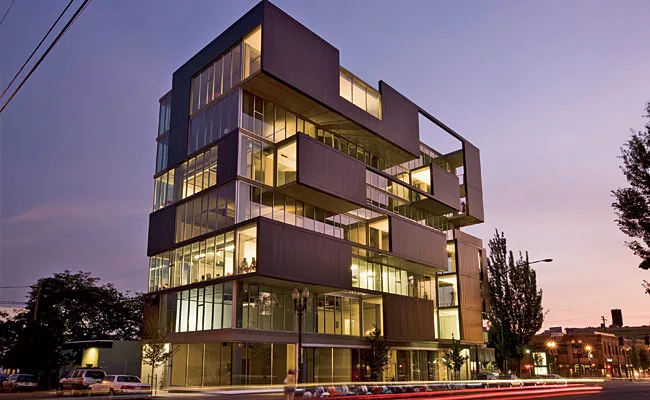
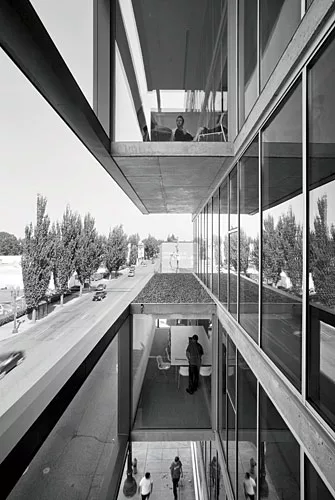
BSide6 is the first building W.PA designed from Scratch. The client was already working with another architect but asked the firm to look at the project's pro forma analysis. Strickland and Neburka noticed several ways the proposed building could be made more viable, and they won the job. For example, through the use of post-tensioned concrete slabs, offices could be column-free, and with shallower slabs, an extra floor could fit within the neighborhood's zoning height limits. The seven-story office/retail building is located in Portland's historic arcade district, created in the 1920s when East Burnside, a major street, was widened. Back then, the city claimed 12 feet of space for new sidewalks from building owners, forcing them to move storefronts behind the sidewalks but allowing upper stories of the buildings to remain as they were. It is still permissible for the upper floors of new buildings within this district to project into the public right-of-way. The architects took advantage of this to cantilever floors and balconies over the sidewalks in the arcade district tradition. The rest of the building is sheathed in metal panels and inexpensive storefront glazing.
Photo © Stephen A. Miller
BSide6 is the first building W.PA designed from Scratch. The client was already working with another architect but asked the firm to look at the project's pro forma analysis. Strickland and Neburka no
Bside6
Portland, Oregon
BSide6 is the first building W.PA designed from Scratch. The client was already working with another architect but asked the firm to look at the project's pro forma analysis. Strickland and Neburka noticed several ways the proposed building could be made more viable, and they won the job. For example, through the use of post-tensioned concrete slabs, offices could be column-free, and with shallower slabs, an extra floor could fit within the neighborhood's zoning height limits. The seven-story office/retail building is located in Portland's historic arcade district, created in the 1920s when East Burnside, a major street, was widened. Back then, the city claimed 12 feet of space for new sidewalks from building owners, forcing them to move storefronts behind the sidewalks but allowing upper stories of the buildings to remain as they were. It is still permissible for the upper floors of new buildings within this district to project into the public right-of-way. The architects took advantage of this to cantilever floors and balconies over the sidewalks in the arcade district tradition. The rest of the building is sheathed in metal panels and inexpensive storefront glazing.
Photo © Stephen A. Miller
The grow.pdx project is a community-oriented multifamily housing complex. W.PA conceived the 19-unit development as a starter-home alternative to Portland's typical high- and mid-rise condominiums. Th
Grow.pdx
Portland, Oregon
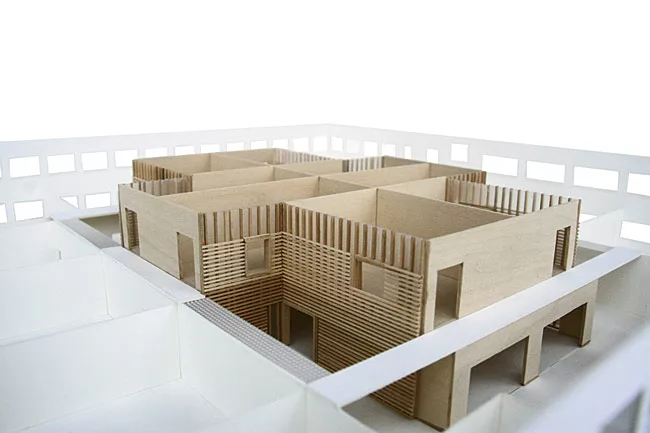
The grow.pdx project is a community-oriented multifamily housing complex. W.PA conceived the 19-unit development as a starter-home alternative to Portland's typical high- and mid-rise condominiums. The concept is to incorporate all the things that made suburban life popular in a modern, sustainable, urban community. The 850- to 1,100-square-foot units have been arranged around the site to take advantage of the views, and each has access to a shared central courtyard as well as a private exterior garden. The buildings were designed to be built out of metal shipping containers, but a special type was required, and these turned out to be costly and scarce. With many carpenters in the area out of work, it has turned out that conventional stick framing will be less expensive. The developer of the project is currently seeking funding.
Photo © Stephen A. Miller
The grow.pdx project is a community-oriented multifamily housing complex. W.PA conceived the 19-unit development as a starter-home alternative to Portland's typical high- and mid-rise condominiums. Th
Grow.pdx
Portland, Oregon
The grow.pdx project is a community-oriented multifamily housing complex. W.PA conceived the 19-unit development as a starter-home alternative to Portland's typical high- and mid-rise condominiums. The concept is to incorporate all the things that made suburban life popular in a modern, sustainable, urban community. The 850- to 1,100-square-foot units have been arranged around the site to take advantage of the views, and each has access to a shared central courtyard as well as a private exterior garden. The buildings were designed to be built out of metal shipping containers, but a special type was required, and these turned out to be costly and scarce. With many carpenters in the area out of work, it has turned out that conventional stick framing will be less expensive. The developer of the project is currently seeking funding.
Photo © Stephen A. Miller
The grow.pdx project is a community-oriented multifamily housing complex. W.PA conceived the 19-unit development as a starter-home alternative to Portland's typical high- and mid-rise condominiums. Th
Grow.pdx
Portland, Oregon
The grow.pdx project is a community-oriented multifamily housing complex. W.PA conceived the 19-unit development as a starter-home alternative to Portland's typical high- and mid-rise condominiums. The concept is to incorporate all the things that made suburban life popular in a modern, sustainable, urban community. The 850- to 1,100-square-foot units have been arranged around the site to take advantage of the views, and each has access to a shared central courtyard as well as a private exterior garden. The buildings were designed to be built out of metal shipping containers, but a special type was required, and these turned out to be costly and scarce. With many carpenters in the area out of work, it has turned out that conventional stick framing will be less expensive. The developer of the project is currently seeking funding.
Photo © Stephen A. Miller
The Olympic Mills Commerce Center began its life as a cereal mill located in Portland's Central Eastside Industrial District, a gritty area that has become a magnet for designers and tech startups. Pr
Olympic Mills Commerce Center (OMCC)
Portland, Oregon
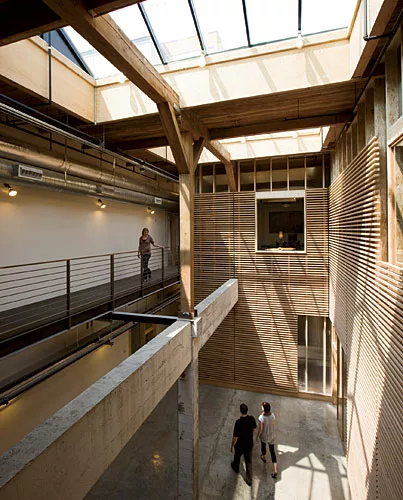
The Olympic Mills Commerce Center began its life as a cereal mill located in Portland's Central Eastside Industrial District, a gritty area that has become a magnet for designers and tech startups. Prior to W.PA's remodel, only a tiny amount of this 1920s-era building, whose two-story base covers an entire city block with an eight-story grain elevator rising at one end, was rentable. Although the building's heavy-timber-and-concrete-frame construction is dense by modern office standards (most of the building's columns are only 12 feet apart), none of the structural system could be removed. So W.PA could make only modest interventions. To open up the building's 200-by-200-foot first- and second-floor plates, the architects dropped in four two-story skylit atria without touching the structure. Although this meant the loss of some floor space, the offices that were created now have access to daylight through windows cut into the atrium shaft walls. These lightwells are lined with floor decking recycled from the building.
Photo © Stephen A. Miller
The Olympic Mills Commerce Center began its life as a cereal mill located in Portland's Central Eastside Industrial District, a gritty area that has become a magnet for designers and tech startups. Pr
Olympic Mills Commerce Center (OMCC)
Portland, Oregon
The Olympic Mills Commerce Center began its life as a cereal mill located in Portland's Central Eastside Industrial District, a gritty area that has become a magnet for designers and tech startups. Prior to W.PA's remodel, only a tiny amount of this 1920s-era building, whose two-story base covers an entire city block with an eight-story grain elevator rising at one end, was rentable. Although the building's heavy-timber-and-concrete-frame construction is dense by modern office standards (most of the building's columns are only 12 feet apart), none of the structural system could be removed. So W.PA could make only modest interventions. To open up the building's 200-by-200-foot first- and second-floor plates, the architects dropped in four two-story skylit atria without touching the structure. Although this meant the loss of some floor space, the offices that were created now have access to daylight through windows cut into the atrium shaft walls. These lightwells are lined with floor decking recycled from the building.
Photo © Stephen A. Miller
BSide6 is the first building W.PA designed from Scratch. The client was already working with another architect but asked the firm to look at the project's pro forma analysis. Strickland and Neburka no
The grow.pdx project is a community-oriented multifamily housing complex. W.PA conceived the 19-unit development as a starter-home alternative to Portland's typical high- and mid-rise condominiums. Th
The Olympic Mills Commerce Center began its life as a cereal mill located in Portland's Central Eastside Industrial District, a gritty area that has become a magnet for designers and tech startups. Pr
December 16, 2010

Portland, Oregon

William Neburka describes the founding of W.PA/Works Partnership Architecture, the firm he and Carrie Strickland started five years ago, as “kind of a shotgun marriage. Carrie and I didn’t really know each other when we started the office.” But a developer with a big project in his back pocket had been encouraging Strickland to start her own office so she could take it on, and when she expressed reluctance to go it alone, he introduced her to Neburka. The two aspiring firm owners got together over drinks to discuss the possibility of working together. Strickland adds that their first meeting was “totally like a first date,” with the two of them agreeing on two things, at least: They both wanted to start firms, and the firms they started would most assuredly be design-oriented. “The project was too enticing to pass up,” Neburka continues, and with a large project in hand, they set up shop.

To date the firm’s clientele have been developers in the commercial office and multi- and single-family housing markets. Taking advantage of the fact that Portland has intense competition for office tenants, meaning that developers must use design as a way to attract them, the duo have turned out bSIDE6 (opposite), their first ground-up building, along with the 172,000-square-foot Olympic Mills Commerce Center and several housing projects. To attract housing developers, they have invented manufacturing systems that allow some elements of these buildings to be economically prefabricated.

Developers are pragmatists at heart, far more interested in the bottom line than, say, the niceties of cornice detailing. Yet Strickland and Neburka agree that one key to their success in subtly pushing a design agenda is to use a rational approach to show how good design will help make projects more successful. “People were willing to take a chance on us even though we were new because we never sat down and said, ‘Oh, here is a conceptual idea. Isn’t it cool?’ ” says Strickland. “We were talking about building design in a way that they could understand it, even if the conversation we were having on our own was a little different.” Neburka adds, “We’re comfortable looking at things very, very objectively. Once you can evaluate ideas and criteria that way, versus ‘We like this so you should like it, and you shouldn’t like this,’ then it really gets down to how functional design is going to improve their prospects for surviving economically and making money. We find that they care about the same things we do, but for different reasons.”

They also agree that being in the City of Roses, whose population is only 580,000, helped too. Neburka says, “You feel like you’re part of the conversation as opposed to just witnessing the conversation. There is nobody you can’t get on the phone, and there’s no construction issue that we can’t solve by talking to someone. Elsewhere, people come to the office with preconceived notions of what they want. The first meeting is where they bring the magazines out. In five years no one has brought a magazine in here and said, ‘This is what we want.’ Here, people are more open to you.”

We might not expect a “shotgun marriage” to be a success, but Neburka says, “Our interests and our abilities are so complementary — it’s serendipity, I guess.” It is a good thing. Olympic Mills, the project the pair went into business to get, went on hold almost immediately after they opened their doors. The project came back eventually, but many young firms wouldn’t have survived the crash business-development effort that saved their fledgling business.

W.PA/Works Partnership Architecture

LOCATION: Portland, Oregon

FOUNDED: 2005

DESIGN STAFF: 10

PRINCIPALS: William Neburka, Carrie Strickland

EDUCATION: Neburka — Syracuse University, B.A., 1997. Strickland — University of Cincinnati, B.A., 1999

WORK HISTORY: Neburka — Opsis Architecture, 2003–05; Potestio Architect, 2002; Strand/Neburka.Architects, 1999–2002; Kiss + Zwigard Architects, 1996–99; Koetter Kim & Associates, 1989–91. Strickland — DiLoreto Architects, 2002–05; Hub and Weber Architecture, 2000–02; GBBN Architects, 1998–2000; Sienna Architecture Company, 1996–97; Pieper O’Brien Herr Architects, 1994

KEY COMPLETED PROJECTS: Prototype A Tract House, Ridgefield, Wash., 2010; Bunk Bar, Portland, Ore., 2010; tandemDUO, Portland, Ore., 2010; bSIDE6, Portland, Ore., 2009; Milepost5 Artist Housing, Portland, Ore., 2008; Olympic Mills Commerce Center, Portland, Ore., 2007; 3808 Williams – The Hub, Portland, Ore., 2006

KEY CURRENT PROJECTS: Convention Plaza, Portland, Ore., 2011; grow.PDX, Portland, Ore., 2011; Theatre 300b, Portland, Ore., 2012; Workforce Housing, Portland, Ore., 2012

WEB SITE: www.worksarchitecture.net


Share This Story

Looking for a reprint of this article?
From high-res PDFs to custom plaques, order your copy today!
Charles Linn is a Kansas City–based writer and architect and a former deputy editor of Architectural Record.

Post a comment to this article

Report Abusive Comment

Subscription Center
  • Create an Account
  • Start a Subscription
  • Manage My Account
  • Sign Up for Newsletters
  • Visit Customer Service
  • Update Preferences

More Videos

Sponsored Content

Sponsored Content is a special paid section where industry companies provide high quality, objective, non-commercial content around topics of interest to the Architectural Record audience. All Sponsored Content is supplied by the advertising company and any opinions expressed in this article are those of the author and not necessarily reflect the views of Architectural Record or its parent company, BNP Media. Interested in participating in our Sponsored Content section? Contact your local rep!

close
  • cold storage facility
    Sponsored byCarlisle SynTec Systems

    How Architects Can Design More Continuous Cold Storage Envelopes

  • TAMLYN XtremeTrim Exterior Trim
    Sponsored byTamlyn

    Designing Cleaner Panel Facades: Why Exterior Trim Details Matter

  • Building with Vapor Barriers
    Sponsored byReef Industries, Inc.

    Vapor Barriers Help Control Moisture in Tighter Building Designs

DESIGN:ED Podcast
Listen to Architectural Record’s DESIGN:ED Podcast

Events

June 23, 2026

Enhancing Fire Resistance with Advanced PVC Solutions

Credits: 1 AIA LU/HSW; 1 AIBD P-CE; 0.1 ICC CEU; 1 IIBEC CEH

Evaluate advanced PVC solutions that improve fire resistance, support WUI compliance, and enhance resilience in residential and commercial building design.

June 25, 2026

Designing Glass Railing Systems that Enhance Aesthetics and Meet Code

Credits: 1 AIA LU/HSW; 1 AIBD P-CE; 0.1 ICC CEU

Upon course completion, participants will possess a deeper understanding of glass railings to help ensure that safety, aesthetic, and performance objectives are achieved.

View All Submit An Event

Products

2026 Architect's Square Foot Costbook

2026 Architect's Square Foot Costbook

See More Products

Popular Stories

SanDiegoAirport

Top 300 Architecture Firms of 2026

Lorcan O' Herilhy

California Architect Lorcan O’Herlihy Has Died, Age 66

CCA, Studio Gang

The Winners of the AIA’s 2026 Architecture Award Range from Collegiate Rowing Hubs to Housing for the Homeless

Spoonbill Ranch

Johnsen Schmaling Architects Integrates Spoonbill Ranch into a Pristine Landscape

Dusk House

Design Vanguard 2026: ONO

Enhancing Fire Resistance with Advanced PVC Solutions - Free Webinar - June 23, 2026

Related Articles

  • Sag Harbor Church.

    The Church by Lee H. Skolnick Architecture + Design Partnership

    See More
  • New York Library

    A Library by Skolnick Architecture + Design Partnership Features Colorful Wayfinding

    See More
  • How Architecture Works: A Humanist's Toolkit

    See More

Related Products

See More Products
  • ribbonarch.jpg

    Ribbon Architecture: Light, Shadow, and Reflection in Architecture

See More Products
×

The latest news and information

#1 Source for Architectural Design, News and Products

SUBSCRIBE
  • RESOURCES
    • Advertise
    • Contact Us
    • Submit
    • Store
  • ACCOUNT CENTER
    • Create an Account
    • Start a Subscription
    • Manage My Account
    • Sign Up for Newsletters
    • Visit Customer Service
    • Update Preferences
  • PRIVACY
    • PRIVACY POLICY
    • TERMS & CONDITIONS
    • DO NOT SELL MY PERSONAL INFORMATION
    • PRIVACY REQUEST
    • ACCESSIBILITY
  • SERVICES
    • Marketing Services
    • Reprints
    • Market Research
    • List Rental
    • Survey/Respondent Access
  • STAY CONNECTED
    • Linkedin
    • Facebook
    • Instagram
    • YouTube
    • X (Twitter)

Copyright ©2026. All Rights Reserved BNP Media, Inc. and BNP Media II, LLC.

Design, CMS, Hosting & Web Development :: ePublishing