Architectural Record
search
cart
facebook twitter linkedin youtube
  • Sign In
  • Subscribe
  • Sign Out
  • My Account
Architectural Record
  • NEWS
    • Latest News
    • Awards
    • Interviews
    • Obituaries
    • Podcasts
      • Design:Ed Podcast
      • Sponsored Podcasts
  • OPINION
    • Book Reviews / Excerpts
    • Exhibition Reviews
    • Forum
  • EXCLUSIVES
    • Videos
    • Design Vanguard
    • Top 300 Firms
    • Sponsored Content
    • Sponsored eBooks
    • From the Archives
  • CONTINUING ED
    • Editorial Continuing Ed
    • CE Center
    • CE Academies
  • PROJECTS
    • Buildings By Type
    • Reuse & Renovation
    • Museums & Arts Centers
    • Colleges & Universities
    • Multifamily Housing
    • Interiors
    • Lighting
    • Kitchen & Bath
  • HOUSES
    • Record Houses
    • House of the Month
    • Featured Houses
  • PRODUCTS
    • Products by Category
    • Record Products of the Year
    • Latest Products
  • EVENTS
    • Dates & Events
    • Record on the Road
    • Innovation Conference
    • Sustainability in Practice
    • Women In Architecture
    • Webinars
    • Ad Excellence Awards
    • Submit an Event
  • CONNECT
    • Ask RECORD AI
    • Newsletters
    • Contact
    • Advertise
    • Editorial Calendar
    • Store
    • Customer Service
  • SUBMIT
    • Submission Guidelines
    • RECORD Competitions
  • MAGAZINE
    • Subscribe
    • My Account
    • Digital Edition
    • Current Issue
    • Firm Pass
    • Historic Archive
Design Vanguard

Arquitecturia

After winning a number of design competitions, a young firm develops a body of work that responds to its rugged but rich context.
By James S. Russell, FAIA Emeritus
Arquitecturia
Cultural Center
Barcelona, Spain
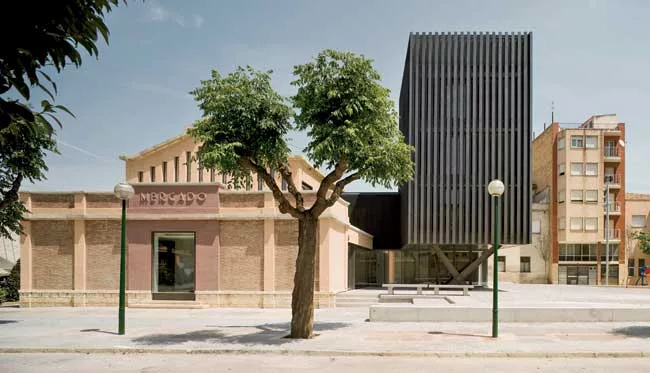
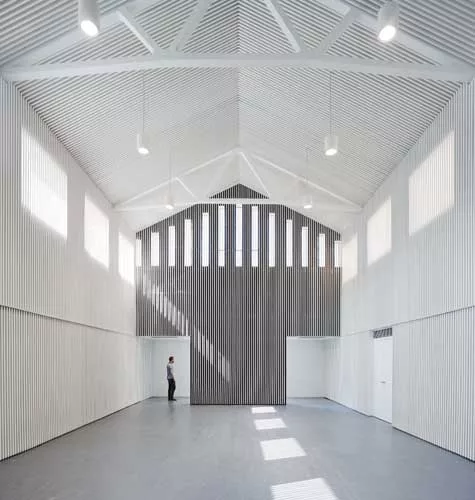
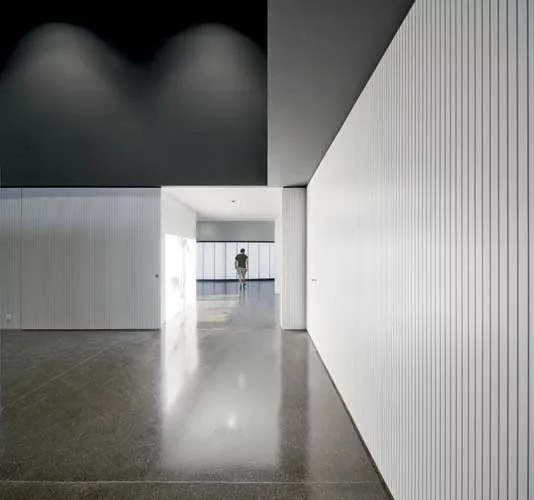
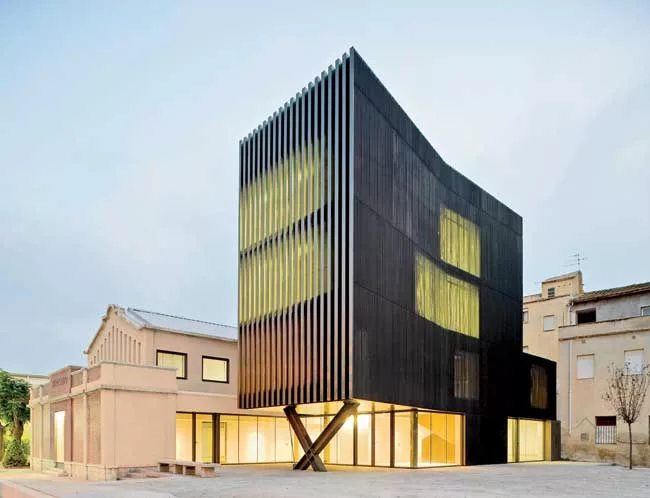
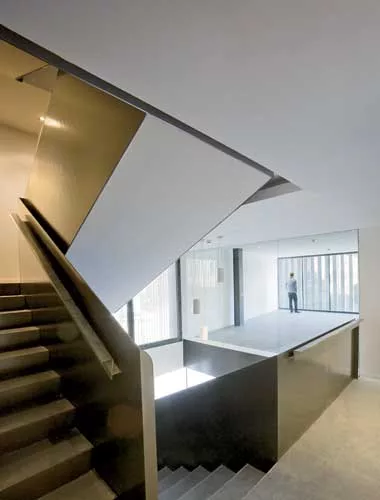
Felip and Camps contrasted the horizontal, navelike form of a restored market building in Tortosa with a vertical addition on angled pylons. The addition gently pulls away to form an entrance court and glass lobby, while the pylons evoke a dancer's pose. A rainscreen of perforated-metal fins contrasts with the sand-colored market, but the addition matches the prevailing cornice line of older buildings. Inside, white-painted wood fins line a space for exhibitions, talks, and musical events while concealing sound-absorbing material.
 
Photo © Pedro Pegenaute
Arquitecturia
Cultural Center
Barcelona, Spain
Felip and Camps contrasted the horizontal, navelike form of a restored market building in Tortosa with a vertical addition on angled pylons. The addition gently pulls away to form an entrance court and glass lobby, while the pylons evoke a dancer's pose. A rainscreen of perforated-metal fins contrasts with the sand-colored market, but the addition matches the prevailing cornice line of older buildings. Inside, white-painted wood fins line a space for exhibitions, talks, and musical events while concealing sound-absorbing material.
 
Photo © Pedro Pegenaute
Arquitecturia
Cultural Center
Barcelona, Spain
Felip and Camps contrasted the horizontal, navelike form of a restored market building in Tortosa with a vertical addition on angled pylons. The addition gently pulls away to form an entrance court and glass lobby, while the pylons evoke a dancer's pose. A rainscreen of perforated-metal fins contrasts with the sand-colored market, but the addition matches the prevailing cornice line of older buildings. Inside, white-painted wood fins line a space for exhibitions, talks, and musical events while concealing sound-absorbing material.
 
Photo © Pedro Pegenaute
Arquitecturia
Cultural Center
Barcelona, Spain
Felip and Camps contrasted the horizontal, navelike form of a restored market building in Tortosa with a vertical addition on angled pylons. The addition gently pulls away to form an entrance court and glass lobby, while the pylons evoke a dancer's pose. A rainscreen of perforated-metal fins contrasts with the sand-colored market, but the addition matches the prevailing cornice line of older buildings. Inside, white-painted wood fins line a space for exhibitions, talks, and musical events while concealing sound-absorbing material.
 
Photo © Pedro Pegenaute
Arquitecturia
Visitor Center and Museum of Energy
Barcelona, Spain
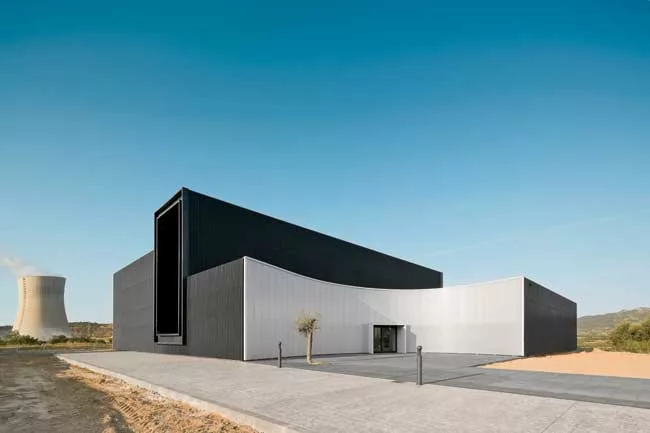
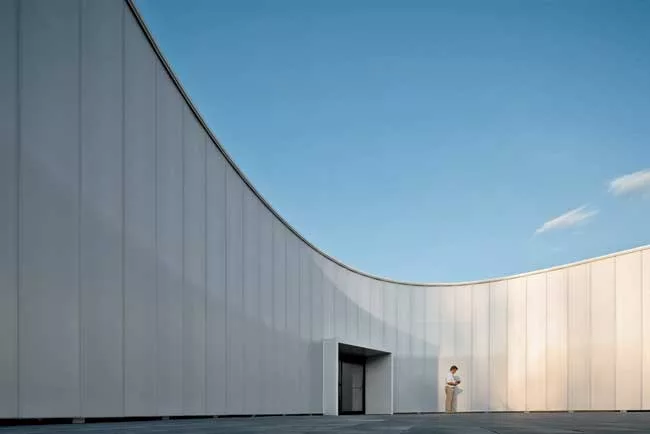
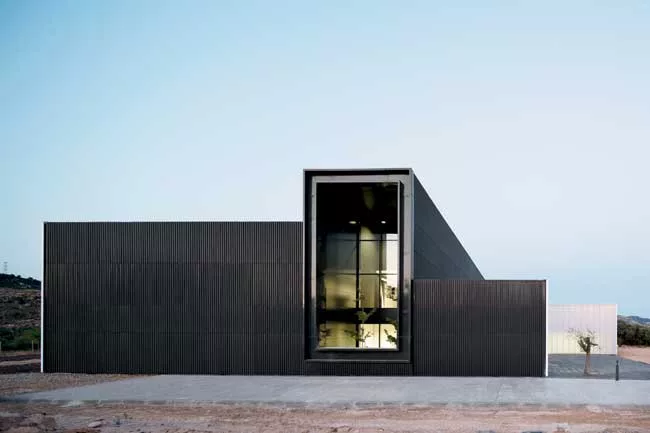
The architects scooped sensuously curved courtyards out of a prismatic, dark-steel volume that houses a visitor center in Asc' for a power plant operated by ANAV, Spain's nuclear power utility. A high-windowed central volume for stairways and services divides the plan into two basic areas. A reception space, which can be divided into smaller rooms, opens from a tightly curved entry court on one side of the building. On the other side, the broad curved wall of an exhibition space frames views of the power plant through a second, external courtyard.
 
Photo © Pedro Pegenaute
Arquitecturia
Visitor Center and Museum of Energy
Barcelona, Spain
The architects scooped sensuously curved courtyards out of a prismatic, dark-steel volume that houses a visitor center in Asc' for a power plant operated by ANAV, Spain's nuclear power utility. A high-windowed central volume for stairways and services divides the plan into two basic areas. A reception space, which can be divided into smaller rooms, opens from a tightly curved entry court on one side of the building. On the other side, the broad curved wall of an exhibition space frames views of the power plant through a second, external courtyard.
 
Photo © Pedro Pegenaute
Arquitecturia
Visitor Center and Museum of Energy
Barcelona, Spain
The architects scooped sensuously curved courtyards out of a prismatic, dark-steel volume that houses a visitor center in Asc' for a power plant operated by ANAV, Spain's nuclear power utility. A high-windowed central volume for stairways and services divides the plan into two basic areas. A reception space, which can be divided into smaller rooms, opens from a tightly curved entry court on one side of the building. On the other side, the broad curved wall of an exhibition space frames views of the power plant through a second, external courtyard.
 
Photo © Pedro Pegenaute
Arquitecturia
Visitor Center and Museum of Energy
Barcelona, Spain
The architects scooped sensuously curved courtyards out of a prismatic, dark-steel volume that houses a visitor center in Asc' for a power plant operated by ANAV, Spain's nuclear power utility. A high-windowed central volume for stairways and services divides the plan into two basic areas. A reception space, which can be divided into smaller rooms, opens from a tightly curved entry court on one side of the building. On the other side, the broad curved wall of an exhibition space frames views of the power plant through a second, external courtyard.
 
Photo © Pedro Pegenaute
Arquitecturia
Law Court
Barcelona, Spain
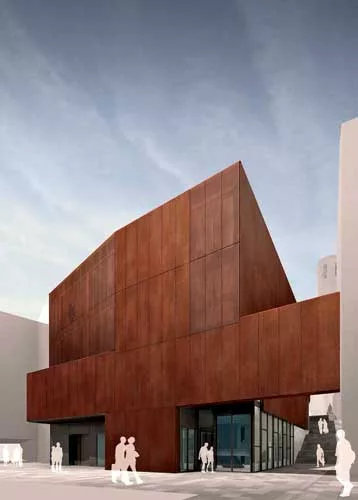
The site for this project demanded that the building squeeze tightly within the narrow medieval streets of Balaguer. 'Two meters away from where judges would be working an old lady might be cooking,' explains Felip. Perforated weathering-steel panels wrap the building, bending to follow the street walls while veiling the rectangular glass and metal volume within. Depending on the light and point of view, people walking by can see through the metal scrim to the main stair that ascends within the residual space between the wall layers. The project is under construction and scheduled to be completed in 2012.
 
Photo © Pedro Pegenaute
Arquitecturia
Law Court
Barcelona, Spain
The site for this project demanded that the building squeeze tightly within the narrow medieval streets of Balaguer. 'Two meters away from where judges would be working an old lady might be cooking,' explains Felip. Perforated weathering-steel panels wrap the building, bending to follow the street walls while veiling the rectangular glass and metal volume within. Depending on the light and point of view, people walking by can see through the metal scrim to the main stair that ascends within the residual space between the wall layers. The project is under construction and scheduled to be completed in 2012.
 
Photo © Pedro Pegenaute
Arquitecturia
Arquitecturia
Arquitecturia
Arquitecturia
Arquitecturia
Arquitecturia
Arquitecturia
Arquitecturia
Arquitecturia
Arquitecturia
December 16, 2011

Barcelona, Spain

A cluster of windblown branches sprouts from a tree stump in front of a museum in Ascó, Spain. The tree is sufficiently battered that I wonder why architects Olga Felip and Josep Camps kept it. “Our landscape doesn’t have a lot of character. But it does have lots of history,” said Felip. That little tree looks like it has seen plenty.

Felip, 30, and Camps, 36, are the two partners of Arquitecturia, a nine-person firm in Barcelona, Spain, which won a competition to design the Balaguer Law Court just five months after it started in 2006. The partners, who are married to each other, look for cues in the landscape or locale to imbue ordinary building programs with a haunting power. Both hail from Catalonia, a semi-autonomous region within Spain that retains its own language and culture. Asked if their Catalan status gives them a unique outlook on architecture, Felip answers, “Absolutely. We studied at the Barcelona School of Architecture and had very strong leaders in Carlos Ferrater and Elias Torres. They have what I consider a Catalan way of doing architecture—in how they consider the site, understanding all of its historic layers and trying to feel the context.”

Their ascetic minimalism seems ubiquitous among young Spanish firms, in Catalonia and elsewhere. Their powerful, geometric forms respond in a dignified way to the centuries-old towns they’ve worked in. When working with historic structures or contexts, she says, “We try to bring a new view, but emphasize the most important original elements to reveal their power.” History figured deeply in the design of a tiny plaza that wraps the outside of a Gothic church’s apse in Tortos, following the site’s original contours and evoking the town’s ancient roots. Similarly, the partners stripped down a public market building in Tortosa to convert it to a cultural center. The challenge, says Felip, is to figure out what to keep and what to remove.

The museum in Ascó, which acts as a visitor center for a nuclear power plant, reveals another key source of expression: The way site characteristics can—and often should—distort an ideal resolution of the building program. For this project, the partners started with a neatly gridded plan, then cut out a pair of sweeping curves to open distant views rather than focus on a characterless foreground.

Architecturia’s simple geometric forms and limited range of materials work well for tight public-building budgets. In a pair of future projects (for a school and a public library), overlapping and colliding forms create broad overhangs and intimate courtyards, strategies that suit places where sun is relentless and shade is welcome. Felip and Camps bring a brooding yet compelling monumentality even to small projects in small towns, intensifying the effect with tough materials like steel fins and concrete and bold contrasts of color and texture. The two partners’ accomplishments so far suggest that they will succeed in scaling up their approach as they mature.

Arquitecturia

LOCATION: Barcelona

FOUNDED: 2006

DESIGN STAFF: 9

PRINCIPALS: Josep Camps and Olga Felip Ordis

EDUCATION: Camps – Universitat Politècnica de Catalunya, Diploma of Advanced Studies, 2004, and B.Arch., 2000. Felip – Universitat Politècnica de Catalunya, Diploma of Advanced Studies, 2009, and B.Arch., 2005

WORK HISTORY: Hurme – Cohlmeyer Architects Limited, 2002–07; Office of Architecture, City of Helsinki, 2000. Radulovic – Cohlmeyer Architects Limited, 1996–2007

KEY COMPLETED PROJECTS: Visitor Center and Museum of Energy, Ascó, 2011; Cultural Center, Tortosa, 2010; Apse Square, Tortosa, 2009

KEY CURRENT PROJECTS: Health Center, Aldea, 2011; House, Caldes de Malavella, 2012; Law Court, Balaguer, 2012, Peace Center, Ascó, 2012; Public Library, Caldes de Malavella, 2013

WEB SITE: WWW.ARQUITECTURIA.NET


Share This Story

Looking for a reprint of this article?
From high-res PDFs to custom plaques, order your copy today!

James S. Russell, FAIA Emeritus, a journalist who often focuses on sustainability and resilience, is the author of­­­­­ ­­­The Agile City: Building Well Being and Wealth in an Era of Climate Change (Island Press, 2011).

Post a comment to this article

Report Abusive Comment

Subscription Center
  • Create an Account
  • Start a Subscription
  • Manage My Account
  • Sign Up for Newsletters
  • Visit Customer Service
  • Update Preferences

More Videos

Sponsored Content

Sponsored Content is a special paid section where industry companies provide high quality, objective, non-commercial content around topics of interest to the Architectural Record audience. All Sponsored Content is supplied by the advertising company and any opinions expressed in this article are those of the author and not necessarily reflect the views of Architectural Record or its parent company, BNP Media. Interested in participating in our Sponsored Content section? Contact your local rep!

close
  • cold storage facility
    Sponsored byCarlisle SynTec Systems

    How Architects Can Design More Continuous Cold Storage Envelopes

  • TAMLYN XtremeTrim Exterior Trim
    Sponsored byTamlyn

    Designing Cleaner Panel Facades: Why Exterior Trim Details Matter

  • Building with Vapor Barriers
    Sponsored byReef Industries, Inc.

    Vapor Barriers Help Control Moisture in Tighter Building Designs

DESIGN:ED Podcast
Listen to Architectural Record’s DESIGN:ED Podcast

Events

June 18, 2026

Rebooting the Aging Office Building

Credits: 1 AIA LU/HSW; 1 AIBD P-CE; 0.1 ICC CEU; 1 PDH

Explore façade retrofit strategies and award-winning design concepts that can transform aging office buildings into healthier, higher-performing workplaces for today’s hybrid workforce.

June 23, 2026

Enhancing Fire Resistance with Advanced PVC Solutions

Credits: 1 AIA LU/HSW; 1 AIBD P-CE; 0.1 ICC CEU; 1 IIBEC CEH

Evaluate advanced PVC solutions that improve fire resistance, support WUI compliance, and enhance resilience in residential and commercial building design.

View All Submit An Event

Products

2026 Architect's Square Foot Costbook

2026 Architect's Square Foot Costbook

See More Products

Popular Stories

SanDiegoAirport

Top 300 Architecture Firms of 2026

Lorcan O' Herilhy

California Architect Lorcan O’Herlihy Has Died, Age 66

Coronado Bridge

The Architect’s Guide to San Diego

CCA, Studio Gang

The Winners of the AIA’s 2026 Architecture Award Range from Collegiate Rowing Hubs to Housing for the Homeless

Dusk House

Design Vanguard 2026: ONO

Rebooting the Aging Office Building - Free Webinar - June 18, 2026

Related Articles

  • Book Tower

    Continuing Education: Office Conversions

    See More
  • Penn 1

    A+I and Lighting Workshop Rejuvanate the Lobby of Penn 1

    See More
  • Geffen-Hall-1.jpg

    A Friendlier, More Intimate David Geffen Hall Makes its New York Debut

    See More
×

The latest news and information

#1 Source for Architectural Design, News and Products

SUBSCRIBE
  • RESOURCES
    • Advertise
    • Contact Us
    • Submit
    • Store
  • ACCOUNT CENTER
    • Create an Account
    • Start a Subscription
    • Manage My Account
    • Sign Up for Newsletters
    • Visit Customer Service
    • Update Preferences
  • PRIVACY
    • PRIVACY POLICY
    • TERMS & CONDITIONS
    • DO NOT SELL MY PERSONAL INFORMATION
    • PRIVACY REQUEST
    • ACCESSIBILITY
  • SERVICES
    • Marketing Services
    • Reprints
    • Market Research
    • List Rental
    • Survey/Respondent Access
  • STAY CONNECTED
    • Linkedin
    • Facebook
    • Instagram
    • YouTube
    • X (Twitter)

Copyright ©2026. All Rights Reserved BNP Media, Inc. and BNP Media II, LLC.

Design, CMS, Hosting & Web Development :: ePublishing