Architectural Record
search
cart
facebook twitter linkedin youtube
  • Sign In
  • Subscribe
  • Sign Out
  • My Account
Architectural Record
  • NEWS
    • Latest News
    • Awards
    • Interviews
    • Obituaries
    • Podcasts
      • Design:Ed Podcast
      • Sponsored Podcasts
  • OPINION
    • Book Reviews / Excerpts
    • Exhibition Reviews
    • Forum
  • EXCLUSIVES
    • Videos
    • Design Vanguard
    • Top 300 Firms
    • Sponsored Content
    • Sponsored eBooks
    • From the Archives
  • CONTINUING ED
    • Editorial Continuing Ed
    • CE Center
    • CE Academies
  • PROJECTS
    • Buildings By Type
    • Reuse & Renovation
    • Museums & Arts Centers
    • Colleges & Universities
    • Multifamily Housing
    • Interiors
    • Lighting
    • Kitchen & Bath
  • HOUSES
    • Record Houses
    • House of the Month
    • Featured Houses
  • PRODUCTS
    • Products by Category
    • Record Products of the Year
    • Latest Products
  • EVENTS
    • Dates & Events
    • Record on the Road
    • Innovation Conference
    • Sustainability in Practice
    • Women In Architecture
    • Webinars
    • Ad Excellence Awards
    • Submit an Event
  • CONNECT
    • Ask RECORD AI
    • Newsletters
    • Contact
    • Advertise
    • Editorial Calendar
    • Store
    • Customer Service
  • SUBMIT
    • Submission Guidelines
    • RECORD Competitions
  • MAGAZINE
    • Subscribe
    • My Account
    • Digital Edition
    • Current Issue
    • Firm Pass
    • Historic Archive

Lions Park Playscape by Rural Studio

Greensboro, Alabama
By Joann Gonchar, FAIA
Lions Park Playscape
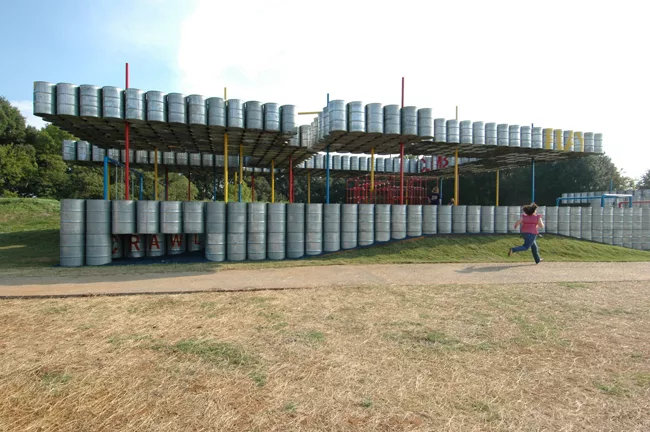
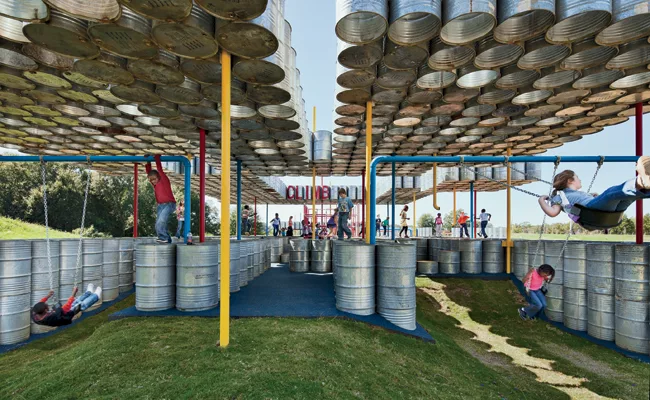
For the playscape at the Lions Park in Greensboro, Alabama, students from Auburn University's Rural Studio created a mazelike environment on the ground and a canopy overhead of steel drums.
 
Photo courtesy Auburn University Rural Studio
Lions Park Playscape
The playscape includes sound tubes made of the same steel that supports the canopy.
 
Photo courtesy Auburn University Rural Studio
Lions Park Playscape
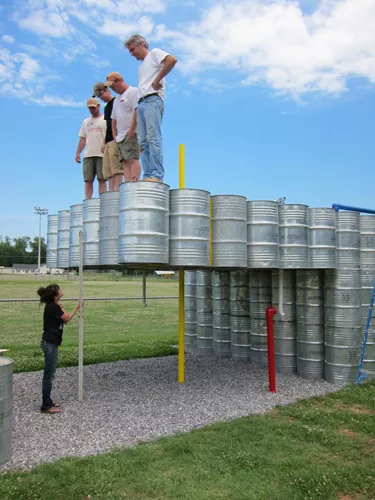
The students built mockups of the playscape before constructing the final version.
 
Photo courtesy Auburn University Rural Studio
Lions Park Playscape
The Rural Studio students sculpted the land around the playscape to create small hills and mounds.
 
Photo courtesy Auburn University Rural Studio
Lions Park Playscape
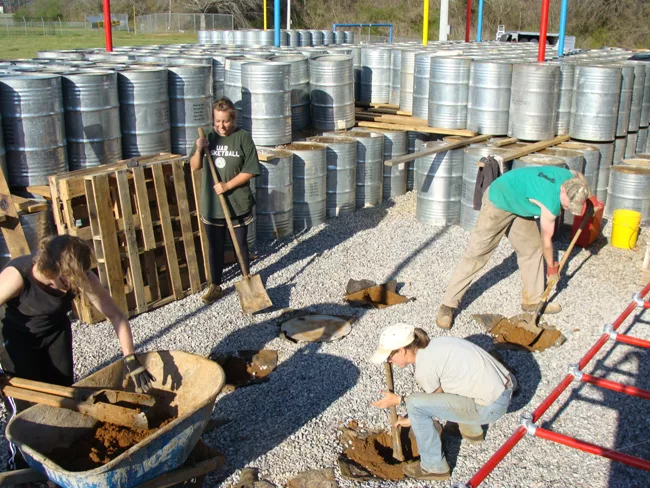
Building the playscape involved earthwork, installation of geotextile fabric, and the spreading and tamping of gravel.
 
Photo courtesy Auburn University Rural Studio
Lions Park Playscape
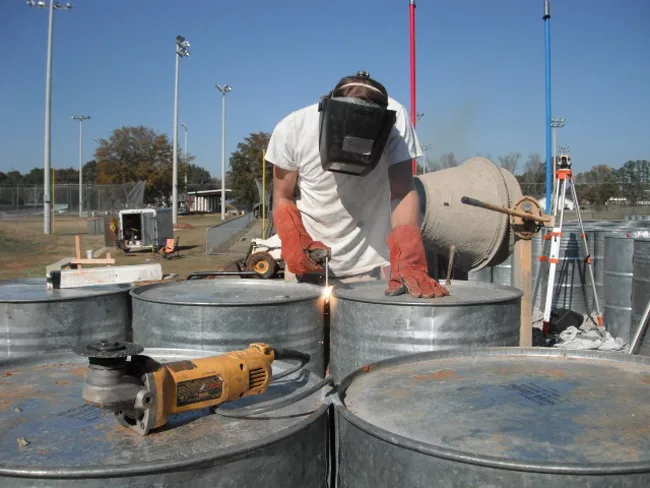
Each steel drum is welded to adjacent drums in eight places.
 
Photo courtesy Auburn University Rural Studio
Lions Park Playscape
Image courtesy Auburn University Rural Studio
Lions Park Playscape
March 16, 2012

Architects & Firms

Rural Studio

'Individually they are ugly. But in agglomeration they are beautiful,' says Andrew Freear, director of Auburn University's Rural Studio. Freear is referring to the galvanized steel drums making up the design-build studio's latest intervention at Lions Park in Greensboro, Alabama.

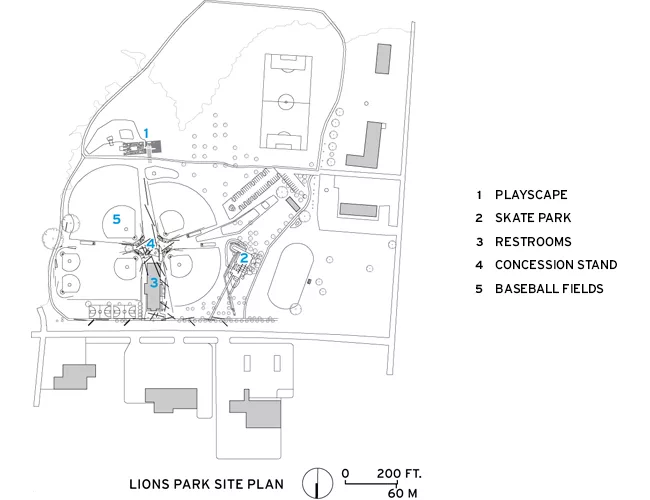
Completed in September, the 'playscape,' which replaces a much-vandalized playground, is the fifth element designed and constructed at Lions Park by Rural Studio students. Since 2007, successive thesis classes have built baseball fields, bathrooms, a skate park, and a concession stand in the 40-acre park.

With this most recent piece, the students hoped to create an environment that would foster children's sense of imagination. 'Traditional playgrounds don't encourage make-believe,' says Cameron Acheson, a current Rural Studio staffer and a member of the thesis class that designed and built the playscape. Acheson, along with fellow students Bill Batey, Courtney Mathias, and Jamie Sartory, clustered almost 2,000 of the donated 55-gallon drums'originally used to transport mint oil'in a mazelike arrangement. Kids can hop from the top of one drum to the other and run in between them.

In order to shade the playscape, Chicago-based structural engineer Joe Farruggia helped the students develop a canopy constructed of the drums. With the exception of those that surround vertical tube-steel supports (where extra rigidity was required), the top and bottom of each container have been removed, so that children can see the sky and watch the clouds sweep by. Each cylinder is welded to those adjacent to it in eight places, creating an assemblage that performs structurally like a truss, explains Freear.

Although the studio subcontracted the installation of rubber safety surfacing, the students performed almost all of the remaining work themselves. For each of the cylinders comprising the maze, for example, the students leveled the earthwork, installed geotextile fabric, and spread and tamped gravel. They then placed and leveled each drum, welding it to its neighbors, before starting the process again. It was tedious and backbreaking work, but rewarding, says Acheson. Construction 'was both the best and the most difficult part.'

DESIGNERS: Auburn University Rural Studio

BUDGET: N/A

CONTEXT: The playscape replaces an inhospitable playground at a park jointly owned by the City of Greensboro, Hale County, and the local Lions Club.

People

Client: Lions Park Committee

Design Team: Auburn University Rural Studio*

Structural: GFGR Architects and Engineers*

Landscape: Xavier Vendrell Studio*

Environmental consultant: Atelier Ten*

Architecture: Wheeler Kearns Architects*


Products

55-gallon galvanized barrels: IP Callison*

Steel: Turnipseed International*, Dogan Steel (discounted)

Surfacing: Shaw (partially donated by Strategic
Alliance for Health)

Weathered steel: Dogan Steel (discounted)

*Individual or company donated fully or in part their materials and/or services.


Looking for quick answers on architecture and design topics?
Try Ask RECORD, our new smart AI search tool.
Ask RECORD →

KEYWORDS: Alabama architecture education

Share This Story

Looking for a reprint of this article?
From high-res PDFs to custom plaques, order your copy today!

Joann gonchar

Joann Gonchar, FAIA, LEED AP, is deputy editor at Architectural Record. She joined RECORD in 2006, after working for eight years at its sister publication, Engineering News-Record. Before starting her career as a journalist, Joann worked for several architecture firms and spent three years in Kobe, Japan, with the firm Team Zoo, Atelier Iruka. She earned a Master of Architecture degree from the University of Pennsylvania and a Bachelor of Arts from Brown University. She is licensed to practice architecture in New York State.

Post a comment to this article

Report Abusive Comment

Subscription Center
  • Create an Account
  • Start a Subscription
  • Manage My Account
  • Sign Up for Newsletters
  • Visit Customer Service
  • Update Preferences

More Videos

Sponsored Content

Sponsored Content is a special paid section where industry companies provide high quality, objective, non-commercial content around topics of interest to the Architectural Record audience. All Sponsored Content is supplied by the advertising company and any opinions expressed in this article are those of the author and not necessarily reflect the views of Architectural Record or its parent company, BNP Media. Interested in participating in our Sponsored Content section? Contact your local rep!

close
  • TAMLYN XtremeTrim Exterior Trim
    Sponsored byTamlyn

    Designing Cleaner Panel Facades: Why Exterior Trim Details Matter

  • Building with Vapor Barriers
    Sponsored byReef Industries, Inc.

    Vapor Barriers Help Control Moisture in Tighter Building Designs

  • Duct Interior with Prodeq System
    Sponsored byHenry, a Carlisle Company

    Designing Resilient Water Containment Systems

DESIGN:ED Podcast
Listen to Architectural Record’s DESIGN:ED Podcast

Events

June 10, 2026

Rethinking Stormwater – The Power of Porous Paving

Credits: 1 AIA LU/HSW; 1 AIBD P-CE; 0.1 ICC CEU

Learn how porous paving systems support stormwater management, reduce heat island effects, and enhance sustainable site design performance.

June 11, 2026

Very Early Warning Fire Detection for Mission-Critical Facilities

Credits: 1 AIA LU/HSW; 1 AIBD P-CE; 0.1 ICC CEU

Examine advanced fire detection strategies that support uptime and enhance safety in data centers and other mission-critical facilities.

View All Submit An Event

Products

2026 Architect's Square Foot Costbook

2026 Architect's Square Foot Costbook

See More Products

Popular Stories

Coronado Bridge

The Architect’s Guide to San Diego

Practice Matters illustration

What’s in a (Firm’s) Name? Thinking About Succession and Legacy

Practice Matters illustration

By the Numbers: Counting America's Architects

Inward House

Inward House by VeeV Design Studio

Riverdale House by Studio Lau

Riverdale House by Studio Lau

Broader Sustainability of CMU - Free Webinar - May 21, 2026

Related Articles

  • Lions Park Scout Hut

    Lions Park Scout Hut by Rural Studio

    See More
  • County Fare

    Four Food-Related Projects by Rural Studio

    See More
  • Newbern Library

    Newbern Library by Rural Studio

    See More
×

The latest news and information

#1 Source for Architectural Design, News and Products

SUBSCRIBE
  • RESOURCES
    • Advertise
    • Contact Us
    • Submit
    • Store
  • ACCOUNT CENTER
    • Create an Account
    • Start a Subscription
    • Manage My Account
    • Sign Up for Newsletters
    • Visit Customer Service
    • Update Preferences
  • PRIVACY
    • PRIVACY POLICY
    • TERMS & CONDITIONS
    • DO NOT SELL MY PERSONAL INFORMATION
    • PRIVACY REQUEST
    • ACCESSIBILITY
  • SERVICES
    • Marketing Services
    • Reprints
    • Market Research
    • List Rental
    • Survey/Respondent Access
  • STAY CONNECTED
    • Linkedin
    • Facebook
    • Instagram
    • YouTube
    • X (Twitter)

Copyright ©2026. All Rights Reserved BNP Media, Inc. and BNP Media II, LLC.

Design, CMS, Hosting & Web Development :: ePublishing