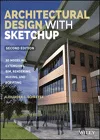
The ArchRecord Interview: SOM's Carl Galioto and Paul Seletsky on BIM

A night view of the “Analemma” at the Koch Center for Science, Math & Technology at Deerfield Academy. SOM used BIM software to arrive at the form that allows a narrow beam of light to pass through onto a 30-foot wall, creating a figure-eight pattern throughout the year.
Photo courtesy Florian Holzherr
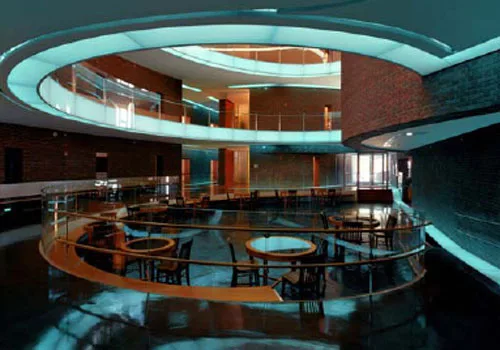
An interior view of the Koch Center for Science, Math & Technology at Deerfield Academy. SOM used BIM software on the project.
Photo courtesy Robert Polidori
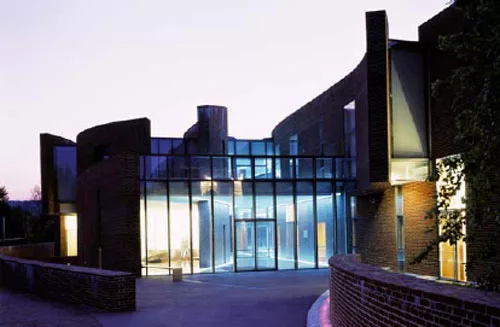
The entrance to the Koch Center for Science, Math & Technology at Deerfield Academy. SOM used BIM software on the project.
Photo courtesy Florian Holzherr
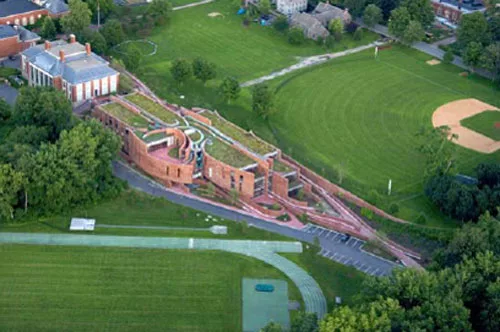
An aerial view of the Koch Center for Science, Math & Technology at Deerfield Academy. SOM used BIM software on the project.
Photo courtesy Aerial Photos of New Jersey

Carl Galioto, partner-in-charge of SOM’s New York Technical Group.
Photo courtesy Bruce Byers

Paul Seletsky, SOM’s director of digital design.
Photo courtesy SOM
Carl Galioto: I have one word for where I believe all the software falls short: interoperability. One can always find the software that can deal with curvilinear forms best, or that deals with interference checking best, or daylighting. The issue right now is that there isn’t one software that can do all of these things. And consequently, we need the various applications to talk to each other and to move data from one to the other in a seamless, interoperable manner. We also need for these applications to accept data. That is absolutely at the top of the list: to cut down on the frustration and for the applications to work together in a harmonious environment.

What is going to drive interoperability? Large firms banding together? The AIA? What’s going to have to happen to achieve interoperability?
CG: I believe that the marketplace will drive it, and the marketplace which drives it is the clients. The clients will drive this. Whether it’s the GSA, whether it’s other government agencies, they will drive interoperability. Simply to wave one’s hands and say all applications must be interoperable is not a realistic criteria. But to specifically look at the need for interoperability and to what’s the nature of interoperability and the purpose of the data, then that will enable architects, engineers, and the software developers to begin to further develop the interoperability among these applications to meet the clients’ needs.
Speaking of owners, how can BIM change the financial relationship, for better or worse, between architects and their clients?
CG: In my opinion, it is necessary for architects and engineers to demonstrate that the contributions we’re making in this design process is bringing greater value to our clients. If we demonstrate that we bring enhanced value, we’re entitled to greater compensation. Now, hopefully, that’s the outcome. I’m an optimist. If we can demonstrate there is an improved quality of the design, if it is demonstrated the designs are more cost effective and that, in fact, construction durations are reduced by this greater efficiency, then we as a profession will be in a better position to seek more appropriate compensation.
Carl, you specifically mentioned the GSA and government agencies. What about commercial developers and owners—are they currently pushing BIM adoption?
CG: Not the commercial owners yet, and by commercial, I’m looking at, the developers of, let’s say, office buildings in New York. However, the owner-occupied buildings—those clients are beginning to realize the benefits of BIM. And some of our public-sector clients are requiring a building information model that could be interoperable and to work with facility-management applications. That’s just beginning, probably within the last year, that we’ve seen that in RFPs.
How are the legal and insurance issues either speeding up the adoption or being an obstacle to it?
CG: I’m pleasantly surprised by the fairly rapid resolution that is going on right now regarding these particular issues. And certainly the AIA is moving quickly with its modifications to owner-architect agreements; and regarding transmission of data. Internally, our general counsel has developed language in our contract that is being accepted by clients and by construction managers. And, at their end of the table, the owners and construction managers understand the value of what they’re gaining to their project by the acceptance of these various provisions on the ownership of the data, or the acceptance of responsibility once they accept the data. This is such a compelling movement that people everywhere in the profession, even the extended profession, are understanding this, and the issues are being resolved.
Paul Seletsky: I believe the insurance industry likes predictability. We all like it. We don’t want to be caught off guard, and we don’t like surprises either within the design process or out in the field. If anything increases that level of predictability, everyone stands to gain. If I go to a doctor, I don’t want any guesses from the doctor, I want to go to a professional practitioner who I know has a great degree of knowledge and can predict to a certain extent better than a non-professional can. This is where the role of the architect will be enhanced if this process is changed not only with the geometry but with the performance integrated in that geometry. Everything should be predictable to a degree, and the level of knowledge should be raised between the architect, between the engineers, between the construction manager, and certainly with the owner.
You mentioned the Freedom Tower a little bit earlier. Can we talk about BIM’s use on this specific project? I’m guessing that when you found out the footprint had to be substantially moved for security reasons after the design process had started that BIM really facilitated that change—that it was less traumatic than it might have been without BIM?
CG: It certainly was a help. Some of the building elements were able to be retained in the inner workings of the overall building. There was a great deal of effort put up front in the project and that is part of the change that we’re experiencing—that there’s a much greater investment up front than there is in other projects. So therefore, in schematic design, one must begin to develop the building core, the routing of streets and avenues vertically and horizontally, the building services, the interaction with the structure. So since that information is so well advanced at an early stage, we were able to take much of this information and to be able to save it in the building core. And it was retained at a very high level of value. So it did facilitate—although, overall, it was still a great deal of work to redesign this building. But there were elements that were already well thought out that were able to be retained.
PS: But the interesting part of Freedom Tower is that when we started to use [Autodesk’s] Revit, for example, on the first design, it was not to study the overall building, but for the team to understand all of the sub-grade conditions that existed on the site. And this is a great story in that Revit was introduced into the firm because people were able to see all of the infrastructure, and all of the layering of the infrastructure, that existed within the sub-grade conditions of the site. That drove us to move further and further into use of building information modeling. It wasn’t that we thought, “Oh, gee, let’s design the building with building information modeling.” It was more: How do we understand what’s there? We can’t see this through flat drawings. We can’t really see the internecine web of conduits and water mains and subways and so on.
I’ve read that some of the firm’s members were so happy with what they were able to do with that element of it, that they were asking, “Can we use Revit for the rest of the building?”
CG: That’s exactly what they asked me. Trying not to overreach, I had asked the team simply to study the below-grade conditions, and that went so well on the first design, they asked if they could study the core up to the lower mechanical levels. And then it was easy for them to work on the rest of the core to the top of the building. And once we got that far it became pretty simple to model the remainder of the building because we had already worked out the most difficult parts. It was very interesting to see the quick evolution.
Looking for a reprint of this article?
From high-res PDFs to custom plaques, order your copy today!