South Africa's Golden Bowls
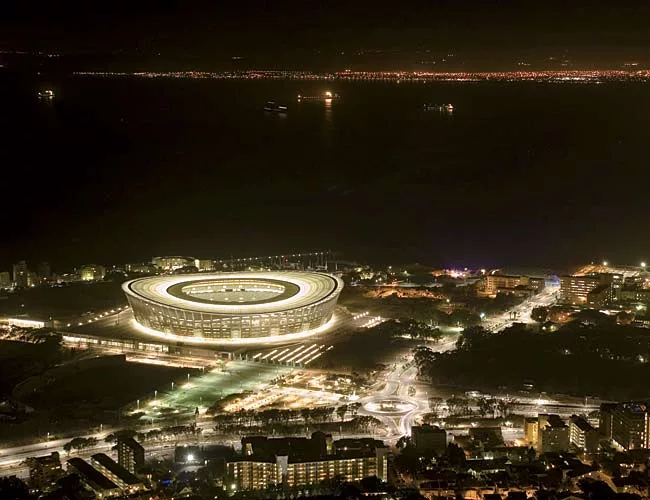
Cape Town Stadium
Cape Town, South Africa
Photo © Leon Krige
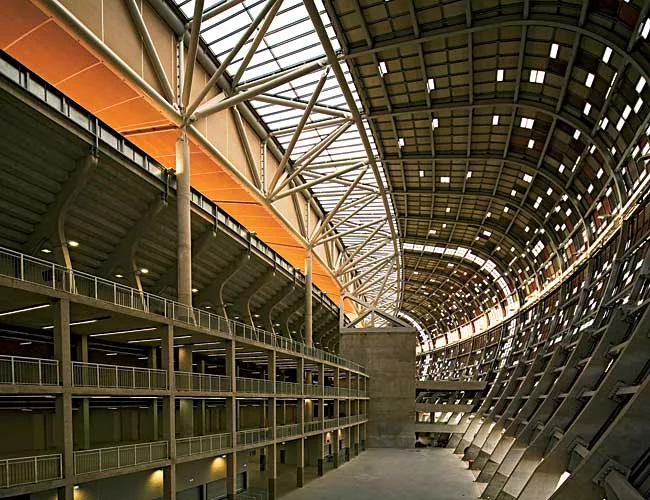
Soccer City
Johannesburg, South Africa
Photo © Dennis Guichard
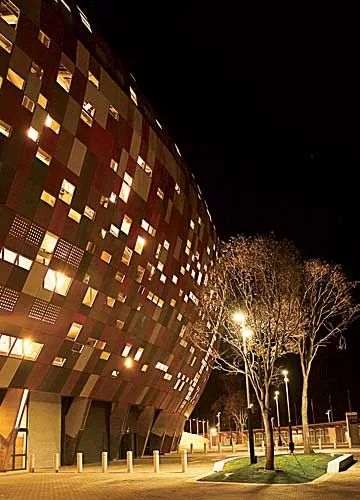
Soccer City
Johannesburg, South Africa
Photo © Leon Krige
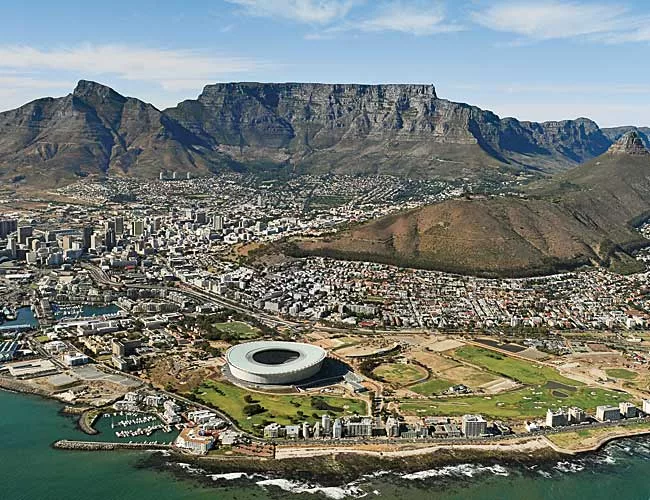
Cape Town Stadium
Cape Town, South Africa
Photo © Bruce Sutherland
Cape Town Stadium
Cape Town, South Africa
Photo © Leon Krige
Cape Town Stadium
Cape Town, South Africa
Photo © Leon Krige
Cape Town Stadium
Cape Town, South Africa
Photo © Leon Krige
Moses Mabhida Stadium
Durban, South Africa
Photo © Marcus Bredt
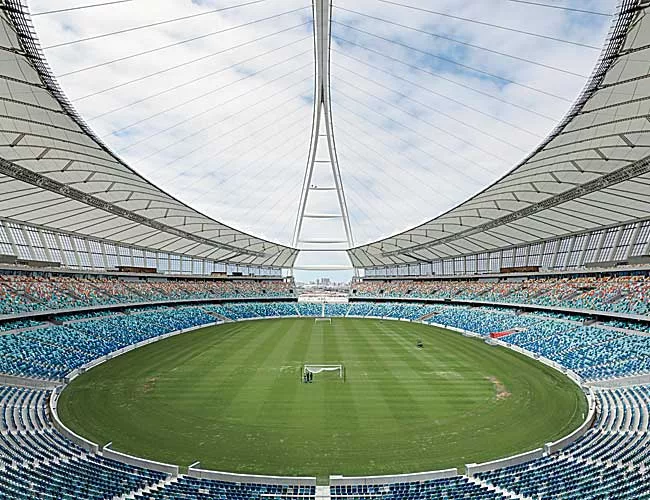
Moses Mabhida Stadium
Durban, South Africa
Photo © Marcus Bredt
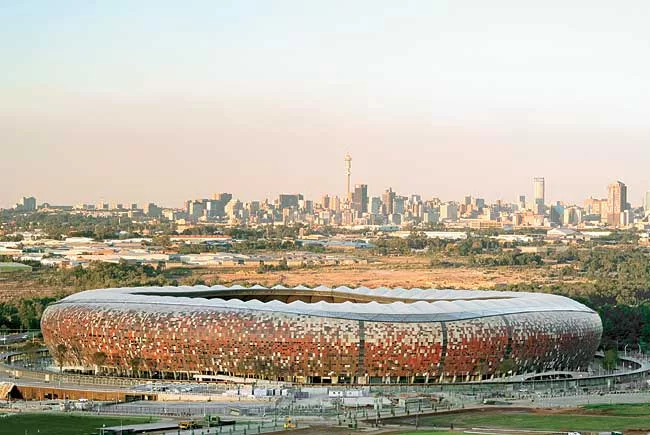
Soccer City
Johannesburg, South Africa
Photo courtesy Boogertman Urban Edge + Partners, in partnership with Populous
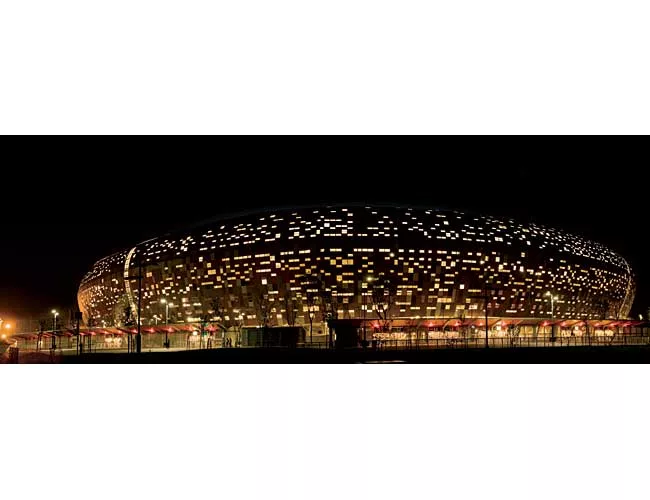
Soccer City
Johannesburg, South Africa
Photo courtesy Boogertman Urban Edge + Partners, in partnership with Populous
With millions watching the first World Cup to be held on the African continent, the spotlight is on the host country — and the stadiums commissioned for the games.
Soccer City
The tough, glistening epitome of life in Johannesburg, Soccer City — the home of football in South Africa — lies coiled at the foot of a mine dump in the Nasrec Precinct adjacent to Soweto.
Click on the slide show icon to see more images.
Given the task of transforming the city’s inadequate 20-year-old venue into a state-of-the-art facility, the Johannesburg-based Boogertman Urban Edge + Partners, in partnership with Populous, aimed to find a suitable envelope to “fit” over the aging structure, integrating some of the footings and the western grandstand.
The program also specified an iconic architectural response. So the architects devised a scheme based on the idea of a typical African clay pot that informs the building’s silhouette, patterning, and hues. According to Boogertman Urban Edge + Partners director Bob van Bebber, the idea was to create a simple “object” that would be easily recognizable as African.
“Traditionally, the pattern of the pot says something about the person making it or the people who will use it,” explains van Bebber. “Here, the pattern depicts the road to the World Cup final, with lines drawn in the direction of the other nine stadiums, and a line in the direction of Berlin, host city for the 2006 FIFA World Cup. These lines carry through from the podium paving to the facade to the seating inside the bowl. The colors are also reminiscent of the natural firing process of clay, darker at the bottom and lighter at the top.”
The shell is made of honed and sandblasted extruded-glass-fiber reinforced-concrete panels fixed to a galvanized-steel subframe. This surround is punctured with a secondary pattern to filter daylight indoors and allow interior lighting to illuminate the facade at night. Overhead, a lightweight PTFE-membrane roof cantilevers 131 feet above the upper tier and embankment. Below, a mine-shaftlike players’ tunnel refers to the city’s gold mining days. And an existing moat is now capped by a concrete slab and stores rainwater that will be filtered and recycled.
Sibongile Mazibuko, executive director of the City of Johannesburg’s 2010 Project Office, says that, in addition to the stadium, the Nasrec Urban Development Framework plans include an International Broadcast Centre; the possible redevelopment of the Nasrec Expo Centre; as well as the potential for commercial, light-industrial, hospitality, and residential opportunities.
The new Nasrec Transport Hub, an integrated taxi and bus terminus, including a Bus Rapid Transit (BRT) station and upgraded Nasrec Railway Station, not only provides efficient public transport for the World Cup, but it will tie into surrounding activities well after the fans go home.
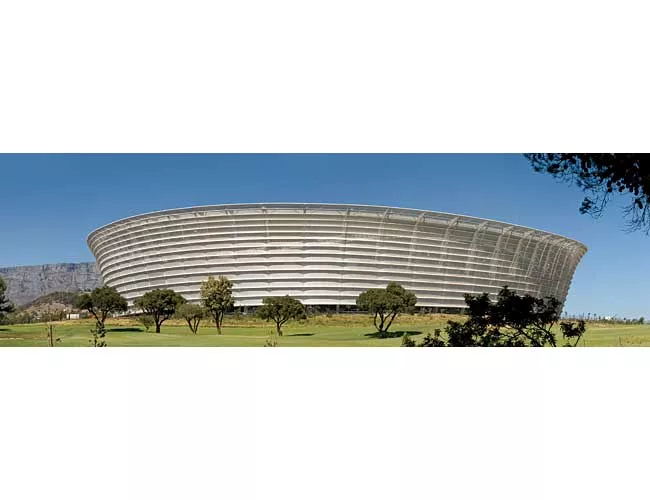
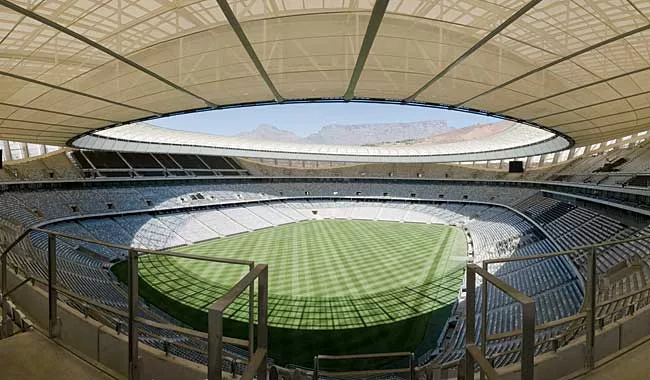
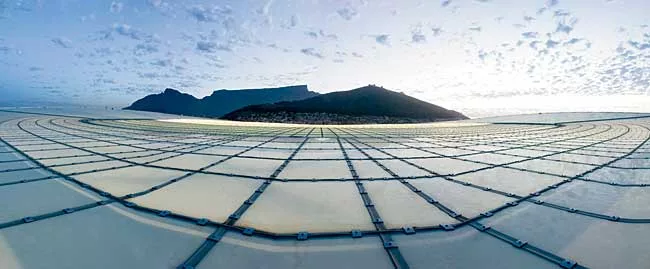
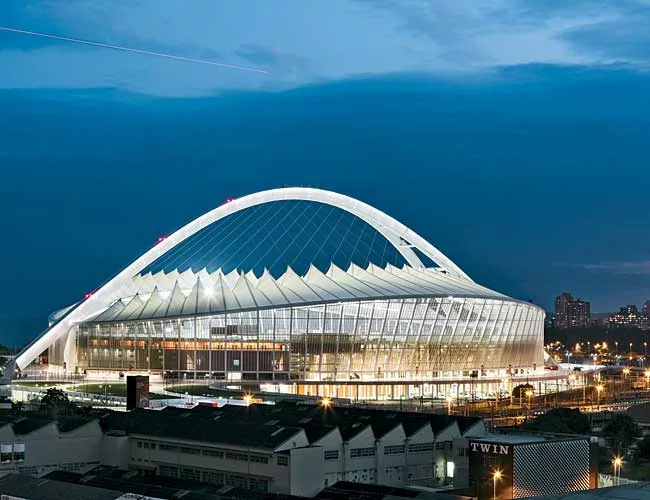
In a diverse society with African roots and global aspirations, the smooth, abstract forms of Cape Town and Moses Mabhida Stadiums, and the culturally inspired Soccer City may well inspire a sense of ownership within their surrounding communities. Ultimately, the collaboration of South African and international design teams has created a series of buildings that are inherently appropriate for their physical settings. Meant to attract and entertain the world, they will hopefully benefit the local communities around them and withstand the test of time.
The Legacy of the Games According to Bloomberg Businessweek, South Africa has spent upwards of $4.5 billion to host the World Cup. Was it worth it? “Yes, of course,” says Paragon Architects’ Henning Rasmuss, a member of the Cape Town Stadium consortium. “If we want to be foremost in Africa, then there is no question that we should be able to host the world. So let’s not question whether this is money well spent.” While the international press has questioned the logic of such expenditures, many members of South Africa’s bureaucratic, professional, and business communities claim that the 2010 FIFA World Cup offered an opportunity for the country to be a player in the global economy. According to Julie-May Ellingson of the eThekwini Municipality’s Strategic Projects Unit and 2010 Programme, “The work we are doing in Durban is part of a broader economic development strategy aimed at building domestic and international tourism, and improving infrastructure.” And the Cape Town effort’s technical director, Dave Hugo, asserts that without the stadium in Green Point there would probably have been no reconstruction of the Common. Overall, there has been a major focus in all the host cities on improving transport infrastructure for access to the stadiums during the World Cup, and for better accessibility and affordable public transportation for residents post-event. These projects include the Gautrain Rapid Rail Link and Gauteng Freeway Improvement Project (GFIP) in Gauteng (including the cities of Johannesburg and Tshwane); the new King Shaka International Airport, the new Moses Mabhida Railway Station, and the Warwick Junction interchange in Durban; as well as significant upgrades to Cape Town’s Railway Station and International Airport. Stadium precinct development plans have been put in place in each location and include long-term visions for the integration of public open spaces, enhanced pedestrian links, and surrounding urban fabric. “There has been huge capital investment by the public and private sectors in terms of skills development,” observes Sibongile Mazibuko of the City of Johannesburg’s 2010 Project Office. “The challenge now is the sustainability of work, and how to absorb the labor force that has been skilled up.” |
Looking for a reprint of this article?
From high-res PDFs to custom plaques, order your copy today!