Architectural Record
search
cart
facebook twitter linkedin youtube
  • Sign In
  • Subscribe
  • Sign Out
  • My Account
Architectural Record
  • NEWS
    • Latest News
    • Awards
    • Interviews
    • Obituaries
    • Podcasts
      • Design:Ed Podcast
      • Sponsored Podcasts
  • OPINION
    • Book Reviews / Excerpts
    • Exhibition Reviews
    • Forum
  • EXCLUSIVES
    • Videos
    • Design Vanguard
    • Top 300 Firms
    • Sponsored Content
    • Sponsored eBooks
    • From the Archives
  • CONTINUING ED
    • Editorial Continuing Ed
    • CE Center
    • CE Academies
  • PROJECTS
    • Buildings By Type
    • Reuse & Renovation
    • Museums & Arts Centers
    • Colleges & Universities
    • Multifamily Housing
    • Interiors
    • Lighting
    • Kitchen & Bath
  • HOUSES
    • Record Houses
    • House of the Month
    • Featured Houses
  • PRODUCTS
    • Products by Category
    • Record Products of the Year
    • Latest Products
  • EVENTS
    • Dates & Events
    • Record on the Road
    • Innovation Conference
    • Sustainability in Practice
    • Women In Architecture
    • Webinars
    • Ad Excellence Awards
    • Submit an Event
  • CONNECT
    • Ask RECORD AI
    • Newsletters
    • Contact
    • Advertise
    • Editorial Calendar
    • Store
    • Customer Service
  • SUBMIT
    • Submission Guidelines
    • RECORD Competitions
  • MAGAZINE
    • Subscribe
    • My Account
    • Digital Edition
    • Current Issue
    • Firm Pass
    • Historic Archive
Architectural Technology

"Smart Glass" on the Verge

After languishing for years outside the mainstream, "switchable glazing" is poised to become a viable alternative and could soon have a significant impact on facade design.

By Sara Hart
"Smart Glass" on the Verge

"Smart Glass" on the Verge

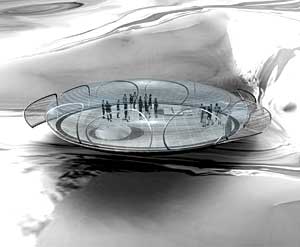
Rendering courtesy EDAW

Smart Glass on the Verge

Smart Glass on the Verge

Rendering courtesy EDAW

Smart Glass on the Verge

Smart Glass on the Verge

Rendering courtesy EDAW

Smart Glass on the Verge

Smart Glass on the Verge

Rendering courtesy EDAW

Smart Glass on the Verge

Smart Glass on the Verge

Rendering courtesy EDAW 
"Smart Glass" on the Verge
Smart Glass on the Verge
December 19, 2007
Most people are familiar with sunglasses that have photochromic lenses. Commercially available since 1983, the lenses darken in response to ultraviolet light and revert to clear when the exposure is removed. Though it may not seem like much of a leap from eyeglasses to windows, this technology has been slow to infiltrate the building-products marketplace.
 
Smart Glass on the Verge
Rendering: ' Werner Sobek
 
But now it appears that both private- and government-sponsored research could soon make more energy-efficient building products widely available. One of the areas receiving considerable attention is “switchable glazing.” The National Renewable Energy Laboratory (NREL), the Department of Energy’s (DOE) primary laboratory for renewable energy and energy-efficiency research, has focused much of its attention on windows, and with good reason. NREL reports, “Windows contribute about 30 percent to building heating and cooling electrical loads nationwide. Thus, potential energy savings from the wide-scale use of advanced windows is nearly 6 percent of the national energy consumption.” NREL’s research includes advanced window concepts, particularly those combining high thermal efficiency and dynamic transmittance of light. A key area of research activity is in switchable glazing, also known as “smart glass,” for a variety of residential and commercial applications. The goal is to create a viable product to control the light and gain transmittance through windows. The benefits are clear: reducing light reduces glare; reducing solar gain reduces energy costs; and controlling transparency controls privacy.

“Smart glass” and “switchable glazing” are generic terms that refer to all types of passive and active systems. Photochromic and thermochromic glazing, which are light- and heat-sensitive, respectively, are considered passive, because they do not require electricity. Those transitional sunglasses are smart, but passive. Active-control or electrochromic systems offer more options, but must be hard-wired to a power source.

Active technologies are the focus of most of the current research. Electrochromic windows are generally considered to be the most suitable chromogenic technology for energy control in buildings. They reduce or block light transmission and alter transparency in response to environmental signals, such as glare, sunlight, or temperature. The change from transparent to tinted is achieved when a small electrical current is applied to the window. The window returns to transparent when the voltage is turned off. Light transmittance during operation varies from 5 to 80 percent. Once the change in tint is initiated, the electrochromic glazing does not need constant current to maintain the tinting. In addition, the film can be tuned to block certain wavelengths, such as solar (heat) energy.

Electrochromic windows are made up of several extremely thin plies. Darkening occurs when hydrogen or lithium ions from an ion-storage layer are transmitted through an ion-conducting layer, which, when a voltage is applied, hurls the ions into an electrochromic layer typically made of tungsten oxide. The ions cause this layer to absorb visible light, thus darkening the window’s glass. The thin plies are sandwiched between two sheets of a transparent conducting oxide material. Finally, all the layers are encased between two layers of glass. (Gasochromic windows are similar to electrochromic, but rely on diluted hydrogen in the cavity of the insulated window unit to effect color change.) The main advantage of electrochromic windows is that they typically require low-voltage power, remain transparent across their switching range, and can be modulated to any intermediate state between clear and fully darkened.

Some of the most exciting electrochromatic research is taking place at the Lawrence Berkeley National Laboratory (LBNL), another DOE agency. Tom Richardson and Jonathan Slack of the lab’s Environmental Energy Technologies Division are developing switchable-mirror (reflective) technology. By avoiding the rare earth metals originally used in metal-hydride switchable mirrors, Richardson and Slack expect to lower the cost and simplify manufacturing. Energy performance is also improved, since the new windows can reflect or transmit both visible and infrared light.

“We are working to make reflective, electrochromic windows,” explains Richardson. “These would give the user more control of the relative reflectance/transparency than is possible with gasochromic windows. Reflective electrochromic windows have several advantages relative to both the static low-E products now used in nearly all new construction and to the absorbing electrochromic windows now on the market. They can become opaque to provide privacy and control glare even in direct sun.” Because one can choose to admit or reject solar energy at all wavelengths, they offer better savings on heating, cooling, and lighting costs. They also do not get as hot in direct sunlight and, in principle, should be less expensive to manufacture.


Share This Story

Looking for a reprint of this article?
From high-res PDFs to custom plaques, order your copy today!
Post a comment to this article

Report Abusive Comment

Subscription Center
  • Create an Account
  • Start a Subscription
  • Manage My Account
  • Sign Up for Newsletters
  • Visit Customer Service
  • Update Preferences

More Videos

Sponsored Content

Sponsored Content is a special paid section where industry companies provide high quality, objective, non-commercial content around topics of interest to the Architectural Record audience. All Sponsored Content is supplied by the advertising company and any opinions expressed in this article are those of the author and not necessarily reflect the views of Architectural Record or its parent company, BNP Media. Interested in participating in our Sponsored Content section? Contact your local rep!

close
  • TAMLYN XtremeTrim Exterior Trim
    Sponsored byTamlyn

    Designing Cleaner Panel Facades: Why Exterior Trim Details Matter

  • Building with Vapor Barriers
    Sponsored byReef Industries, Inc.

    Vapor Barriers Help Control Moisture in Tighter Building Designs

  • Duct Interior with Prodeq System
    Sponsored byHenry, a Carlisle Company

    Designing Resilient Water Containment Systems

DESIGN:ED Podcast
Listen to Architectural Record’s DESIGN:ED Podcast

Events

June 10, 2026

Rethinking Stormwater – The Power of Porous Paving

Credits: 1 AIA LU/HSW; 1 AIBD P-CE; 0.1 ICC CEU

Learn how porous paving systems support stormwater management, reduce heat island effects, and enhance sustainable site design performance.

June 11, 2026

Very Early Warning Fire Detection for Mission-Critical Facilities

Credits: 1 AIA LU/HSW; 1 AIBD P-CE; 0.1 ICC CEU

Examine advanced fire detection strategies that support uptime and enhance safety in data centers and other mission-critical facilities.

View All Submit An Event

Products

2026 Architect's Square Foot Costbook

2026 Architect's Square Foot Costbook

See More Products

Popular Stories

Practice Matters illustration

What’s in a (Firm’s) Name? Thinking About Succession and Legacy

Practice Matters illustration

By the Numbers: Counting America's Architects

House on a Hill

Design Vanguard 2026: Forma

Crane Cove, ONO

Design Vanguard 2026 Winners

House A on a Hill

Design Vanguard 2026: Santiago Valdivieso

Broader Sustainability of CMU - Free Webinar - May 21, 2026

Related Articles

  • "Smart Glass" on the Verge

    See More
  • Casa BFF

    A Corporate Bank Headquarters by OBR Offers a Fresh Take on the Milanese Glass Box

    See More
  • BatesSmart_Embassy_50S6112_flag_(c)Joe Fletcher.jpg

    A New Embassy for Australia is Completed on the Site of its Earlier Counterpart

    See More

Related Products

See More Products
  • superlux.jpg

    SuperLux: Smart Light Art, Design & Architecture for Cities

See More Products

Events

View AllSubmit An Event
  • June 16, 2026

    Focus on the Façade: Exploring Steel, Timber & Fire-Rated Curtain Walls and Channel Glass Systems

    Credits: 1 AIA LU/HSW; 1 AIBD P-CE; 0.1 ICC CEUExplore modern façade and glazing systems that enhance daylighting, fire safety, and thermal performance while expanding architectural design possibilities.
View AllSubmit An Event
×

The latest news and information

#1 Source for Architectural Design, News and Products

SUBSCRIBE
  • RESOURCES
    • Advertise
    • Contact Us
    • Submit
    • Store
  • ACCOUNT CENTER
    • Create an Account
    • Start a Subscription
    • Manage My Account
    • Sign Up for Newsletters
    • Visit Customer Service
    • Update Preferences
  • PRIVACY
    • PRIVACY POLICY
    • TERMS & CONDITIONS
    • DO NOT SELL MY PERSONAL INFORMATION
    • PRIVACY REQUEST
    • ACCESSIBILITY
  • SERVICES
    • Marketing Services
    • Reprints
    • Market Research
    • List Rental
    • Survey/Respondent Access
  • STAY CONNECTED
    • Linkedin
    • Facebook
    • Instagram
    • YouTube
    • X (Twitter)

Copyright ©2026. All Rights Reserved BNP Media, Inc. and BNP Media II, LLC.

Design, CMS, Hosting & Web Development :: ePublishing