Architectural Record
search
cart
facebook twitter linkedin youtube
  • Sign In
  • Subscribe
  • Sign Out
  • My Account
Architectural Record
  • NEWS
    • Latest News
    • Awards
    • Interviews
    • Obituaries
    • Podcasts
      • Design:Ed Podcast
      • Sponsored Podcasts
  • OPINION
    • Book Reviews / Excerpts
    • Exhibition Reviews
    • Forum
  • EXCLUSIVES
    • Videos
    • Design Vanguard
    • Top 300 Firms
    • Sponsored Content
    • Sponsored eBooks
    • From the Archives
  • CONTINUING ED
    • Editorial Continuing Ed
    • CE Center
    • CE Academies
  • PROJECTS
    • Buildings By Type
    • Reuse & Renovation
    • Museums & Arts Centers
    • Colleges & Universities
    • Multifamily Housing
    • Interiors
    • Lighting
    • Kitchen & Bath
  • HOUSES
    • Record Houses
    • House of the Month
    • Featured Houses
  • PRODUCTS
    • Products by Category
    • Record Products of the Year
    • Latest Products
  • EVENTS
    • Dates & Events
    • Record on the Road
    • Innovation Conference
    • Sustainability in Practice
    • Women In Architecture
    • Webinars
    • Ad Excellence Awards
    • Submit an Event
  • CONNECT
    • Ask RECORD AI
    • Newsletters
    • Contact
    • Advertise
    • Editorial Calendar
    • Store
    • Customer Service
  • SUBMIT
    • Submission Guidelines
    • RECORD Competitions
  • MAGAZINE
    • Subscribe
    • My Account
    • Digital Edition
    • Current Issue
    • Firm Pass
    • Historic Archive
Architectural Technology

A Fetish for Fabrication

By Russell Fortmeyer
For the eatery Earl's Gourmet Grub, FreelandBuck created a mural made of white maple veneer laminated onto standard sheets of medium-density fiberboard.
A Fetish for Fabrication
For the eatery Earl's Gourmet Grub, FreelandBuck created a mural made of white maple veneer laminated onto standard sheets of medium-density fiberboard.
Photo © Lawrence Anderson
To develop the low relief in the Earl's mural, Freeland and Buck digitally translated a photograph of an Alpine landscape into a gridlike pattern. They then worked with fabricator Joe Cooper to set th
A Fetish for Fabrication
To develop the low relief in the Earl's mural, Freeland and Buck digitally translated a photograph of an Alpine landscape into a gridlike pattern. They then worked with fabricator Joe Cooper to set the tool path for the CNC machine. They programmed it to make cuts in the direction of the grain first, to avoid chipping or splintering the veneer.
Image courtesy of FreelandBuck
Justin Rice (left) and Kagan Taylor (center) from the Knowhow Shop worked with architect Jason Payne, principal of Hirsuta, on 'Rawhide, or, the New Shingle Style' an exhibition that ran at the SCI-Ar
A Fetish for Fabrication
Justin Rice (left) and Kagan Taylor (center) from the Knowhow Shop worked with architect Jason Payne, principal of Hirsuta, on 'Rawhide, or, the New Shingle Style' an exhibition that ran at the SCI-Arc gallery from late July through the middle of September. The installation, made of lumber, lath, cedar shingles, and steel, depended on a number of fabrication techniques, including stick framing, steam bending, flame finishing, CNC routing, and welding.
Photo © Molly Munsen
Ball-Nogues Studio is creating a public art piece named Talus Dome for the City of Edmonton, Alberta from 2,000 stainless steel spheres.
A Fetish for Fabrication
Ball-Nogues Studio is creating a public art piece named Talus Dome for the City of Edmonton, Alberta from 2,000 stainless steel spheres.
Image courtesy of Ball-Nogues Studio
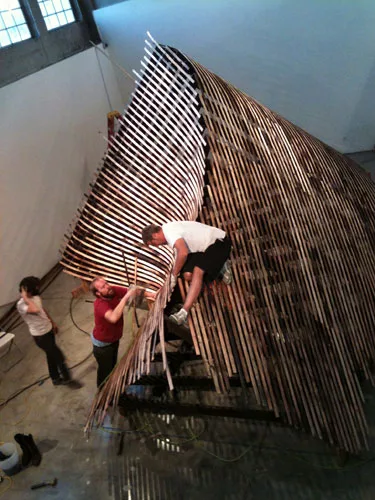
To form the spheres into Talus Dome, Ball-Nogues is building a CNC-milled, 30-foot-tall timber frame at a leased film warehouse in Burbank, California.
A Fetish for Fabrication
To form the spheres into Talus Dome, Ball-Nogues is building a CNC-milled, 30-foot-tall timber frame at a leased film warehouse in Burbank, California.
Photo © Allison Porterfield
To form the spheres into Talus Dome, Ball-Nogues is building a CNC-milled, 30-foot-tall timber frame at a leased film warehouse in Burbank, California.
A Fetish for Fabrication
To form the spheres into Talus Dome, Ball-Nogues is building a CNC-milled, 30-foot-tall timber frame at a leased film warehouse in Burbank, California.
Photo © Allison Porterfield
Steel connector plates, bent into U-shapes on molds cut out by CNC mill, will be welded to the Talus Dome spheres, holding them in place.
A Fetish for Fabrication
Steel connector plates, bent into U-shapes on molds cut out by CNC mill, will be welded to the Talus Dome spheres, holding them in place.
Photo © Russell Fortmeyer
After the Talus Dome's fabrication, the studio plans to install the timber frame at a site near Yucca Valley, California and convert it into an elevated 'crater' filled with water.
A Fetish for Fabrication
After the Talus Dome's fabrication, the studio plans to install the timber frame at a site near Yucca Valley, California and convert it into an elevated 'crater' filled with water.
Image courtesy of Ball-Nogues Studio
This past spring, the Robot House at SCI-Arc opened. The facility includes five robotic arm St'ubli instruments.
A Fetish for Fabrication
This past spring, the Robot House at SCI-Arc opened. The facility includes five robotic arm St'ubli instruments.
Photo courtesy SCI-Arc
In the RoCoCo seminar held this past summer in SCI-Arc's Robot House, students conducted various activities with robots, including deforming or bending materials and winding filaments.
A Fetish for Fabrication
In the RoCoCo seminar held this past summer in SCI-Arc's Robot House, students conducted various activities with robots, including deforming or bending materials and winding filaments.
Photo courtesy SCI-Arc
In the RoCoCo seminar held this past summer in SCI-Arc's Robot House, students conducted various activities with robots, including deforming or bending materials and winding filaments.
A Fetish for Fabrication
In the RoCoCo seminar held this past summer in SCI-Arc's Robot House, students conducted various activities with robots, including deforming or bending materials and winding filaments.
Photo courtesy SCI-Arc
In the RoCoCo seminar held this past summer in SCI-Arc's Robot House, students conducted various activities with robots, including deforming or bending materials and winding filaments.
A Fetish for Fabrication
In the RoCoCo seminar held this past summer in SCI-Arc's Robot House, students conducted various activities with robots, including deforming or bending materials and winding filaments.
Photo courtesy SCI-Arc
In preparation for one final group demonstration, students in the SCI-Arc seminar created an algorithm that calculates the distance between the robots' arms, helping coordinate movement.
A Fetish for Fabrication
In preparation for one final group demonstration, students in the SCI-Arc seminar created an algorithm that calculates the distance between the robots' arms, helping coordinate movement.
Image courtesy of SCI-Arc
For the eatery Earl's Gourmet Grub, FreelandBuck created a mural made of white maple veneer laminated onto standard sheets of medium-density fiberboard.
To develop the low relief in the Earl's mural, Freeland and Buck digitally translated a photograph of an Alpine landscape into a gridlike pattern. They then worked with fabricator Joe Cooper to set th
Justin Rice (left) and Kagan Taylor (center) from the Knowhow Shop worked with architect Jason Payne, principal of Hirsuta, on 'Rawhide, or, the New Shingle Style' an exhibition that ran at the SCI-Ar
Ball-Nogues Studio is creating a public art piece named Talus Dome for the City of Edmonton, Alberta from 2,000 stainless steel spheres.
To form the spheres into Talus Dome, Ball-Nogues is building a CNC-milled, 30-foot-tall timber frame at a leased film warehouse in Burbank, California.
Steel connector plates, bent into U-shapes on molds cut out by CNC mill, will be welded to the Talus Dome spheres, holding them in place.
After the Talus Dome's fabrication, the studio plans to install the timber frame at a site near Yucca Valley, California and convert it into an elevated 'crater' filled with water.
This past spring, the Robot House at SCI-Arc opened. The facility includes five robotic arm St'ubli instruments.
In the RoCoCo seminar held this past summer in SCI-Arc's Robot House, students conducted various activities with robots, including deforming or bending materials and winding filaments.
In preparation for one final group demonstration, students in the SCI-Arc seminar created an algorithm that calculates the distance between the robots' arms, helping coordinate movement.
October 16, 2011
 

In digitally sophisticated Los Angeles, the Southern California Institute of Architecture's new Robot House ups the ante.

The architects Peter Testa and Devyn Weiser like to point out that the robots are not people. The robots, in this case, are five white robotic arm Stäubli instruments installed last spring in the new Robot House at the Southern California Institute of Architecture (SCI-Arc) in Los Angeles. For that matter, the Robot House is not a house, but rather a converted double-height space at the south end of SCI-Arc’s main building. The room has two glass walls and a catwalk overhead, which allow students to view the robots in action.


Testa and Weiser, partners in the firm Testa/Weiser and faculty members at SCI-Arc, initiated the school’s partnership with Stäubli and oversaw the Robot House’s design and construction. The five robots in the facility, along with a sixth, much smaller one in an adjacent classroom, range in weight from 60 to 550 pounds and can handle loads of up to 75 pounds, moving as fast as 35 feet per second. They might not be people, but they may well populate the next frontier of digital design.

Similar models of robots build cars, process pharmaceuticals, and perform surgery, guaranteeing precision and consistency. In architecture, robots have mostly been used individually to “pick and place” materials, such as bricks. But with multiple robots, designers can investigate movement, choreography, and collaboration, providing an alternative to the typical linear sequence of design and programming, followed by fabrication and construction. “We consider the robots a real-time design and construction platform,” explains Testa. Robots offer a way of getting beyond the computer screen, which doesn’t account for gravity or material properties. “We wanted to move on to something more tangible and interactive,” he says. Robots could also enable free-form fabrication, minimizing or eliminating the use of molds. This summer, Weiser taught the first seminar using the robots, called Robotic Confections and Confabulations, or RoCoCo, while Testa’s earlier XLab studios at SCI-Arc had speculated on their potential use.

Contractors and other schools have robots as part of fabrication shops. Machineous, a Los Angeles–based fabricator, has a six-axis robot in its stable of equipment that was used to cut the tri-lobe-shaped plastic “bricks” for architect Greg Lynn’s Blobwall for Panelite in 2007. A six-axis robot can move in the typical X-Y-Z planes but also rotate 360 degrees around an object. If robots are not new, they represent the next phase in the fascination with digital design and fabrication that has defined some of Los Angeles’ most progressive architectural practices. Twenty years ago, computer numerical control (CNC) milling machines, which typically consist of large beds with a vertical spindle that can cut material based on programming input, were not common in architecture schools, let alone in commercial practice. High-profile local projects such as Gehry Partners’ Walt Disney Concert Hall, which opened in 2003, helped change the situation. The approximately 8,000 wood panels and components inside the hall were fabricated using a CNC mill with digital files created by the architects.

Several fabrication shops in Los Angeles now feature CNC mills, while some architects have their own equipment. Kagan Taylor, Justin Rice, and Joshua Howell—architects who met while studying at the University of California in Los Angeles (UCLA)—opened the Knowhow Shop in the Highland Park neighborhood in July 2010. The shop operates as a cooperative, where smaller practices and individuals can buy time to use woodworking equipment and the mill, as well as attend instructional classes. They also share space with Manny Torres, an architect who operates a laser cutting design shop called 2ndwnd. Laser cutting is similar to CNC milling, but relies on a high-powered laser and results in finer materials with less technological residue like chips, splinters, or rough edges. “In Los Angeles, you have access to this equipment in school and you become fluent in the languages and tools, but when you graduate, you find you no longer have that access,” says Rice, noting that even large commercial firms rarely offer opportunities to build on this knowledge. He points out that similar ventures have opened elsewhere, including larger, established shops like ADX in Portland, Oregon, and 3rd Ward in Brooklyn. Howell expects to open a Knowhow branch in Seattle, where he has recently relocated.

Knowhow has a three-axis CNC mill, which means it cuts in the x, y and z axes and can create something that resembles a topographical map out of a surface no larger than four by eight feet. Larger shops often have five-or-more-axis mills to handle more complicated geometry, but three-axis mills are reasonably affordable for entry level. Typically, architects provide shops like Knowhow with Rhino files, which translate easily into the so-called “G code” programming language used by the mill controller. Software based on Non-Uniform Rational B-Splines, or NURBS, such as Rhino, provide greater precision and flexibility in fabrication compared to less-exacting node-based mesh modeling software like Maya. NURBS are digital approximations of complex forms, relying on control points to accurately calculate inputs like curves and surfaces. Even with precise fabrication, the partners at Knowhow still often use sand paper to smooth out the finished product.

In August, Knowhow was fabricating millwork for a new restaurant interior designed by FreelandBuck. David Freeland, the Los Angeles-based half of the architecture firm he founded with New York-based partner Brennan Buck, says CNC milling has helped them explore their interests in embedding spatial qualities in flat surfaces with low reliefs. Both Freeland and Buck studied at UCLA with Greg Lynn, who they credit with informing their interest in multi-dimensional surface effects or, as Freeland says, “Incorporating the thin surface back into the deep spatial and structural fabric of architecture.”

Freeland and Buck collaborated with Los Angeles fabricator Joe Cooper for a mural installed in their Earl’s Gourmet Grub on Venice Boulevard (see related story). Cooper, who counts the Getty Center among his clients, is a retired high school wood shop teacher and has operated a fabrication shop out of his backyard for 20 years. His first step with any project is to clean up architectural CAD files, connecting lines or deleting offsets, as mills require exact instructions. He then converts them into a Mastercam file, which he uses to produce the G code that runs the mill’s controller. “There’s no room for mistakes,” Cooper says. “Whatever I program is exactly what it will do.” He then sets up a tool path that directs where and how fast the mill will cut. Cooper’s mill can handle thicknesses of up to eleven inches, including wood, plastic, foam, and metals, among others, but the ideal is around four inches or less. For the Earl’s mural, Cooper used two bits—one to cut the pattern and another to cut the overall boards. These tool changes are programmed into the tool path file.

For Earl’s, FreelandBuck created the design for the mural, which consists of maple veneer laminated onto standard sheets of medium-density fiberboard, based on a photograph the client had provided showing a mountain landscape. With the software Maya, the architects translated the image into a grid that resembled a topographic map, with darker tones indicating a denser grid. They then translated this into a Rhino file to send to Cooper. The architects worked with Cooper to set the tool path, programming the mill to make cuts in the direction of the veneer’s grain first in order to minimize chipping or splintering. “The way it is on the wall is the exactly the way it came off the mill,” says Freeland, adding that eliminating the need for post-CNC cleanup makes the fabrication process efficient. It took less than four days to mill the 60-foot-long mural.

If FreelandBuck’s work in digitized architectural surfaces represents one mode of practice in Los Angeles, the art installations of the Ball-Nogues Studio represent another. Architects Benjamin Ball and Gaston Nogues, two SCI-Arc graduates, started working together in 2004. Ball had worked for Gehry before pursuing set design for film productions, while Nogues had spent much of his career working in digital design for Gehry. (Ball says “everyone in L.A. is standing on Gehry’s shoulders.”) The architects are fabricating a public art piece they will install in Edmonton, Alberta, later this year. Called Talus Dome, the installation consists of approximately 2,000 stainless steel spheres that range from 8 to 30 inches in diameter and are interconnected and self-supported in place.

Working with the Los Angeles office of engineer Buro Happold to optimize the design, Ball and Nogues used their own CNC mill to fabricate the timber frame that will serve as the dome’s mold. If all goes as planned, the freestanding, self-supported 30-foot-tall mold will then be reused as an elevated aquatic basin for a proposed project called Yucca Crater to be installed near Yucca Valley, California, for the nonprofit arts group High Desert Test Sites.

To build the dome—which Ball describes as a happy medium between a pile of sand and a parabolic sphere—the architects are lining the frame with thin plywood and stacking the spheres along the interior surface. “We have not been able to find a piece of software to predict with any accuracy how these spheres will stack,” says Nogues. Steel connector plates, bent into U-shapes on molds cut out by the CNC mill, will then be welded to adjacent spheres to hold them in place. The dome will be fabricated in sections to allow it to be transported to Canada and assembled on-site, with no internal support mechanisms. Next year, Ball and Nogues are scheduled to undertake an installation at SCI-Arc using the Robot House. Ball has jokingly suggested that the robots be fitted with chain saws.

There were no chain saws in Weiser’s summer seminar. In fact, there were few physical objects created. Instead, the students used the robots to explore synchronous movement, projection, sonic environments, weaving, and material deformation. “The Robot House is not an extension of the shop,” explains Testa. “It is a design environment.” In August, Weiser’s students presented the outcomes of their research projects, many of which are included on the Robot House’s website www.machinators.org.

One of the key achievements of the seminar and the prior SCI-Arc studios was the creation of an interface between the VAL-3 programming language that controls robots and the architectural modeling software Maya. VAL-3 was developed by the original robotics company, Unimation, in the 1950s and 1960s. As part of their final presentation, M.Arch students Brandon Kruysman, Jonathan Proto, and Curime Batliner used this software platform to produce a choreographed demonstration with three synchronously moving robots, attempting to coordinate movement, sound, and other variables. Two robots held projectors displaying video on the walls, while the third robot filmed the event. The students created an algorithm-based program that determined the distance between the two projection robots to modulate the tone and frequency of an ambient sound track. Each student manually controlled the preprogrammed sequence of an individual robot, resulting in a few near-collisions.

Part of the appeal of such demonstrations is their unpredictability. Testa and Weiser began developing ideas around emergent and agent-based Artificial Intelligence systems a the Emergent Design Group at the Massachusetts Institute of Technology. “Emergent” and “agent-based” systems describe an approach to design where algorithmic programming can generate multiple classes of structure, pattern, and form with unpredictable and various outcomes, but according to a preset, precisely defined logic.

Testa expects that the tools will eventually be sophisticated enough to enable designers to tightly control the work spheres of multiple robots in complex spatial conditions. Robots could move out of the factory and onto the construction site, ultimately allowing a much more adaptive and responsive design environment, where both architect and client can evaluate outcomes in real time. Although that may be a few decades out, the rise of the machines has begun in architecture.

People


Products


Share This Story

Looking for a reprint of this article?
From high-res PDFs to custom plaques, order your copy today!

Russell fortmeyer
Russell Fortmeyer, a contributing editor to RECORD, is a Los Angeles-based sustainability principal at Arup and adjunct professor at the University of Southern California School of Architecture.

Post a comment to this article

Report Abusive Comment

Subscription Center
  • Create an Account
  • Start a Subscription
  • Manage My Account
  • Sign Up for Newsletters
  • Visit Customer Service
  • Update Preferences

More Videos

Sponsored Content

Sponsored Content is a special paid section where industry companies provide high quality, objective, non-commercial content around topics of interest to the Architectural Record audience. All Sponsored Content is supplied by the advertising company and any opinions expressed in this article are those of the author and not necessarily reflect the views of Architectural Record or its parent company, BNP Media. Interested in participating in our Sponsored Content section? Contact your local rep!

close
  • TAMLYN XtremeTrim Exterior Trim
    Sponsored byTamlyn

    Designing Cleaner Panel Facades: Why Exterior Trim Details Matter

  • Building with Vapor Barriers
    Sponsored byReef Industries, Inc.

    Vapor Barriers Help Control Moisture in Tighter Building Designs

  • Duct Interior with Prodeq System
    Sponsored byHenry, a Carlisle Company

    Designing Resilient Water Containment Systems

DESIGN:ED Podcast
Listen to Architectural Record’s DESIGN:ED Podcast

Events

June 16, 2026

Focus on the Façade: Exploring Steel, Timber & Fire-Rated Curtain Walls and Channel Glass Systems

Credits: 1 AIA LU/HSW; 1 AIBD P-CE; 0.1 ICC CEU

Explore modern façade and glazing systems that enhance daylighting, fire safety, and thermal performance while expanding architectural design possibilities.

June 18, 2026

Rebooting the Aging Office Building

Credits: 1 AIA LU/HSW; 1 AIBD P-CE; 0.1 ICC CEU; 1 PDH

Explore façade retrofit strategies and award-winning design concepts that can transform aging office buildings into healthier, higher-performing workplaces for today’s hybrid workforce.

View All Submit An Event

Products

2026 Architect's Square Foot Costbook

2026 Architect's Square Foot Costbook

See More Products

Popular Stories

SanDiegoAirport

Top 300 Architecture Firms of 2026

Coronado Bridge

The Architect’s Guide to San Diego

Dusk House

Design Vanguard 2026: ONO

West Village Penthouse

Design Vanguard 2026: Brent Buck Architects

Hikma Community Complex

Design Vanguard 2026: Mariam Issoufou Architects

Focus on the Facade - Free Webinar - June 16, 2026

Related Articles

  • Betty Bazar Community Center and Preschool

    Kadre Architects Transforms an L.A. Denny’s into a Resource for Families Transitioning Out of Homelessness

    See More
  • Malibu High School

    A New High School in Malibu Turns the Tide on Learning

    See More
  • Powerhouse Arts

    At Herzog & de Meuron's Powerhouse Arts, Nostalgia for a Lost Industrial Past

    See More

Related Products

See More Products
  • 0470126736.gif

    Modern Sustainable Residential Design: A Guide for Design Professionals

  • WC_-SCA.png

    Building Great Schools for a Great City

See More Products

Events

View AllSubmit An Event
  • April 23, 2025

    Artificial Intelligence, Machine Learning, and the Future of the Firm: A Conversation for Emerging Professionals

    NOW ON DEMANDCredits: 1 AIA LU/Elective; 1 AIBD P-CE;  0.1 ICC CEU; 0.1 IACET CEUJoin us for a practical discussion for emerging professionals on AI’s evolving role in architecture - beyond the hype, exploring its real impact on practice.
  • October 2, 2025

    Rewriting the Fee Formula: A Smarter Model for Pricing Your Services

    NOW ON DEMANDCredits: 1 AIA LU/Elective; 1 AIBD P-CE; 0.1 ICC CEU; 0.1 IACET CEUThis webinar reveals a more powerful approach to pricing that aligns with the actual value you create for clients, not just the time you spend or the construction costs you influence.
View AllSubmit An Event
×

The latest news and information

#1 Source for Architectural Design, News and Products

SUBSCRIBE
  • RESOURCES
    • Advertise
    • Contact Us
    • Submit
    • Store
  • ACCOUNT CENTER
    • Create an Account
    • Start a Subscription
    • Manage My Account
    • Sign Up for Newsletters
    • Visit Customer Service
    • Update Preferences
  • PRIVACY
    • PRIVACY POLICY
    • TERMS & CONDITIONS
    • DO NOT SELL MY PERSONAL INFORMATION
    • PRIVACY REQUEST
    • ACCESSIBILITY
  • SERVICES
    • Marketing Services
    • Reprints
    • Market Research
    • List Rental
    • Survey/Respondent Access
  • STAY CONNECTED
    • Linkedin
    • Facebook
    • Instagram
    • YouTube
    • X (Twitter)

Copyright ©2026. All Rights Reserved BNP Media, Inc. and BNP Media II, LLC.

Design, CMS, Hosting & Web Development :: ePublishing