Making Sense of the New LEED
The latest version of the widely adopted green building standard is set to debut in November with the most thorough overhaul since its inception. Here’s what you need to know.
 |

To earn one AIA/CES continuing education hour (CEH), including one hour of health, safety, and welfare credit (HSW), read the article and complete the test online. Upon passing, you will receive a certificate of completion and your credit will automatically be reported to the AIA. Find additional information regarding credit-reporting and continuing-education requirements at ce.construction.com, under “requirements.”
Learning Objectives
- Outline new strategies incorporated into LEED v4, and explain how these strategies address limitations of earlier versions of the rating system.
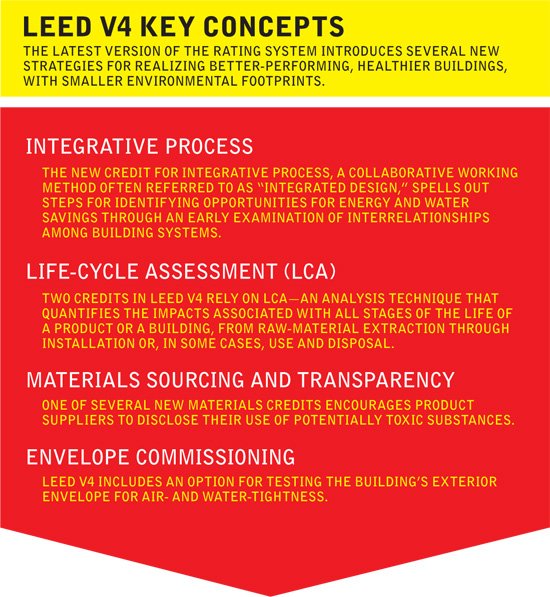
- Define 'integrative process' and explain why such a process should result in a more energy- and water-efficient building.
- Define the concept 'life-cycle assessment' and discuss how it applies to a building and its components.
- Discuss those aspects of LEED v4 intended to encourage manufacturers to disclose product ingredients and explain why they have been particularly controversial.
AIA/CES Course #K1309A
Take the Continuing Education Test
A revamped LEED is launching later this year. The new rating system, referred to as LEED version 4, or v4 for short, has generated a lot of controversy in the design and construction industry, both from practitioners concerned about how different it is from the current LEED, and from product suppliers worried about new demands from their customers.
Mara Baum, director of sustainability for HOK's healthcare practice, captures the mood well when she says, “It feels like too much change now, but that's making up for not enough change in the last few years,” noting that many aspects of LEED hadn't been modified since the launch of version 2.0 in 2000. “The old version was starting to feel stale,” Josh Radoff, principal with the consulting firm YR&G Sustainability, concurs.
There are important pieces that were missing from the rating system, according to Scot Horst, senior vice president for LEED at the U.S. Green Building Council (USGBC). In the realm of product ingredients, for example, “We still don't know what it is we're bringing into our space and exposing ourselves to when we do a green building,” he says. “It's kind of a shameful thing.” A new ingredient-transparency credit to address this shortcoming has proved particularly controversial, raising the ire of some product manufacturers and their suppliers in the chemical industry.
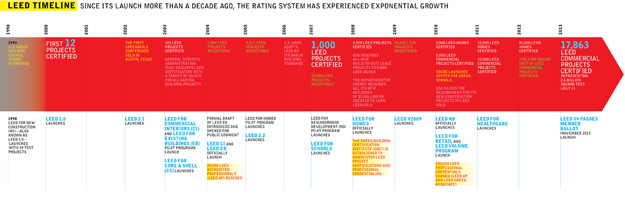
Since it first launched in March of 2000, LEED has been through many incremental revisions. It expanded from one rating system, initially created for office buildings—LEED for New Construction and Major Renovations—into multiple rating systems for different building types, including schools and healthcare facilities. The most noteworthy changes were the addition of LEED for Existing Buildings (EB) and LEED for Commercial Interiors (CI) in 2004, and then an update that aligned all the rating systems around a consistent 100-point scale in 2009.
LEED EB, now called “LEED for Existing Buildings: Operations and Maintenance,” covers retrofits and ongoing operations but not major renovations. It now rivals the new-construction rating systems in market reach, with approximately 2,500 projects certified, comprising over one billion square feet. Unlike the new construction rating systems, which award points based on predicted energy and water efficiency, LEED EB rewards actual performance.
Short of making all projects wait for certification until they've demonstrated that they actually perform as predicted—which might discourage many owners from pursuing LEED—the USGBC is moving to strengthen the connection between aspiration and performance. For example, according to Radoff, unlike the old measurement and verification credit, the new advanced-energy-metering credit “reflects how operators use data, and gives people a better head start” at tracking their actual performance.
 |
Change At Last
The update was developed in accordance with the USGBC's consensus process, which includes volunteer committees and “technical advisory groups” who draft changes, and multiple public-comment cycles that provide stakeholders—both USGBC members and nonmembers—the opportunity to weigh in.
LEED v4 was approved in July by 86 percent of the voting body, after three years of development and six public-comment periods.
For the previous release, LEED 2009, the USGBC determined that the market was still getting familiar with the rating system and wasn't ready to accommodate major changes. The earlier update focused on point reallocations rather than the rating system's content, and it required only two public-comment periods before the member ballot. But that restraint created enormous pent-up demand for changes, inside and outside the organization. There was much broader audience participation this time, says Chrissy Macken, USGBC's assistant project manager for v4, both because LEED is now more widely used and because “it's the first time that we've proposed changes to basically every prerequisite and credit.”
LEED v4, originally slated to launch in 2012, is now set for public release in November. That's when project teams will be able to register and get access to online forms, reference guides, and other supporting materials. However, in response to concerns that some product- and materials-related measures in the new system are too far ahead of the market, USGBC took the unusual step of promising to keep LEED 2009—also known as LEED version 3—open until June 2015. For approximately a year and a half, teams will have the option of registering for either system.
The USGBC has already announced incentives for opting into the new system, such as waiving the application fee for the first project in each country to achieve Platinum—the highest possible LEED rating. There will probably be more such enticements as the USGBC tries to convince project teams to make the leap to v4, even while the more familiar LEED 2009 is still available.
“My hunch is that it will be a harder sell to use v4,” says Radoff. The latest version raises the bar for energy performance and in other key areas, so “to earn the most points and get the highest level certification, 2009 will be the answer,” he says. However, Radoff believes that updates in v4 make it a better tool for guidance on green strategies, so YR&G will be using it as a reference, along with other sources, even on projects that are seeking certification under LEED 2009.
Looking for a reprint of this article?
From high-res PDFs to custom plaques, order your copy today!