Modular Classroom Makeover
New designs for portable school buildings make improvements that are more than cosmetic.
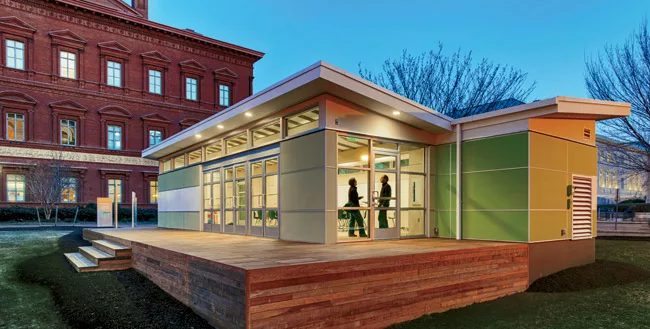
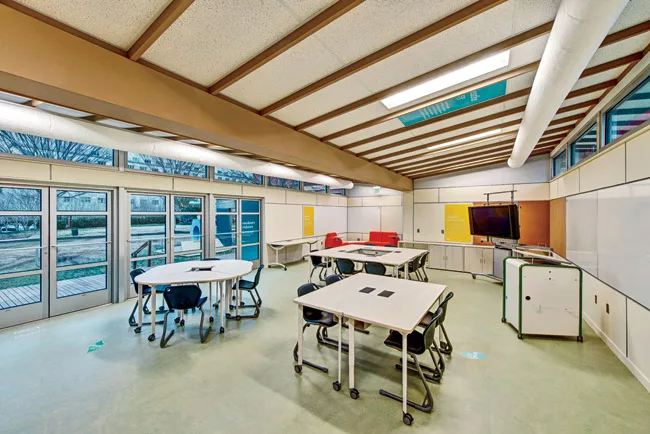
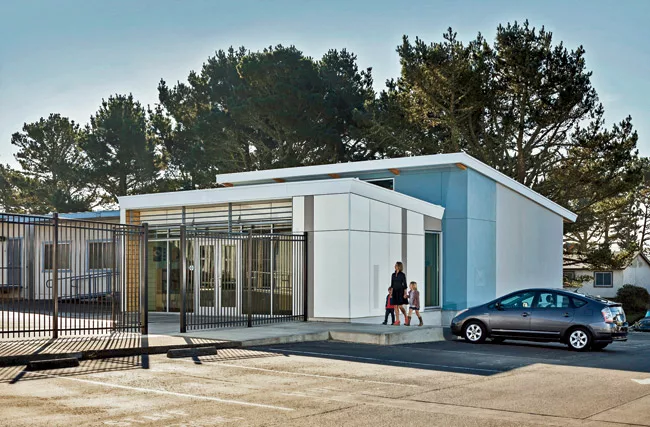
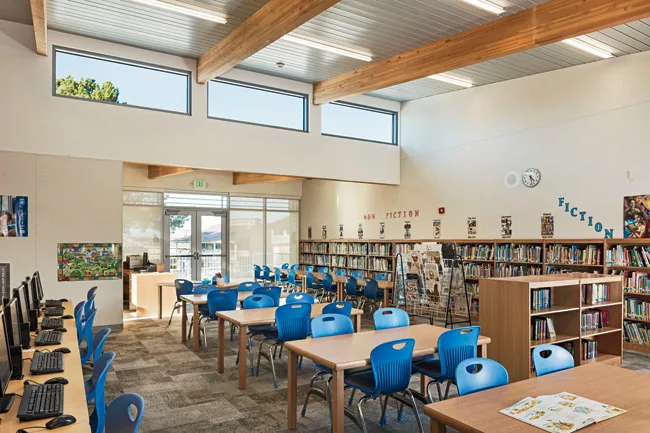
The mention of “portable” classrooms—or any similar term—puts fear into the hearts of parents with school-age children. Regardless of whether you call them portable, modular, or temporary classrooms, they conjure up unwelcome images of shoebox-like structures with few windows, stuffy air, and noisy and ineffective mechanical systems. But now several design firms, nonprofit organizations, and prefab building companies are developing improved portable classrooms that address these problems and allow schools to expand quickly and sustainably.
Although there isn't much current literature addressing the performance of portable classrooms, older research supports this dubious reputation. One study conducted in 2004 by the California Air Resources Board and the state's Department of Health Services found a much higher instance of environmental problems in the relocatable units as compared with permanently built school buildings. The investigation documented conditions such as inadequate ventilation, excessive noise, poor thermal comfort, low lighting levels, and high concentrations of formaldehyde.
Despite these shortcomings, many school systems can't do without portable units. According to the trade association the Modular Building Institute (MBI), across the U.S. about 260,000 classrooms are in “relocatable” buildings—buildings that are designed to be reused multiple times on different sites and are partially or completely constructed in a manufacturing facility. The National Center for Education Statistics estimates that a third of American schools have such classrooms.
These classrooms exist because they fulfill critical needs. Districts can respond to fluctuations in enrollment quickly and cost-effectively. Since almost all of the construction occurs off-site, portables ordered in the spring can easily be built and installed over summer break. And because they are generally less expensive than traditionally constructed schools, the units can often be paid for with funds from operations and maintenance budgets, allowing districts to avoid the lengthy and uncertain bond-approval process. “There are many good reasons portable schools exist,” says Margarette Leite, a principal at the Portland, Oregon'based architecture firm Palleroni Leite Design Partnership (PLDP). Leite and fellow PLDP principal Sergio Palleroni have designed (along with others, including architecture and engineering students at Portland State University, where both teach) a higher-performing alternative to the typical modular school.
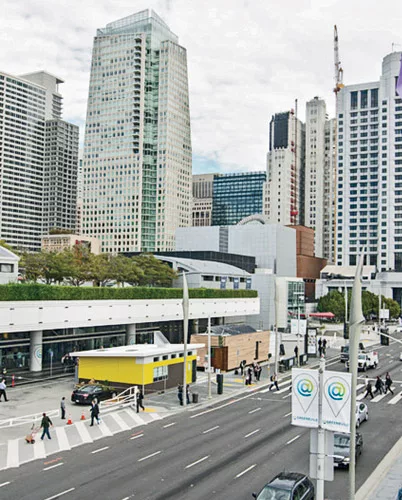
Palleroni and Leite's classroom, which they have dubbed SAGE for “Smart Academic Green Environment,” features an efficient mechanical system that depends on an energy-recovery ventilator, materials with no or very low levels of volatile organic compounds (VOCs), and ample daylighting through clerestory windows. Following the debut of a prototype in late 2012 at the U.S. Green Building Council's Greenbuild conference in San Francisco, the first SAGE classroom will be installed later this winter at a Waldorf School in Corvallis, Oregon. But it is not the only option for schools looking for ways to expand quickly and sustainably. Several design firms, nonprofit organizations, and prefab building companies are also developing improved portable classrooms that already have begun to attract orders from both independent schools and public school districts.
For example, a new charter school in Chattahoochee Hills, Georgia, is planning an entire campus made out of Sprout Space units. Designed by Perkins+Will, the Sprout includes elements intended to promote student health and productivity such as architectural-grade storefront glazing, dimmable LED lighting controlled by daylight and occupancy sensors, and marker boards and tack surfaces as substitutes for typical finishes.
And Project Frog, a San Francisco'based developer of component building systems established in 2006, is in the midst of fulfilling its largest contract to date—more than 250,000 square feet of educational facilities on 15 different campuses in the South San Francisco Unified School District (SSFUSD). The buildings are designed to perform 40 percent better than Title 24, California's strict energy code, mandates.
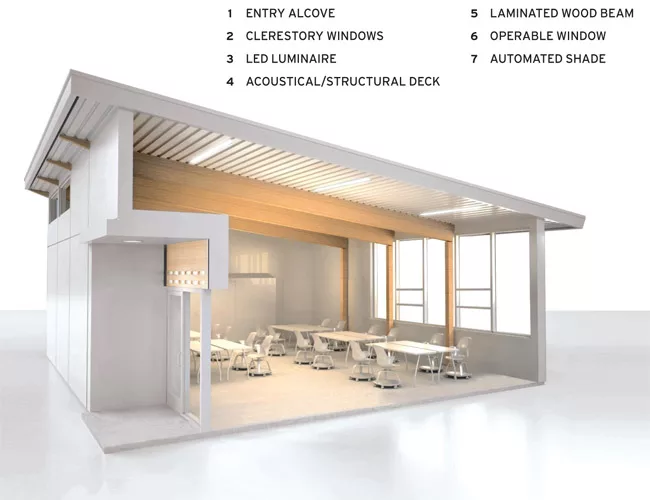
Project Frog developed the panelized system it is deploying at SSFUSD in collaboration with HMC Architects—a firm that specializes in education facilities, among other building types. The system relies on load-bearing wall sections with electrical chases included, laminated wood beams, and an acoustical metal ceiling and roof deck that acts as a structural diaphragm. These elements are fabricated in a factory and flat-packed for transport to the site, where they are erected on top of an on-grade slab. “This component assembly approach is derived from the lean manufacturing techniques used by companies like Boeing and Toyota,” says Ash Notaney, Project Frog executive vice president of product and innovation.
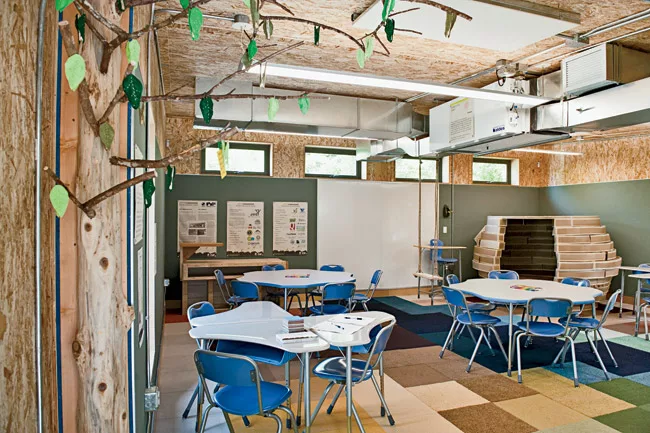
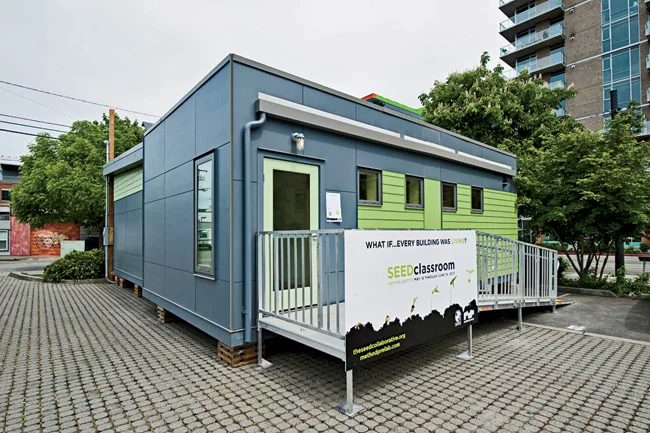
Arguably, the portable classroom with the most ambitious set of performance goals is the one developed by the Seattle-based nonprofit SEED Collaborative. The SEED (Sustainable Education Every Day) is designed to meet the criteria of the Living Building Challenge—a “beyond LEED” building certification program administered by the International Living Future Institute (ILFI). In order to earn Living Building designation, a project must satisfy 20 tough-to-achieve “imperatives.” Among these is a requirement for net zero energy: the building must produce enough renewable energy on-site to meet or exceed demand on an annual basis. It must also comply with the Challenge's materials standards prohibiting the use of 14 potentially toxic substances on the certification program's Red List. Many, such as formaldehyde and PVC, are commonplace in building materials and prevalent in conventional portable classrooms.
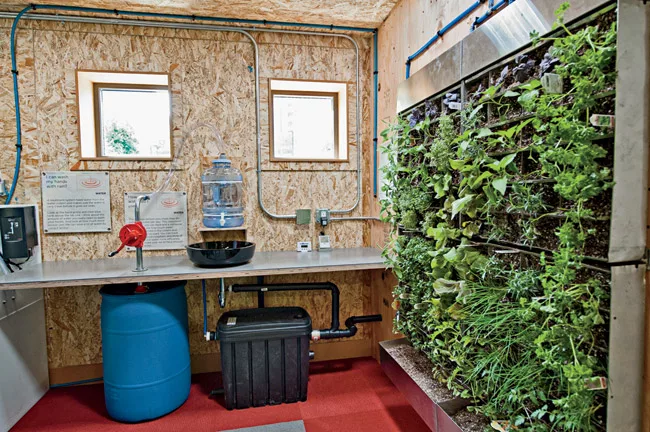
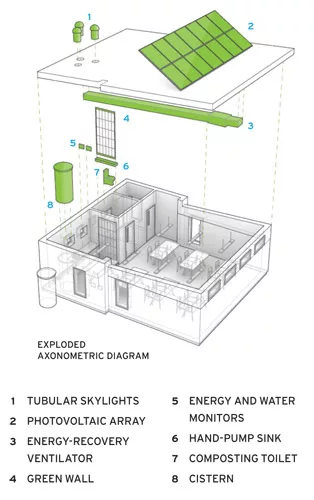
A prototype SEED manufactured by Method Prefab—an off-site builder of homes and commercial structures—was displayed as part of an ILFI conference held in Seattle last April. The 32-by-28-foot classroom has a durable building envelope with a high R-value (a measure of thermal resistance or insulating value). It is made of structural insulated panels exposed on the interior and clad on the exterior with a fiber-cement rainscreen. Additional features include triple-glazed windows, a photovoltaic (PV) array, and a composting toilet.
The prototype has been purchased by the Perkins School, an 80-student independent elementary school for children in kindergarten through fifth grade, located in Northeast Seattle. Once the permitting process is complete and the unit installed, Perkins plans to use it as a science classroom. Part of what made the SEED so attractive was the learning opportunity afforded by its clearly evident structure, visible electrical conduits, and a digital dashboard. This will allow students to track the electricity generated by a 6-kilowatt PV array, to be mounted on the roof of an adjacent building, as well as energy consumption. “The classroom inspires kids to look around them and think about intelligent design,” says school head Barry Wright. These features also made fundraising relatively easy: the school was able to raise $130,000, about half of what is needed to buy and install the SEED, in less than three weeks, “because the concept is so intriguing,” explains Wright.
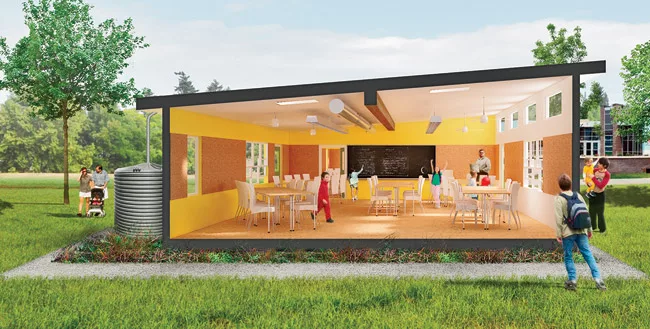
The SEED classroom isn't the only green modular conceived as a three-dimensional teaching aid. For instance, teachers can point to the butterfly roof that tops Perkins+Will's Sprout and describe how it funnels rainwater for irrigation to two 50-gallon storage cisterns. Similarly, the expansion and contraction of a fabric duct suspended just below the Sprout's ceiling helps students understand how their classroom is heated, cooled, and ventilated.
The recent crop of higher-performing modular classrooms share more than a pedagogical philosophy—in fact, these new portable schoolrooms have more similarities than differences. With the exception of the Project Frog buildings, which are made up of a panelized kit-of-parts, a single classroom is generally formed from two long and narrow units whose dimensions respond to the limitations of what can be hauled by a semi-truck over bridges and roadways. The portable classrooms typically have simple shed roofs, or a variation on a shed roof, tweaked to maximize the opportunities for windows and daylighting. Structural elements are often left exposed—a strategy that not only allows teachers to explain what is holding the building up but also eliminates unnecessary materials. This approach helps keep costs in check and reduces the number of potential sources of VOCs. Those basic finishes that are included, such as linoleum flooring or carpet tile, are carefully vetted so that they do not negatively affect indoor air quality.
In addition, the green portables are designed for much longer lifespans than the typical relocatable units, which are intended for only 5 or 10 years of use—though in reality they often stay in place much longer. The SAGE, for instance, is a 50-year building, according to its designers. And although its superstructure is wood, its floor framing is steel—a feature that should make the unit easy to move multiple times, enhancing its longevity.
Although the developers of the green portables try hard to keep costs down, features like high-performance glazing, ultra-efficient mechanical systems, and extra insulation typically make them more expensive than standard-issue modular units. Leite estimates that in Portland, an 1,800-square-foot, two-classroom SAGE would be about $160,000, excluding foundations and site work, while a standard two-classroom portable building would cost about $125,000 in the same market. The cost of the SEED is comparable to site-built construction, according to Stacy Smedley, the SEED Collaborative's executive director. (At Perkins, the 900-square foot SEED will cost about $260,000 installed.) However, the classroom should pay for itself in operation and maintenance savings in only 11 years, she says.
Project Frog would not disclose the construction budget for the classrooms it is erecting in South San Francisco. However, the company maintains that the buildings' cost is equal to permanent modular construction (factory-built units installed on permanent foundations). But it still has the advantage of being high in quality and fast to complete. The on-site work for the district's almost 200 Project Frog buildings will extend over three summer breaks but total only 8 or 9 months, estimates James “Larry” Scott, the SSFUSD bond manager. Conventional new construction would have required a year and a half, he says.
Whether a schoolroom is delivered to the site as an almost-complete modular unit or in smaller prefabricated components, the architect's role is different from that of traditional brick-and-mortar construction. In the case of the Sprout Space unit, for example, Perkins+Will has licensed the design to a distributor, Triumph Modular. An interested school would enter into a contract directly with Triumph, who would in turn subcontract with a fabricator close to the site. For each unit sold, Perkins+Will will earn a royalty, explains Allen Post, Perkins+Will's Sprout Space team leader. But the architects may not have any subsequent involvement with the project—unless the client wants the standard unit customized, or desires the firm to design the site surrounding the classroom. In both cases, Perkins+Will would perform these services under a separate contract.
Although the architect's responsibilities may be different when modular construction is involved, the goal is the same, says Post. “We are trying to up the game and improve both temporary and permanent classrooms,” he says. The objective is to make them “healthy, sustainable, and flexible.”
Perkins+Will's Sprout Space, along with SEED, SAGE, and Project Frog, all have shared constraints and common design goals. Although the results can't be described as iconic architecture, this new generation of portables provides energy-efficient and daylight-filled environments that are conducive to learning. “The goal was never to make the sexiest modular classroom,” says Leite of the SAGE unit. “It was to make an alternative to the everyday modular classroom.” Phil Harrison, Perkins+Will CEO, echoes Leite's sentiment when he characterizes the aim of the Sprout Space: “If you want to make a difference, you have to make something that will be viable in the marketplace—something extremely pragmatic.”
People | Products |
Looking for a reprint of this article?
From high-res PDFs to custom plaques, order your copy today!



.webp?height=200&t=1759395328&width=200 "KlimaKover")