Architectural Record
search
cart
facebook twitter linkedin youtube
  • Sign In
  • Subscribe
  • Sign Out
  • My Account
Architectural Record
  • NEWS
    • Latest News
    • Awards
    • Interviews
    • Obituaries
    • Podcasts
      • Design:Ed Podcast
      • Sponsored Podcasts
  • OPINION
    • Book Reviews / Excerpts
    • Exhibition Reviews
    • Forum
  • EXCLUSIVES
    • Videos
    • Design Vanguard
    • Top 300 Firms
    • Sponsored Content
    • Sponsored eBooks
    • From the Archives
  • CONTINUING ED
    • Editorial Continuing Ed
    • CE Center
    • CE Academies
  • PROJECTS
    • Buildings By Type
    • Reuse & Renovation
    • Museums & Arts Centers
    • Colleges & Universities
    • Multifamily Housing
    • Interiors
    • Lighting
    • Kitchen & Bath
  • HOUSES
    • Record Houses
    • House of the Month
    • Featured Houses
  • PRODUCTS
    • Products by Category
    • Record Products of the Year
    • Latest Products
  • EVENTS
    • Dates & Events
    • Record on the Road
    • Innovation Conference
    • Sustainability in Practice
    • Women In Architecture
    • Webinars
    • Ad Excellence Awards
    • Submit an Event
  • CONNECT
    • Ask RECORD AI
    • Newsletters
    • Contact
    • Advertise
    • Editorial Calendar
    • Store
    • Customer Service
  • SUBMIT
    • Submission Guidelines
    • RECORD Competitions
  • MAGAZINE
    • Subscribe
    • My Account
    • Digital Edition
    • Current Issue
    • Firm Pass
    • Historic Archive
Architecture ProductsProducts by TypeFurnishings

Product Focus: Anatomy of a Dream

Ready to launch in early 2014, a sculptural wood chair by Tadao Ando for Carl Hansen & Søn signals what may be a new era for both. It is the Japanese architect's first design for production, and it is the furniture manufacturer's first collaboration with a non-Danish designer.

By Naomi Pollock, FAIA
Tadao Ando, seated comfortably in his Dream Chair was inspired by the wood furniture of the late Danish designer Hans Wegner and developed this seat—his first production piece—in layers of
Product Focus: Anatomy of a Dream
Tadao Ando, seated comfortably in his Dream Chair was inspired by the wood furniture of the late Danish designer Hans Wegner and developed this seat—his first production piece—in layers of that material for Carl Hansen & Søn, the manufacturer of Wegner’s work.
The chair is available in walnut or oak veneer, with a lacquer or oil finish.
Product Focus: Anatomy of a Dream
The chair is available in walnut or oak veneer, with a lacquer or oil finish.
Product Focus: Anatomy of a Dream
The chair is available in walnut or oak veneer, with a lacquer or oil finish.
Ando examines an early mock-up at his Osaka studio.
Product Focus: Anatomy of a Dream
Ando examines an early mock-up at his Osaka studio.
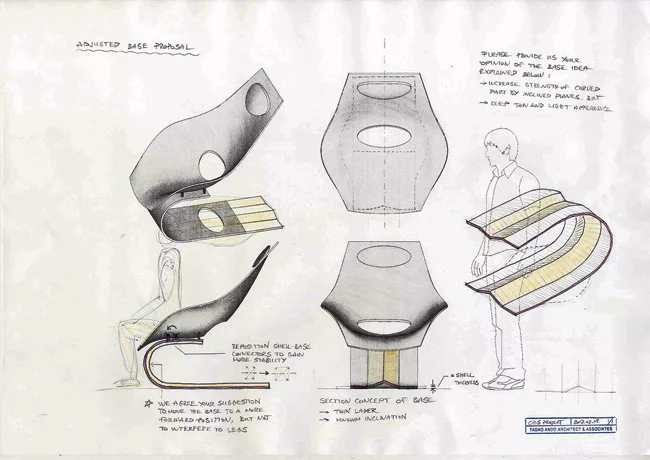
 The architect’s original design, with a contiguous seat and base, would have been difficult to produce. A study for his solution divides the seat and base for strength.
Product Focus: Anatomy of a Dream
The architect’s original design, with a contiguous seat and base, would have been difficult to produce. A study for his solution divides the seat and base for strength.
The Dream Chair is available with leather upholstery.
Product Focus: Anatomy of a Dream
The Dream Chair is available with leather upholstery.
The Dream Chair is available with leather upholstery
Product Focus: Anatomy of a Dream
The Dream Chair is available with leather upholstery
Tadao Ando, seated comfortably in his Dream Chair was inspired by the wood furniture of the late Danish designer Hans Wegner and developed this seat—his first production piece—in layers of
The chair is available in walnut or oak veneer, with a lacquer or oil finish.
Ando examines an early mock-up at his Osaka studio.
 The architect’s original design, with a contiguous seat and base, would have been difficult to produce. A study for his solution divides the seat and base for strength.
The Dream Chair is available with leather upholstery.
The Dream Chair is available with leather upholstery
December 16, 2013
When architect Tadao Ando first opened his Osaka office in 1969, he purchased four Hans Wegner Wishbone Chairs. Little did he know that, some 40 years later, he too would work with Carl Hansen & Søn, the Denmark-based firm responsible for the 1950 Wegner original, as well as for the lion's share of the Danish furniture designer's work. The first collaboration between Ando and the manufacturer, the Dream Chair is poised to make its debut in January. Comprising a shell made of 3-D form-pressed Beech plywood sandwiched between decorative layers of oak or walnut veneer, the elegant lounge chair pairs the architect's refined eye for form and materials with the manufacturer's skill.
 
Tadao Ando, seated comfortably in his Dream Chair was inspired by the wood furniture of the late Danish designer Hans Wegner and developed this seat—his first production piece—in layers of that material for Carl Hansen & Søn, the manufacturer of Wegner’s work.
 
Ando does create custom furnishings for his buildings, but the Dream Chair is his first production piece for a broader market. And while Carl Hansen & Søn has produced classic modern furniture with many notable Danish designers in its 100-plus-year history, this is the family-run company's first joint venture with a Japanese architect. Keen to explore new directions, Knud Erik Hansen, the current head of the company founded by his grandfather in 1908, began looking beyond Denmark's borders for design talent. This search led him to Japan, the company's largest export market for the past 25 years. Impressed by Ando's work with concrete and his concern to keep material waste minimal, which dovetails with the company's philosophy, Hansen approached the designer, who promptly accepted the invitation.
 
“I was struck by Carl Hansen's passion for making something special, with phenomenal craftsmanship,” explains Ando, who has a like-minded approach to architecture. Though his buildings are significantly bigger than a chair, his design process remained constant. The main difference was in the choice of material. While Ando's use of concrete for his structures is legendary, this time he opted for wood. “As with concrete, I wanted to create something unique from a material that is accessible anywhere on the planet,” he notes.
 
Yet when the Carl Hansen technicians saw Ando's initial sketches of a single sinuous plane forming the chair's back, seat, and base, they blanched. Bent in two directions, it cupped the body in a wood shell devoid of hardware. “If it were a cast fiberglass piece, there would be no problem,” says Hansen. The concern was that the chair's large size and complex curvature exceeded the capability of 3-D wood-veneer-shaping technology that entails pressing 0.39-inch thick sheets together in a mold.
 
Ando collaborated with the Hansen fabrication team, which manipulated the most innovative molding methods available to achieve the architect's desired result—with minimal modification to his original scheme. “Together,” says Hansen, “We challenged, and maybe reached, the limits of what is possible with plywood.”
 
The chair reads as a unified whole. In fact, it consists of three distinct pieces, a headrest, seat, and base. Attached to the seat back, the headrest is a simple disk that, like the seat, may be covered in leather or fabric. Playing on solid and void, its oval shape repeats as openings in the seat back and C-curved base, which was the most challenging element. More than a year of study and prototype-testing was required to make it sturdy enough to support the weight of a user and yet maintain the same thin profile as the seat. Though the technicians suggested making it in metal, Ando held out for wood but approved the addition of four steel pegs that discreetly pin the base and seat together.
 
Sculptural as well as ergonomic, the Dream Chair is a work of art, and priced accordingly, from $4,995 for wood and from $6,050 with leather upholstery. But when one sits back and relaxes into its warm embrace, the chair takes on its intended function. The idea, explains Hansen, is that “it embodies Tadao Ando's desire to encourage people to take more time to dream.”

Share This Story

Looking for a reprint of this article?
From high-res PDFs to custom plaques, order your copy today!

Contributing Editor Naomi Pollock, FAIA, is the author of Japanese Design Since 1945: A Complete Sourcebook and the forthcoming Vanishing Japan: Modern Architecture Gone But Not Forgotten,

Post a comment to this article

Report Abusive Comment

Subscription Center
  • Create an Account
  • Start a Subscription
  • Manage My Account
  • Sign Up for Newsletters
  • Visit Customer Service
  • Update Preferences

More Videos

Sponsored Content

Sponsored Content is a special paid section where industry companies provide high quality, objective, non-commercial content around topics of interest to the Architectural Record audience. All Sponsored Content is supplied by the advertising company and any opinions expressed in this article are those of the author and not necessarily reflect the views of Architectural Record or its parent company, BNP Media. Interested in participating in our Sponsored Content section? Contact your local rep!

close
  • cold storage facility
    Sponsored byCarlisle SynTec Systems

    How Architects Can Design More Continuous Cold Storage Envelopes

  • TAMLYN XtremeTrim Exterior Trim
    Sponsored byTamlyn

    Designing Cleaner Panel Facades: Why Exterior Trim Details Matter

  • Building with Vapor Barriers
    Sponsored byReef Industries, Inc.

    Vapor Barriers Help Control Moisture in Tighter Building Designs

DESIGN:ED Podcast
Listen to Architectural Record’s DESIGN:ED Podcast

Events

June 18, 2026

Rebooting the Aging Office Building

Credits: 1 AIA LU/HSW; 1 AIBD P-CE; 0.1 ICC CEU; 1 PDH

Explore façade retrofit strategies and award-winning design concepts that can transform aging office buildings into healthier, higher-performing workplaces for today’s hybrid workforce.

June 23, 2026

Enhancing Fire Resistance with Advanced PVC Solutions

Credits: 1 AIA LU/HSW; 1 AIBD P-CE; 0.1 ICC CEU; 1 IIBEC CEH

Evaluate advanced PVC solutions that improve fire resistance, support WUI compliance, and enhance resilience in residential and commercial building design.

View All Submit An Event

Products

2026 Architect's Square Foot Costbook

2026 Architect's Square Foot Costbook

See More Products

Popular Stories

SanDiegoAirport

Top 300 Architecture Firms of 2026

Coronado Bridge

The Architect’s Guide to San Diego

Lorcan O' Herilhy

California Architect Lorcan O’Herlihy Has Died, Age 66

CCA, Studio Gang

The Winners of the AIA’s 2026 Architecture Award Range from Collegiate Rowing Hubs to Housing for the Homeless

Dusk House

Design Vanguard 2026: ONO

Rebooting the Aging Office Building - Free Webinar - June 18, 2026

Related Articles

  • Elegy for a Dream Queen

    See More
  • Northern Lights

    Product Focus: Frandsen Project Lighting Fixtures

    See More

Related Products

See More Products
  • book3.jpg

    If Architecture is a Language, Then a Building is a Story

  • arch concept.jpg

    The Architecture Concept Book

See More Products
×

The latest news and information

#1 Source for Architectural Design, News and Products

SUBSCRIBE
  • RESOURCES
    • Advertise
    • Contact Us
    • Submit
    • Store
  • ACCOUNT CENTER
    • Create an Account
    • Start a Subscription
    • Manage My Account
    • Sign Up for Newsletters
    • Visit Customer Service
    • Update Preferences
  • PRIVACY
    • PRIVACY POLICY
    • TERMS & CONDITIONS
    • DO NOT SELL MY PERSONAL INFORMATION
    • PRIVACY REQUEST
    • ACCESSIBILITY
  • SERVICES
    • Marketing Services
    • Reprints
    • Market Research
    • List Rental
    • Survey/Respondent Access
  • STAY CONNECTED
    • Linkedin
    • Facebook
    • Instagram
    • YouTube
    • X (Twitter)

Copyright ©2026. All Rights Reserved BNP Media, Inc. and BNP Media II, LLC.

Design, CMS, Hosting & Web Development :: ePublishing