Architectural Record
search
cart
facebook twitter linkedin youtube
  • Sign In
  • Subscribe
  • Sign Out
  • My Account
Architectural Record
  • NEWS
    • Latest News
    • Awards
    • Interviews
    • Obituaries
    • Podcasts
      • Design:Ed Podcast
      • Sponsored Podcasts
  • OPINION
    • Book Reviews / Excerpts
    • Exhibition Reviews
    • Forum
  • EXCLUSIVES
    • Videos
    • Design Vanguard
    • Top 300 Firms
    • Sponsored Content
    • Sponsored eBooks
    • From the Archives
  • CONTINUING ED
    • Editorial Continuing Ed
    • CE Center
    • CE Academies
  • PROJECTS
    • Buildings By Type
    • Reuse & Renovation
    • Museums & Arts Centers
    • Colleges & Universities
    • Multifamily Housing
    • Interiors
    • Lighting
    • Kitchen & Bath
  • HOUSES
    • Record Houses
    • House of the Month
    • Featured Houses
  • PRODUCTS
    • Products by Category
    • Record Products of the Year
    • Latest Products
  • EVENTS
    • Dates & Events
    • Record on the Road
    • Innovation Conference
    • Sustainability in Practice
    • Women In Architecture
    • Webinars
    • Ad Excellence Awards
    • Submit an Event
  • CONNECT
    • Ask RECORD AI
    • Newsletters
    • Contact
    • Advertise
    • Editorial Calendar
    • Store
    • Customer Service
  • SUBMIT
    • Submission Guidelines
    • RECORD Competitions
  • MAGAZINE
    • Subscribe
    • My Account
    • Digital Edition
    • Current Issue
    • Firm Pass
    • Historic Archive
ProjectsBuildings by TypeHospitality Projects

Stonehenge Exhibition and Visitor Centre

Portal to the Past: Denton Corker Marshall created a forest of columns for the Stonehenge Exhibition and Visitor Centre that respects the ancient monument it serves.

By Chris Foges
Stonehenge Exhibition and Visitor Centre
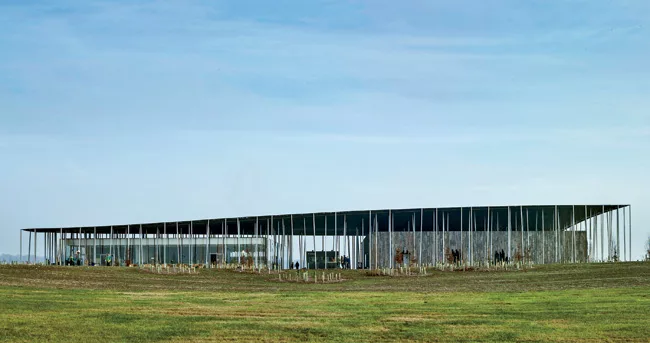
The building’s roof floats above 211 slender steel columns.
 
Photo © Peter Cook
Stonehenge Exhibition and Visitor Centre
To establish a clear contrast with the heavy stones of the historic circle, the architects designed the visitor center so it would sit lightly on the ground.
 
Photo © Peter Cook
Stonehenge Exhibition and Visitor Centre
English Heritage, which administers Stonehenge, removed an old gift shop and a road running through the site near the monument. The new 17,000-square-foot visitor center is now located 1.5 miles away and is set in a slight depression, so it cannot be seen from the stone circle.
 
Photo © Peter Cook
Stonehenge Exhibition and Visitor Centre
An old photograph shows the site when a gift shop and a road marred the visitor experience.
 
Photo © Peter Cook
Stonehenge Exhibition and Visitor Centre
A collaged image shows the site with the gift shop and road removed.
 
Photo © Peter Cook
Stonehenge Exhibition and Visitor Centre
The new 17,000-square-foot visitor center is now located 1.5 miles away and is set in a slight depression, so it cannot be seen from the stone circle.
 
Photo © Peter Cook
Stonehenge Exhibition and Visitor Centre
The architects designed the visitor center so it would sit lightly on the ground.
 
Photo © Peter Cook
Stonehenge Exhibition and Visitor Centre
An exhibition in the visitor centre was created by Haley Sharpe Design.
 
Photo © Peter Cook
Stonehenge Exhibition and Visitor Centre
Image courtesy Denton Corker Marshall
Stonehenge Exhibition and Visitor Centre
June 16, 2014

Architects & Firms

Denton Corker Marshall

Shrewton, England

People/Products

Visiting Stonehenge in 1829, the photographer William Henry Fox Talbot was dismayed to find the scene “wholly destroyed” by five carriages and 30 picnicking sightseers. Things were to get much worse. By the 21st century, the attraction drew a million visitors a year, who were corralled within close sight of parked tour buses and heavy traffic on two public roads passing north and south of the stone circle.

Numerous improvement schemes ended in failure, but relief has finally come with a radical reorganization of access to and through the 6,500-acre World Heritage Site. A new entrance at Airman's Corner, 1.5 miles west of the stone circle, is marked by an elegant visitor center designed by the Australian architecture firm Denton Corker Marshall (DCM). From there, visitors travel to the monument on foot or by shuttle service along the now-decommissioned road north of the stones, allowing greater appreciation of the site's extensive earthworks. The section of road east of the monument is being returned to grass, as is the site of the old gift shop and ticket office next to the stones.

When DCM was appointed in 2009, it already had substantial experience with the site's sensitivities, having won an earlier competition for a subterranean visitor center, which was canceled along with a related road tunnel that was deemed too expensive. The firm's second take on the project applies a very different approach: instead of digging into the earth, the 17,000-square-foot building sits lightly on it and echoes the gentle folds of the landscape.

A forest of slender, raking columns lifts an undulating roof over three visibly separate pavilions. An outward-looking glass-walled box contains a café, shop, and classroom, while an inward-looking pod clad in weathered sweet chestnut houses an interpretive exhibition created by Leicester-based Haley Sharpe Design. Between them is a smaller zinc-clad ticket booth. The disaggregated composition subtly prefigures the permeable character of the stone circle, and keeps the landscape in view. As they approach the building, visitors can see the hilly horizon through the gap between the pavilions and the roof.

DCM partner Barrie Marshall made his first sketches before the final site had been selected, and took inspiration from one of the alternative locations, a lightly wooded spot closer to the stones. Airman's Corner is more exposed, but new planting will allow the center to be seen in its intended arboreal context and further soften the distinction between building and topography. The allusion is already apparent: the 211 close-spaced steel columns resemble a stand of saplings, and perforated patterns in the blade-like eaves allow sunlight to dapple the limestone pavement below, as if through a leafy canopy.

Because the building sits in a slight depression, it is not visible from the stones. Nevertheless, its size has been rigorously constrained so as not to detract from the experience of the monument. The tallest standing stones determined its maximum height, and although early calculations showed that the program required a building 330 feet long, this was reduced to 255 feet by removing mechanical equipment and offices to a discreet chestnut-clad structure nearby.

The generous amount of space given to on-site treatment of water and waste was the product of another of the project's central concerns: to tread lightly on the archaeologically rich site. To eliminate the need to dig trenches for utilities connections, the building uses water collected from the roof to flush toilets or drawn from the aquifier for drinking and underfloor heating. A shallow concrete raft foundation can be removed without trace at the end of the building's life.

The architects further lightened the project's environmental footprint by using geothermal heating and mixed-mode ventilation, and by limiting the amount of tempered internal space. External circulation, exposed to wind and rain, is also consistent with the outdoor experience of Stonehenge says Stephen Quinlan, director of DCM's UK office. It means that visitors can choose the order in which they visit the facilities, or skip them altogether. The decision not to impose a prescribed route also had a practical purpose: two-thirds of visitors arrive in tour buses, often in convoy, and “anything that worked like a normal building would have difficulty catering for that mass arrival,” says Quinlan.

The slightly skewed placement of the pods is one measure undermining any impression of sterile rationalism, and details such as irregular timber “teeth” around windows in the chestnut pavilion show a playful quality. Children enjoy twirling around the eccentric columns.

The project's success is evident both in the fact that the site is busier than ever—visitor numbers are up by a fifth, and the duration of the average visit has doubled—and in the feeling that it is more orderly and dignified. Much of the harm suffered by Stonehenge over time has resulted from heavy-handed treatment by archaeologists, public authorities, and landowners claiming special responsibility for its protection. Denton Corker Marshall's lightweight, lighthearted building shows what can be done with a lighter touch.

London-based Chris Foges is the editor of Architecture Today.


People

Owner:
English Heritage, United Kingdom

Architect:
Denton Corker Marshall,
Exmouth House,
3 Pine Street,
London EC1R 0JH.
Tel +44 207 833 2020.

Personnel in architect's firm who should receive special credit:
Partners: John Denton & Barrie Marshall (Melbourne),
Stephen Quinlan (London).
Project Associate: Angela Dapper

Interior designer:
Denton Corker Marshall

Engineers:
Jacobs (Structural),
Norman Disney Young (Building Services)

Consultant(s):
Landscape:
Chris Blandford Associates

General contractor:
Vinci plc

Photographer(s):
Peter Cook,
English Heritage/James I Davies

Size:

17,000 square feet

Construction cost:

$21 million

Project cost:

$45.4 million

Completion date:

December 2013


Products

Structural system
Timber SIPs panels
Glosford Timber Solutions
www.glosford.com

Steel frame and columns
SHS Structures Limited
www.shstructures.com

Exterior cladding
Metal Panels:
Composite panels and sheet material QUARTZ ZINC
VMZINC
www.vmzinc.co.uk

Metal/glass curtain wall:
Glazing
Vitrine Systems Ltd (using Pilkington glass)
+44 (0)1276 600842

Wood:
Pre weathered Sweet Chestnut timber planks
Associated Timber Services Limited
www.associatedtimber.co.uk

Moisture barrier:
DuPont Tyvek
UV Fa'ade wrap
www.tyvek.co.uk

Roofing
Elastomeric:
Alwitra
Evalastic membrane
http://alwitra.de/en

Metal:
Underside of canopy;
Composite panels and sheet material QUARTZ ZINC
VMZINC
www.vmzinc.co.uk

Interior finishes
Acoustical ceilings:
Sto
Silent Panel System with applied Sto Superfine finish
www.sto.co.uk

Paneling:
Pre weathered Sweet Chestnut timber planks
Associated Timber Services Limited
www.associatedtimber.co.uk

Furnishings
Chairs & Tables: Caf'
Designed by Denton Corker Marshall LLP
Sweet Chestnut Veneered Timber

Energy
Other unique products that contribute to sustainability:
Built using local, recycled and renewable materials where possible, as well as adopting a sustainable, low energy approach to building services and water use.

  • Potable water supplied via the aquifer beneath Airman's Corner
  • Rain water harvesting and recycled black water to flush WC's
  • Waste treated on site via the MBR (Membrane Bioreactor).
  • Water sourced heat pumps deliver heating to the buildings
Natural Ventilation provides occupant comfort and ventilation. Backed up by mechanical ventilation when full capacity. Automated via CO2 sensors.


KEYWORDS: United Kingdom

Share This Story

Looking for a reprint of this article?
From high-res PDFs to custom plaques, order your copy today!


Chris Foges is a writer and editor working in architecture and the built environment, based in London. He is contributing editor at the RIBA Journal and was formerly editor of Architecture Today magazine. His books include Imagination and The City Works.

Post a comment to this article

Report Abusive Comment

Subscription Center
  • Create an Account
  • Start a Subscription
  • Manage My Account
  • Sign Up for Newsletters
  • Visit Customer Service
  • Update Preferences

More Videos

Sponsored Content

Sponsored Content is a special paid section where industry companies provide high quality, objective, non-commercial content around topics of interest to the Architectural Record audience. All Sponsored Content is supplied by the advertising company and any opinions expressed in this article are those of the author and not necessarily reflect the views of Architectural Record or its parent company, BNP Media. Interested in participating in our Sponsored Content section? Contact your local rep!

close
  • TAMLYN XtremeTrim Exterior Trim
    Sponsored byTamlyn

    Designing Cleaner Panel Facades: Why Exterior Trim Details Matter

  • Building with Vapor Barriers
    Sponsored byReef Industries, Inc.

    Vapor Barriers Help Control Moisture in Tighter Building Designs

  • Duct Interior with Prodeq System
    Sponsored byHenry, a Carlisle Company

    Designing Resilient Water Containment Systems

DESIGN:ED Podcast
Listen to Architectural Record’s DESIGN:ED Podcast

Events

June 16, 2026

Focus on the Façade: Exploring Steel, Timber & Fire-Rated Curtain Walls and Channel Glass Systems

Credits: 1 AIA LU/HSW; 1 AIBD P-CE; 0.1 ICC CEU

Explore modern façade and glazing systems that enhance daylighting, fire safety, and thermal performance while expanding architectural design possibilities.

June 18, 2026

Rebooting the Aging Office Building

Credits: 1 AIA LU/HSW; 1 AIBD P-CE; 0.1 ICC CEU; 1 PDH

Explore façade retrofit strategies and award-winning design concepts that can transform aging office buildings into healthier, higher-performing workplaces for today’s hybrid workforce.

View All Submit An Event

Products

2026 Architect's Square Foot Costbook

2026 Architect's Square Foot Costbook

See More Products

Popular Stories

SanDiegoAirport

Top 300 Architecture Firms of 2026

Coronado Bridge

The Architect’s Guide to San Diego

House A on a Hill

Design Vanguard 2026: Santiago Valdivieso

Dusk House

Design Vanguard 2026: ONO

Crystal Bridges Museum of American Art expansion

Safdie Architects Returns to the Crystal Bridges Museum of American Art for Major Expansion

Focus on the Facade - Free Webinar - June 16, 2026

Related Articles

  • Giant's Causeway Visitor Centre

    See More
  • Maggie's Centre

    Maggie's Centre by Foster + Partners

    See More
  • Elbphilharmonie Hamburg

    Design Processes Take Center Stage at a New Exhibition on Herzog & de Meuron

    See More
×

The latest news and information

#1 Source for Architectural Design, News and Products

SUBSCRIBE
  • RESOURCES
    • Advertise
    • Contact Us
    • Submit
    • Store
  • ACCOUNT CENTER
    • Create an Account
    • Start a Subscription
    • Manage My Account
    • Sign Up for Newsletters
    • Visit Customer Service
    • Update Preferences
  • PRIVACY
    • PRIVACY POLICY
    • TERMS & CONDITIONS
    • DO NOT SELL MY PERSONAL INFORMATION
    • PRIVACY REQUEST
    • ACCESSIBILITY
  • SERVICES
    • Marketing Services
    • Reprints
    • Market Research
    • List Rental
    • Survey/Respondent Access
  • STAY CONNECTED
    • Linkedin
    • Facebook
    • Instagram
    • YouTube
    • X (Twitter)

Copyright ©2026. All Rights Reserved BNP Media, Inc. and BNP Media II, LLC.

Design, CMS, Hosting & Web Development :: ePublishing