Architectural Record
search
cart
facebook twitter linkedin youtube
  • Sign In
  • Subscribe
  • Sign Out
  • My Account
Architectural Record
  • NEWS
    • Latest News
    • Awards
    • Interviews
    • Obituaries
    • Podcasts
      • Design:Ed Podcast
      • Sponsored Podcasts
  • OPINION
    • Book Reviews / Excerpts
    • Exhibition Reviews
    • Forum
  • EXCLUSIVES
    • Videos
    • Design Vanguard
    • Top 300 Firms
    • Sponsored Content
    • Sponsored eBooks
    • From the Archives
  • CONTINUING ED
    • Editorial Continuing Ed
    • CE Center
    • CE Academies
  • PROJECTS
    • Buildings By Type
    • Reuse & Renovation
    • Museums & Arts Centers
    • Colleges & Universities
    • Multifamily Housing
    • Interiors
    • Lighting
    • Kitchen & Bath
  • HOUSES
    • Record Houses
    • House of the Month
    • Featured Houses
  • PRODUCTS
    • Products by Category
    • Record Products of the Year
    • Latest Products
  • EVENTS
    • Dates & Events
    • Record on the Road
    • Innovation Conference
    • Sustainability in Practice
    • Women In Architecture
    • Webinars
    • Ad Excellence Awards
    • Submit an Event
  • CONNECT
    • Ask RECORD AI
    • Newsletters
    • Contact
    • Advertise
    • Editorial Calendar
    • Store
    • Customer Service
  • SUBMIT
    • Submission Guidelines
    • RECORD Competitions
  • MAGAZINE
    • Subscribe
    • My Account
    • Digital Edition
    • Current Issue
    • Firm Pass
    • Historic Archive
ProjectsBuildings by TypeK-12 School Design

Sandy High School

A Walk in the Woods: By breaking a large program into a set of components, a Portland firm creates a high school that hugs the land and minimizes its carbon footprint.
By Clifford A. Pearson
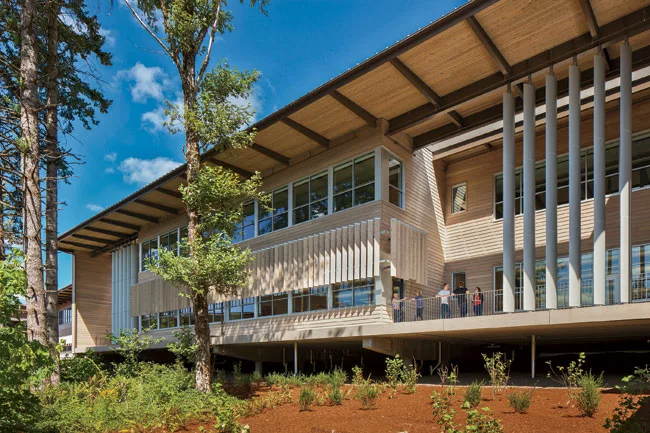
A classroom wing looks onto the wooded site and provides a large balcony where students, or even entire classes, can meet.
Sandy High School
Dull Olson Weekes Architects'IBI Group
Sandy, Oregon
A classroom wing looks onto the wooded site and provides a large balcony where students, or even entire classes, can meet.
Photo © Josh Partee
To fit in with the local tradition of rustic lodges and farm structures, the architects used a sawtooth roof over the gym and cedar siding above the main entry.
Sandy High School
Dull Olson Weekes Architects'IBI Group
Sandy, Oregon
To fit in with the local tradition of rustic lodges and farm structures, the architects used a sawtooth roof over the gym and cedar siding above the main entry.
Photo © Josh Partee
The two-story library can stay open to the public when the rest of the school is closed.
Sandy High School
Dull Olson Weekes Architects'IBI Group
Sandy, Oregon
The two-story library can stay open to the public when the rest of the school is closed.
Photo © Josh Partee
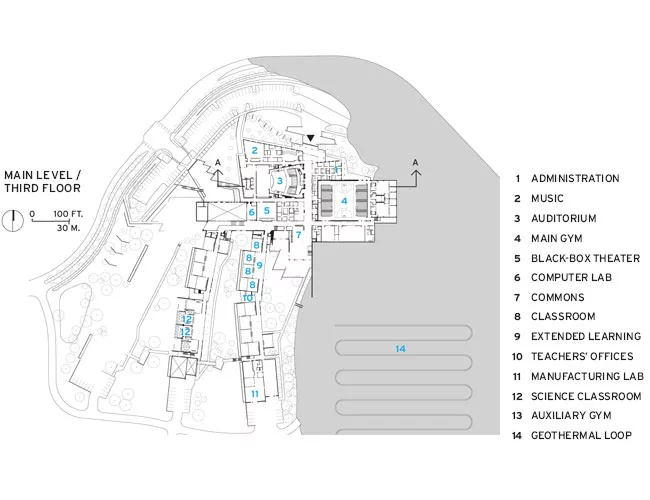
A 600-foot-long axis connects the three classroom wings to the shared facilities such as the gym, auditorium, and library, while stepping down an 80-foot-high hill.
Sandy High School
Dull Olson Weekes Architects'IBI Group
Sandy, Oregon
A 600-foot-long axis connects the three classroom wings to the shared facilities such as the gym, auditorium, and library, while stepping down an 80-foot-high hill.
Photo © Josh Partee
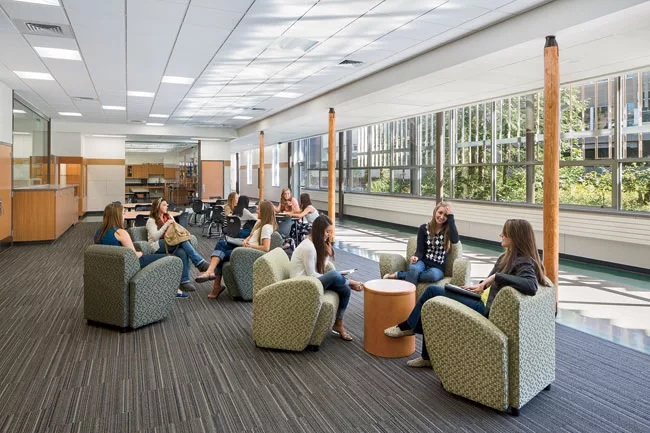
An extended-learning area serves as an extension to a cluster of five classrooms or can be a casual place for students to relax.
Sandy High School
Dull Olson Weekes Architects'IBI Group
Sandy, Oregon
An extended-learning area serves as an extension to a cluster of five classrooms or can be a casual place for students to relax.
Photo © Josh Partee
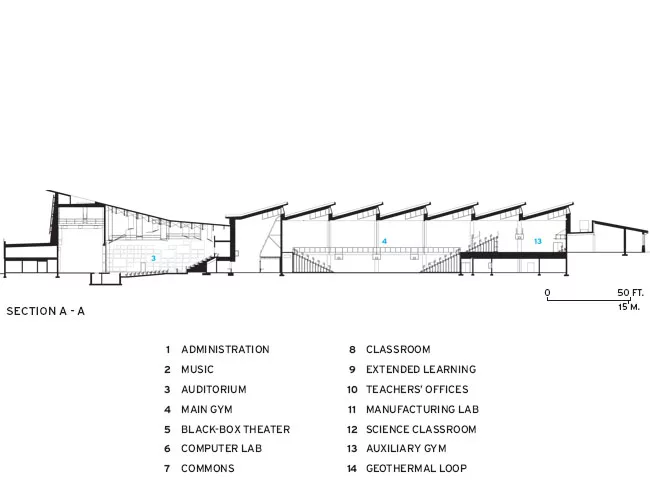
Daylight from clerestory windows in the gym reduces the need for electric lights.
Sandy High School
Dull Olson Weekes Architects'IBI Group
Sandy, Oregon
Daylight from clerestory windows in the gym reduces the need for electric lights.
Photo © Josh Partee
Sandy High School
Sandy High School
Dull Olson Weekes Architects'IBI Group
Sandy, Oregon
Image courtesy DOWA-IBI
Sandy High School
Sandy High School
Dull Olson Weekes Architects'IBI Group
Sandy, Oregon
Image courtesy DOWA-IBI
A classroom wing looks onto the wooded site and provides a large balcony where students, or even entire classes, can meet.
To fit in with the local tradition of rustic lodges and farm structures, the architects used a sawtooth roof over the gym and cedar siding above the main entry.
The two-story library can stay open to the public when the rest of the school is closed.
A 600-foot-long axis connects the three classroom wings to the shared facilities such as the gym, auditorium, and library, while stepping down an 80-foot-high hill.
An extended-learning area serves as an extension to a cluster of five classrooms or can be a casual place for students to relax.
Daylight from clerestory windows in the gym reduces the need for electric lights.
Sandy High School
Sandy High School
January 16, 2013

Architects & Firms

Dull Olson Weekes Architects'IBI Group

Sandy, Oregon

In a town of just 8,000 people, a 310,000-square-foot building is a big deal, especially if it's the new high school. But such a project could easily overwhelm a rural town like Sandy, Oregon, halfway between Portland and historic Timberline Lodge on Mount Hood. So the design team at Dull Olson Weekes Architects'IBI Group (DOWA-IBI) broke the mass of the building into a number of pieces and tucked them into the sloping, wooded site. The architects also employed a broad range of sustainable-design strategies that reduce the school's carbon footprint and tie it to the environmental ethos of the Pacific Northwest.


'It's a big building in a small town,' says John Weekes, one of the firm's principals, 'and we wanted it to fit in.' Thirty miles from Portland, Sandy High School draws its 1,400 students from a sprawling, 425-square-mile district that encompasses national forests and scrappy farming towns where money is often tight. The steel-frame building opened in the fall of 2012 to replace a 90-year-old facility down the road that was cramped and outdated.

The challenge was to fit the project into its physical, environmental, and social context. The architects started by organizing the school as if it were an ancient Roman town'with two axes at right angles and the most public spaces at the intersection. One axis runs north'south and serves as a corridor linking shared elements such as a gym, an auditorium, and a dining 'commons' that are sometimes open to the public. A 600-foot-long east'west axis takes students and faculty from the public areas to a trio of classroom wings extending out to the south and to a double-height library to the north. The 82-acre site drops 80 feet from east to west, so the architects stepped the long student axis and the classroom wings down the slope. As a result, each of the school's four floors has direct access to the outdoors and hugs the hill. By reducing the amount of excavation needed, the scheme also saved the client several million dollars, says Jerry Waters, the senior designer for DOWA-IBI on the project. And by wiggling the classroom wings between existing trees, it preserved the wooded character of the site.

The local development code requires new buildings to follow a loosely defined 'Sandy style,' which incorporates elements of Cascadian architecture such as the pitched roofs and heavy timbers found at Timberline Lodge. Instead of borrowing such things literally, DOWA-IBI adapted them'for example, in the form of a sawtooth roof over the gym and wood louvers that block the sun on the classroom wings.

The architects pursued an aggressive environmental agenda in designing the school, using both passive and active solar strategies. 'The building needed to live in nature, just as the people around here do,' says Weekes. So in addition to pushing much of it up against the hill for protection against heat and cold, DOWA-IBI installed a 300-kilowatt photovoltaic solar array on the roof, along with a solar preheat system for hot water. Green roofs top two of the classroom wings, and a 500,000-gallon rainwater-storage tank supplies water for irrigation and toilets. A 3-mile-long loop of geothermal piping runs beneath the athletic fields, providing heating and cooling, while a displacement-air system moves air up and out so germs don't hang around and infect other people.

Daylighting is another important factor in reducing the building's energy use. The school's distinctive sawtooth roof brings sunlight into the gym through long clerestories, and large skylights along the student axis do the same there. All the classroom wings have single-loaded corridors lined with glazing, and classrooms themselves have plenty of windows looking both outside and into the corridors. So even on a rainy late-November afternoon, there were few electric lights on in most parts of the school. Where shading is needed, the architects used deep overhangs and a combination of vertical and horizontal cedar louvers. Overall, the building will perform about 54 percent more efficiently in terms of energy use than the Environmental Protection Agency's baseline for high schools in this area, says Waters.

To break down the learning areas into smaller sections, the architects created two 'cabins' in each wing and placed a small block of teachers' offices between them. Each cabin consists of four or five classrooms clustered around an open 'extended-learning area.' This arrangement offers teachers the chance to combine classes in the more casual extended-learning areas and students the opportunity to hang out there between classes. Each wing ends with a large space for learning practical skills such as automobile repair or agriculture.

Tim Werner, Sandy's principal, says everyone is still getting used to the new building. While students and staff have to walk farther now, since the school is twice the size of the old one, they appreciate all the daylight and impressive facilities like the gym and the double-height library, he adds.

Getting from one end of the school to the other may be a bit of a hike, but the building's strong relationship to the land makes it feel almost like a walk in the woods. That's not only good for the body, but good for the environment.

Completion Date: August 2012

Gross square footage: 310,000 square feet

Total construction cost: $75.4 million

Architect:
Dull Olson Weekes –IBI Group Architects, Inc.
907 SW Stark Street
Portland, OR 97205
Ph 503 226.6950 
Fax 503 273.9192

People

Owner:
Oregon Trail School District

Architect:
Dull Olson Weekes –IBI Group Architects, Inc.
907 SW Stark Street
Portland, OR 97205
Ph 503 226.6950 
Fax 503 273.9192

Personnel in architect's firm who should receive special credit:
John Weekes, AIA; Keith Johnson, AIA; Jerry Waters, AIA; Eric Buschert, Mathew Braun 

Interior designer: Dull Olson Weekes –Jerry Waters, AIA; Nancy Rad, AIA IIDA

Engineer(s): KPFF consulting engineers, Interface Engineering

Consultant(s):
Landscape: Mayer Reed

Lighting: Interface Engineering

Acoustical: Altermatt Associates

Other: PLA Designs -theater

General contractor: Hoffman Construction Company

Photographer(s): Josh Partee

CAD system, project management, or other software used: AutoCad, SketchUp
 

Products

Structural system
Concrete and steel frame

Manufacturer of any structural components unique to this project: Knife River  -structural, insulated precast concrete panels (carboncast)

Exterior cladding 
1/8” cor-ten plate  -Pohl Inc. of America
 
Windows
Kawneer

Doors
Entrances: Kawneer

Interior finishes
Floor and wall tile: Dal tile  halls and wainscot

Special interior finishes unique to this project: perforated plywood panels

Energy
Photovoltaic system: Energy Unlimited

 
KEYWORDS: Oregon

Share This Story

Looking for a reprint of this article?
From high-res PDFs to custom plaques, order your copy today!

Cliff portrait 2 0t5a1761 0031

Contributing editor Clifford Pearson is the co-author, with A. Eugene Kohn, of The World By Design, and writes about architecture and urbanism.

Post a comment to this article

Report Abusive Comment

Subscription Center
  • Create an Account
  • Start a Subscription
  • Manage My Account
  • Sign Up for Newsletters
  • Visit Customer Service
  • Update Preferences

More Videos

Sponsored Content

Sponsored Content is a special paid section where industry companies provide high quality, objective, non-commercial content around topics of interest to the Architectural Record audience. All Sponsored Content is supplied by the advertising company and any opinions expressed in this article are those of the author and not necessarily reflect the views of Architectural Record or its parent company, BNP Media. Interested in participating in our Sponsored Content section? Contact your local rep!

close
  • TAMLYN XtremeTrim Exterior Trim
    Sponsored byTamlyn

    Designing Cleaner Panel Facades: Why Exterior Trim Details Matter

  • Building with Vapor Barriers
    Sponsored byReef Industries, Inc.

    Vapor Barriers Help Control Moisture in Tighter Building Designs

  • Duct Interior with Prodeq System
    Sponsored byHenry, a Carlisle Company

    Designing Resilient Water Containment Systems

DESIGN:ED Podcast
Listen to Architectural Record’s DESIGN:ED Podcast

Events

June 18, 2026

Rebooting the Aging Office Building

Credits: 1 AIA LU/HSW; 1 AIBD P-CE; 0.1 ICC CEU; 1 PDH

Explore façade retrofit strategies and award-winning design concepts that can transform aging office buildings into healthier, higher-performing workplaces for today’s hybrid workforce.

June 23, 2026

Enhancing Fire Resistance with Advanced PVC Solutions

Credits: 1 AIA LU/HSW; 1 AIBD P-CE; 0.1 ICC CEU; 1 IIBEC CEH

Evaluate advanced PVC solutions that improve fire resistance, support WUI compliance, and enhance resilience in residential and commercial building design.

View All Submit An Event

Products

2026 Architect's Square Foot Costbook

2026 Architect's Square Foot Costbook

See More Products

Popular Stories

SanDiegoAirport

Top 300 Architecture Firms of 2026

Coronado Bridge

The Architect’s Guide to San Diego

Lorcan O' Herilhy

California Architect Lorcan O’Herlihy Has Died, Age 66

CCA, Studio Gang

The Winners of the AIA’s 2026 Architecture Award Range from Collegiate Rowing Hubs to Housing for the Homeless

Dusk House

Design Vanguard 2026: ONO

Rebooting the Aging Office Building - Free Webinar - June 18, 2026

Related Articles

  • Benjamin E. Mays High School

    See More
  • North Atlanta High School

    See More
  • Marysville Getchell High School Campus

    See More

Related Products

See More Products
  • facade.jpg

    Sustainable Facades: Design Methods for High-Performance Building Envelopes

  • Web-Regenerative-school4-1920x1125.jpg

    Creating the Regenerative School

  • WC_-SCA.png

    Building Great Schools for a Great City

See More Products

Events

View AllSubmit An Event
  • September 11, 2025

    Safe by Design: Security Glazing and High-Performance Glass in Educational Facilities

    NOW ON DEMANDCredits: 1 AIA LU/HSW; 1 AIBD P-CE; 0.1 ICC CEU; 0.1 IACET CEUThis webinar explores the critical role of security glazing and high-performance glass in educational facility design.
View AllSubmit An Event
×

The latest news and information

#1 Source for Architectural Design, News and Products

SUBSCRIBE
  • RESOURCES
    • Advertise
    • Contact Us
    • Submit
    • Store
  • ACCOUNT CENTER
    • Create an Account
    • Start a Subscription
    • Manage My Account
    • Sign Up for Newsletters
    • Visit Customer Service
    • Update Preferences
  • PRIVACY
    • PRIVACY POLICY
    • TERMS & CONDITIONS
    • DO NOT SELL MY PERSONAL INFORMATION
    • PRIVACY REQUEST
    • ACCESSIBILITY
  • SERVICES
    • Marketing Services
    • Reprints
    • Market Research
    • List Rental
    • Survey/Respondent Access
  • STAY CONNECTED
    • Linkedin
    • Facebook
    • Instagram
    • YouTube
    • X (Twitter)

Copyright ©2026. All Rights Reserved BNP Media, Inc. and BNP Media II, LLC.

Design, CMS, Hosting & Web Development :: ePublishing